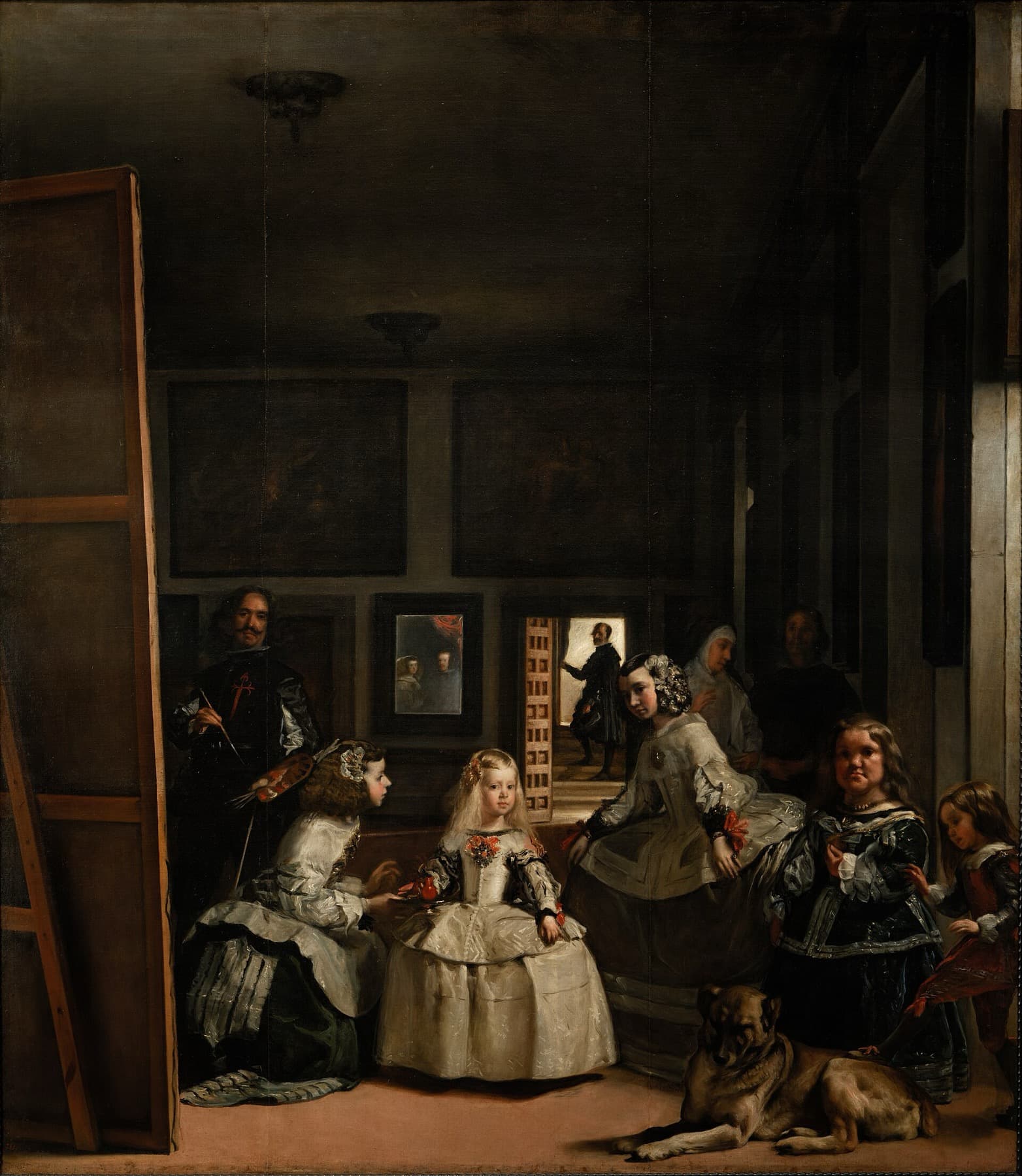
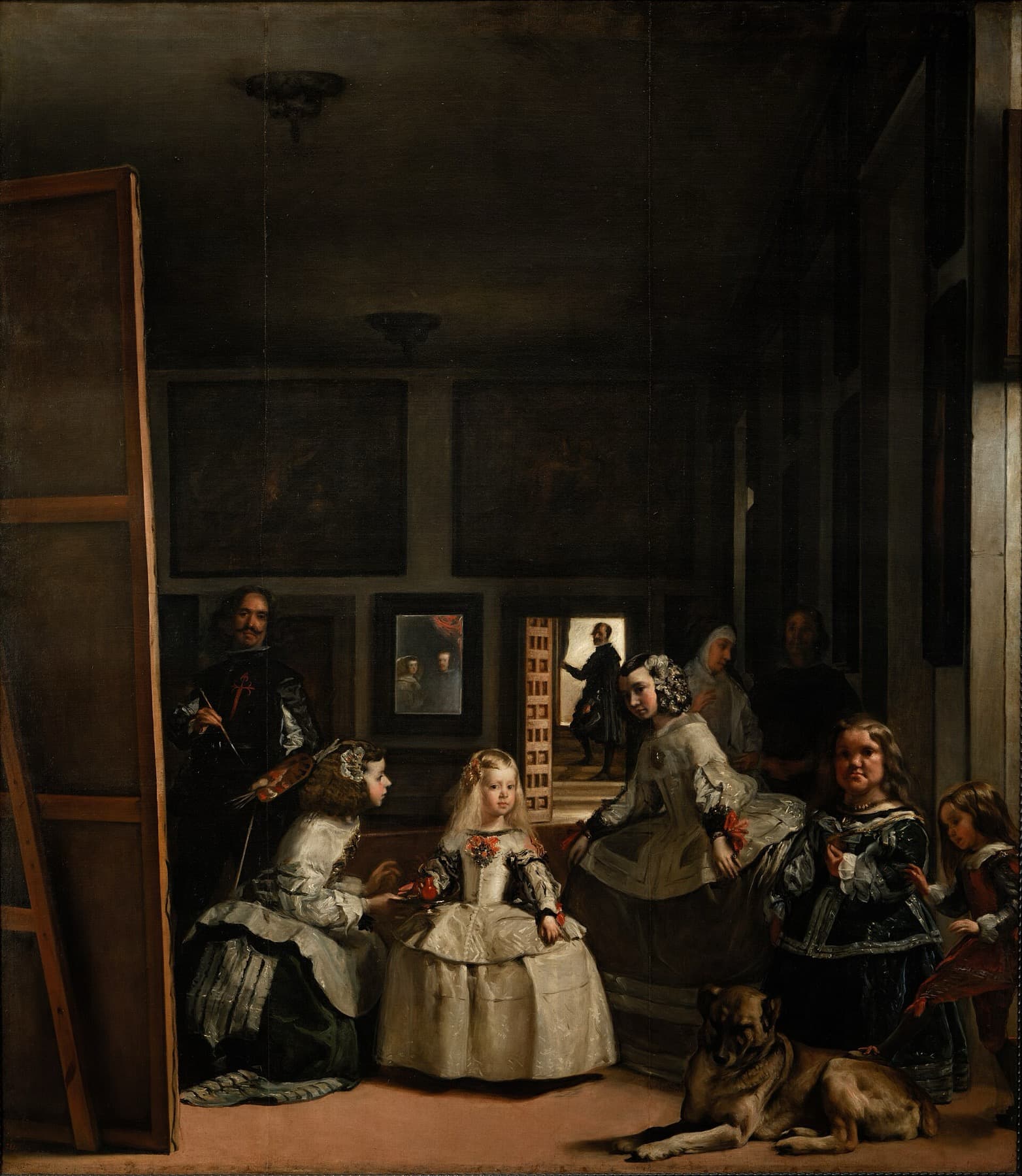
Las Meninas is Diego Velázquez's 1656 painting of the five-year-old Infanta Margarita, her maids of honour and members of the court in a room of the Alcázar palace in Madrid. A mirror on the back wall reflects King Philip IV and Queen Mariana, and most readings place them where the viewer stands. It hangs in Room 12 on the main floor of the Museo del Prado.
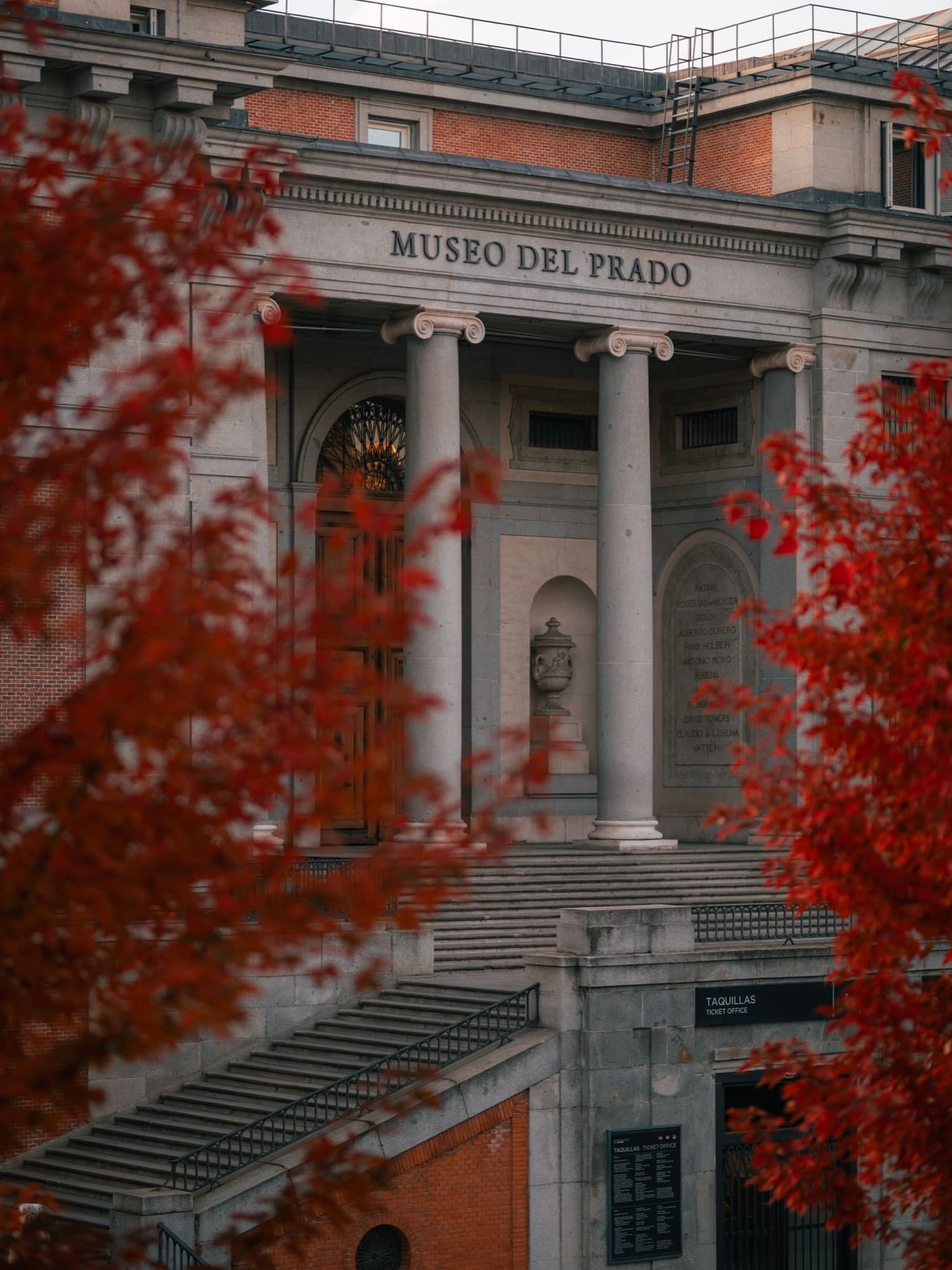
If you are asking where Las Meninas is: it hangs in Room 12 on the main floor of the Museo del Prado in Madrid. If you are asking what it means: it is a picture about looking, and the person it is looking at is you.
Diego Velázquez painted it in 1656. It shows the Infanta Margarita, five years old, with her maids of honour and other members of the court, in a room of the Alcázar, the royal palace in Madrid, that Velázquez used as a studio. The title names the maids of honour. The earliest inventories call the picture The Family, and the title Las Meninas first appears in the Prado's catalogue of 1843.
What you see
Start with the light. It falls on the Infanta, who stands in the brightest patch of the room while her maids lean toward her. María Agustina Sarmiento kneels and offers her a drink in a small red cup on a tray, and Isabel de Velasco attends her too. At the right stand the dwarf Mari Bárbola and Nicolasito Pertusato, and behind them in a doorway José Nieto looks back into the room.
Then look for the huge canvas at the left, seen from behind, and the man standing in front of it with a brush: Velázquez himself. And look at the back wall, where a small mirror holds two faint faces. They are Philip IV and Queen Mariana, the Infanta's parents.
The question the mirror asks
Hear a stop from this walk
Buen Retiro: The Habsburg Park the Bourbons Opened
Here is the puzzle. If the king and queen are in the mirror, they are standing somewhere in front of the picture, in the place where you are standing. Most readings of the painting take it that way: the royal couple have walked into the studio, the painter has stopped to look at them, and the Infanta and her maids have turned to greet them. That is why Velázquez looks straight out at you, and why Mari Bárbola does too. You are standing where the king stands.
The picture is also very large, about 3.2 metres tall, one of the biggest canvases Velázquez ever painted. In front of it, the room can feel as if it continues past the frame.
The cross that was added later
Look at the painter's chest and you will see the red cross of the Order of Santiago. Velázquez was not yet a knight when he painted the picture. He received the honour in 1659, three years later, and the cross was painted in afterwards. By the early 1650s he was the palace chamberlain as well as the king's painter, so the picture shows a man already at the centre of the court he serves. He died in 1660.
Where it hung, and how it survived
The painting was in the Alcázar in 1700. It survived the fire of 1734, is recorded in the new Royal Palace in 1747, 1772, 1794 and 1814 to 1818, and entered the Prado in 1819, the year the museum opened. When Goya painted The Family of Charles IV in 1800, he put himself at the left behind a huge canvas on an easel. That is a quotation from this picture, and his viewers knew it well.
What hangs around it
Room 12 is a room about Philip IV's court, with thirty years of it on the walls. Around Las Meninas are the royal horsemen Velázquez made around 1635 for the Hall of Realms. Philip IV rides in strict profile on a rearing horse, borrowing his calm from Titian's Charles V at Mühlberg, and in the bottom left corner there is a blank sheet of paper where a painter signs. Prince Baltasar Carlos, about six, rides a pony with a strangely round belly. The picture was meant to hang high above a door, and seen from below that shape looks right. The Guadarrama hills behind him still have snow on their peaks.
Walk from those pictures to Las Meninas and watch the faces change: the young king of the 1630s becomes the tired man of the 1650s.
How to see it
Works rotate and rooms are rehung, so check the museum's plan on the day. In the Roamer guide, Las Meninas has its own story in Room 12, and it is a stop on the Prado in an Hour, Velázquez, Room by Room and Kings Who Collected routes. You can listen at your own pace, with no group, and skip any room you do not want. The guide is independent and not affiliated with the museum, and admission to the museum is separate. The full guide to the museum is here: Museo del Prado: what to see, floor by floor.
Cover: Las Meninas, Diego Velázquez, Museo del Prado. Photograph from Wikimedia Commons (the Prado image in Google Earth), public domain.
Ready to experience it?
Capital by Decree: The Habsburg-Bourbon Spine of Madrid
130 min · 6.5 km · moderate
More from Madrid
Explore more at your own pace.
Capital by Decree: Why Madrid Is the Capital of Spain

Eating Through Lavapiés: A Neighborhood You Can Taste in Layers
Goya's Black Paintings: Saturn, the Dog and the House That No Longer Exists
Museo del Prado: What to See, Floor by Floor
The Garden of Earthly Delights: What It Means and Why It Is in Madrid