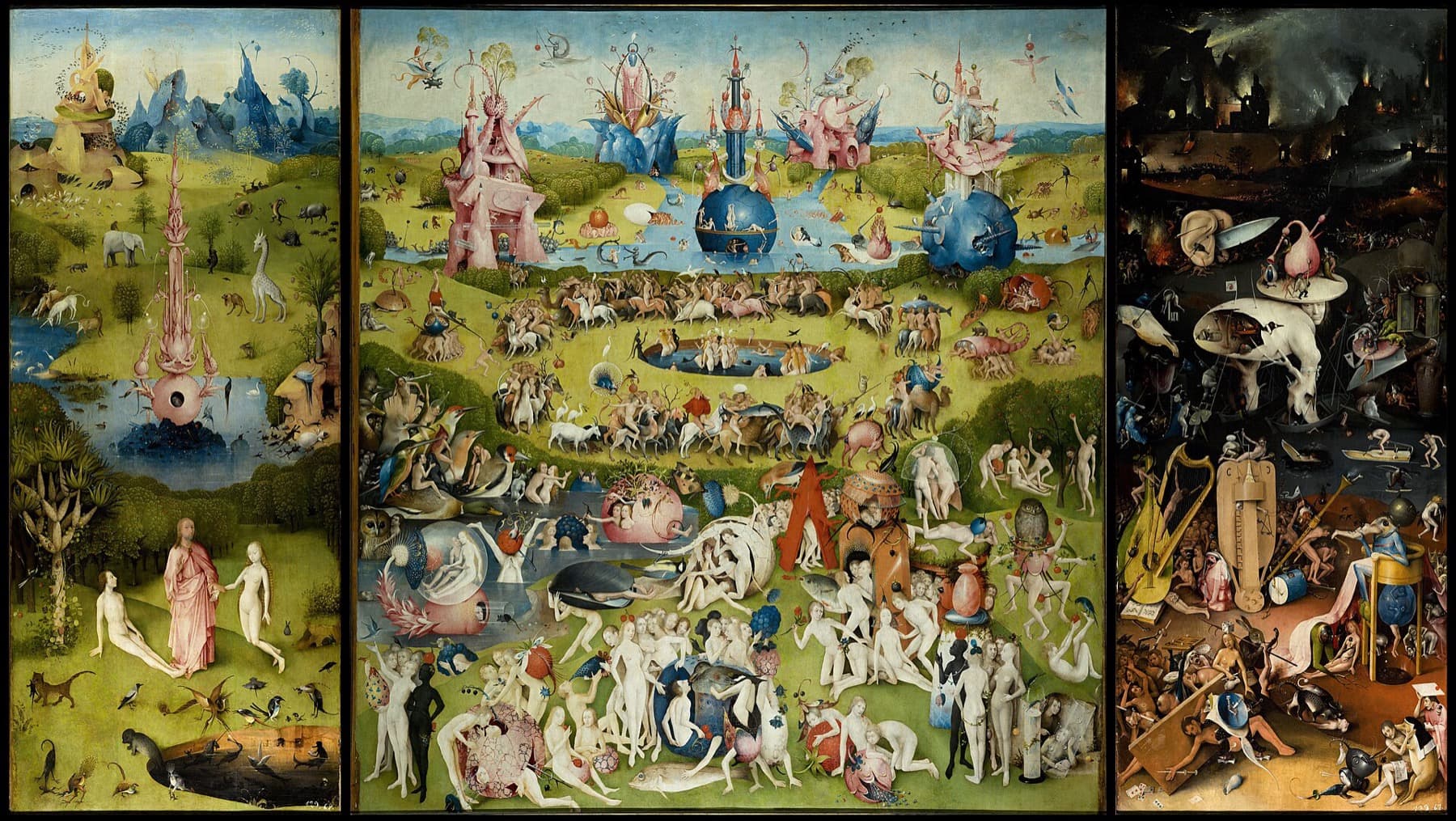
The Garden of Earthly Delights is Hieronymus Bosch's triptych of paradise, a crowded garden of naked lovers and a hell at night, painted between 1490 and 1500. It is in the Museo del Prado in Madrid, Room 56A on the ground floor, because the Duke of Alba seized it in Brussels in 1568 and Philip II bought it at an estate sale in 1591. Scholars still disagree about its meaning.
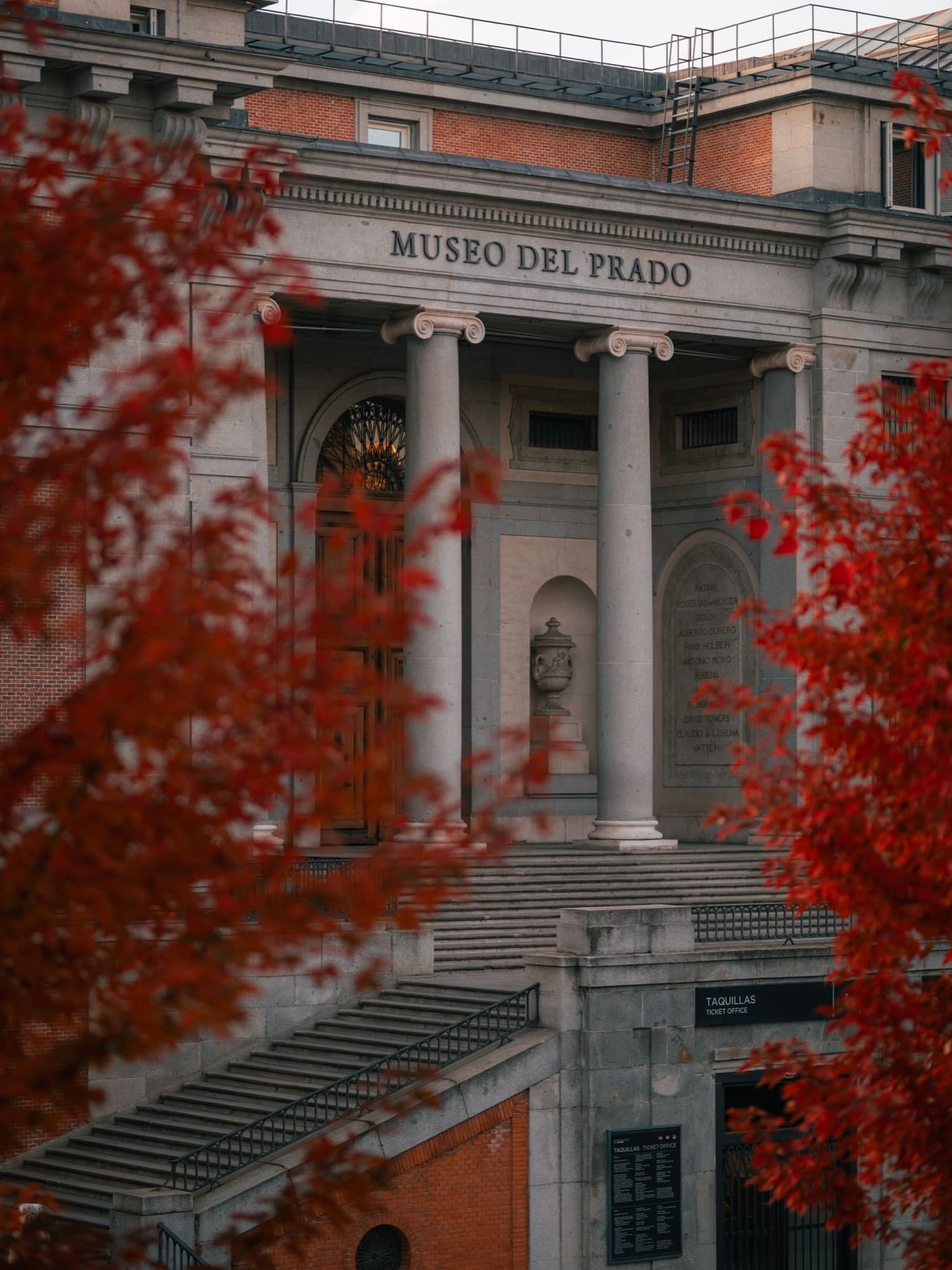
If you are asking where The Garden of Earthly Delights is: it hangs in Room 56A on the ground floor of the Museo del Prado in Madrid. If you are asking what it means: nobody has a settled answer, and the best way in is to look at what is actually painted.
Hieronymus Bosch made it on oak panels between 1490 and 1500. He spent most of his life in the Dutch town of 's-Hertogenbosch and died in 1516. Only about twenty-five paintings are confidently accepted as his, and the Prado holds some of the greatest.
What you see
Start with the outside. Closed, the wings show the world on the third day of creation, painted in greys: a globe of new land and water, with God tiny in the upper left corner.
Open it and the triptych bursts into colour. On the left, in paradise, God presents Eve to Adam. In the centre is a garden of naked men and women with giant red berries, birds taller than people, lovers inside a bubble, and riders circling a pool full of women. Look for the two owls staring out at you. On the right is hell at night: a man made of tree trunks with a broken eggshell for a body, sinners crucified on a harp and a lute, and a bird-headed monster on a chamber pot eating sinners.
What it means
Hear a stop from this walk
Buen Retiro: The Habsburg Park the Bourbons Opened
Scholars have read it in opposite ways. In 1937 Charles de Tolnay and later Ludwig von Baldass saw a warning against lust: the middle panel shows how brief worldly pleasure is, and the right panel shows its price. In 1947 Wilhelm Fraenger saw a joyful, innocent paradise, and tied Bosch to a heretical sect; later critics found his case speculative. E. H. Gombrich suggested the middle panel shows mankind on the eve of the Flood. Erwin Panofsky admitted in 1953 that the picture's core meaning had not been found.
The open question is part of what keeps people in front of it, and the Roamer guide does not pick a side for you.
Why it is in Madrid
Bosch died in 1516. Philip II was born eleven years after that, so he never commissioned anything from him. He bought second-hand, from the heirs of courtiers and at estate sales.
The garden's route to Madrid begins in Brussels. It was probably made for Engelbrecht II of Nassau, and was seen in the Nassau palace there in 1517. It then belonged to William of Orange, until the Duke of Alba seized it in Brussels in 1568 from the rebel William of Orange. It passed to Alba's illegitimate son Fernando de Toledo, and Philip II bought it at his estate sale in 1591. On 8 July 1593 he gave it to the monastery palace of El Escorial. The record of that gift describes the painting only as the one "of the madroño", the strawberry tree.
It stayed at the Escorial for more than three centuries and moved to the Prado in the 1930s. Sources disagree on the exact year: the museum's record says 1933, others say 1936 or 1939. It is still on deposit from the Patrimonio Nacional.
Its neighbours in Room 56A
Room 56A is Philip II's Bosch room, with the garden beside the Haywain, the Seven Deadly Sins and the Adoration of the Magi. The Haywain shows a world that is a haycart, pulled toward hell while everyone grabs a handful; behind it ride a pope, an emperor, a king and a duke. Bosch painted in thin, almost transparent layers, so you can sometimes see his drawing underneath, and tiny things hide in every corner.
How to see it
Works rotate and rooms are rehung, so check the museum's plan on the day. In the Roamer guide, The Garden of Earthly Delights has its own story in Room 56A, and it is the first stop on the Prado in an Hour route and a stop on Bosch, Bruegel and the North. You can listen at your own pace, with no group, and skip any room you do not want. The guide is independent and not affiliated with the museum, and admission to the museum is separate. The full guide to the museum is here: Museo del Prado: what to see, floor by floor.
Cover: The Garden of Earthly Delights, Hieronymus Bosch, Museo del Prado. Photograph from Wikimedia Commons, public domain.
Ready to experience it?
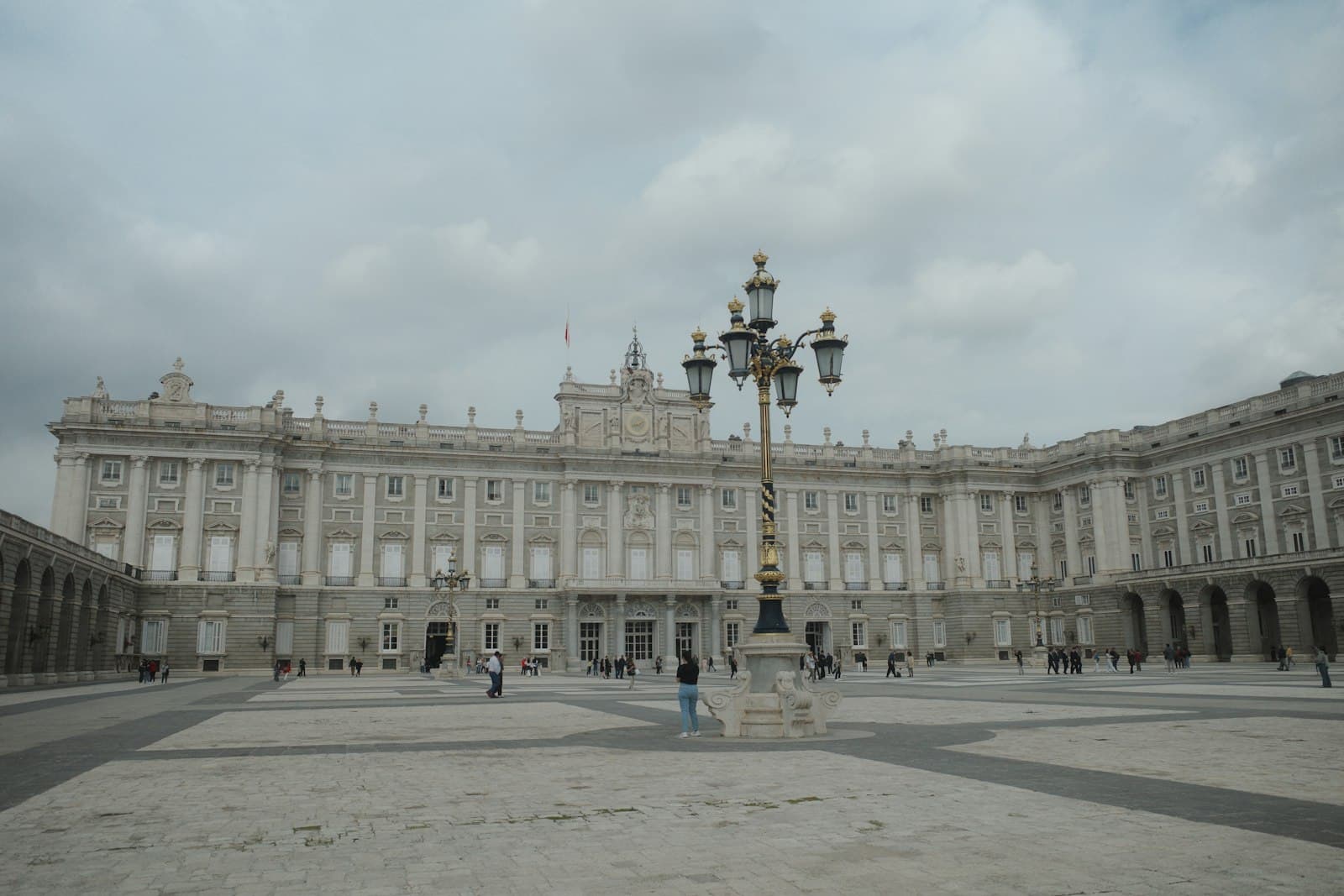
Capital by Decree: The Habsburg-Bourbon Spine of Madrid
130 min · 6.5 km · moderate
More from Madrid
Explore more at your own pace.
Capital by Decree: Why Madrid Is the Capital of Spain

Eating Through Lavapiés: A Neighborhood You Can Taste in Layers
Goya's Black Paintings: Saturn, the Dog and the House That No Longer Exists
Las Meninas: Who Is Looking at Whom, in Room 12
Museo del Prado: What to See, Floor by Floor