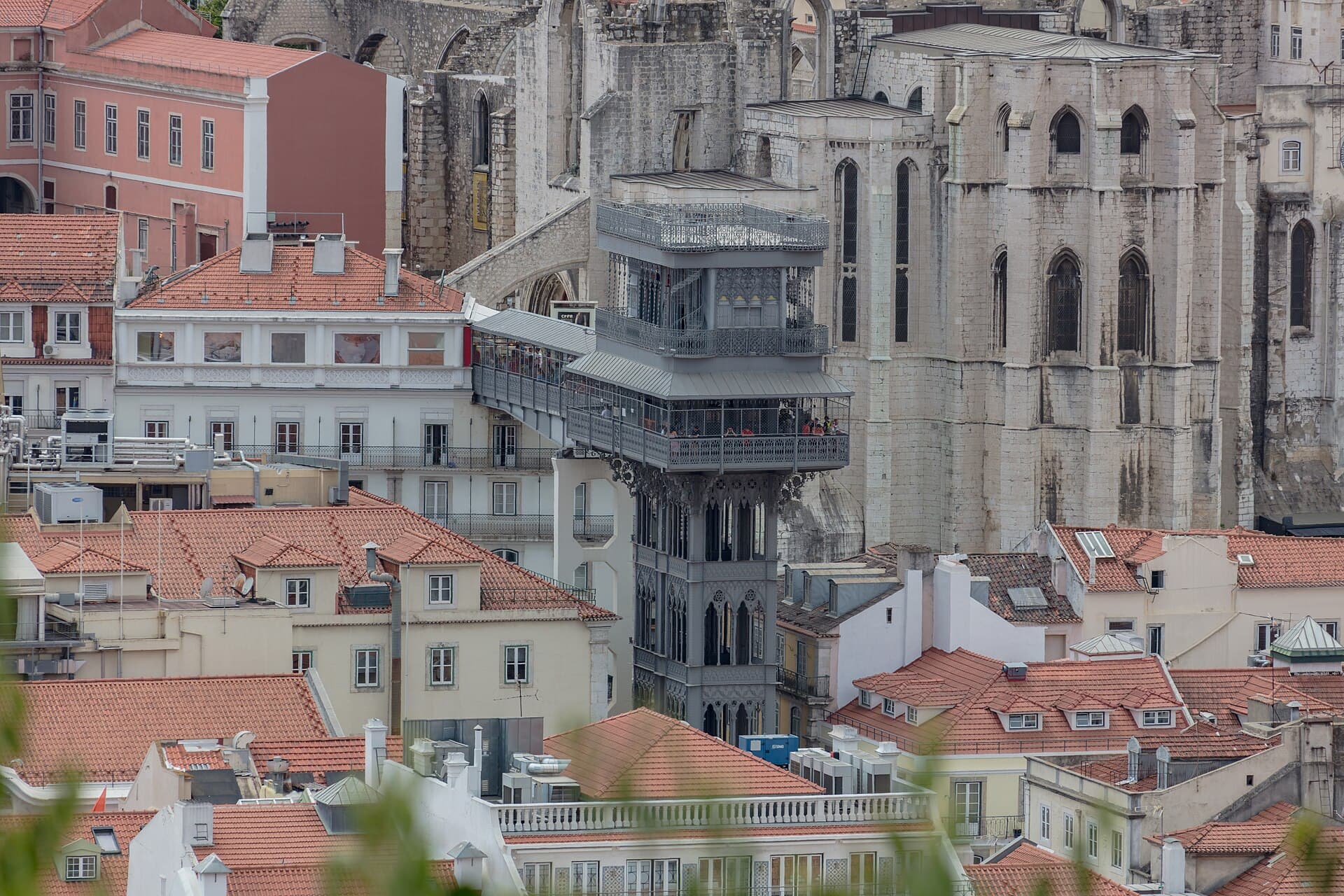
Stand at the base of the Elevador de Santa Justa and you are looking at an engineering answer to a problem the rest of Lisbon's downtown deliberately avoided. The rebuilt Baixa is flat by design, a rational grid laid across the riverside plain after the earthquake of seventeen fifty-five. But Lisbon is a city of hills, and the flat grid eventually had to reach the higher ground of Carmo and Chiado above it. The Santa Justa Lift is where that reach becomes literal: a wrought-iron vertical street, forty-five metres high across seven storeys, hoisting passengers from the low downtown to the terrace above. Stone built the grid. Iron built the way up.
What you are actually looking at
The structure is a free-standing iron tower, and the honest way to read it is as infrastructure first and ornament second. It stands forty-five metres tall across seven storeys, and it carries two wood-paneled cabins that originally held about twenty-four passengers each. The visible skin is neo-Gothic: lacy panels, pointed detail, the kind of decorative program that late-nineteenth-century iron architecture liked to drape over its riveted frame. But strip the ornament away and the logic is plain. This is a machine for moving people vertically through a gap in the terrain that the flat grid below could never close on its own.
The dates matter, because they place the lift precisely in its moment. The iron structure was inaugurated on the thirty-first of August, nineteen oh one. The working passenger car entered service the following year, in nineteen oh two. That two-step sequence, structure first and mechanism second, is worth noticing: you build the frame, prove it stands, then hang the working parts inside it. It is the same patient discipline that shaped the whole rebuilt downtown, only compressed here into a single tower rather than spread across a district.
The engineer, and the myth to set aside
Hear a stop from this walk
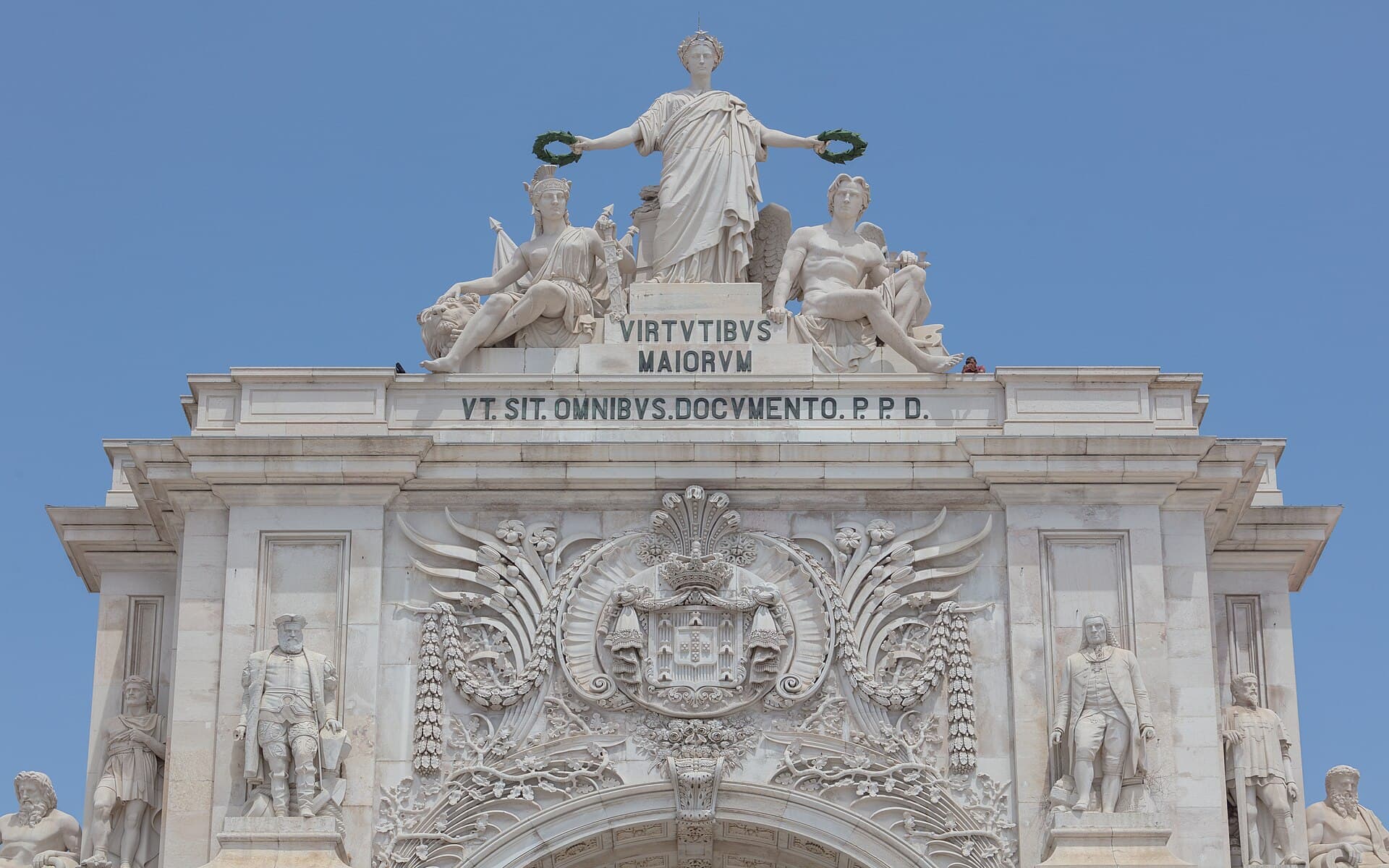
Arco da Rua Augusta: The Monument to Recovery
The lift was the work of Raoul Mesnier du Ponsard, born in Porto to French parentage, who founded the company that ran Lisbon's mechanical lifts. That is the verified biography, and it is enough to admire. He built the company behind the city's ascensores, the mechanical lifts that let a hill city function vertically, and this tower is his most legible monument.
There is a second story you will hear repeated all over Lisbon, in guidebooks and from guides at the base of the tower: that Mesnier du Ponsard was a pupil of Gustave Eiffel, the engineer behind the Paris tower. Set that claim aside. It is not confirmed by the historical record, and there is no verified apprenticeship. The attraction of the story is obvious, because the tower does look like it belongs to Eiffel's world, all riveted metal and confident verticality. But the resemblance is idiomatic, not personal. What is actually true is more useful. This lift belongs to the same late-nineteenth-century European love affair with iron, the shared conviction that you could build almost anything out of riveted metal, that produced the great iron structures of the era. You do not need a fabricated apprenticeship to place the tower in that lineage. The material and the ambition do it for you.
Why the lift matters to the shape of the city
To understand the one thing worth grasping while you stand here, you have to hold the whole downtown in view. After the earthquake of seventeen fifty-five leveled the medieval center, the Marques de Pombal rebuilt the ruined district as a single rational instrument: a rigid grid, standardized facades, and a hidden anti-seismic timber cage engineered so buildings would flex rather than fall. The genius of that plan was that it solved the problem of building on a flat riverside plain. Streets ran straight, facades repeated, the geometry was clean.
But a grid is a solution for flat ground, and Lisbon is not flat ground. The rational downtown sat in the low basin between hills. Getting from the Baixa up to Carmo and Chiado meant climbing, and climbing is precisely what a flat grid is bad at. The Santa Justa Lift is the moment the engineering logic of the reconstruction confronts the topography it could not flatten. Here, iron does what stone could not: it lets the flat, rational city reach up and touch the hills. That is the sentence to carry with you. The lift is not a curiosity bolted onto the downtown. It is the vertical clause in the same argument the grid makes horizontally.
Standing in front of it
Practically, the lift connects two very different registers of the city. Below sits the Baixa, engineered flat and calm. Above sits the higher ground of Carmo and Chiado, including the roofless nave of the Convento do Carmo, the earthquake's most visible scar, whose Gothic arches were left open to the sky rather than rebuilt. The lift threads between these two moods, the confident order of the grid and the wound left open on the hill, in a single mechanical rise.
The tower still runs as a working lift. A return ride costs roughly five euros and thirty cents, and it is free with a transit pass, though the queues build fast by late morning, so an early arrival saves you a long wait. You do not have to ride it to read it, though. From the ground you can see the whole logic: the flat downtown at your feet, the hill above, and the iron column bridging them. The wood-paneled cabins rising through the neo-Gothic frame are the mechanism doing exactly what it was built to do, over a century after it first entered service.
The lift is one stop on a walk that reads Lisbon's rebuilt heart as a single engineered argument, from the ceremonial riverfront square through the hidden timber cage of the grid to the open ruins above. If you want to see how the flat city and the vertical city fit together as one idea, walk the whole route. Explore the full range of Lisbon walking tours, or start from the Lisbon city page and follow the Baixa and Chiado tour that includes the Santa Justa Lift.
Sources
- Santa Justa Lift, Wikipedia. Baseline reference for the tower's height, storeys, inauguration date, and engineer, cross-checked against the tour's fact-audited transcript.
- Pombaline style, Wikipedia. Context for the flat rebuilt grid and the anti-seismic timber cage that the lift's verticality answers.
- Pombaline Lisbon, UNESCO tentative list. Official recognition of the rebuilt Baixa as an early anti-seismic cityscape, framing why the grid was engineered flat.
- Carmo Convent, Wikipedia. Reference for the higher-ground destination the lift reaches, the roofless nave preserved as the earthquake's visible scar.
Ready to experience it?
Baixa and Chiado: The City Reason Rebuilt
90 min · 1.8 km · easy
More from Lisbon
Explore more at your own pace.
Lisbon Rebuilt by Reason: Three Answers to Catastrophe
Jeronimos Monastery: How a Tax on Pepper Built Lisbon's Belem
Portas do Sol: The Terrace on Lisbon's Vanished Moorish Wall
The Hidden Cage Under Rua Augusta: How Lisbon Engineered Its Downtown to Shake and Not Fall
Castelo de Sao Jorge: The Lisbon Hilltop Every Ruler Fortified