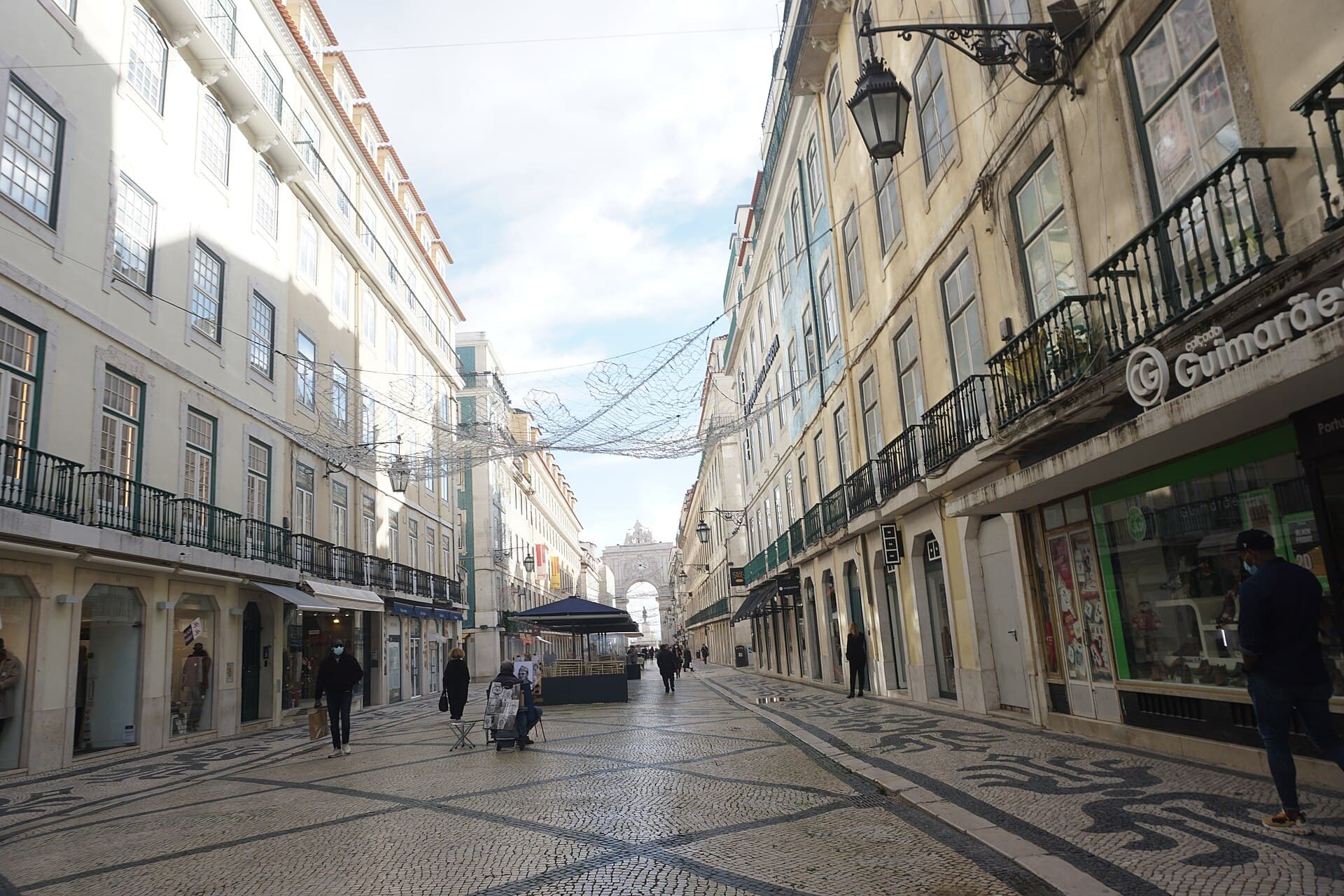
Walk the length of Rua Augusta and you are standing on top of an argument. The repetitive facades that line this pedestrian spine hide a wooden cage engineered to flex rather than shatter in an earthquake, and once you learn to read that hidden machine, the whole rebuilt downtown of Lisbon reads as a single deliberate idea: order engineered out of rubble. The Baixa Pombalina, the rationalist grid laid down after 1755, is not a pretty accident. It is a designed instrument, and Rua Augusta is the best place to feel how it works.
The calm facades are the point
Start with what you can see. The streets around you run in a strict grid, planned by military engineers Manuel da Maia, Eugenio dos Santos, and Carlos Mardel. Roads and pavements were fixed at about forty feet wide, roughly twelve metres, running in straight lines from the riverfront square inland to Rossio. The building fronts are calm, repetitive, and standardized, with restrained decoration and almost no individual flourish.
To a modern eye that uniformity can read as monotony. It is the opposite. The sameness is the engineering. Standardized facades meant standardized structural bays behind them, which meant components could be measured, cut, and specified in advance. Many of those components were manufactured outside the city and assembled on site, an early form of prefabricated urban construction. Think of it as an eighteenth-century kit of parts, produced to spec and snapped together across an entire downtown at speed. Nothing about this grid is decorative first. Every calm, identical front is the visible skin of a hidden system.
The cage you cannot see
Hear a stop from this walk
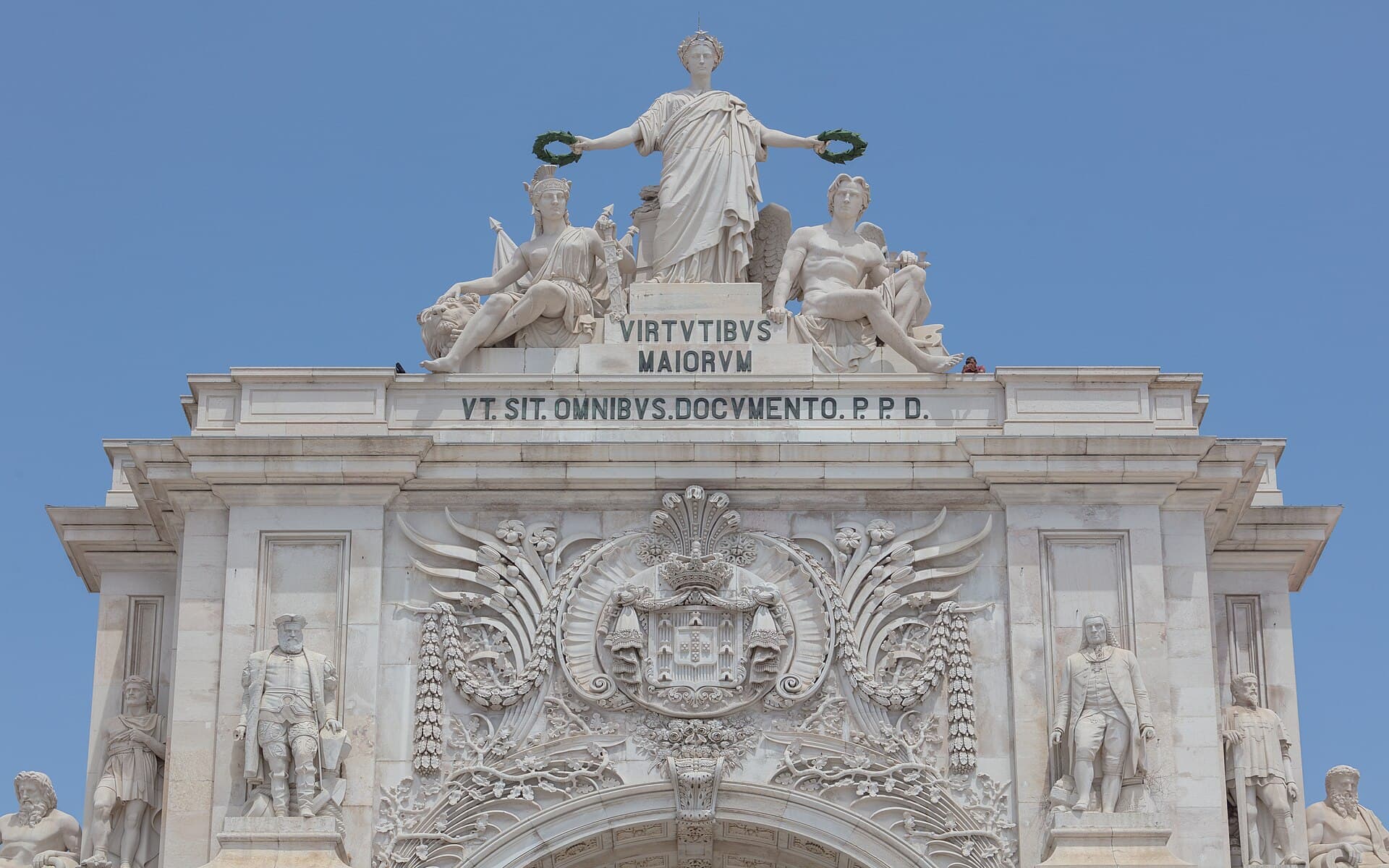
Arco da Rua Augusta: The Monument to Recovery
Now for the part that matters most and that no photograph shows. Inside these walls sits the gaiola pombalina, which translates literally as the cage. It is a three-dimensional wooden truss: vertical posts, horizontal beams, and diagonal braces that cross into Saint Andrew's crosses, embedded in the walls, floors, and roofs, then packed with masonry.
The physics is elegant. When the ground shakes, an ordinary masonry building fights the motion, resists it, and eventually cracks apart. The gaiola does the opposite. The timber frame lets the building flex and absorb the horizontal energy of a quake instead of standing rigid until it fails. The design philosophy, stated plainly, is that the building should shake but not fall. Scholars describe this as among the genesis of seismic engineering in Europe, a systematic structural answer to earthquakes at a time when such thinking was rare. The Baixa Pombalina now sits on the UNESCO tentative list as Pombaline Lisbon, recognized precisely for this early anti-seismic construction.
Stand on Rua Augusta and hold both facts at once. The surface is uniform and reassuring. The interior is a hidden machine designed to outlast the next catastrophe. That gap between visible calm and invisible cleverness is the thesis of the entire walk.
Why one man got to test this idea
The grid exists because of a disaster. On the first of November, 1755, an earthquake, a tsunami off the river, and days of fire erased much of central Lisbon and killed tens of thousands. Rather than patch the medieval city back together, King Jose the First's chief minister, the man now called the Marques de Pombal, rebuilt the ruined downtown as a single rational instrument.
This is the paradox worth sitting with before you set out. The same catastrophe that shattered a royal capital also handed one autocratic minister a clean grid on which to test a radically modern idea: that a city could be engineered against nature itself. The Enlightenment, poured into stone. You will feel two things along this route, the cold confidence of the streets below and the wound left open on the hill above, and the grid under Rua Augusta is where the confidence is most complete.
Reading the rest of the route from here
Once the cage clicks, every other stop on the walk becomes a variation on the same theme.
At Praca do Comercio, the great riverfront square, the reconstruction turned the space outward to the water and renamed the old Palace Yard the Square of Commerce. The message was blunt: the future would be trade, not the closed world of the court. The bronze King Jose the First at its center rides a horse trampling serpents, order crushing chaos carved into metal. The Arco da Rua Augusta closes the north side and frames the very street you are about to walk. Fittingly for a project as patient as rebuilding a capital, that monument to recovery was structurally completed in 1873 and only inaugurated on the ninth of August, 1875, well over a century after the quake.
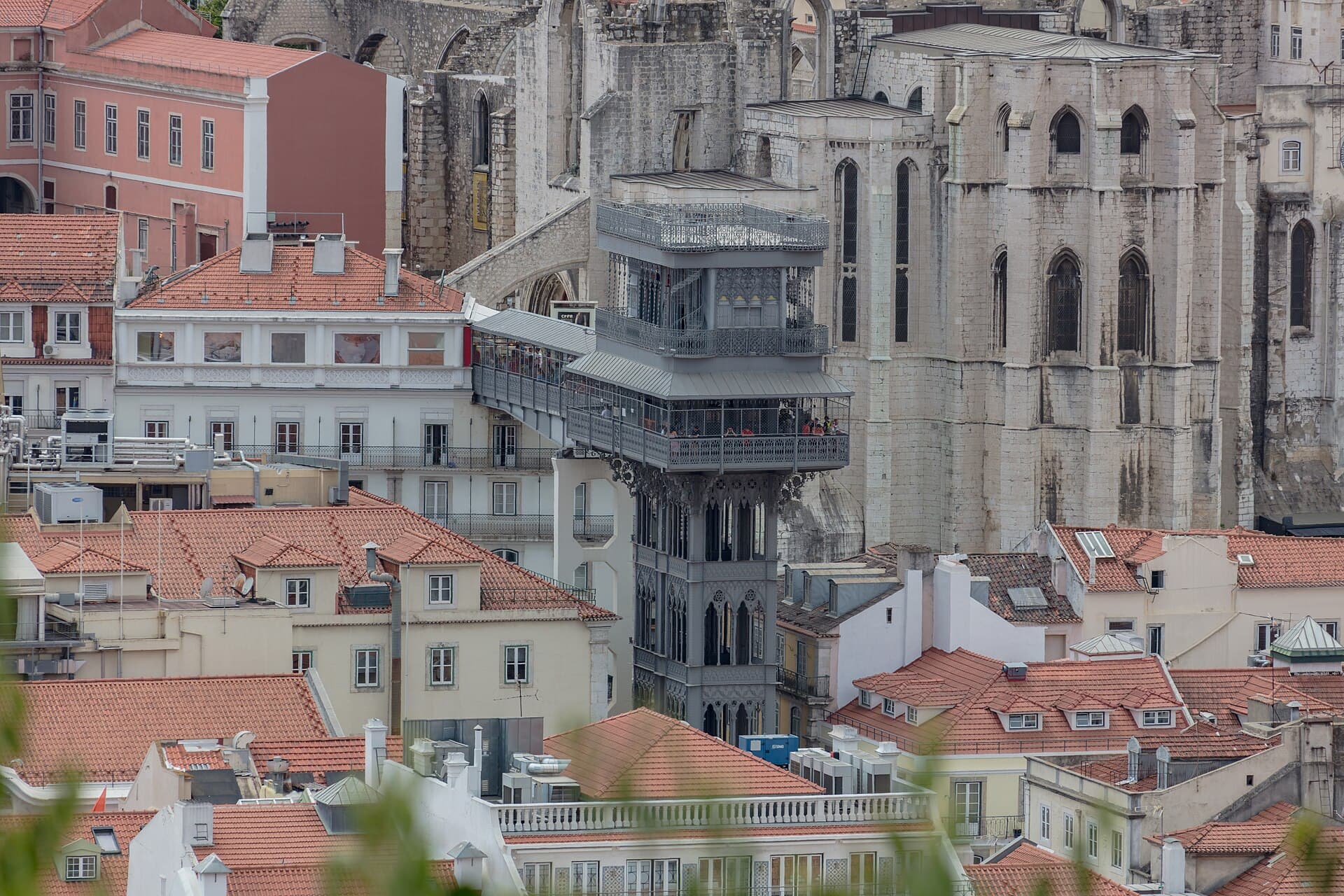
Follow the grid to Rossio and the confidence acquires a shadow. The rolling wave pavement called Mar Largo is beautiful, but the national theatre on its north side stands on the site of the Palace of Estaus, once the seat of the Portuguese Inquisition, whose first Lisbon auto-da-fe took place in 1540. At the Elevador de Santa Justa the flat, rational downtown finally reaches up: a wrought-iron lift, forty-five metres tall across seven storeys, doing what the stone grid could not by climbing the hills. (Ignore the guidebook line that its engineer, Raoul Mesnier du Ponsard, was a pupil of Gustave Eiffel; that claim is not confirmed by the historical record.)
Then the counter-argument. The Convento do Carmo up the hill lost its stone roof in 1755, and the roof was never rebuilt. Its bare Gothic arches, open to the sky, are the most legible trace of the earthquake still standing. While the city below was engineered into confident order, this ruin was left as grief kept on display. The walk closes in Chiado, where a 1988 fire forced the district to rebuild again, this time reinterpreted by the architect Alvaro Siza Vieira, and where a bronze Fernando Pessoa sits at a cafe table with an empty chair. Building, ruin, rebuilding: the same pattern, three centuries running.
Walk it in order
The paradox only fully lands on foot, in sequence, because each stop answers the one before it. The self-guided audio route runs about ninety minutes over a little under two kilometres, mostly flat with one climb near the end, and every stop is short and skippable. If you are planning your days, browse the wider set of Lisbon walking tours or start from the Lisbon city page. Then come stand on Rua Augusta, look at the calm facades, and remember the cage inside them.
Sources
- Roamer audio tour transcript, The City Reason Rebuilt (Baixa and Chiado), fact-audited primary source for every date, name, and figure above.
- Wikipedia, Pombaline style, for the gaiola timber-cage construction and the standardized grid.
- UNESCO World Heritage tentative list, Pombaline Lisbon, for the anti-seismic recognition of the Baixa.
- Wikipedia, Rua Augusta Arch, for the arch's 1873 completion and 1875 inauguration.
- Wikipedia, Carmo Convent and Santa Justa Lift, for the roofless nave and the iron lift's dimensions and history.
Ready to experience it?
Baixa and Chiado: The City Reason Rebuilt
90 min · 1.8 km · easy
More from Lisbon
Explore more at your own pace.
Lisbon Rebuilt by Reason: Three Answers to Catastrophe
Jeronimos Monastery: How a Tax on Pepper Built Lisbon's Belem
Portas do Sol: The Terrace on Lisbon's Vanished Moorish Wall
Castelo de Sao Jorge: The Lisbon Hilltop Every Ruler Fortified
The National Coach Museum: Where Empire Came Home as Gold Leaf