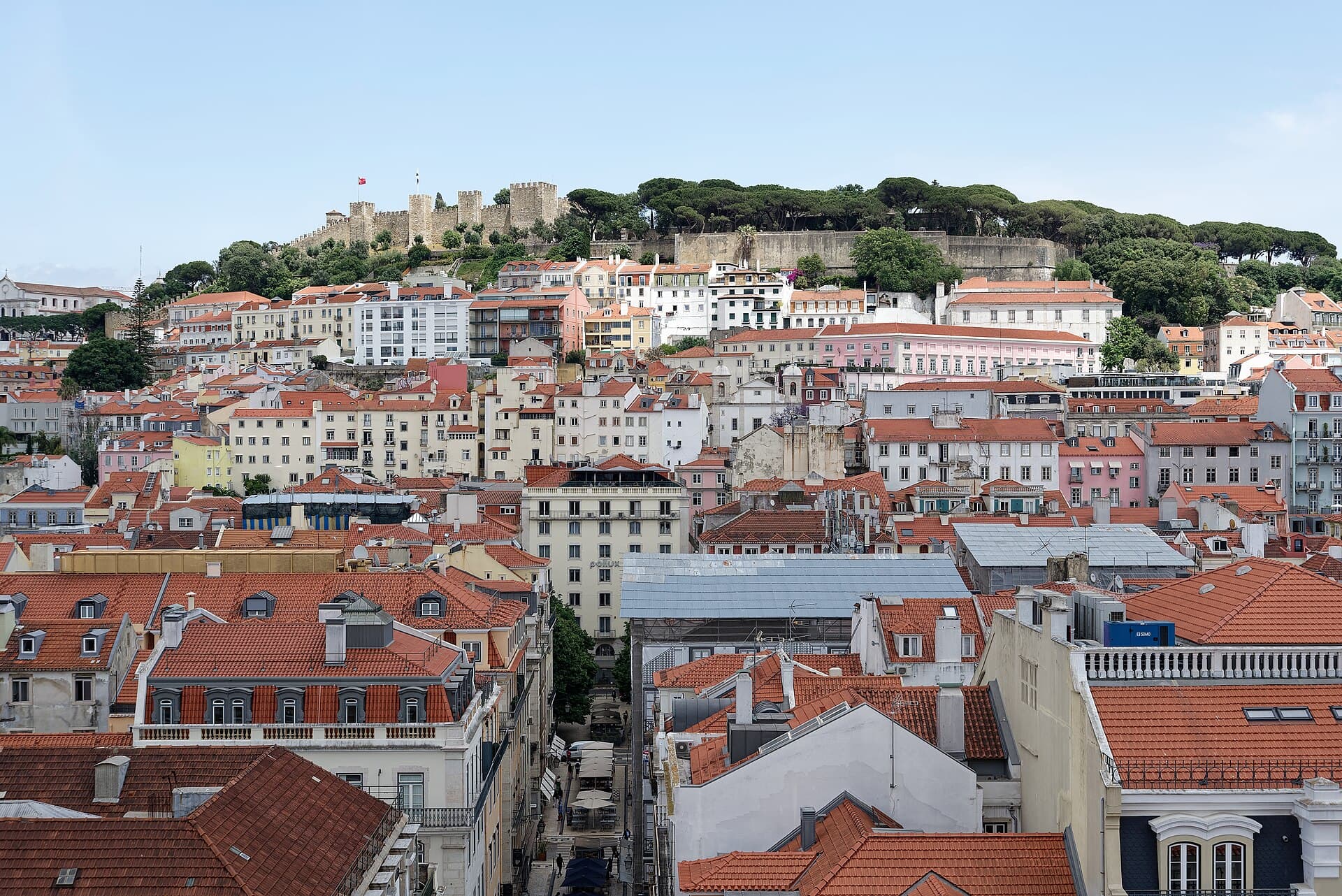
Castelo de Sao Jorge crowns the highest hill above the Tejo, and it is the deepest fortified layer of Lisbon. Long before the castle carried a Christian saint's name, this summit was defended in turn by a succession of peoples that includes Phoenicians, Carthaginians, Romans, Visigoths, and Moors. Every ruler who wanted to hold Lisbon wanted to hold this hill first, because it is the one commanding height over the river. Stand at the ramparts and you are standing on the single point that has been continuously worth fighting for since there was a Lisbon to fight for.
That is the one thing to understand while you are here. The castle is not primarily a monument to any one conqueror or any one century. It is a record of the fact that geography does not change. The height that let a Roman garrison watch the Tejo is the same height that let a Moorish citadel guard the city below, and the same height that a Portuguese king later chose for a royal residence. The walls you touch are a palimpsest, written over and over on the same commanding rock.
The conquest that founded Christian Lisbon
The Moorish citadel, and the city below it, fell in the year eleven forty-seven. In that year Afonso Henriques, the first king of Portugal, took Lisbon with the help of northern European knights who were passing through on the Second Crusade. The event is remembered as the Siege of Lisbon, and it is the hinge on which this whole neighborhood turns. The same conquest that captured this castle also planted the cathedral downhill, the Se de Lisboa, which was begun about eleven forty-seven on the site of the city's main mosque and built to look like a fortress.
So the castle and the cathedral are twins of the same moment. One is the stronghold the conquerors seized, the other is the church they raised to mark the new order. Both were shaped by war, and both sit on the rock of Alfama, the dense Arab-era maze on the slope that, centuries later, would survive the catastrophe that erased so much of the flat city below. When you walk this hill you are reading the oldest surviving layer of Lisbon from the top down.
The name arrived late, and it came from England
Hear a stop from this walk
Castelo de Sao Jorge: The Hill Everyone Fortified
Here is the detail that surprises almost everyone. Saint George, Sao Jorge in Portuguese, is neither Roman nor Moorish, and the name is not even from the eleven forty-seven conquest. King Joao the First dedicated the castle to the warrior saint only in the late fourteenth century, more than two hundred years after Afonso Henriques took the hill. The choice was tied to the saint's popularity in both Portugal and England, and specifically to Joao's marriage to the English princess Philippa of Lancaster.
That marriage cemented an alliance between Portugal and England that endures as one of the oldest in the world. The name you say at the ticket gate today is therefore medieval, and it is quietly Anglo-Portuguese, a piece of dynastic diplomacy fossilized into a place name. It is a small thing, but it reframes the whole site. The castle is Roman in its bones and Moorish in its most consequential defeat, yet the label it carries belongs to a fourteenth-century royal wedding. The deepest layer wears the newest name.
What to look for on the ramparts
The fortress has ten towers. One of them, the Tower of Ulysses, holds a camera obscura installed in nineteen ninety-eight, an optical device that projects a live moving image of the city onto a screen inside a darkened room. It is a period-appropriate marvel: a way of seeing the whole city at once, mounted on the very height built for exactly that purpose, watching. When it runs, a guide swivels the mirror and Lisbon slides across the screen in real time, gulls and trams and all.
From the ramparts themselves, the view runs across all of Lisbon and out over the Tejo. Look down and you can trace the tumbling red roofs of Alfama, the streets refusing to run straight because they inherited the tangle of the Arab-era town. Look further and the flat grid of the Baixa announces where the earthquake of seventeen fifty-five forced a total rebuild on the reclaimed floodplain. From up here the two Lisbons are legible at a glance: the maze that held on the rock, and the grid that replaced what the quake took.
Practical notes before you climb
Adult entry runs about seventeen euros, and it is free with a Lisboa Card. If the ticket price gives you pause, the terraces and viewpoints just outside the walls, the miradouros along the ridge, deliver a fine panorama at no cost. Buying your castle ticket online in advance helps you skip the queue, and the Lisboa Card also covers the National Pantheon further along the same walk. The climb to the summit is steep, and the calcada, Lisbon's traditional cobblestone paving, turns genuinely slippery when wet, so wear shoes with real grip and take the hill in unhurried stages.
Give yourself time up here. The castle rewards standing still. Consider how many flags have flown over this exact stone, and how the one constant across all of them was not a people or a faith but the height itself. That is the argument the whole hill is making, and this is where it is loudest.
Walk the hill, not just the summit
The castle is one stop on a route that reads Alfama as a series of layers, from the fortress-cathedral at the base to the riverside pantheon that took nearly three centuries to build. Seeing Sao Jorge in that sequence, after the Moorish wall line at Portas do Sol and before the descent into the streets that produced Fado, is what turns a viewpoint into an argument about a whole city.
If you want to walk it that way, at your own pace with the history in your ear, the self-guided Alfama audio tour includes this castle as its climax. Browse more Lisbon walking tours to plan the day, or start from the Lisbon city page to see how the hill fits the rest of the city.
Sources
- Sao Jorge Castle, Wikipedia. Documents the successive Phoenician, Carthaginian, Roman, Visigoth, and Moorish fortifications, the eleven forty-seven Siege of Lisbon, Joao the First's late fourteenth-century dedication to Saint George, the ten towers, and the Tower of Ulysses camera obscura installed in nineteen ninety-eight.
- Castelo de Sao Jorge official site (castelodesaojorge.pt). Confirms the summit's status as Lisbon's highest hill, current admission, and Lisboa Card coverage.
- Lisbon Cathedral, Wikipedia. Establishes the twin founding of the Se de Lisboa around eleven forty-seven on the former mosque site, the same conquest that took the castle.
- Roamer Alfama tour transcript and fact audit (data/tours/lisbon-alfama). The fact-audited source for the castle's layered history, the Philippa of Lancaster marriage link, and current entry details.
Ready to experience it?
The Quarter That Outlived the Quake
130 min · 3.4 km · moderate
More from Lisbon
Explore more at your own pace.
Lisbon Rebuilt by Reason: Three Answers to Catastrophe
Jeronimos Monastery: How a Tax on Pepper Built Lisbon's Belem
Portas do Sol: The Terrace on Lisbon's Vanished Moorish Wall
The Hidden Cage Under Rua Augusta: How Lisbon Engineered Its Downtown to Shake and Not Fall
The National Coach Museum: Where Empire Came Home as Gold Leaf