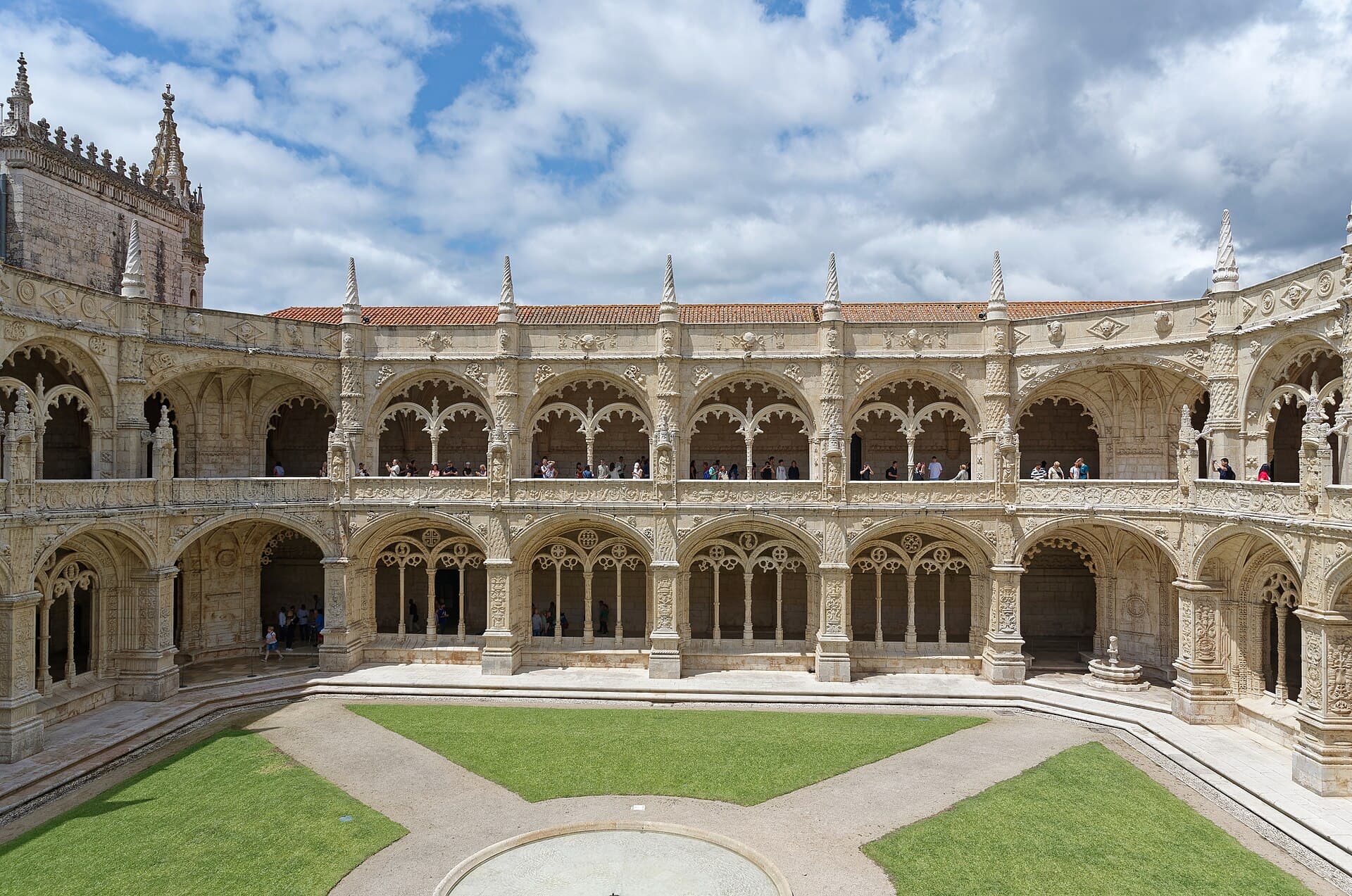
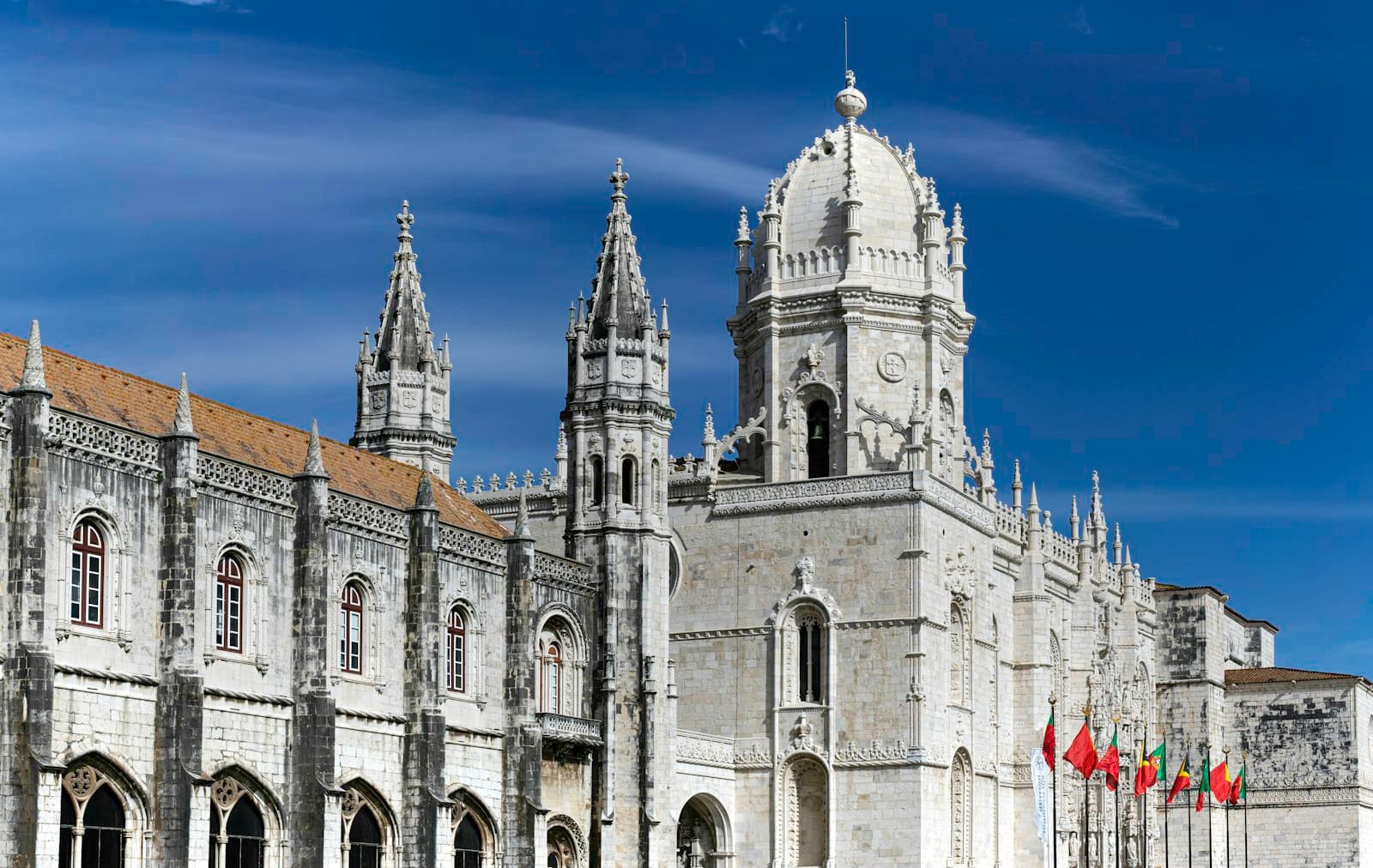
The Jeronimos Monastery is the spice route turned into stone. Its enormous Manueline facade, carved with rope worked as though it were soft, was funded not from a general royal treasury but from a tax of roughly five percent on the pepper and spices coming home from Africa and the Orient. Stand in front of it in Belem, a stretch of Lisbon riverbank a few kilometres west of the center, and you are reading the sea route to India written directly into the stone. Once you see the monastery that way, the rest of the walk along this river opens up: not as a row of pretty monuments, but as a single argument about how a small kingdom paid for greatness and then remembered it.
The tax that carved the stone
King Manuel the First inaugurated the monastery in the year fourteen ninety-five, and construction began on the sixth of January, fifteen oh-one. Do not imagine it rose in one reign. Building it took roughly a hundred years and a chain of architects: Diogo de Boitaca laid the initial design, and Juan de Castillo took over from around fifteen seventeen. The money came from the Vintena da Pimenta, a tax of about five percent on commerce coming from Africa and the Orient. That is the crucial fact to hold. Every knot, coil, and armillary sphere on this building was paid for by the trade that Portuguese ships opened by sailing south around Africa and back with a route to India.
That is why the ornament looks the way it does. The stone carries the maritime language of a kingdom that had just learned it could reach the whole world by water. The monastery also sits on the site of an earlier chapel, the Hermitage of Restelo, where sailors are said to have prayed before departing. Manuel the First lies inside. So do two figures who anchor Portugal's memory of the sea, and meeting them is the reason to step through the door.
Departure, and one tomb that may be empty
Hear a stop from this walk
Torre de Belem: The True Doorway
Inside the church of Santa Maria de Belem, the columns rise and branch into ribbed vaulting designed by Juan de Castillo, carved with the same sea motifs as the exterior. In the lower choir lie two tombs, their remains transferred in eighteen eighty and carved by the sculptor Costa Mota. One holds Vasco da Gama, the navigator who reached India by sea. The other is inscribed for Luis de Camoes, Portugal's great poet of the discoveries.
Here the honest version of the story matters. Camoes was originally buried elsewhere, and that grave was destroyed after the great earthquake of seventeen fifty-five. When bones were gathered in eighteen eighty, they were identified as only probably his. In all probability, the remains in that tomb belong to someone else entirely. This is the double vision the whole walk rewards. Belem is genuinely a threshold of world-changing voyages, and it is also a place where memory has been dressed as certainty. Holding both at once is what turns a stroll into an education.
The square, and the ship that is younger than it looks
Walk out of the monastery and you enter the Praca do Imperio, a formal garden square of roughly a hundred and seventy-five metres per side, its greenery converging on a large central fountain. It feels ancient. It is not. The square was laid out in nineteen forty for the Portuguese World Exhibition, which ran from the twenty-third of June to the second of December that year and drew around three million visitors. The Estado Novo, the twentieth-century dictatorship then governing Portugal, staged it to mark two anniversaries at once: eight hundred years since the founding of the kingdom in eleven forty, and three hundred years since the restoration of independence from Spain in sixteen forty.
The same lesson repeats at the riverbank, where the Padrao dos Descobrimentos rises about fifty-six metres in the shape of a caravel's prow, thirty-three figures marching up its ramps behind the Infante Dom Henrique, Henry the Navigator, holding a small ship. It looks five centuries old. The structure standing there was built between nineteen fifty-eight and nineteen sixty and inaugurated on the ninth of August, nineteen sixty, a permanent rebuild of a temporary version from the nineteen forty exhibition, designed originally by Jose Angelo Cottinelli Telmo with sculptor Leopoldo de Almeida. Much of what feels ancient in Belem is genuinely five centuries old, and some of it is barely eighty. If you want a broader map of the city's other neighborhoods and their own layered stories, the Lisbon walking tours hub is a good place to plan from.
The wealth comes home, sweet and gilded
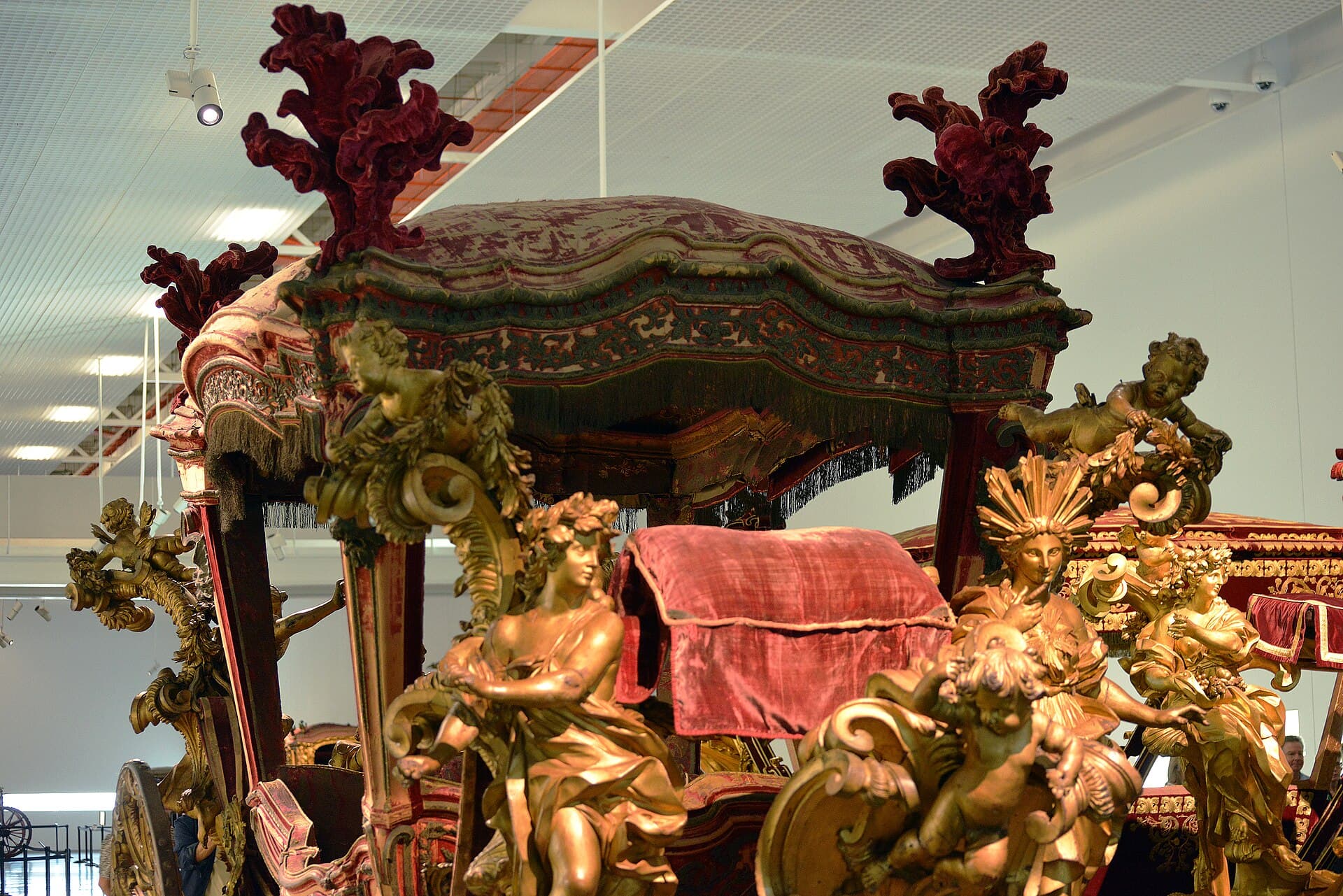
Two smaller stops close the loop. The National Coach Museum, founded on the twenty-third of May, nineteen oh-five, by Queen Amelia of Orleans and Braganza, wife of King Carlos the First, holds the gilded coaches of the royal houses in the former Royal Riding School of seventeen eighty-seven. If the monastery shows wealth flowing in as a tax on pepper, these coaches show the same wealth flowing back out as spectacle. In twenty sixteen this was the most-visited national museum in Portugal.
Then there is the sweetest thread. The custard tart known as the pastel de nata, and here as the pastel de Belem, traces its origin to the monks of Jeronimos, who used surplus egg yolks left after egg whites went to starch their garments. When the religious orders were dissolved after the Liberal Revolution and the monastery closed, the recipe passed to a nearby sugar refinery in eighteen thirty-four, and a confectionery opened in eighteen thirty-seven that has carried it ever since. The monks are gone. The small thing they invented outlived the entire order.
Ending at the true doorway
The walk ends at the Torre de Belem, built around fifteen fourteen to fifteen nineteen under Manuel the First, with Francisco de Arruda named master of the works. Standing about thirty metres tall at the river's edge, it was the ceremonial gateway and point of embarkation: very likely the last piece of Portugal a departing sailor saw, and the first stone that told a returning one he had made it. Look for the carved rhinoceros head at the base of a turret, considered the first sculpture of such an animal in Western European art, likely modeled on a rhinoceros Manuel the First sent to Pope Leo the Tenth in fifteen fifteen. In nineteen eighty-three the tower and the monastery were together inscribed as a UNESCO World Heritage Site.
Seven stops, a little over three kilometres, mostly flat along the river, and about two hours at a slow pace. You can read the whole argument standing in front of Jeronimos, then let the self-guided audio carry you the rest of the way, stop by stop, at your own speed. Start planning at Lisbon.
Sources
- Jeronimos Monastery, Wikipedia: funding via the Vintena da Pimenta pepper tax, the fourteen ninety-five inauguration, and the fifteen oh-one construction start.
- Luis de Camoes, Wikipedia: the tomb attribution, the destroyed original grave after the seventeen fifty-five earthquake, and the eighteen eighty transfer.
- Portuguese World Exhibition, Wikipedia: the nineteen forty exhibition dates, visitor numbers, and the Estado Novo anniversaries.
- Monastery of the Hieronymites and Tower of Belem, UNESCO World Heritage List (entry 263): the nineteen eighty-three joint inscription.
- National Coach Museum, Wikipedia: the nineteen oh-five founding by Queen Amelia and the collection housed in the former Royal Riding School.
Ready to experience it?
Belém: The Threshold of the Ocean
105 min · 3.2 km · easy
More from Lisbon
Explore more at your own pace.
Lisbon Rebuilt by Reason: Three Answers to Catastrophe
Portas do Sol: The Terrace on Lisbon's Vanished Moorish Wall
The Hidden Cage Under Rua Augusta: How Lisbon Engineered Its Downtown to Shake and Not Fall
Castelo de Sao Jorge: The Lisbon Hilltop Every Ruler Fortified
The National Coach Museum: Where Empire Came Home as Gold Leaf