The hill sorted people, and Lisbon's castle hill is best read from the bottom up, in the order it did the sorting. Conquered Muslims were kept in a closed quarter outside the walls. Orphans and fado's first remembered name lived in its lanes. A shrinking quarter survives inside the walls, and today a ticket line waits at the gate. Along the way, much of what looks ancient is younger than it looks.
Outside the walls
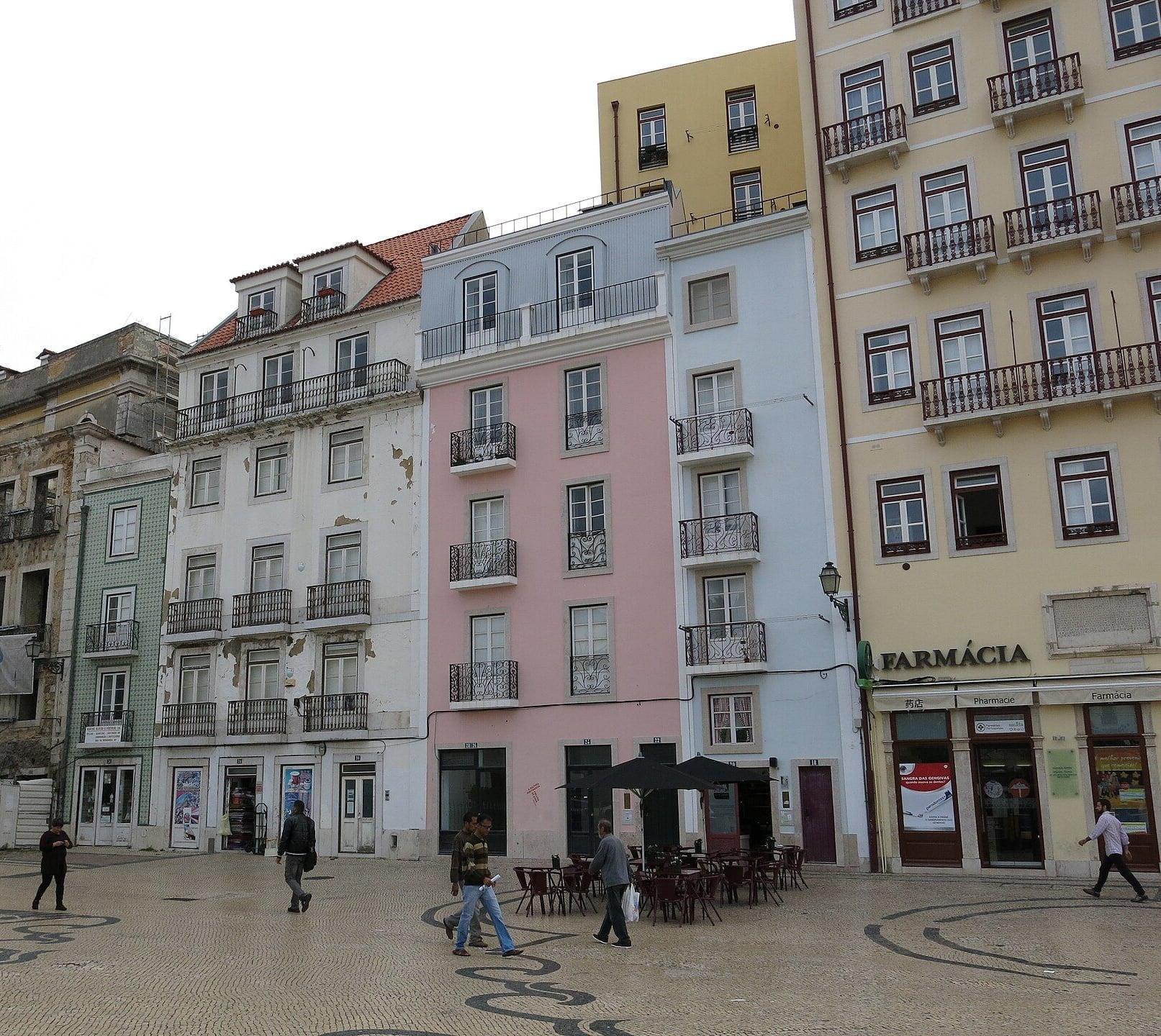
After the citadel fell in 1147, the Muslims who stayed were not allowed to remain within the walls. They were confined to a quarter at the foot of the slope, under a charter of 1170. That quarter is Mouraria, the Moorish quarter, and its name is still on the street signs. It had its own baths, prison, butcher, school, cemetery and two mosques. It closed at a curfew bell. In 1496 its people were given a forced choice of expulsion or baptism. None of that fabric survives to point at. What you see on Rua da Mouraria today is iron balconies, souvenir racks and the patterned pavement in the cover photograph, with people living above the shops.
The walk starts lower still, at the white chapel of Nossa Senhora da Saúde on Martim Moniz square. The gunners of the Lisbon garrison raised it in 1505 to keep a vow after an epidemic. The statue that gives it its name came from an orphans' school across the street, whose many-lobed stone doorway at number 64 is the next thing you pass. Queen Catarina refounded that school in 1549 for thirty poor boys to be trained for the missions. The doorway looks like the ornate Manueline style of that age, but the state's heritage record calls it a later revival. That is the first of several things on this hill that wear an older face than their date.
Fado's thin paper trail
Hear a stop from this walk
Castle Gate on Rua de Santa Cruz: Where the Ticket Starts
Up Rua do Capelão, past portraits of fado singers, a plaque in Largo da Severa names Maria Severa Onofriana, considered in her time the sublime expression of fado. She died on 30 November 1846, aged twenty-six. The city's records are brief: a baptism in July 1820, a death record placing her on this lane, a sudden collapse. The Fado Museum adds that a newspaper account described her singing at the palace of the Count of Vimioso, and that the story of an affair with him hardened into myth. The places she sang, the museum says, cannot be identified.
So the first remembered name in a genre UNESCO inscribed on its intangible heritage list in 2011 fits on one small plaque. Even the house is only a face: behind it, the building was gutted and rebuilt in 2012 as a fado restaurant.
Further up, at Largo de São Cristóvão, the fado story turns communal. Down the stair beside the church is the Fado Vadio mural, from about 2012, painted by six artists and groups and showing Severa among others. A citizens' group raised the money with a fado party in the street. On one small square you have a parish church that came through 1755 losing its towers, and a neighborhood that sang up the money for its own wall.
The climb, and a gate younger than it looks
In Largo dos Trigueiros the walk asks something of you. The photographer Camilla Watson began a project there in 2009, printing portraits of elderly Mouraria residents onto wood along the alley beside her studio. In 2018 she moved across the river, getting away from the tourists crowding her studio. The walk says so plainly, and asks only that you look at the portraits and not through anyone's window.
Then comes the steepest stretch, up Costa do Castelo, to the Arco de São Jorge. With its stone frame, water stains and crowned arms it looks medieval. It was begun in 1831 and took fifteen years, its round arch reusing marble from a chapel of another convent, and its keystone carries the date 1846 and the name of Queen Maria the Second. That is the same year Severa died down the hill. Nothing links the two but the slope.
Inside the walls
Inside the citadel, Santa Cruz do Castelo backs onto the wall itself, its bell tower standing on one of the wall's towers. The record says a mosque here was consecrated as a church in 1147. Earthquakes hit it repeatedly, and when it reopened in 1776 it had been turned round to face west with one nave instead of three. Once again, younger than it looks.
The number that matters most up here is a population. A Lisbon newspaper reported in 2016 that this quarter once had about thirty-five hundred people and by then a little over three hundred. The hill once pushed people out from inside the walls. Now the people inside are the ones running short.
The walk ends at the ticket office, deliberately. The castle's shape comes from the kings of the 1200s, but the royal palace was wrecked in 1755, a military base replaced it, and that came down around 1940, when the entrance gate and bridge were rebuilt. Martim Moniz, the knight said to have jammed a castle gate open with his body, gives his name to the square at the bottom and a gate at the top, though the castle's own site calls the legend hard to prove. The older story is real: an Iron Age settlement, and an inscription dated 985 recording a repair to the wall in Muslim times.
How to walk it
The route is eleven stops over about 1.7 kilometers, about seventy minutes, climbing about seventy meters with one flight of forty-eight steps going down and a way round it. The lanes are lived in, so go quietly and keep out of doorways. Because the walk stops at the gate rather than inside, you decide at the end, on your own schedule, whether the castle is worth the ticket now that you know what it stands on. For the castle hill in more depth, read what is really old on Lisbon's castle hill.
Begin at stop 1 of São Jorge Castle and Mouraria: Who Lived Below the Walls, and see every route on the Lisbon page.
Sources
- Castelo de São Jorge, origins and development: the Iron Age settlement, the inscription of 985 recording a repair to the wall, the 1755 damage, the military base demolished in 1939 and 1940.
- Castelo de São Jorge, the walls: the Martim Moniz gate, the 1258 tomb inscription, the 1646 plaque, the legend called very difficult to prove.
- Museu do Fado, Severa: her dates, the Count of Vimioso account, the plaque's wording.
- UNESCO Intangible Cultural Heritage, Fado: fado inscribed in 2011.
- Castelo de São Jorge, home: tickets and the entrance on Rua de Santa Cruz do Castelo.
Ready to experience it?
São Jorge Castle and Mouraria: Who Lived Below the Walls
70 min · 1.7 km · moderate
More from Lisbon
Explore more at your own pace.
Best Architecture Walking Tours in Lisbon (2026)
Camões's Tomb at the Jerónimos: The Poet and the Doubt
The Jerónimos Monastery in Lisbon: What to See, Space by Space
Bairro Alto and Príncipe Real: Reading a Lisbon Hill That Was Planned Twice
Parque das Nações: How Expo 98 Was Built Out of What It Demolished