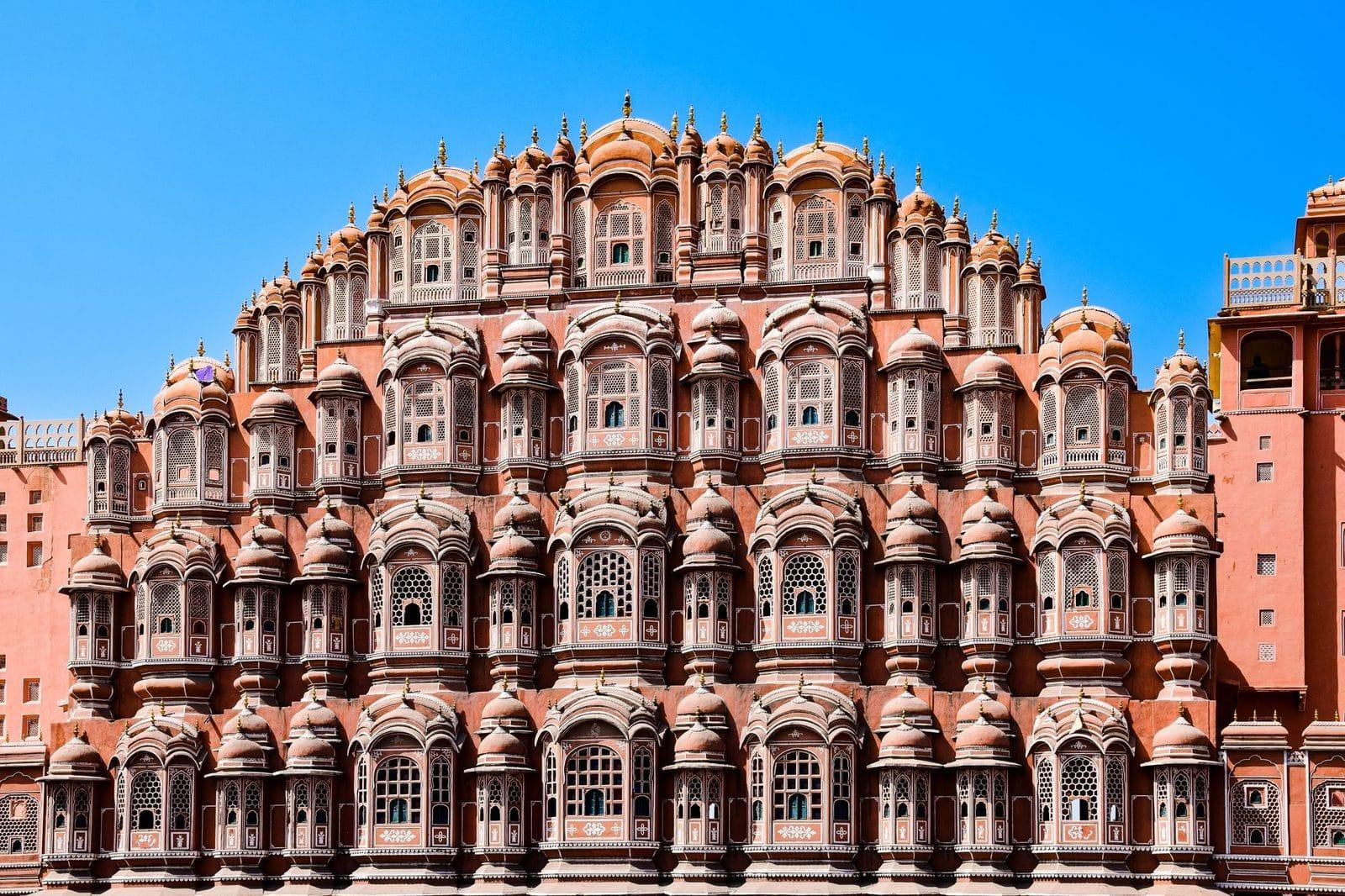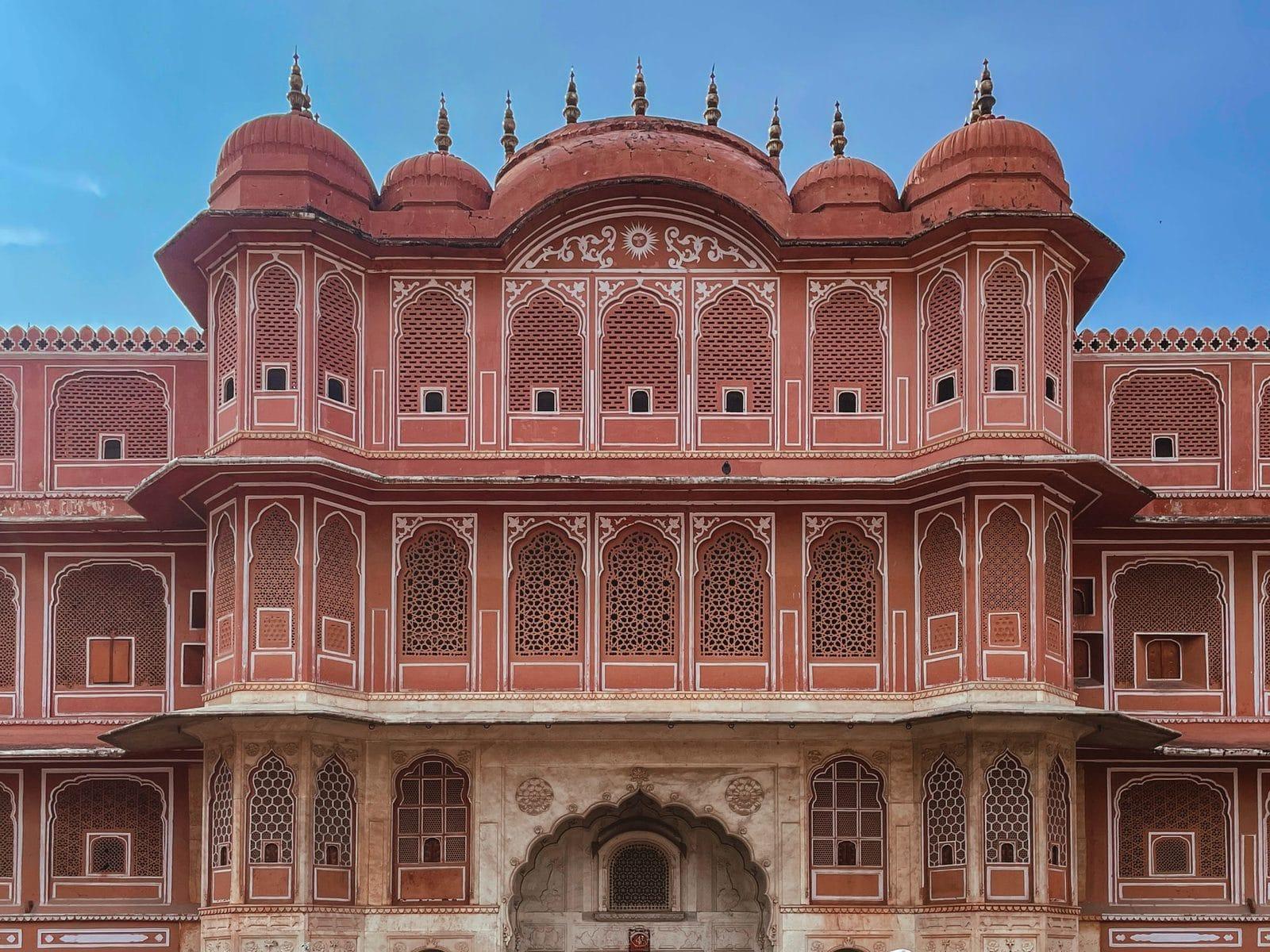
Jaipur's City Palace was begun soon after the city's founding in 1727, when Sawai Jai Singh II moved his court from Amber. It is a chain of seven courtyards: four have been the City Palace Museum, run by a private trust, since 1959, while the seven-story Chandra Mahal at its heart is still the royal family's residence.
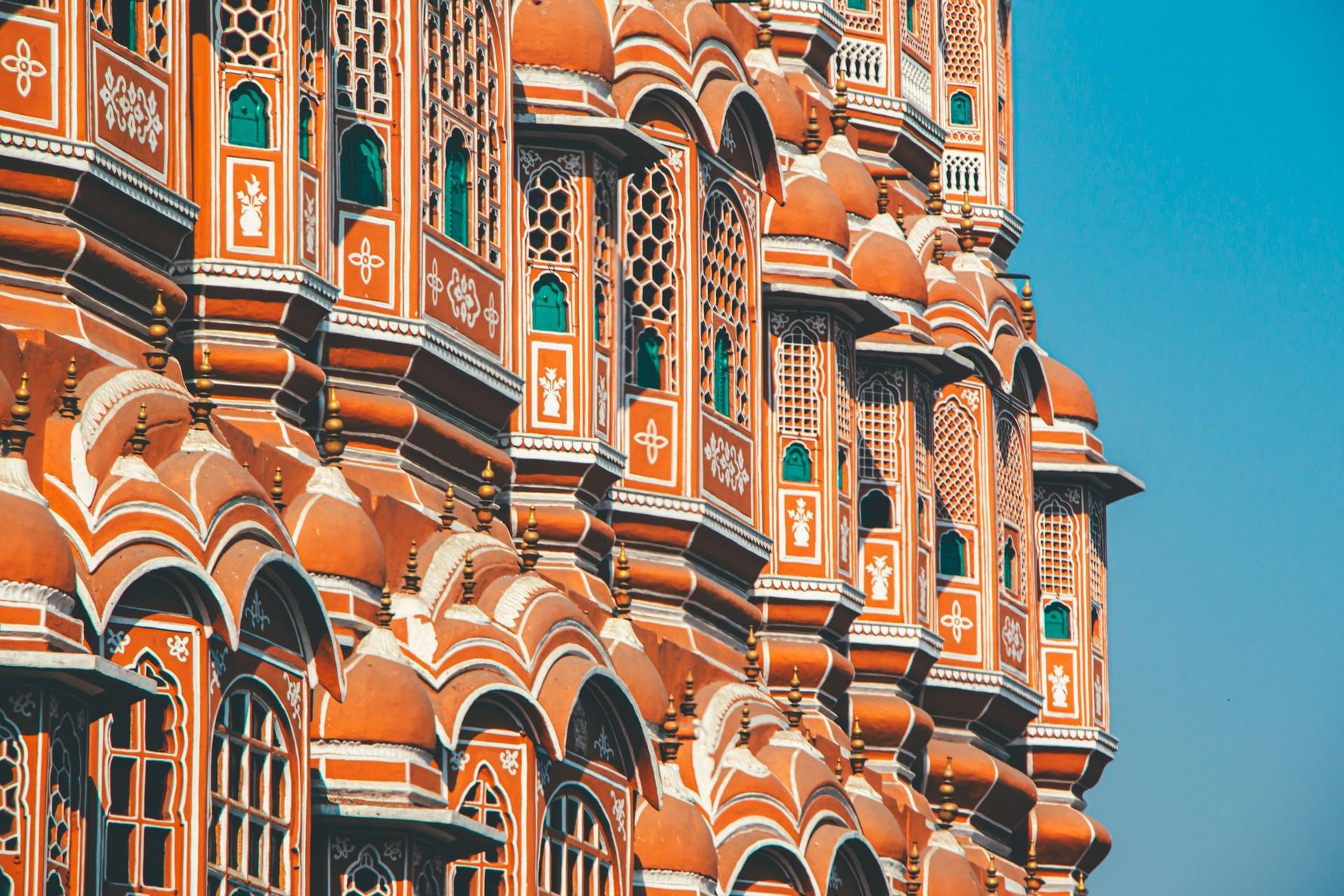
Pink City: The Grid Built for Trade
75 min · 2.2 km · easy
Jaipur's City Palace is a museum built around a home. Building began soon after the city itself was founded, and in 1727, the palace's trust records, Maharaja Sawai Jai Singh the Second moved his court here from Amber in the hills to the north. The palace is a chain of seven courtyards. Four of them have been the City Palace Museum since 1959, run by a private trust. At the heart rises the seven-story Chandra Mahal, which, in the trust's words, "continues to be the residence of the Royal Family of Jaipur". The City Palace walk crosses the open courts from gate to gate, at your pace, and tells the rooms from outside, so it works whichever galleries are open that day.
A guest palace for the empire
You enter by Virendra Pol, Gate 1, across the lane from the Jantar Mantar. The first building ahead is the Mubarak Mahal, the Auspicious Palace. The trust says it was built by the court architect Lala Chimal Lal under Maharaja Sawai Madho Singh the Second to receive dignitaries from abroad; its brochure dates it to about 1902 and calls it a guest house for British visitors. It has held the royal textile collection, though that gallery has been closed for restoration since 27 March 2026.
The wings around the court hold the painting and photography gallery and the armory. The photographs are a surprise: Sawai Ram Singh the Second, who ruled until 1880, began photographing and collecting in the 1860s, and the museum shows his pictures alongside his contemporaries'. A king who worked behind a camera is a good way into a palace that has always been partly on display.
The open hall and the silver urns
Hear a stop from this walk
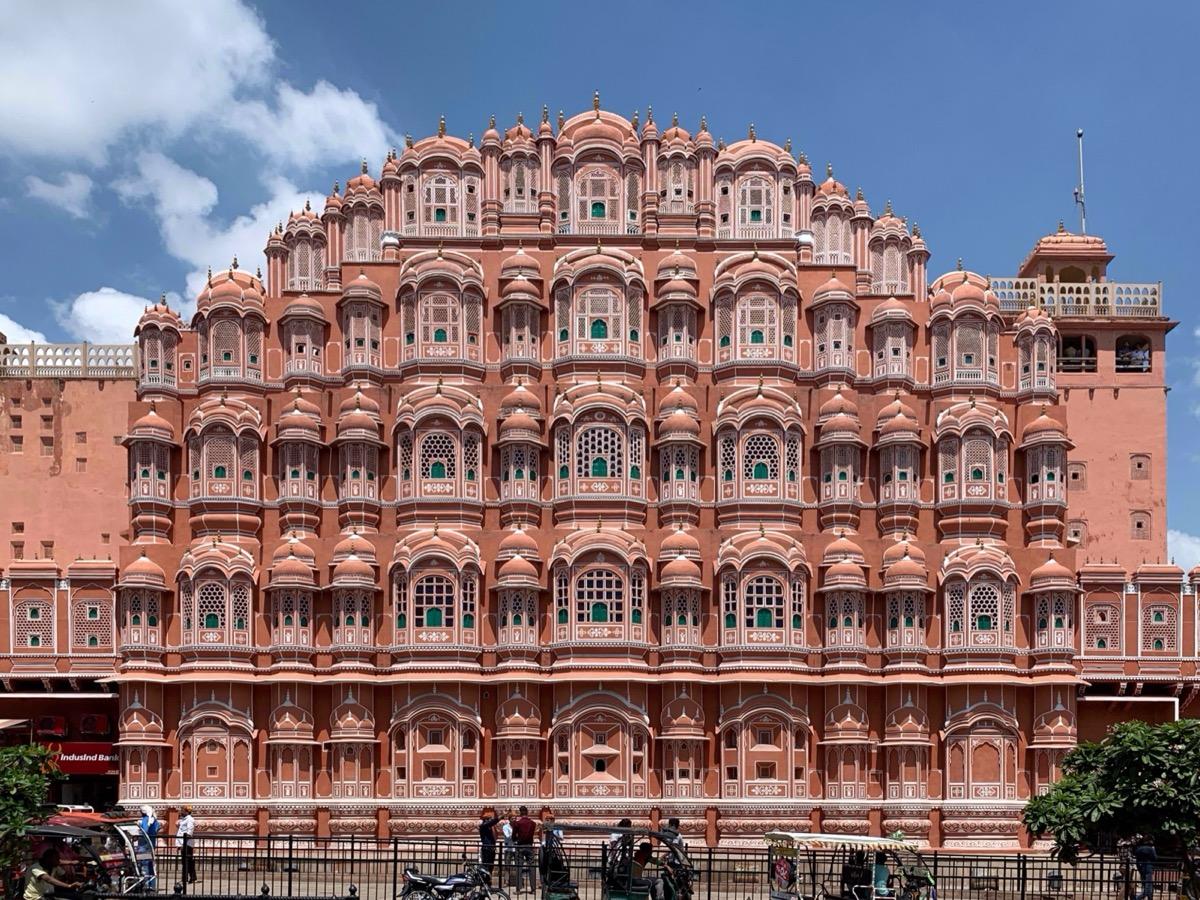
Hawa Mahal: The Palace of Winds
Through Rajendra Pol, a gate flanked by marble elephants said to have been added to celebrate the birth of an heir in 1931, you reach the Sarvato Bhadra. Its name means auspicious on every side, and it is a square hall open on all four. The trust calls it the Diwan-i-Khas, the hall of private audience, where the Maharaja met his ministers in confidential councils, and a place for rituals of the court calendar.
In the hall stand two Gangajalis, giant silver urns. The trust says Madho Singh the Second had them made to carry water from the Ganges on his journey to England, from more than fourteen thousand silver coins. Guinness World Records lists the pair, made in 1902, as the largest pieces of silverware. They are about one and a half meters tall.
The court that corrects its own legend
A doorway leads into Pritam Niwas Chowk, a small court with four painted doorways, under the Chandra Mahal. Visitors are usually told that the doors stand for the four seasons, and many guidebooks name them that way. The palace's own guide politely disagrees: the Indian calendar has six seasons, not four, so each doorway is more likely dedicated to the god whose figure sits above it. Its captions still give season names, for the rains, summer, spring and autumn. Look at the top of each door and see which god you can recognize.
From the hall of private audience you look up at the residence itself. A few of its rooms open only on a separate guided tour sold at the counter; the rest is a private home, and the walk keeps to the courts.
The throne room and the carriages
The Sabha Niwas was the Jaipur State's throne room, where, the trust writes, the court received nobles, envoys from other states and, later, British Viceroys and Residents. The brochure adds that it was first open to its courtyard as the hall of public audience. Its period furniture and ceremonial dress are seen from the doorway.
The last stop is the Rath Khana, the transport gallery: a nineteenth century boat on which an image of Krishna was taken out on the Talkatora lake for a festival, a buggy of Madho Singh the Second, and a suit of elephant armor the trust calls the only one of its kind still fully intact. One object has not retired. The palace's silver palanquin still carries the image of the goddess Gauri out into the city each year for the festivals of Teej and Gangaur. The procession leaves by the Tripolia, the royal gate on the bazaar, and winds through the old city. A museum built around a home sends part of its collection back into the streets it was made for.
Before you go
- The walk is 10 stops over about half a kilometer, about an hour, from Virendra Pol (Gate 1) to Uday Pol (Gate 2) on Jaleb Chowk. It is flat.
- The ticket is separate and sold at both gates: 400 rupees for Indian adults, 1,200 for international adults (concessions 200 and 600). The trust's own composite, adding Jaigarh and the Royal Cenotaphs, is 500 and 1,700. The palace is not on the Rajasthan government's composite monument ticket. Prices as of November 2026.
- Open daily 9:30 am to 6:30 pm, last tickets at 6:00 pm; closed only on Dhulandi, the second day of Holi.
- The trust publishes no photography rule, so check the signs in each gallery. Decline touts offering guides or special tickets at the gates; the trust has guides for hire at its own desk.
The palace shares its wall with the observatory: read the Jantar Mantar companion next, or the Pink City companion for the bazaar outside.
Ready to experience it?
Pink City: The Grid Built for Trade
75 min · 2.2 km · easy
More from Jaipur
Explore more at your own pace.
Best Culture Walking Tours in Jaipur (2026)
Best History Walking Tours in Jaipur (2026)
Amber Fort: Up the Ridge, Back in Time
Amer: The Capital Below the Fort
Nahargarh Fort: The Ridge Above the Grid