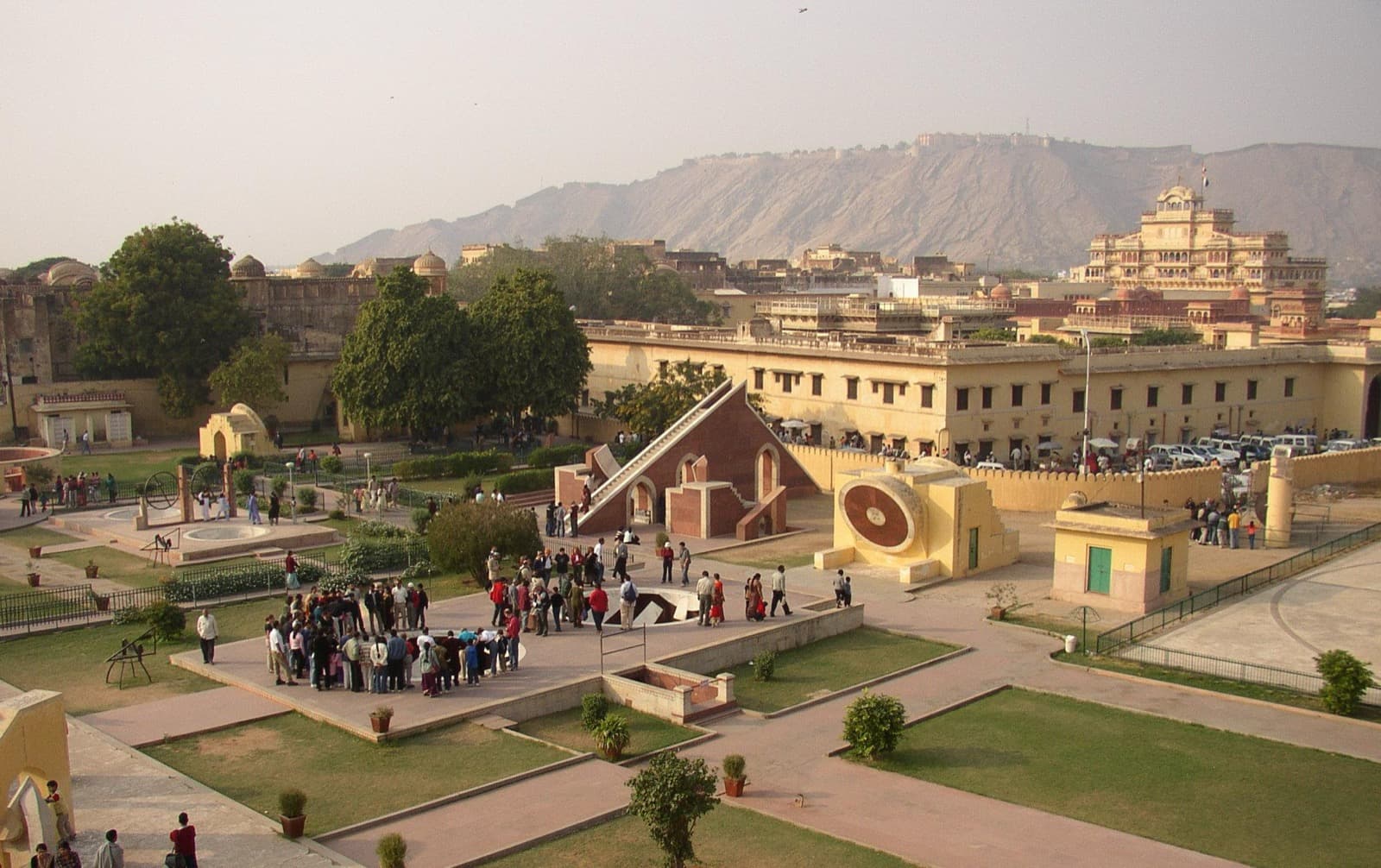
Most observatories hide their instruments: a brass ring, a graduated arc, a telescope small enough to hold. Jantar Mantar in Jaipur does the opposite. Here an astronomer-king took the questions astronomers usually ask through small metal tools and built the answers at the scale of buildings. The result is a walled field of nineteen astronomical instruments made not of brass but of masonry, of stone and plaster, laid out to measure time, predict eclipses, and track the sun, moon, and stars. You do not squint through them. You walk around and through them.
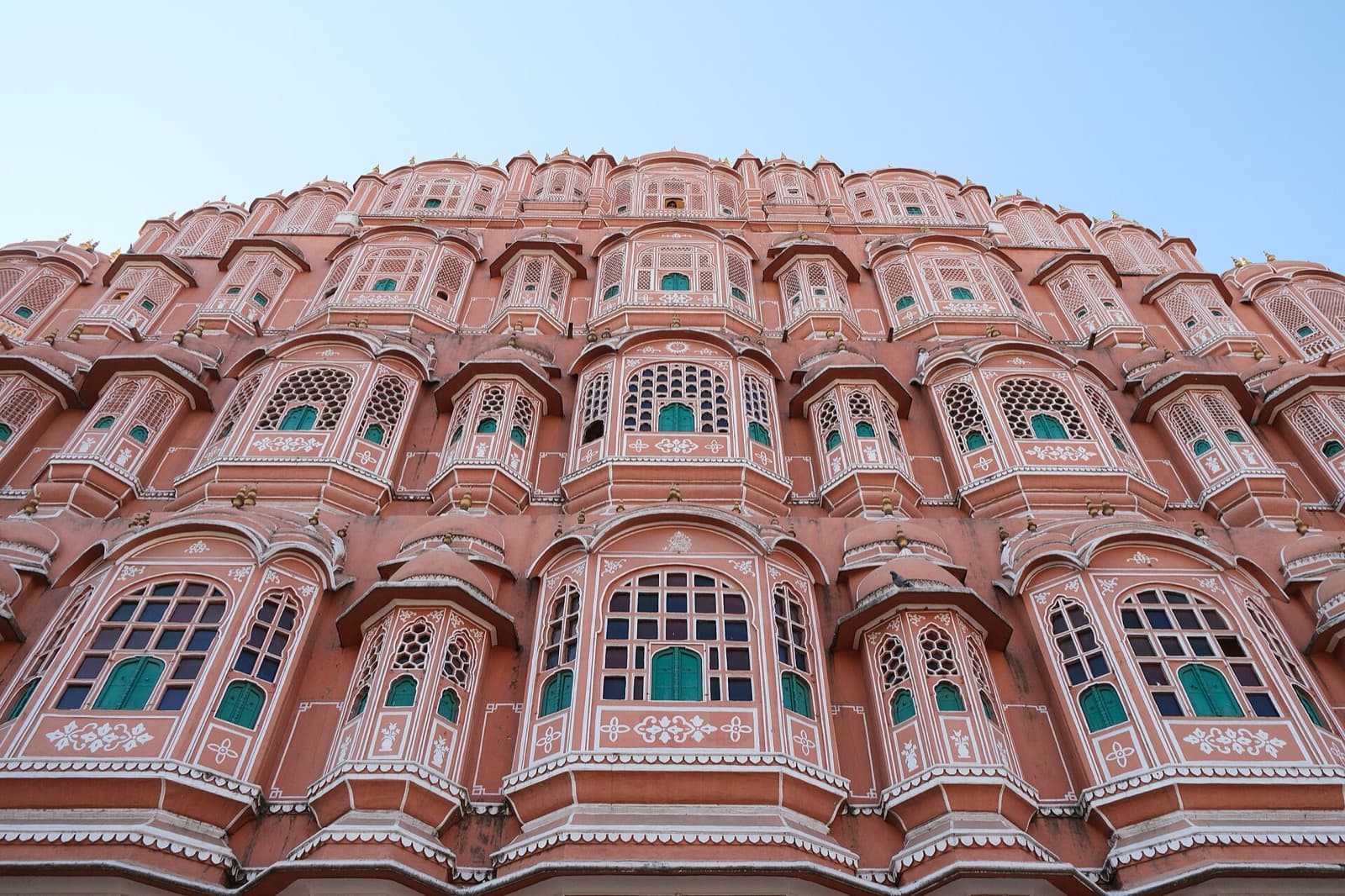
The king was Maharaja Sawai Jai Singh the Second, the Kachhwaha Rajput ruler who founded Jaipur in 1727 and moved his capital down from the hill fortress of Amber. He was a warrior and an administrator, but at heart he was an astronomer, and this observatory is where his mind is most visible. He built Jantar Mantar between roughly 1728 and 1734, and it sits near the center of his planned Pink City, a short walk from the City Palace and the honeycombed Hawa Mahal.
What you are actually looking at
The word helps. "Jantar Mantar" comes from Sanskrit: yantra, meaning instrument or machine, and mantrana, meaning to calculate or consult. So the name is plain and literal. This is a place of calculating machines. Each of the nineteen structures does a specific job. Some measure the altitude of the sun or a star. Some track the position of the moon. Some are tuned to individual signs of the zodiac. What unites them is that they are all instruments first and monuments second, even though they read to a visitor as sculpture.
That is the mental shift worth making before you walk in. These are not decorative follies or abstract shapes. Every ramp, every curved bowl, every angled wall is doing a measurement. The strangeness you feel standing among them comes from that fact: elsewhere, this kind of precision lived in objects you could pick up. Here, a king turned it into architecture you have to climb.
The great sundial
Hear a stop from this walk
Johari Bazaar: The Street of Jewels That Proves the Plan
The centerpiece is the Vrihat Samrat Yantra, a giant sundial standing about twenty-seven metres tall, roughly the height of an eight-storey building. The name translates as the great king of instruments, and it is widely recognized as the largest stone sundial in the world. Its shape is simple to describe and hard to grasp in person: a huge triangular ramp, the gnomon, with a curved scale on either side. The hypotenuse of that triangle is set at the angle of Jaipur's latitude, which means it points at the celestial pole and runs parallel to the Earth's axis of rotation. The sun's shadow falls across the scales, and the observatory reads the time from where it lands.
The site's own history holds that the sundial can tell Jaipur's local time to an accuracy of about two seconds. Take that as the observatory's claim rather than a promise you should test with a stopwatch. But do the arithmetic on what it implies. If the shadow tracks the sun closely enough to resolve two seconds, then it is moving, visibly, all the time. The shadow of that great triangle slides about one millimetre every second, roughly a hand's breadth every minute. That is the single best thing to do at this stop. Stand near the base, find the edge of the shadow on the scale, and simply watch it. Within a minute you can see it move. You are watching time cross a wall.
Why the scale matters
Jai Singh did not build only one of these. He raised similar masonry observatories in Delhi, Ujjain, Varanasi, and Mathura, part of a program to correct and update the astronomical tables in use in his day. Of all of them, UNESCO records that the Jaipur observatory is the largest and best-preserved, and it was inscribed as a World Heritage Site in 2010. That is why this is the one people travel to see.
The scale was not showmanship. In eighteenth-century instrument-making, a bigger scale meant finer graduations, and finer graduations meant more precise readings. A brass quadrant the size of a dinner plate can only be marked so finely before the lines blur together. A masonry arc the length of a courtyard can be divided far more exactly. So the giant sundial and its neighbors are large for a practical reason: Jai Singh was trying to out-resolve the portable instruments of his time by making his instruments too big to hold. The heavens got measured with a building.
There is a quiet human note in that ambition. Jantar Mantar sits inside a city Jai Singh had planned like a diagram, drawn on a strict grid before a single stone was laid. The same mind that ordered the streets into rectangular blocks ordered the sky into masonry scales. Walking here, you are inside the observatory of a ruler who wanted to read both the city and the cosmos as things that could be laid out, measured, and made legible.
Walking it at your own pace
Jantar Mantar rewards slowness, which is exactly what a self-guided visit gives you. There is no group being marched from the sundial to the next instrument on a fifteen-minute clock. You can stand at the base of the Samrat Yantra until you actually catch the shadow moving. You can wander among the smaller zodiac instruments and notice that each is angled slightly differently, tuned to its own patch of sky. A small entry ticket gets you in, and the open field means you are never far from shade at the edges, though the middle is fully exposed to the sun.
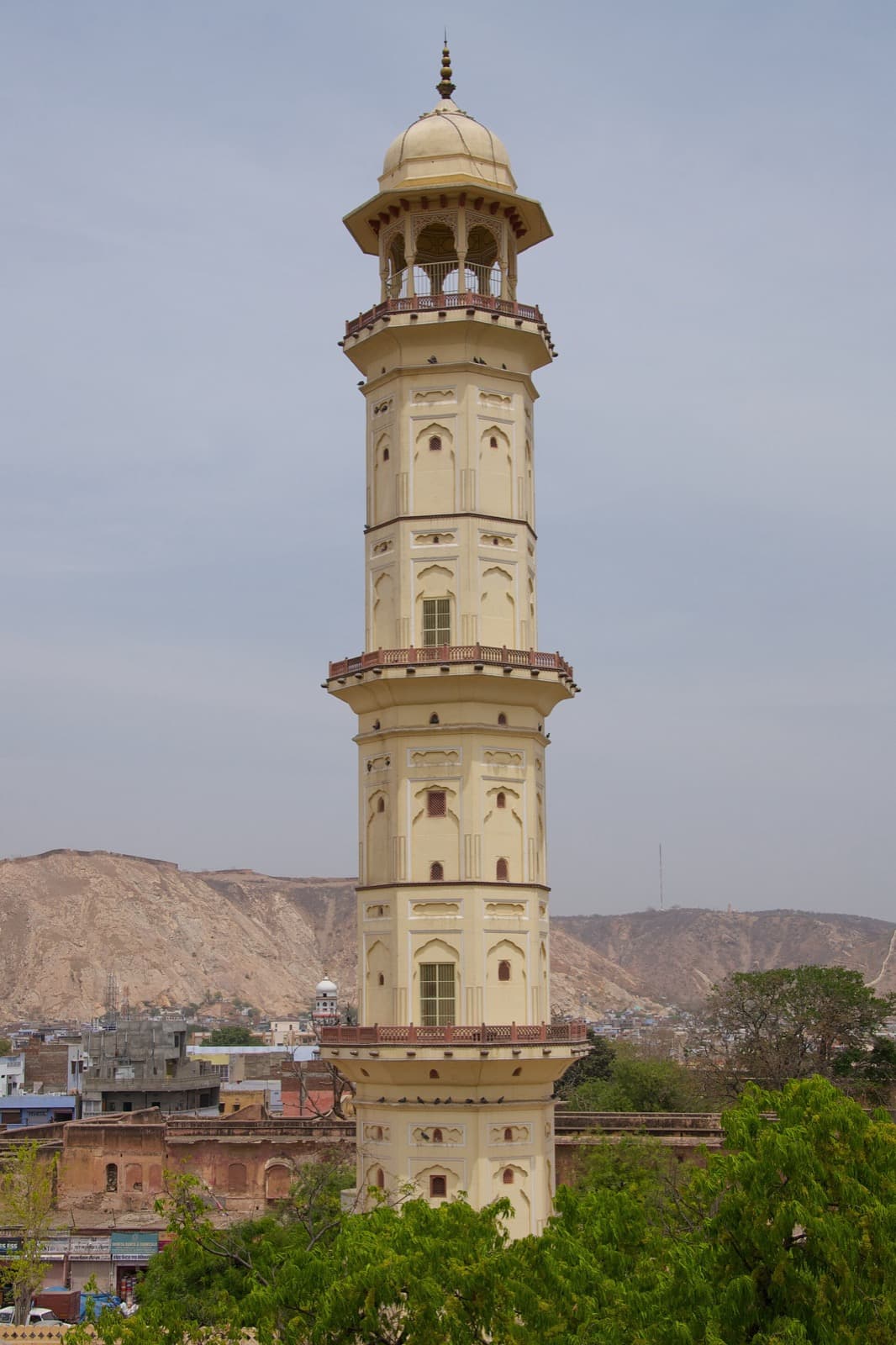
The observatory is stop five on Roamer's self-guided walk through the Pink City, which threads it together with the Hawa Mahal, the City Palace, the Iswari Minar, and the jewellers' bazaar, so the astronomy reads as one clause in the larger sentence of a planned city. If you want the wider view first, the Jaipur walking tours hub lays out the routes, and the Jaipur city page gathers everything worth walking. Come early, before the heat and the crowds build, find the shadow, and watch a king's questions about the sky answer themselves in stone.
Sources
- Jantar Mantar, Jaipur (Wikipedia): the nineteen instruments, construction dates, and the Vrihat Samrat Yantra's dimensions and accuracy claim.
- The Jantar Mantar, Jaipur (UNESCO World Heritage Centre, site 1338): 2010 inscription, largest and best-preserved of Jai Singh's observatories.
- Testbook Static GK, "World's Largest Sundial – Samrat Yantra": confirms the Samrat Yantra as the world's largest sundial and the gnomon's alignment to Jaipur's latitude and the Earth's axis.
- Roamer tour transcript, "Pink City: The Walled Bazaar Grid" (fact-audited, stop five): the observatory's own two-second accuracy claim and the shadow's rate of travel.
Ready to experience it?
Pink City: The Walled Bazaar Grid
90 min · 4 km · moderate
More from Jaipur
Explore more at your own pace.
Jaipur Travel Guide: Days, Transport, Costs, Timing, and Safety
One Day in Jaipur: A Walkable Pink City and Amber Fort Itinerary
Jaipur: The City That Was Drawn Before It Was Built
Amber Fort's Sheesh Mahal: Why One Candle Becomes a Galaxy
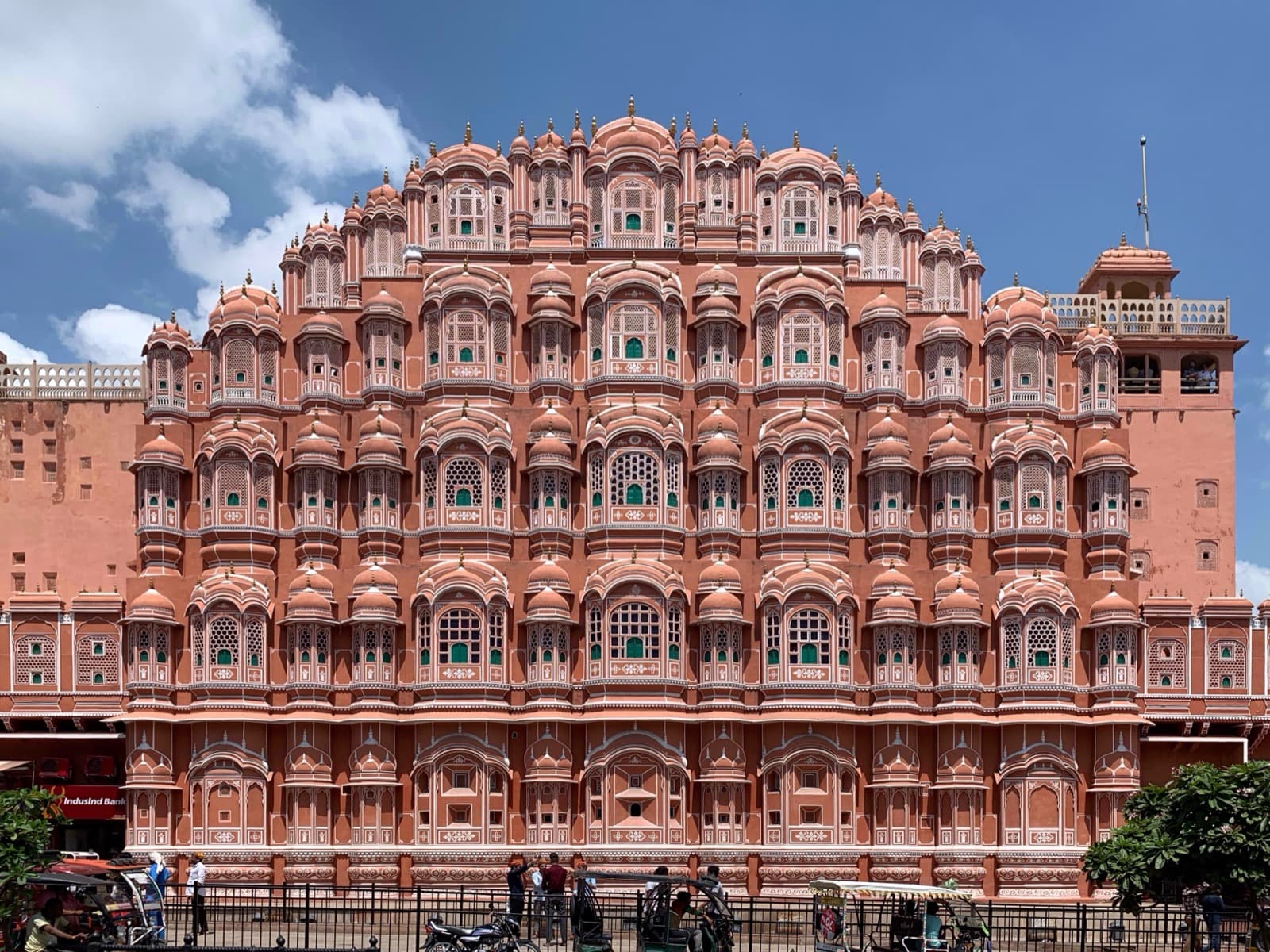
Hawa Mahal: The Honeycomb Window Onto Jaipur's Grid