Behind the mirror palace that draws the crowds at Amber Fort, three quieter structures show what the Kachhwaha kings actually solved on this hill: how to stay cool in fierce heat, how to keep a private world private, and how to catch enough water to live above a lake. The Sukh Niwas, the zenana, and the Panna Meena ka Kund answer those three problems in stone, water, and shade. Stand in front of them and the fort stops being a photo backdrop and becomes an engineering argument about comfort, seclusion, and the harvesting of rain.
The hall cooled by falling water
Face the Sheesh Mahal across the garden courtyard and you are looking at the Sukh Niwas, the Hall of Pleasure. It is easy to walk past on the way to the mirrors, and most visitors do. That is a mistake, because the Sukh Niwas is the most practical marvel in the whole palace. An open channel of water runs straight through the middle of the room. Cool air moving over that falling and flowing water kept the hall, in the words of the site's own history, as pleasant as an air-conditioned environment.
Think about what that meant on a Rajasthan hillside where the summer sun bakes the exposed ramps from April through June. The builders had no mechanical cooling, no fans, no electricity. They had water, marble, and shade, and they combined them into a room that stayed livable when the courtyard outside was an oven. Water was carried up to the fort, channeled through the hall, and left to do the work of lowering the temperature as it moved. This is early air-conditioning, engineered from nothing but physics and patience. The same instinct that produced the Sheesh Mahal's play with light produced the Sukh Niwas's play with water, and the two rooms face each other across the garden for a reason. One is built for the eye, the other for the skin.
The women's quarters and a palace that took a generation
Hear a stop from this walk
The Sukh Niwas, the Zenana and the Panna Meena ka Kund: The Cooled Court and the Stair-Well Below
Look next to the older heart of the complex, the zenana, the women's quarters, which form part of the Man Singh palace. This is the oldest section of the hilltop, and its scale tells you how seriously the court took the private world. The Man Singh palace took twenty-five years to build and was completed in fifteen ninety-nine, under Raja Man Singh the First, who reigned from fifteen eighty-nine to sixteen fourteen. A quarter century for one section of one palace is a measure of both ambition and permanence: these kings were not building for a season.
The layout of the zenana is worth reading closely. Many similar apartments open onto shared corridors, arranged so the king could visit discreetly while the women's world stayed private. This was a court organized around the custom of purdah, seclusion, the same custom that shaped the latticed Suhag Mandir gallery you passed above the Ganesh Pol, where royal women could watch ceremonies through marble screens without being seen. The zenana is the residential version of that same principle. It is architecture as social rule: the plan of the rooms enforces who could see whom, and when. Standing among these apartments, you are reading the domestic logic of a Rajput palace directly off its corridors.
The stepwell in the town below
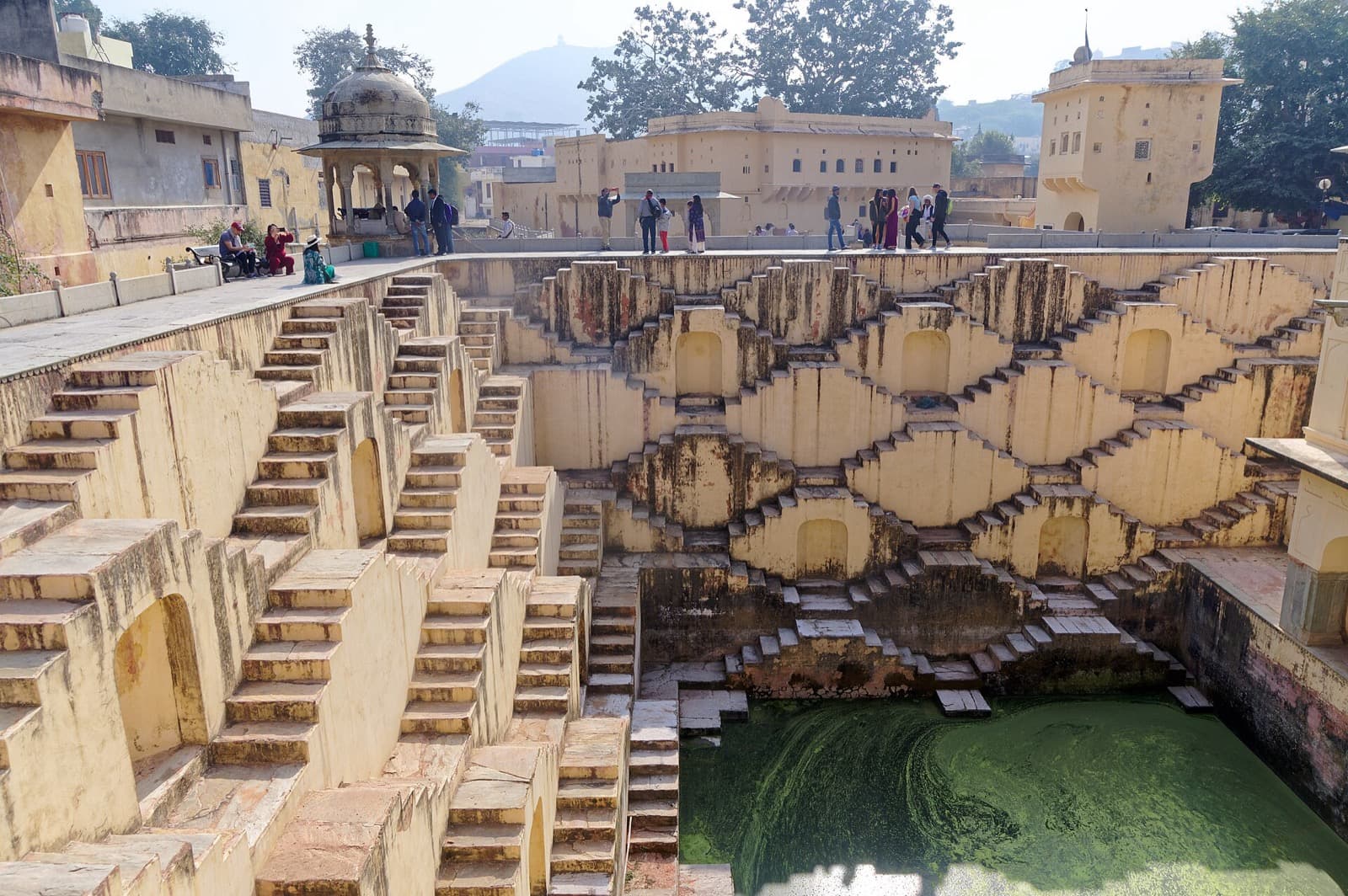
Now carry your eye off the hill to the town below, because the story of water does not end at the fort wall. About a kilometre north of the fort, in the old town of Amer, stands the Panna Meena ka Kund, a stepwell. A kund is a stepwell, a deep tank reached by descending stairs, and this one is famous for its beauty. Symmetrical flights of steps crisscross down three of its sides in a strict geometric pattern, with small octagonal pavilions called chhatris set at the corners.
The Panna Meena ka Kund is generally dated to the sixteenth century, and it was built to harvest rainwater and serve the community. That purpose is the whole point. Where the Sukh Niwas cooled a king, the stepwell watered a town. In a dry landscape, a stepwell is a piece of public infrastructure disguised as sculpture: the descending stairs let people reach the water level whatever the season, rising to meet a drought and falling back in the rains. The strict symmetry of the crossing staircases is not decoration for its own sake. It is a way to give many people access to the water at once, from different sides, without collision. It is free to visit, and it sits quietly in the town while the crowds funnel up to the fort above.
The one thing to understand here
Set these three together and a single idea emerges. The Amber hill and its town were, first and last, a masterpiece of catching water and light. The Sheesh Mahal caught a single flame and scattered it into a galaxy. The Sukh Niwas caught moving water and turned it into cool air. The Panna Meena ka Kund caught the monsoon rain and held it for a community through the dry months. From a king's private galaxy of mirrors to a village well of crossing stairs, the same intelligence runs top to bottom of this place: take a scarce thing, whether light or water, and multiply what it can do.
That is the thing to hold onto standing in front of the Sukh Niwas, looking at the water channel in the floor. This was never only a fortress or a showpiece. It was a solved problem in comfort and survival, and the solution was elegant enough that we still climb the hill to see it four centuries later.
Walk it yourself
The Sukh Niwas and the zenana are inside the fort, included in the Amber ticket, and the Panna Meena ka Kund is a short walk down into Amer town and free to visit. The full self-guided [jaipur-amber-fort] audio walk reads this hill across six stops in about ninety minutes, from the army courtyard by the lake up through the Ganesh Pol and the mirror palace to these final marvels of water and seclusion. See the whole route and the other stops in our guide to Jaipur walking tours, and browse everything on offer in Jaipur. Go early, right at opening, when the light is soft on the pale stone and the touts have not yet built up, and take the climb at your own pace.
Sources
- Amber Fort, Wikipedia. General history of the Kachhwaha hill-capital, the Man Singh palace completed in 1599, and the water-cooled Sukh Niwas hall.
- Hill Forts of Rajasthan, UNESCO World Heritage Centre. Records Amber Fort's 2013 inscription as one of six Rajput hill forts.
- Panna Meena ka Kund, Wikidata (Q97119522). Identity and location of the sixteenth-century Amer stepwell.
- Roamer tour transcript, "Amber Fort: Hillfort of the Kachhwahas." Fact-audited source for the Sukh Niwas water-cooling, the zenana and Man Singh palace dates, and the stepwell description.
Ready to experience it?
Amber Fort: Hillfort of the Kachhwahas
90 min · 1.5 km · moderate
More from Jaipur
Explore more at your own pace.
Jaipur Travel Guide: Days, Transport, Costs, Timing, and Safety
One Day in Jaipur: A Walkable Pink City and Amber Fort Itinerary
Jaipur: The City That Was Drawn Before It Was Built
Amber Fort's Sheesh Mahal: Why One Candle Becomes a Galaxy
Hawa Mahal: The Honeycomb Window Onto Jaipur's Grid