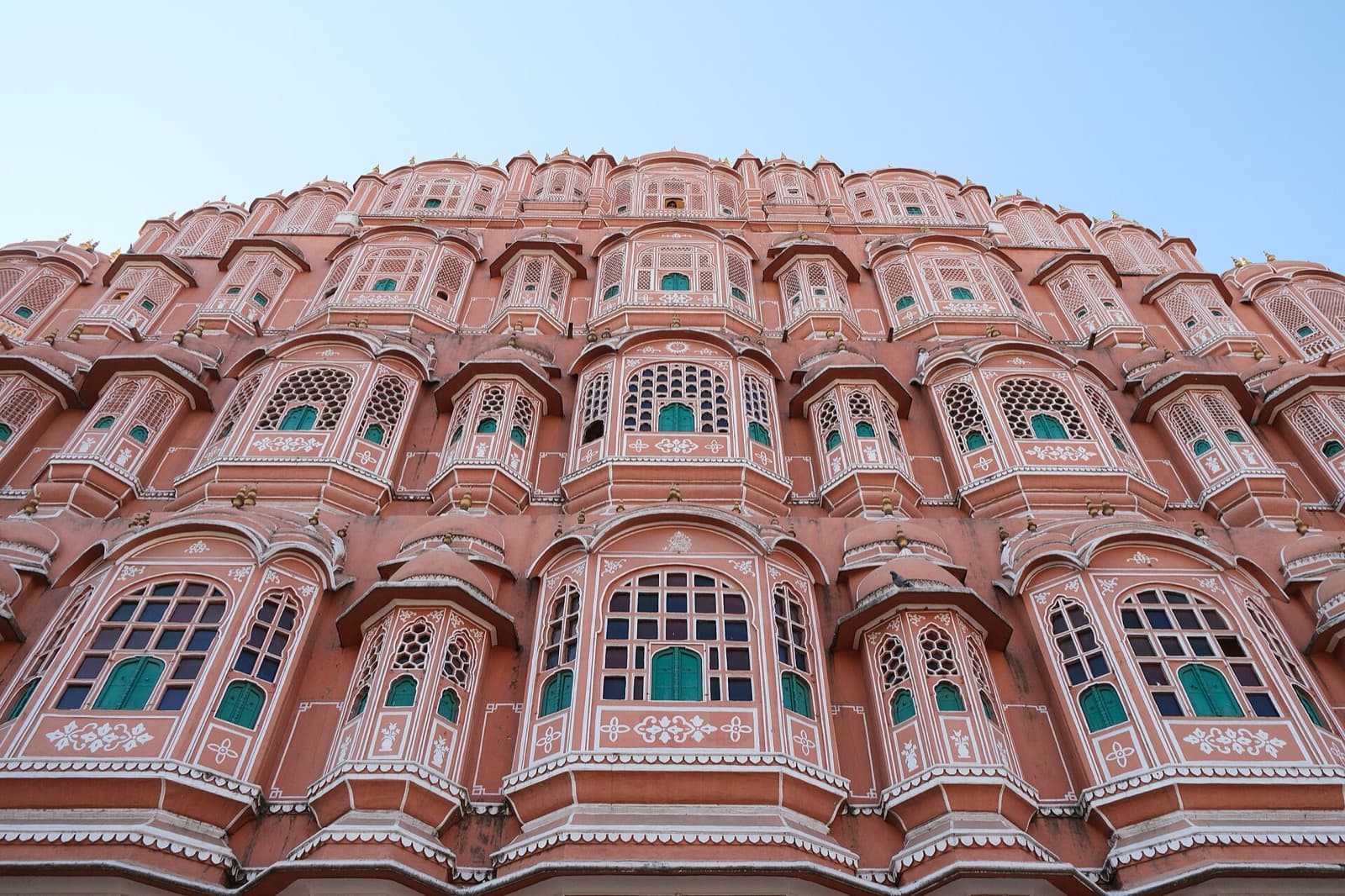
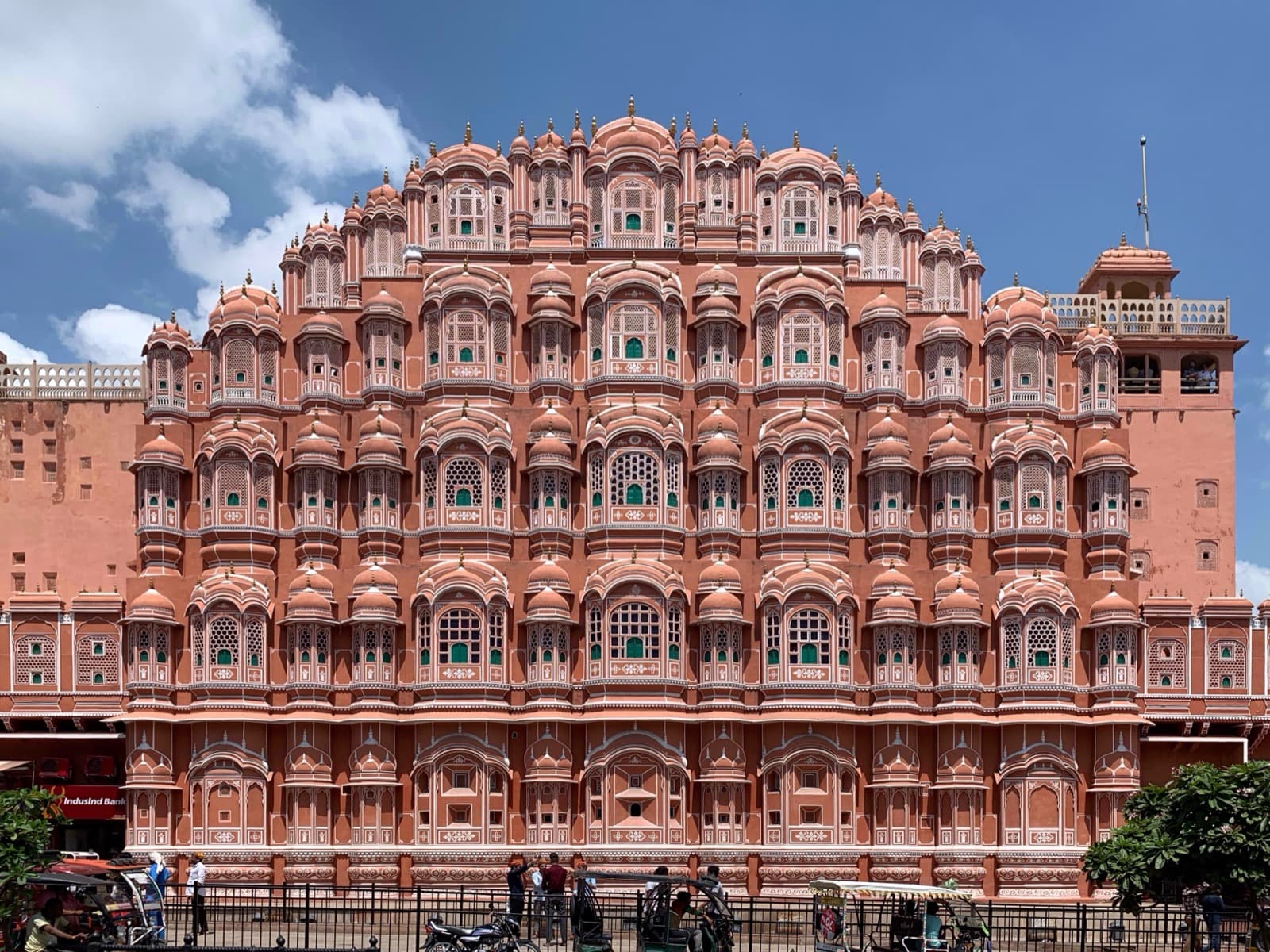
Hawa Mahal, the Palace of Winds, is the face everyone photographs in Jaipur, and its street-facing screen of 953 small lattice windows was built for a single practical reason: so royal women living in seclusion could watch the everyday life of the street below without ever being seen themselves. That one-way window is the best place to begin understanding the whole Pink City, because the same mind that framed those hundreds of tiny openings also framed the streets they look out over. Jaipur was drawn before it was built, laid out as a grid you can walk and read one clause at a time, and Hawa Mahal is where that logic becomes personal.
A wall that is not a wall
The building went up in 1799, commissioned by Maharaja Sawai Pratap Singh and designed by an architect named Lal Chand Ustad. It rises five storeys in red and pink sandstone, and the elaborate facade that fills postcards is not really a wall at all. It is a honeycomb. Each of those 953 openings is a jharokha, an overhanging screened balcony, and together they turn a solid front into a stone lattice.
The purpose was social. The royal women of the palace lived following the custom of purdah, kept from public view. Behind this screen they could sit and watch the vendors, the crowds, and the festival processions moving through the street below. The city looked in, the women looked out, and the lattice kept the exchange strictly one direction. There is a second gift folded into the same design: all those tiny apertures pull air through the building in a steady cooling breeze, the natural ventilation that gave the palace its name.
One quiet fact tends to reorganize how people see the place. The famous screen everyone crowds across the road to photograph is actually the back of the building. The real entrance is around on the City Palace side. You can admire the full facade for free from the street, or step inside with a ticket to look out from behind the lattice the way the women once did. Either way, standing across the road and watching light move over those hundreds of windows is the free version, and it is the one that matters most.
The window explains the grid
Hear a stop from this walk
Johari Bazaar: The Street of Jewels That Proves the Plan
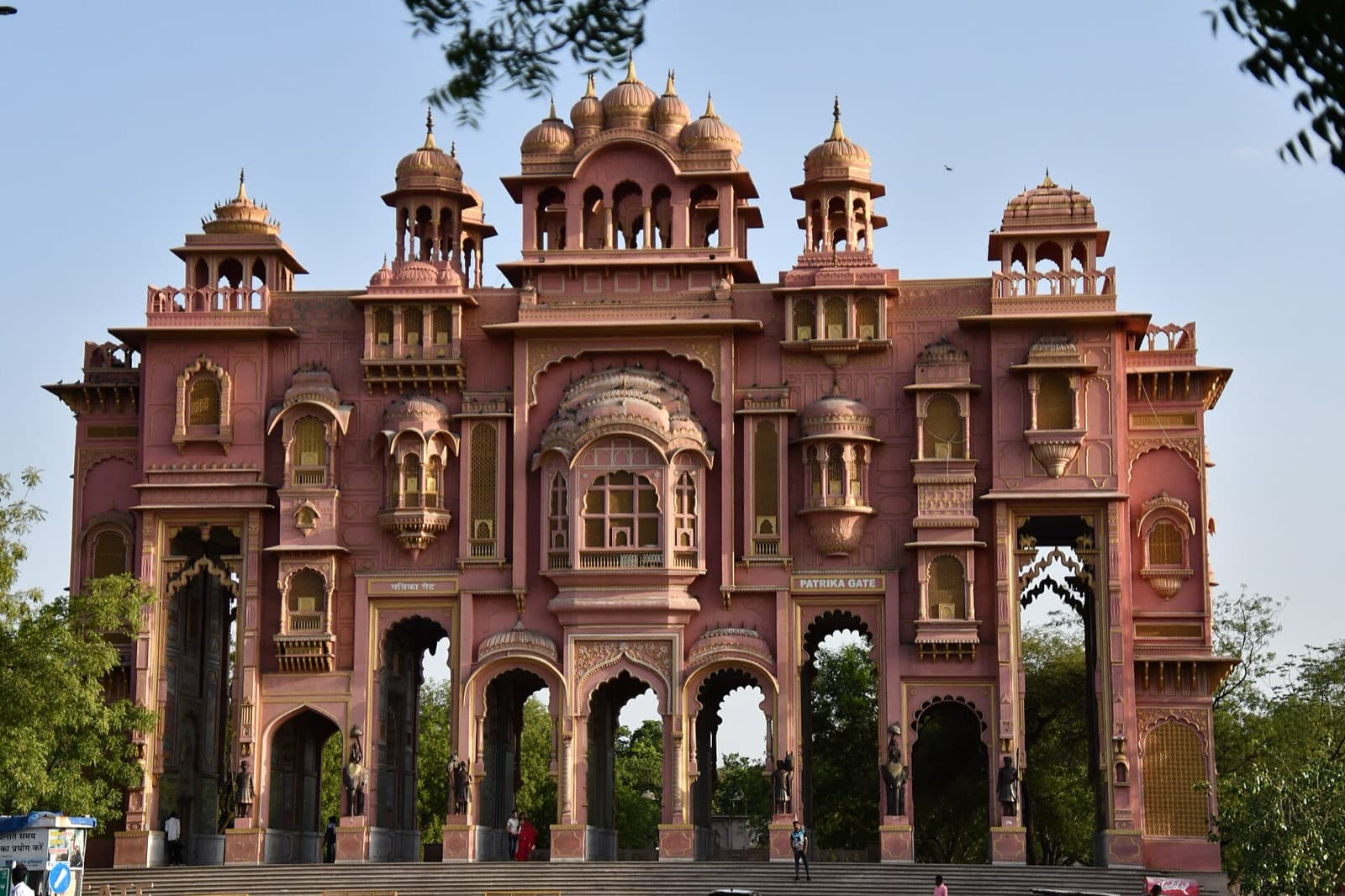
Here is why Hawa Mahal is the right doorway into the rest of the walk. The impulse behind it, the desire to watch and order a city from within a designed frame, runs straight through Jaipur's founding. In 1727, Maharaja Sawai Jai Singh the Second, a Kachhwaha Rajput ruler who was both a warrior and an astronomer, moved his capital about eleven kilometres down from the old hill fortress of Amber as its population outgrew the water there. He did not let the new city sprawl. His planner, Vidyadhar Bhattacharya, drew it first, using ancient Indian texts of town planning, laying out nine rectangular blocks in a grid, two reserved for state buildings and palaces and seven for the public, with bazaars roughly thirty-four metres wide cutting straight through. A wall enclosed all of it, pierced by gates.
The pink came later. In 1876, Sawai Ram Singh the Second ordered the old city painted a warm terracotta pink to welcome the visiting Prince of Wales, and the color was kept afterward by law. UNESCO inscribed the walled city as a World Heritage Site in 2019. So the screen of Hawa Mahal is not an ornament stuck onto a random town. It is one detail in a place built as a single designed object, and once you see the building as a frame for watching, the streets read as the thing being watched.
Reading the rest of the sentence
The self-guided walk that includes Hawa Mahal treats the whole grid as a text, and each stop is a clause. If you want the argument laid out plainly, the Jaipur walking tours hub gathers the routes across the old city.
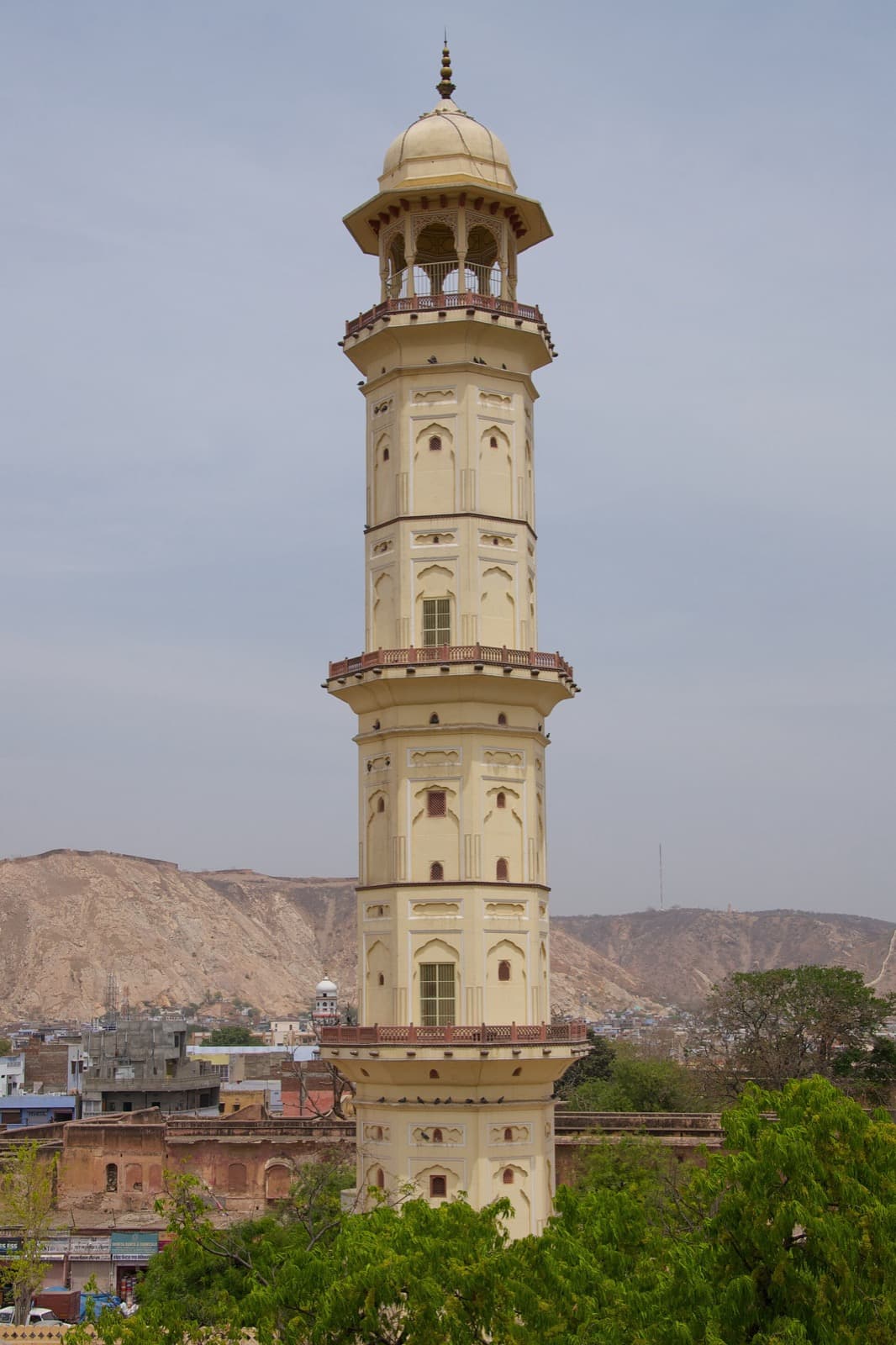
A short way from the palace stands the Iswari Minar, a tall plastered minaret raised around 1749 by Iswari Singh, a son of the city's founder, beside the ceremonial Tripolia Gate above one of the main market streets. A spiral ramp inside leads to a rooftop, and from up there the whole logic of the city becomes visible at once: the honeycomb of Hawa Mahal, the sprawl of the City Palace, the straight bazaars running away in their grid, and the distant outline of Nahargarh Fort on its hill. What reads as a maze at street level resolves into a diagram from the top.
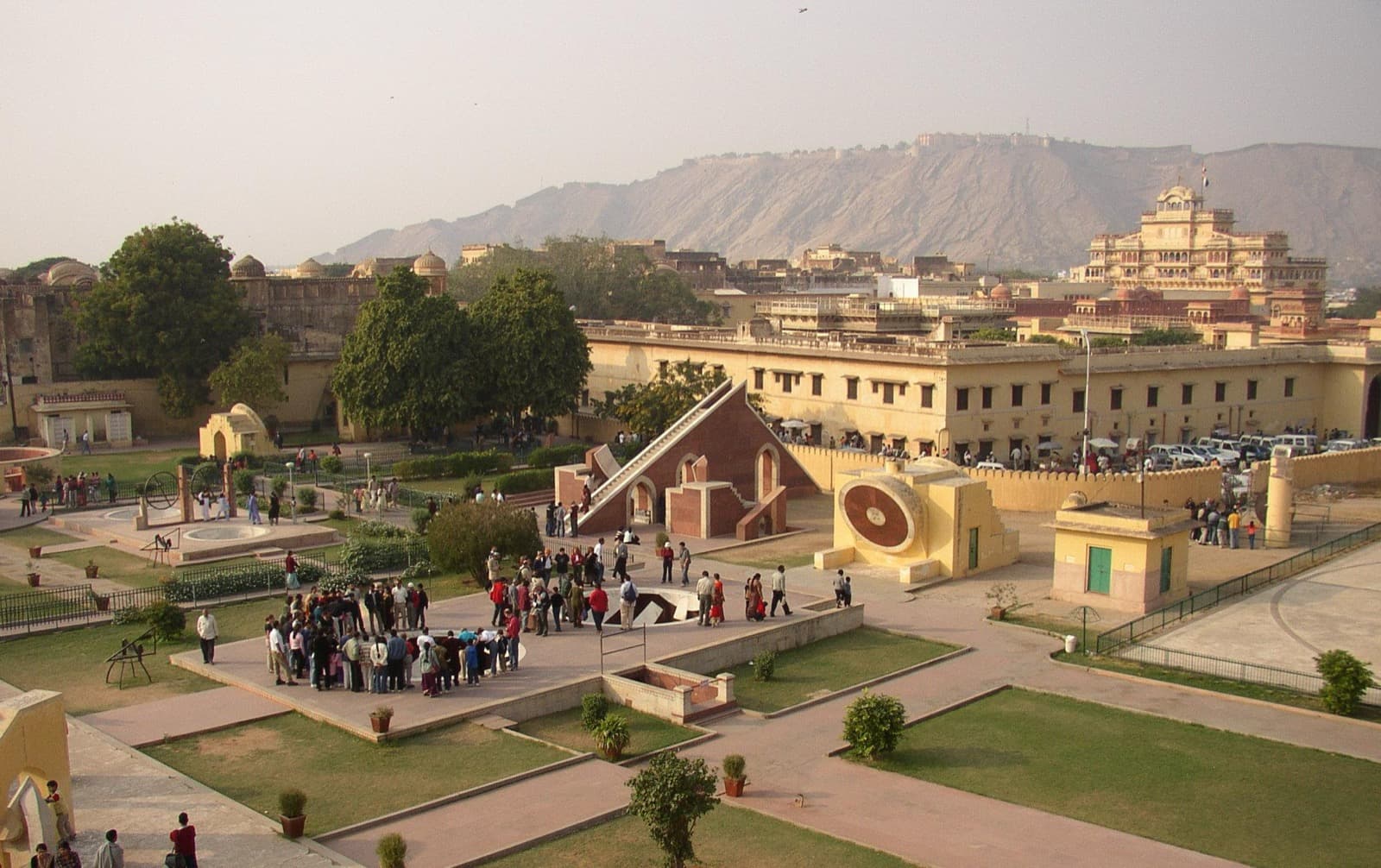
Then there is Jantar Mantar, where Jai Singh's real preoccupation shows through most clearly. Between about 1728 and 1734 he built a field of nineteen astronomical instruments, made not of brass but of stone and plaster, at enormous scale. The centerpiece, the Vrihat Samrat Yantra, is a sundial standing about twenty-seven metres tall, roughly the height of an eight-storey building. By the observatory's own account it tells Jaipur's local time to within about two seconds, and if you stand and watch, the shadow moves about a millimetre a second across the masonry. Jai Singh built several such observatories, but UNESCO records this one as the largest and best-preserved. It was inscribed as a World Heritage Site in 2010.
The City Palace sits at the grid's center, laid out by the same Vidyadhar Bhattacharya, its Chandra Mahal rising seven floors and still, to this day, the residence of the Jaipur royal family. Seek out the small inner courtyard called Pritam Niwas Chowk, where four painted gateways stand for the four seasons, including the brilliant blue and green Peacock Gate for autumn. Behind the palace, in the Jai Niwas garden, the Govind Dev Ji temple holds a form of Krishna; by a much-loved local tradition, Jai Singh placed the deity so he could see the god from his own palace window across the way.
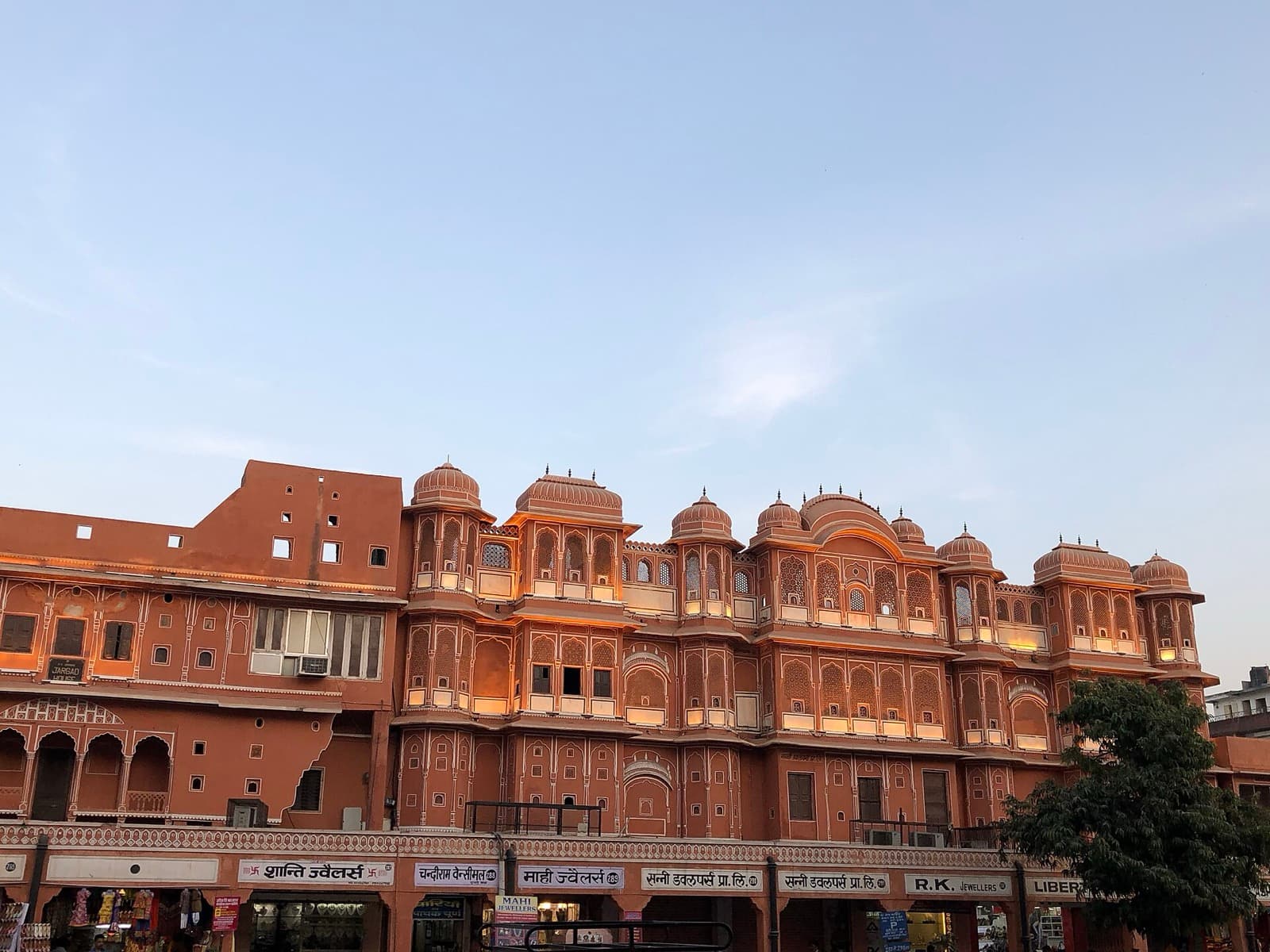
The walk closes at Johari Bazaar, the jewellers' street, where an ancient trade still keeps to its assigned place. UNESCO cites the chattis karkhanas, the thirty-six industries each historically given its own street, and the jewellers are still here, in the street named for jewellers, nearly three hundred years after the plan put them there. That is the whole point Hawa Mahal introduces: a city drawn like a diagram and sorted by trade did not become dead or mechanical. Order framed the life instead of killing it.
This is one of India's most tout-heavy quarters, thick with guides and hawkers, which is exactly why walking it yourself works well. Go at your own pace, cross the road when you want the full facade, and read the city the way its women once read the street: quietly, and on your own terms. Start from Jaipur and let the grid unfold.
Sources
- Hawa Mahal, Wikipedia. Construction date, architect Lal Chand Ustad, the 953 jharokha windows, and the purdah and ventilation functions of the screen.
- Jaipur City, Rajasthan, UNESCO World Heritage Centre (2019 inscription). The 1727 founding, the grid of nine blocks, and the chattis karkhanas of the walled city.
- The Jantar Mantar, Jaipur, UNESCO World Heritage Centre (2010 inscription). The nineteen masonry instruments and the site's standing as the largest and best-preserved of Jai Singh's observatories.
- City Palace, Jaipur, Wikipedia. Vidyadhar Bhattacharya's plan, the seven-floor Chandra Mahal, and the four seasonal gates of Pritam Niwas Chowk.
- Incredible India, Government of India, Hawa Mahal and Govind Dev Ji temple pages. Visitor context for the palace facade and the Krishna temple in the Jai Niwas garden.
Ready to experience it?
Pink City: The Walled Bazaar Grid
90 min · 4 km · moderate
More from Jaipur
Explore more at your own pace.
Jaipur Travel Guide: Days, Transport, Costs, Timing, and Safety
One Day in Jaipur: A Walkable Pink City and Amber Fort Itinerary
Jaipur: The City That Was Drawn Before It Was Built
Amber Fort's Sheesh Mahal: Why One Candle Becomes a Galaxy
Jantar Mantar, Jaipur: The Astronomer-King's Instruments in Stone