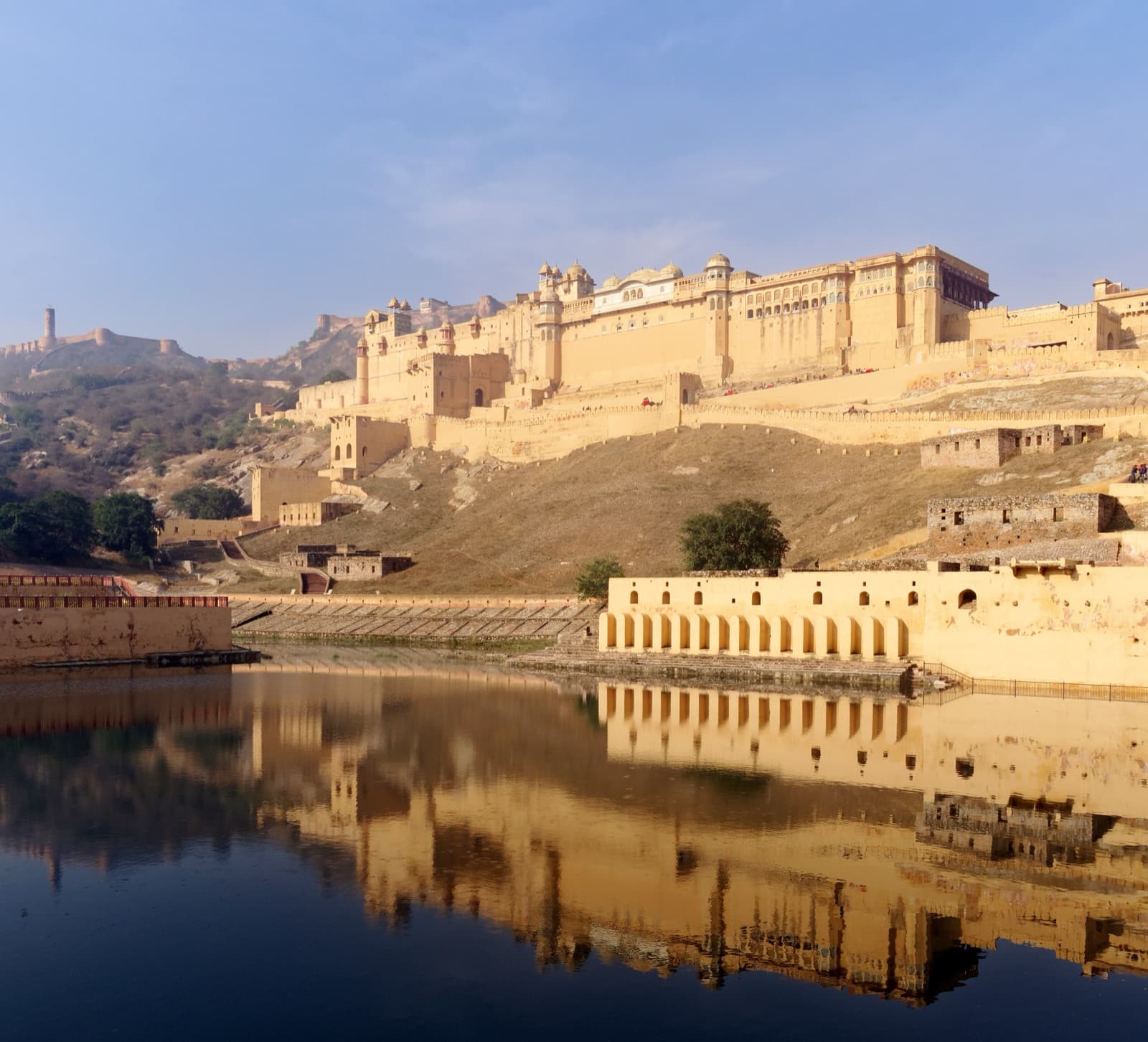
The Amber Fort is not one building but a sequence. The Kachhwaha Rajput kings raised this pale sandstone and marble hill-palace above a lake in Rajasthan, and they arranged it as a climb: from a great military courtyard by the water, through a warrior goddess's shrine and a hilltop hall of audience, up through a painted gate into the private palace, and finally into the Sheesh Mahal, the Mirror Palace, a darkened chamber whose walls turn a single flame into a whole sky of stars. That last room is the argument the entire hill has been making. To understand why people climb it, start with the Sheesh Mahal and read the tour backward from there.
The room the climb builds toward
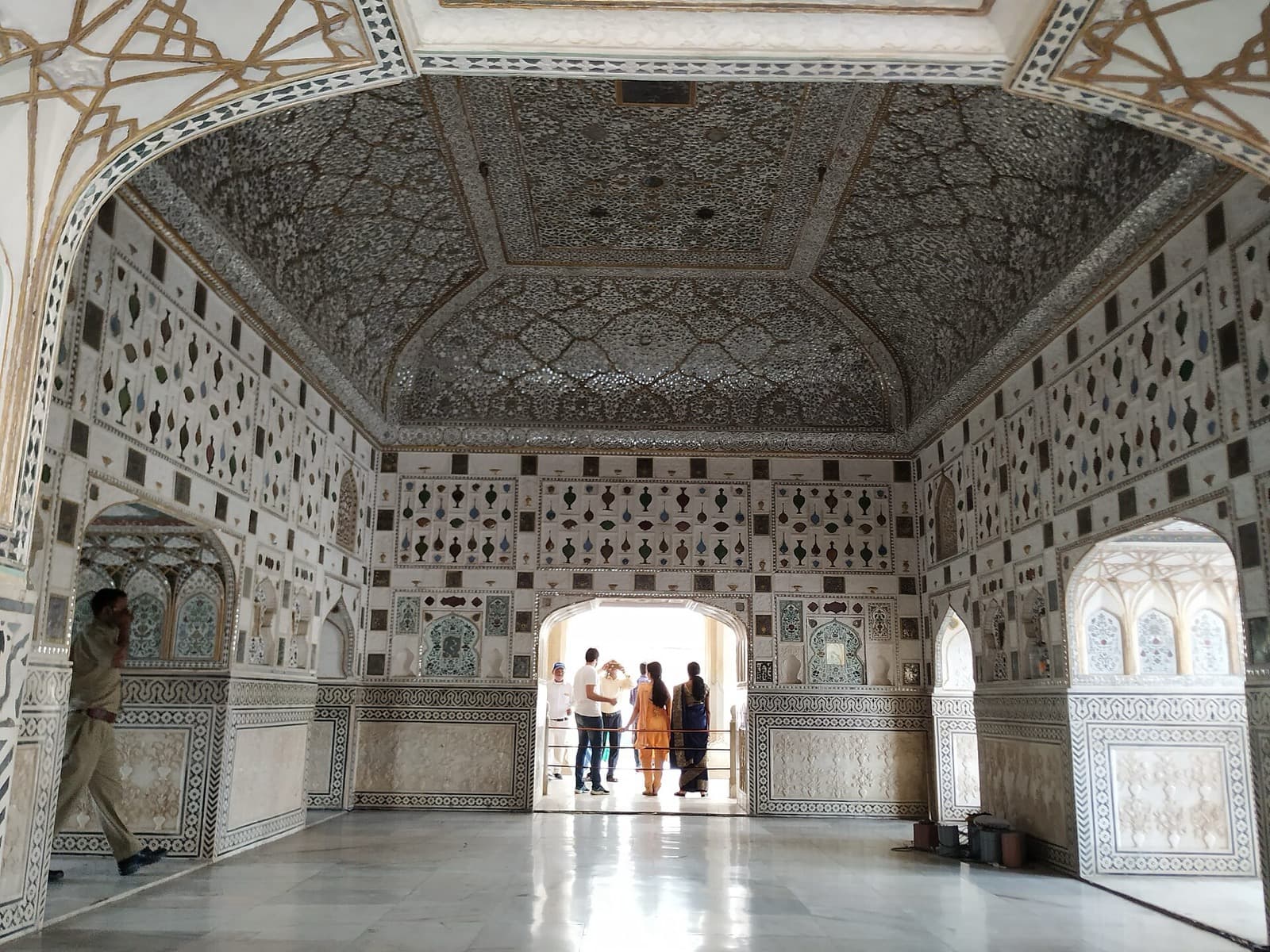
The Sheesh Mahal adjoins the Jai Mandir, the Hall of Victory, the private audience chamber that sits just behind the palace's most beautiful gate. Its walls and vaulted ceiling are covered, edge to edge, in thousands of tiny mirror pieces and fragments of colored glass, set into plaster in a technique called ainakari, mirror-work. The mirrors are convex, each a small curved surface, worked together with colored foil and paint so the whole surface glitters.
The room was never meant to be seen in daylight. Carry a single candle or lamp into the darkened chamber, and every mirror at once catches and throws back that one small fire, scattering a flame into a galaxy across the ceiling and walls. It has been described as a glittering jewel box in flickering candlelight. This is a private night sky built for kings, engineered from glass and plaster and one flame.
There is an honest gap here that the tour keeps, and it is worth keeping. Sources disagree on who finished the room. Some credit Raja Man Singh the First in the sixteenth century, most credit Mirza Raja Jai Singh the First in the seventeenth. The safest reading is to call it a royal apartment of the Kachhwaha kings and let the mirrors speak for themselves. That refusal to invent a tidy attribution is a good measure of how the whole walk treats its material.
Why the anchor needs the whole hill
Hear a stop from this walk
The Sukh Niwas, the Zenana and the Panna Meena ka Kund: The Cooled Court and the Stair-Well Below
The Sheesh Mahal is a marvel on its own, but its meaning is architectural, and architecture is sequential. You feel the mirror room fully only because of what you passed through to reach it. That is the case for walking the entire route rather than photographing the ceiling and leaving.
The climb opens at the Suraj Pol, the Sun Gate, the main eastern entrance, which opens onto the Jaleb Chowk, the wide first courtyard where the returning army once gathered. Troops home from a campaign assembled here to be reviewed by the king, horses and elephants and men filling the paved expanse. Below the fort lies the Maota lake, which supplied water to both fort and town, with a garden island at its center called the Kesar Kyari Bagh, the saffron garden. The palace grew out of that relationship between stone and water: a defensible height with a reliable lake at its foot. UNESCO inscribed Amber Fort in 2013 as one of the six Hill Forts of Rajasthan.
Off that first courtyard stands the Shila Devi temple, shrine of the Kachhwaha family goddess, a form associated with Durga and in popular devotion sometimes with Kali, worshipped by warrior kings before battle. The name comes from shila, a stone slab, because the idol is carved from a single piece of black stone. The temple was established by Raja Man Singh the First, who reigned from 1589 to 1614, and the idol was installed on the sixth day of Navratri in 1604. A legend holds that Man Singh carried the black idol from Bengal after a campaign, but historians treat that origin as tradition, not documented fact, so the tour holds it lightly. The shrine is entered through finely worked silver doors and remains an active place of worship.
Reading a king in stone
Higher up is the Diwan-i-Am, the Hall of Public Audience, where the raja sat in the open to hear ordinary people's petitions. Count the colonnade and you find twenty-seven bays, each column topped with a carved capital shaped like an elephant, galleries running above, the columns a mix of red sandstone and white marble. A Mughal emperor gave audience in a walled hall of state. Here the Rajput kings built their own reading of that idea as an airy pavilion left open on its sides, looking straight out over the courtyards and the folded ridges of the Aravalli hills. It is a place built to make authority feel accessible and elevated at once.
Then the threshold: the Ganesh Pol, the Gate of Ganesha, considered the most beautiful gate at Amber and built at the orders of Mirza Raja Jai Singh the First in the mid-seventeenth century. Three levels high, its whole face alive with frescoes in mineral pigments, the gate is named for the elephant-headed god of good beginnings, whose image sits above the central arch. It divided the public palace from the private royal quarters. Above it runs a latticed gallery, the Suhag Mandir, screened with marble jali, perforated stone cut into fine patterns, from behind which royal women living in the seclusion of purdah could watch ceremonies below without being seen. Pass through the Ganesh Pol and you leave the public fort behind. The Sheesh Mahal waits just inside. By the time you reach the mirrors, you have already learned the palace's grammar of public and private, seen and unseen. The room lands because you climbed to it.
Water, and the walk down
The route closes on three quieter marvels of comfort. Facing the Sheesh Mahal across the garden courtyard is the Sukh Niwas, the Hall of Pleasure, with an open channel of water running straight through it; cool air moving over that water kept the room, in the site's own words, as pleasant as an air-conditioned environment. This was early air-conditioning built from water, marble, and shade. Nearby is the zenana, the women's quarters, part of the Man Singh palace, which took twenty-five years to build and was completed in 1599 under Raja Man Singh the First.
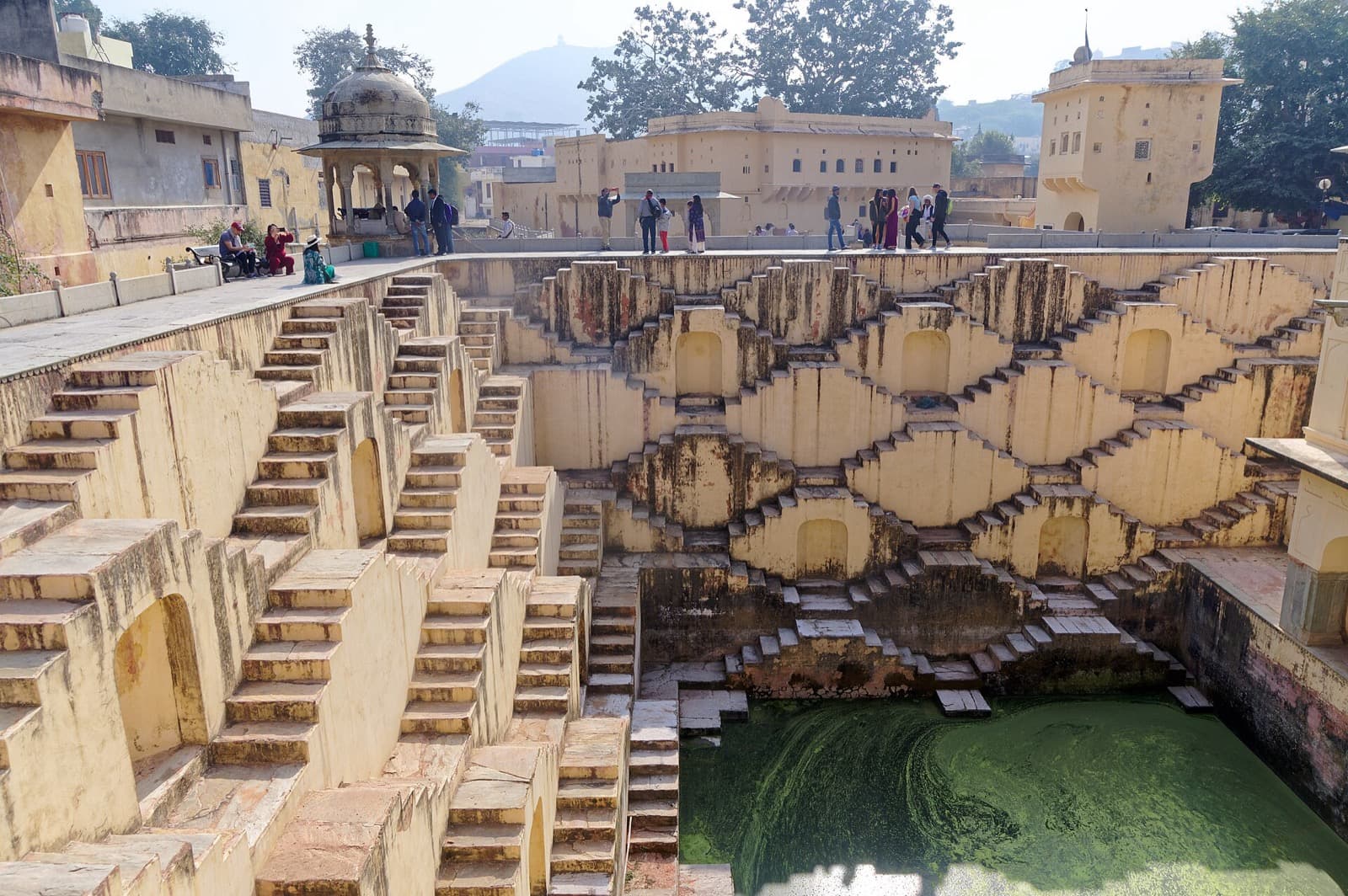
The story of water does not stop at the fort wall. About a kilometre north, in the town below, stands the Panna Meena ka Kund, a stepwell where symmetrical flights of stairs crisscross down three sides in a strict geometric pattern, with small octagonal pavilions called chhatris at the corners. Generally dated to the sixteenth century, it was built to harvest rainwater and serve the community, and it is free to visit. From a king's private galaxy of mirrors to a village well of crossing stairs, this hill and its town were, first and last, a masterpiece of catching water and light.
Walk it on your own clock
Amber Fort sits about eleven kilometres north of the Pink City, a short taxi or auto-rickshaw ride from the center, and it is one of India's most crowded monuments, thick with guides steering groups and touts steering shoppers. A good local guide here is genuinely fine company. What the self-guided walk trades away is only the scheduled-group format and the commercial pressure, so you can climb at your own pace, linger under the mirrors as long as you like, or press on. To plan the wider visit, browse more Jaipur walking tours and the full Jaipur city guide, then reach the Suraj Pol early, right at opening, and start the climb.
Sources
- Amber Fort, Wikipedia. General history of the Kachhwaha hill-palace, its courtyards, gates, and the Sheesh Mahal.
- Hill Forts of Rajasthan, UNESCO World Heritage Centre (List 247). Confirms the 2013 inscription of Amber Fort among the six Rajput hill forts.
- Shila Devi, Wikipedia. The family goddess shrine, Raja Man Singh the First, the 1604 Navratri installation, and the Bengal-origin tradition treated as legend.
- Panna Meena ka Kund, Wikidata (Q97119522). The stepwell in Amer town below the fort, its symmetrical stairs and corner chhatris.
- Roamer tour transcript, "Amber Fort: Hillfort of the Kachhwahas." Fact-audited stop-by-stop narration and site details used throughout.
Ready to experience it?
Amber Fort: Hillfort of the Kachhwahas
90 min · 1.5 km · moderate
More from Jaipur
Explore more at your own pace.
Jaipur Travel Guide: Days, Transport, Costs, Timing, and Safety
One Day in Jaipur: A Walkable Pink City and Amber Fort Itinerary
Jaipur: The City That Was Drawn Before It Was Built
Hawa Mahal: The Honeycomb Window Onto Jaipur's Grid
Jantar Mantar, Jaipur: The Astronomer-King's Instruments in Stone