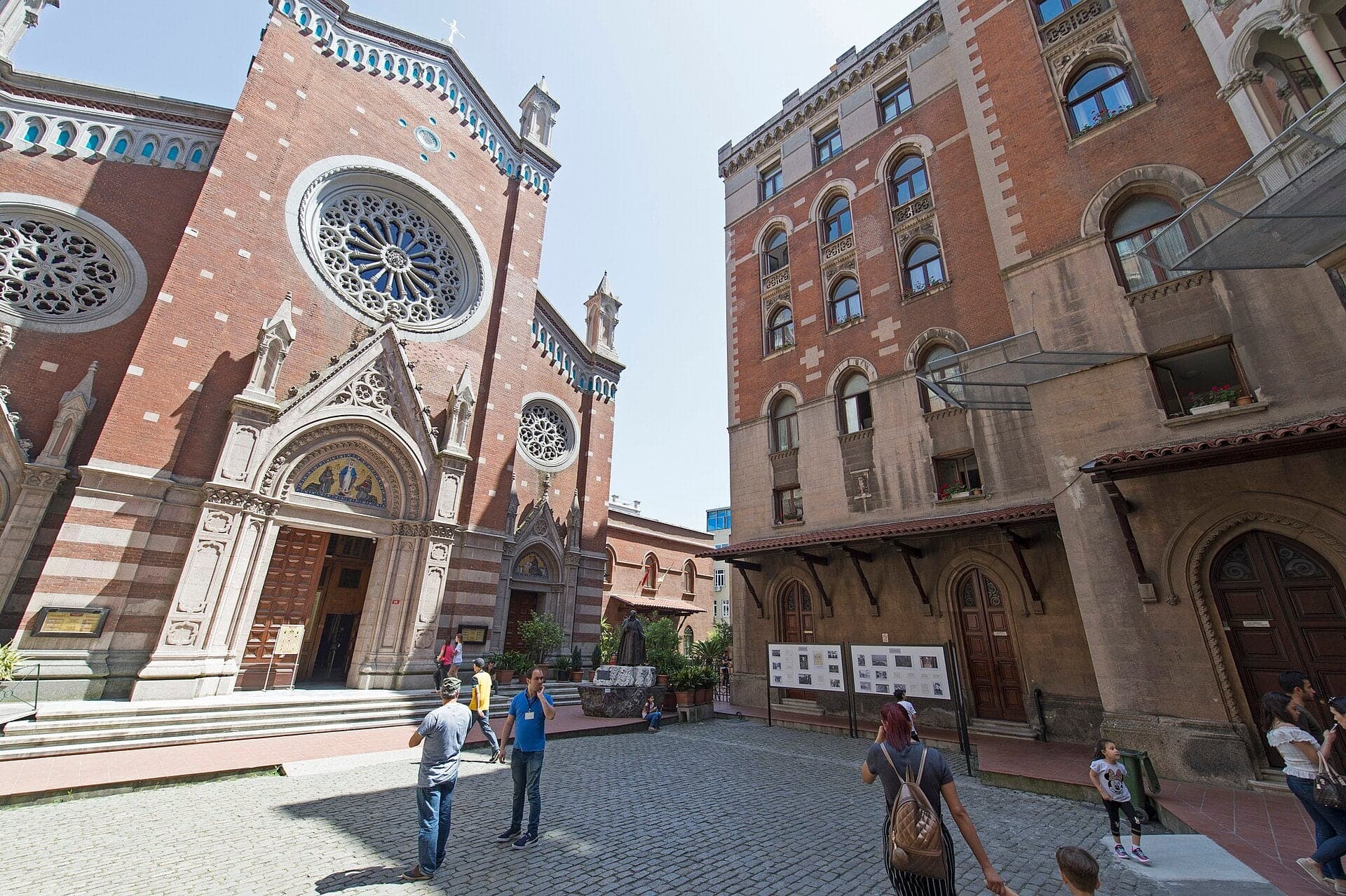
Set back from Istiklal Avenue behind an arched gateway and a courtyard, the Church of Saint Anthony of Padua is one of the largest Roman Catholic churches in Istanbul, and it opens the door to a layer of the city most visitors never read. This is the merchant, banking, European Istanbul of Galata and Pera, the hill across the Golden Horn where Greeks, Armenians, Jews, Italians, and Ottomans built their houses of worship side by side. The famous peninsula of Hagia Sophia and the great mosques is the city of one dominant faith and dynasty. This hill was deliberately the plural city. A single church on a crowded avenue is the clearest way into that whole story.
A church that hides in plain sight
The building you see went up between 1906 and 1912, neo-Gothic in red brick, designed by the architects Giulio Mongeri and Eduardo de Nari. The church itself describes its front as following the Tuscan-Lombard style of the fourteenth century. It replaced an earlier church of Saint Anthony that the Franciscans had built and consecrated in Pera in 1724, and the reason for the rebuild is the best detail of all: the old church had to be demolished to make way for a new tramway line. Work on the new one started in 1906, stopped the next year for lack of money, resumed in 1910, and the church was consecrated on 15 February 1912. That double date matters. It tells you this was not a single monument dropped onto the avenue but a congregation that had held its place here for nearly two centuries before the street itself pushed it back.
There is a detail worth carrying inside with you. The future Pope John the Twenty-third, then Angelo Roncalli, served as the Pope's envoy in Turkey from 1935 to 1944, and on the feast of Saint Anthony in 1940 he read a prayer in this church. Long before he was elected pope, he was a working diplomat in this quarter, and the church he prayed in was one node in a diplomatic and merchant world that stretched across the whole hill.
This is a working parish, not an exhibit. It is usually open to visitors outside Mass; if you step inside, dress modestly and keep quiet. But the reason to pause is larger than the walls. Look at how the church sits: not on a grand civic axis but folded behind a courtyard, about forty metres back, framed by a pair of red-brick street blocks. That is how the plural city survives here, at the upper floors and behind the gateways, above the modern signage.
The layer the postcards leave out
Hear a stop from this walk
Taksim Square: The House That Divided the Water
For centuries Galata and Pera held Roman Catholic churches like this one, Greek Orthodox and Armenian churches, synagogues, and mosques, all within a short walk of one another. That is the layer the imperial story tends to skip. The merchant and diplomatic character of the quarter made it so. Traders and embassies of many origins needed their own institutions, and they got them, clustered on a single steep hill.
Saint Anthony of Padua is the way in because it is legible and central, right on the avenue. But it is one stop on a route built to read the whole plural city in stone, and the argument only lands when you walk the sequence. You can plan that walk from the Istanbul walking tours hub, which gathers the self-guided routes across the city.
Where the church sits on the walk
The tour begins at the bottom, on the Galata Bridge, looking across the water at "the other side", which is what the Byzantines meant by Pera. One block up runs Bankalar Caddesi, Banks Street, once Voyvoda Caddesi. The Ottoman Bank's head office, designed by Alexandre Vallaury and opened in 1892, is now SALT Galata, a free research library and exhibition space. It has two faces: the classical front you see from the street, and an Ottoman-style face turned to the old city across the water. Beside it, the Camondo Stairs climb the slope, named for the Camondo family of Sephardic Jewish bankers who built much of this quarter. Henri Cartier-Bresson photographed people on those steps in 1964.
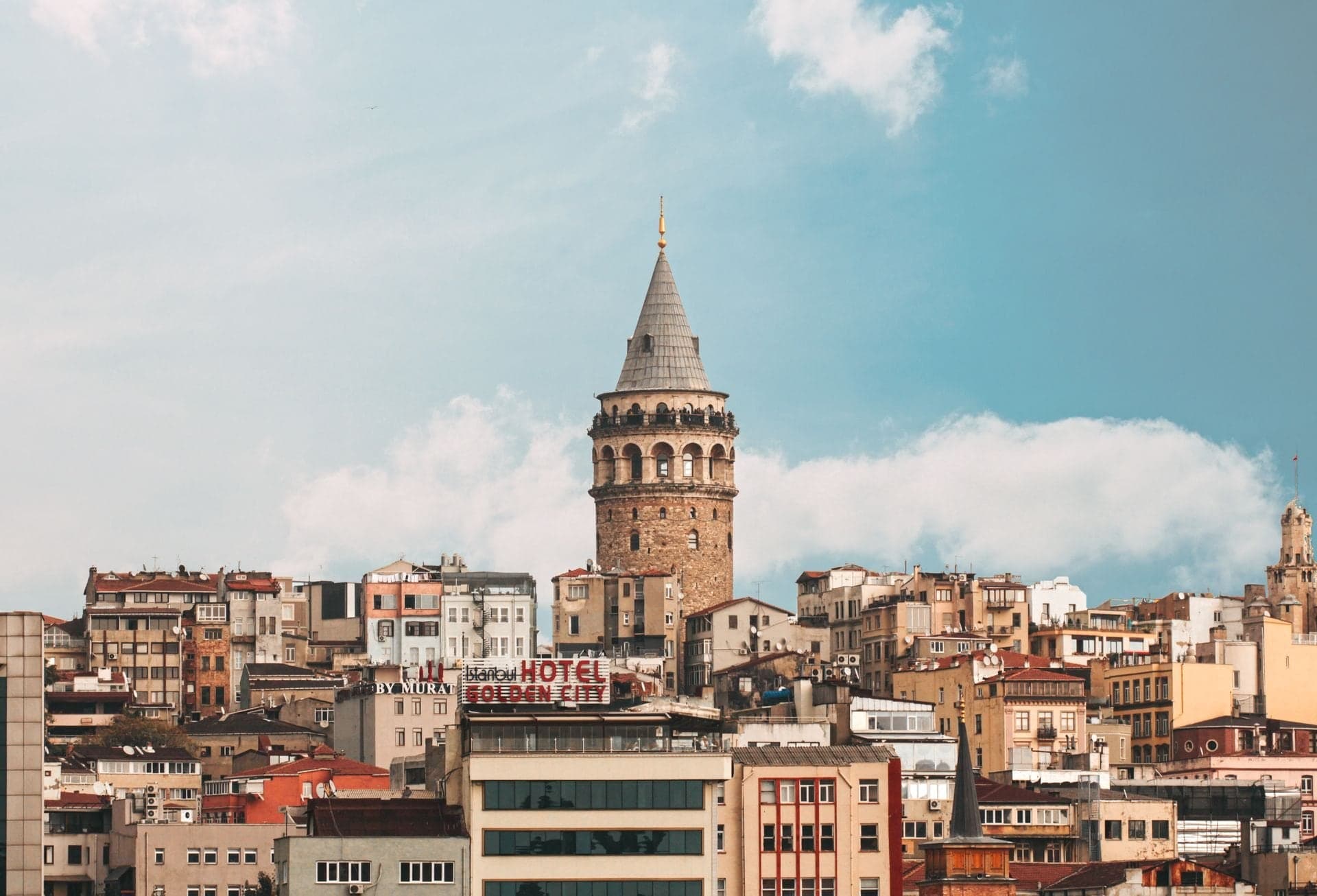
Then the climb. The Galata Tower, which the Genoese built in 1348 at the top of their walled town and called the Christea Turris, the Tower of Christ, is the third stop. Above it, on steep Galip Dede Caddesi, stands the Galata Mevlevi Lodge, founded in 1491 by Iskender Pasha and the oldest lodge of the Mevlevi order in the city, where whirling dervishes performed the sema until the Republic closed the lodges in 1925. It has been a museum since 1975. At the top of the hill, Tunel Square marks the upper station of the Tunel, the underground funicular that has carried passengers up this slope since January 1875, often called the second-oldest underground railway in the world after London's.
From there the walk follows Istiklal along the ridge. Russia's old embassy palace, designed by Gaspare Fossati and now its consulate, stands back behind its forecourt, with Narmanli Han, for decades the Russian consulate, across the avenue. Then comes Saint Anthony of Padua, the multi-faith anchor. After it, Galatasaray Square, where the great fire of 1870 burned down the avenue and stopped at the school's gates. Cicek Pasaji, the Flower Passage, was built in 1876 as the Cite de Pera for the banker Hristaki Zografos and designed by Kleanthis Zannos; it took its flower name from the florists of the years after the First World War, collapsed in 1978 and was rebuilt. The Aga Camii, founded in the 1590s, is older than the avenue around it.
The route resolves at Taksim Square. The name means division: the eight-sided stone water house of 1732, the maksem, split the water brought from the forests to the north for the quarters below, and today it is the Republic Museum. In the middle stands the Republic Monument, sculpted by the Italian artist Pietro Canonica and unveiled in 1928, commemorating the Turkish Republic founded in 1923. The plural, merchant, European hill hands over, at this square, to the republic that came after.
Walk it, don't just read it
Saint Anthony of Padua rewards a minute of quiet, but its full meaning depends on the stops around it. The church makes the plural city legible; the banking street, the tower, the lodge and the arcades prove it. The route runs eleven stops over about two and a half kilometres, roughly an hour and a half, with nearly all the climbing in the first half on stairs and steep cobbles, so wear shoes with grip and keep looking up above the shop signs where the older city survives. Start with the wider context of Istanbul, then let this hill show you the layer the postcards leave out.
Sources
- Sent Antuan, the church's own history pages (sentantuan.com): the 1221 arrival of the Franciscans, the 1724 church, its demolition for the tram line, the 1906 to 1912 rebuild, the architects, the Tuscan-Lombard front, and Angelo Roncalli's prayer in 1940.
- TDV Islam Ansiklopedisi ("Galata Kulesi", "Galata", "Galata Mevlevihanesi", "Maksem", "Galatasaray Mekteb-i Sultanisi"): the 1348 tower and the Christea Turris name, Voyvoda Caddesi, the 1491 lodge, the 1732 maksem, and the 1870 fire.
- SALT and Musee Nissim de Camondo: the Ottoman Bank and its two facades, and the Camondo family.
- IETT: the Tunel's opening in January 1875 and its rank as the second-oldest underground railway.
- IBB and Bellek Mekanlari: the Republic Museum in the Taksim maksem, and the history of Cicek Pasaji.
Ready to experience it?
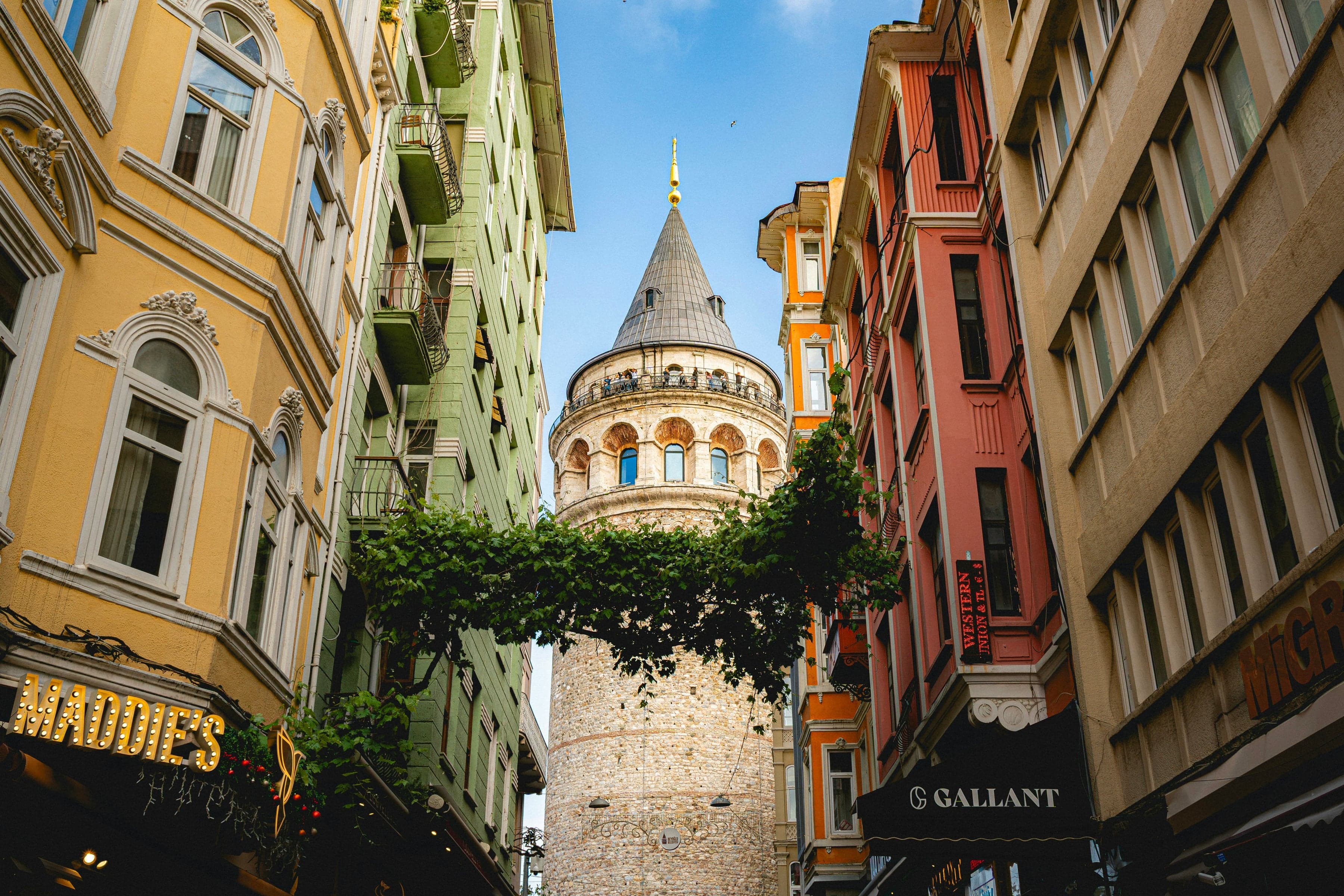
Galata Tower and Istiklal: The Climb from the Golden Horn
90 min · 2.4 km · moderate
More from Istanbul
Explore more at your own pace.
Istanbul: A City Written and Rewritten by Empires
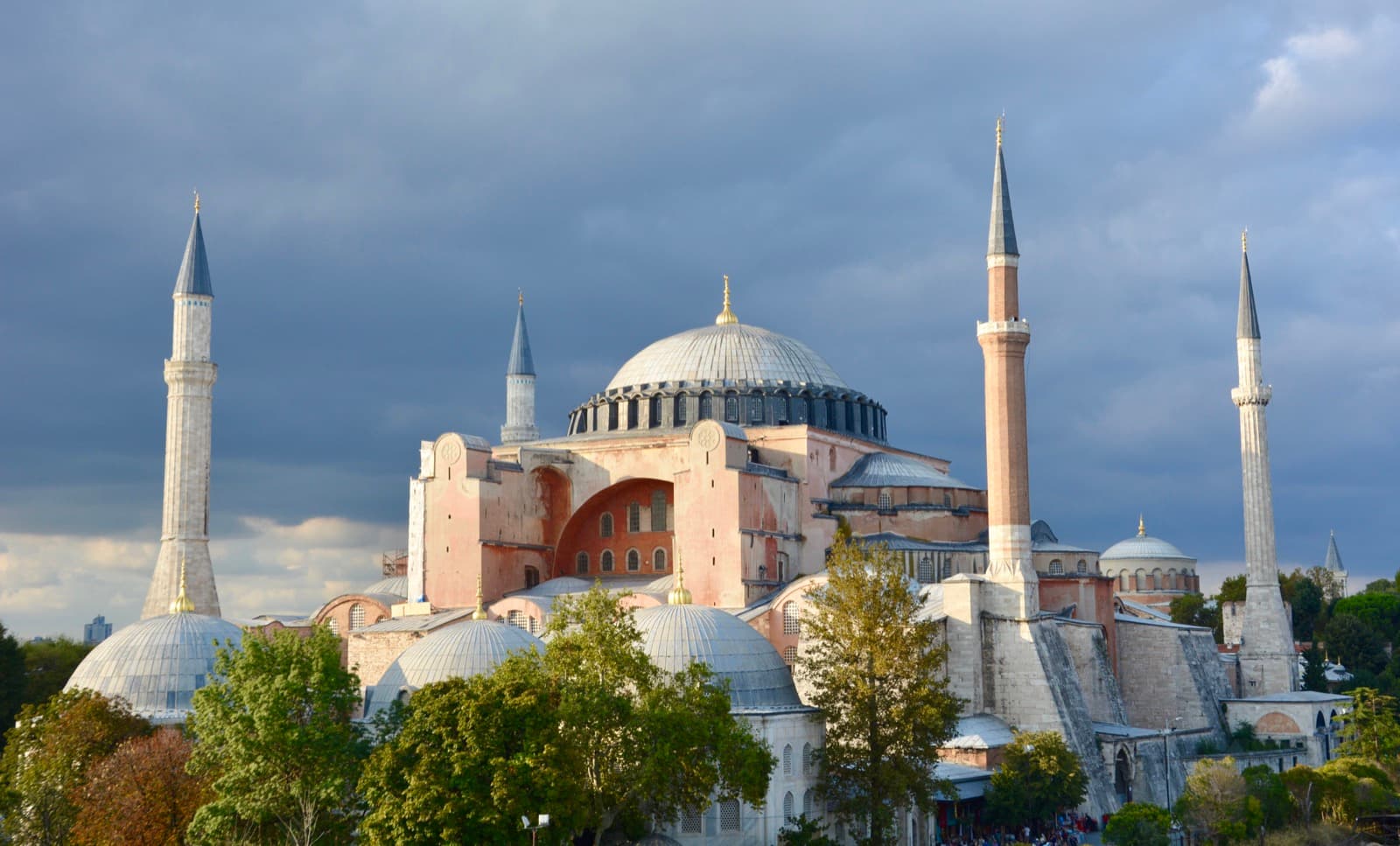
Hagia Sophia's Four Lives: How One Building Teaches You to Read Istanbul
The Grand Bazaar Is an Engine: How Istanbul's Market Paid for Its Domes
Galata Tower: The Watchtower of a Foreign City Inside Istanbul
Suleymaniye Mosque: Why Sinan's Great Complex Was Built to Pay Its Way