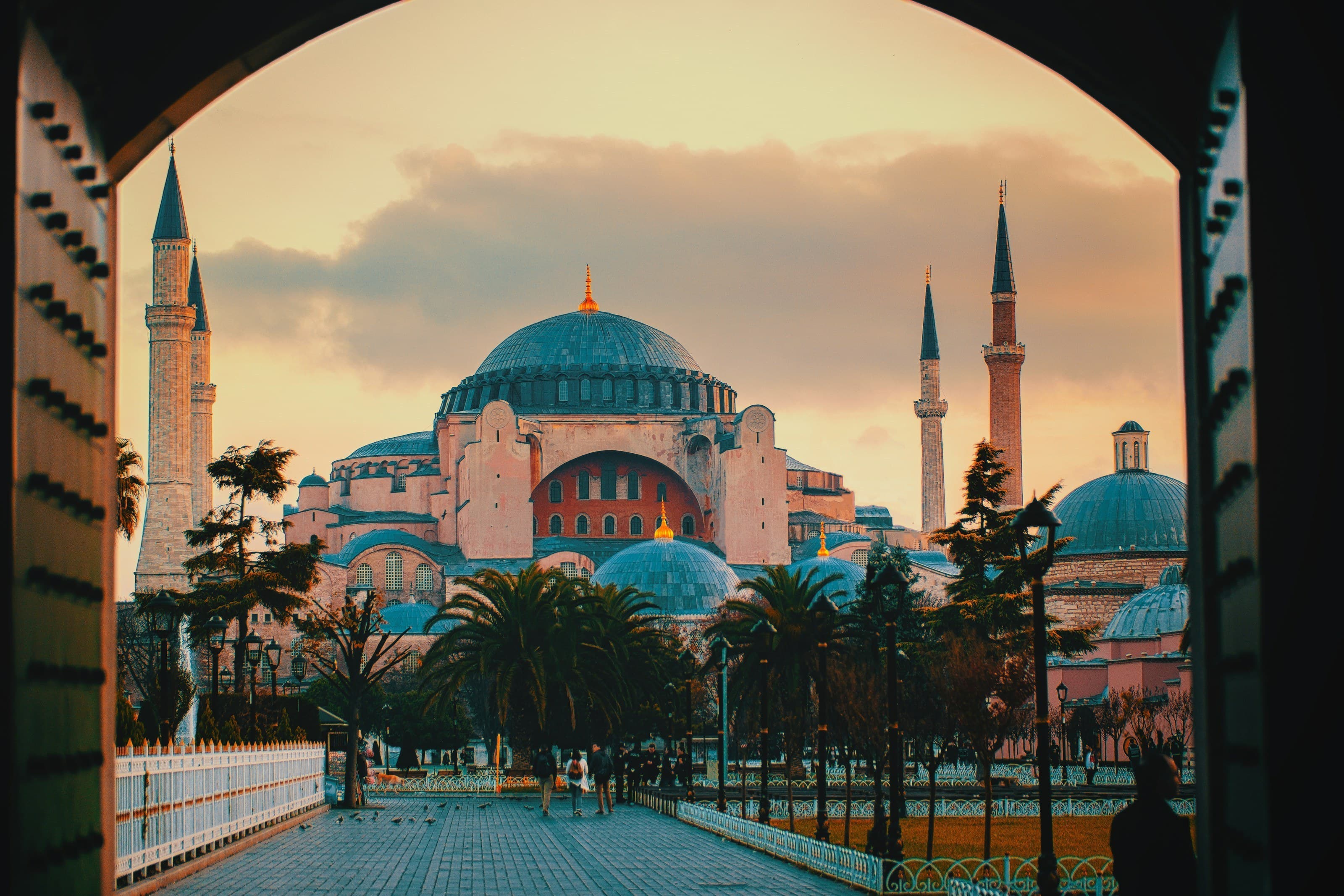
Hagia Sophia compresses the entire history of the Sultanahmet peninsula into one building. It has been a cathedral, a mosque, a museum, and a mosque again, and across every change of use most of the structure survived. That single fact, that each empire on this headland built onto what it found rather than sweeping it away, is the grammar of the whole walk. Learn to read it here, from the park in front of it, and you will read it everywhere else on the old peninsula.
The building that keeps its receipts
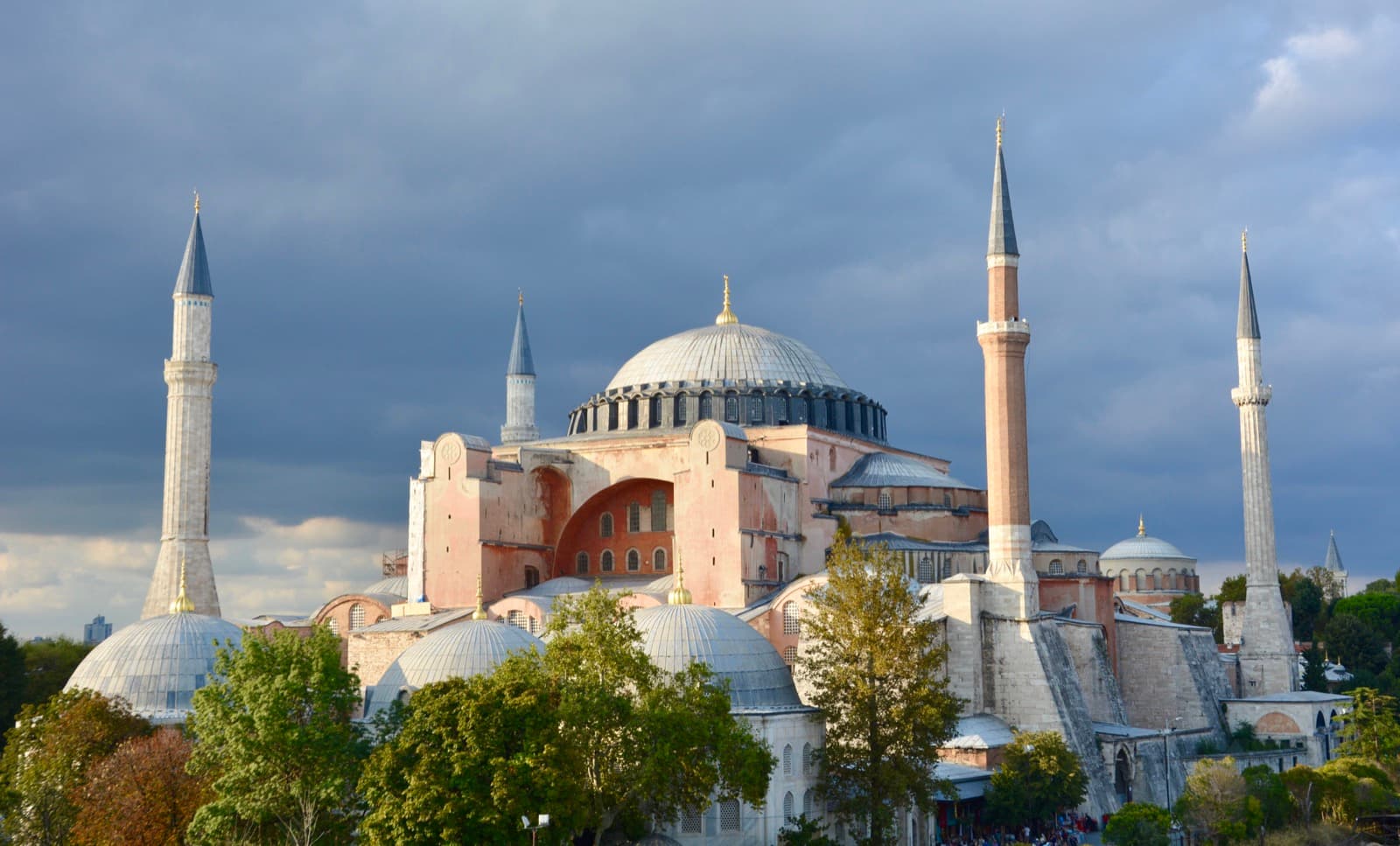
Hagia Sophia was completed as a cathedral in five hundred and thirty-seven, under the emperor Justinian the First. It went up fast: it was finished in under six years, and Byzantine tradition put the workforce at ten thousand. Its architects, Anthemius of Tralles and Isidore of Miletus, carried an enormous dome on four curved triangles of masonry, and Justinian's historian Procopius wrote that it seemed to hang from heaven rather than rest on stone. It was the largest building in Byzantine Constantinople. The current dome is not even the first. After earthquakes brought the original down in five hundred and fifty-eight, Isidore the Younger rebuilt it roughly twenty Byzantine feet higher, giving the interior a height of about fifty-five and a half metres.
Then read the sequence of its uses soberly, because it is the point. It was an Orthodox cathedral until the Ottoman conquest of fourteen fifty-three, with a Catholic interlude during the Latin Empire from twelve oh four to twelve sixty-one. After the conquest it became a mosque, and over the next century and more, minarets were added at its corners. From nineteen thirty-five it was a museum, open to Christian mosaic and Islamic calligraphy at once. In twenty twenty it was reconverted to a working mosque, which is what it is today: the floor under the dome is kept for prayer, and visitors see the interior from the upper gallery. UNESCO inscribed it as part of the Historic Areas of Istanbul in nineteen eighty-five. Four lives in one shell, nothing fully erased. Once you can see that, you have the key to the peninsula.
Rome underneath the square
Hear a stop from this walk
Little Hagia Sophia: The Empress on the Cornice
Carry the idea a few hundred metres and it keeps paying off. The long open square beside the mosques is the Hippodrome, a Roman chariot-racing circus. The first version was built around the year two hundred and three, under the emperor Septimius Severus, and Constantine the Great enlarged it after three hundred and twenty-four, as he rebuilt the city he dedicated in three hundred and thirty. At its height it ran roughly four hundred and fifty metres long and held tens of thousands of spectators. In five hundred and thirty-two the rival factions here united against the emperor Justinian in the Nika riots.
The track is gone, but the trophies Constantine and his successors gathered still stand, and they sit in pits below today's pavement. That gap is the literal depth of Rome. The Obelisk of Theodosius is an ancient Egyptian monument of the pharaoh Thutmose the Third, carved more than three thousand years ago and re-erected here in three hundred and ninety. The Serpent Column was probably cast from Persian bronze captured after the Battle of Plataea in four hundred and seventy-nine B C, and stood at Delphi before Constantine moved it here. This is the same reuse you read at Hagia Sophia, only now you are looking down instead of up.
The Ottoman reply, and a cistern of borrowed columns
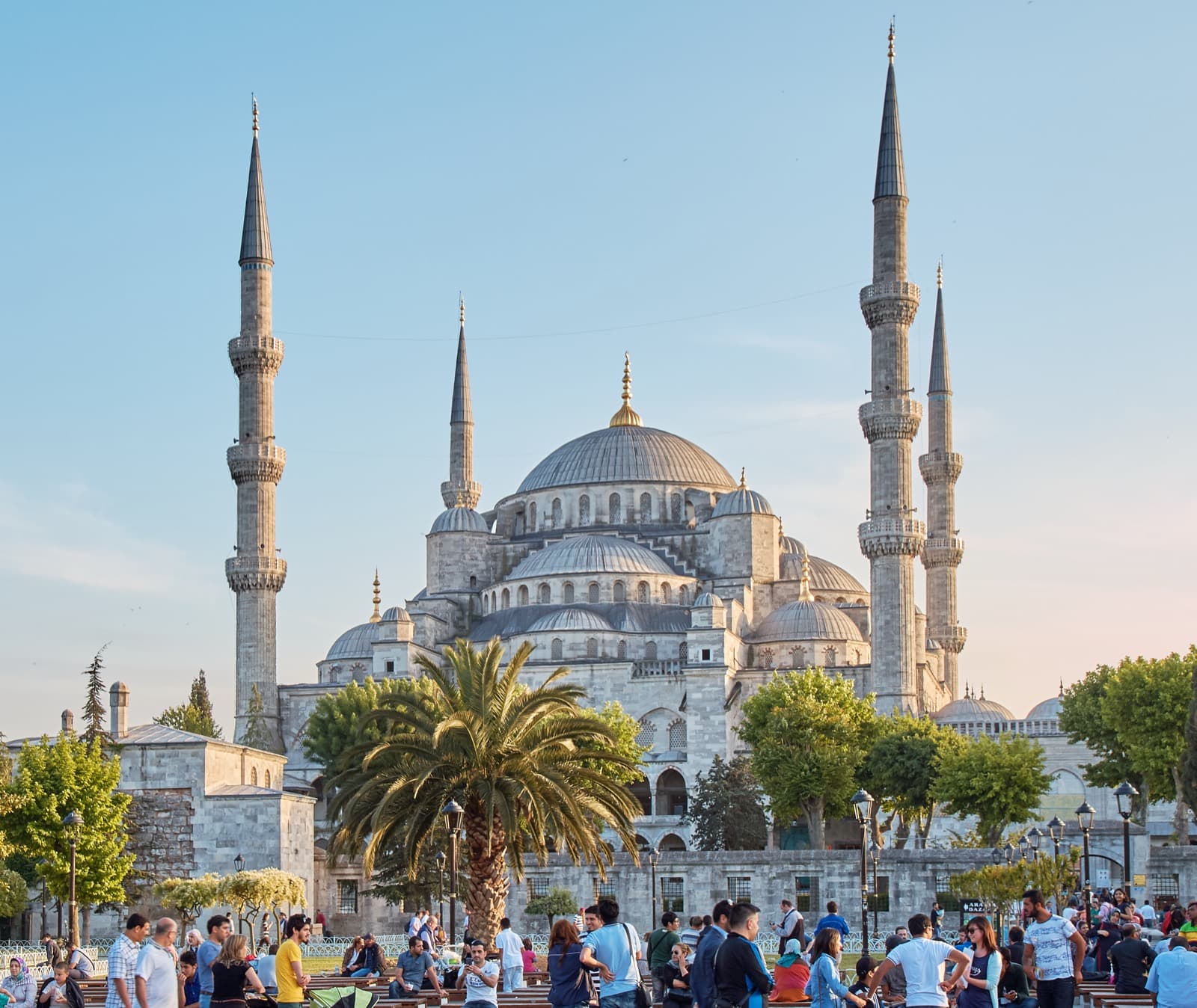
Across Sultanahmet Park, two great domed buildings face each other. The second is the Sultan Ahmed Mosque, the Blue Mosque, built between sixteen oh nine and sixteen seventeen. Its architect, Sedefkar Mehmed Aga, worked in the tradition of the great Sinan, and the silhouette is a deliberate answer to Hagia Sophia across the way: a central dome buttressed by four half-domes that cascade into smaller domes, with six minarets marking the corners of the prayer hall and the courtyard. Inside, more than twenty thousand tiles from the workshops of Iznik and Kutahya, in over fifty designs, line the walls. A major restoration completed in twenty twenty-three. Stand between the two buildings and you are watching two empires hold a conversation across one park.
The walk also stops at the entrance to the Basilica Cistern, built in the sixth century under Justinian to store water for the Great Palace and the buildings around it. The hall itself needs its own ticket. Its roof rests on about three hundred and thirty-six marble columns, and here the layering turns explicit: most of them are spolia, reused pieces salvaged from older Roman buildings. In one corner, two carved Medusa heads serve as column bases, one set sideways and one completely upside down. Nobody knows where they came from, perhaps a Roman fountain, or why they were set that way. That is the whole peninsula in one gesture: the past reused, turned sideways, and kept.
The gate, the zero point, and the quiet echo
The route reaches the Imperial Gate of Topkapi Palace, on Seraglio Point. Mehmed the Second began the palace within a few years of the conquest, and the date over the gate is fourteen seventy-eight. For roughly four hundred years it was the sultans' home and the seat of government, until the court moved to the new Dolmabahce Palace in the mid eighteen-fifties; it became a museum in nineteen twenty-four. Just inside the gate stands Hagia Irene, a Byzantine church the Ottomans kept as an arsenal and never made a mosque. Power here moved inward, court by court, from the public square you crossed toward this guarded point above three seas.
Two street monuments hold the true center. Beside the cistern entrance, the fragment of the Milion was the Byzantine zero-mile marker, the point from which distances along the empire's roads were measured, modelled on Rome's golden milestone. A few minutes west along the line of the old main street, off the route but worth the detour, stands the Column of Constantine, known in Turkish as Cemberlitas. Constantine set it up around three hundred and twenty-eight in the forum of the city he dedicated on the eleventh of May, three hundred and thirty, and it is the only part of that forum still standing. One monument says the world was measured from here. The other says the city was founded here.
The walk ends softly at Little Hagia Sophia, once the Byzantine church of Saints Sergius and Bacchus, built by Justinian and Theodora around five hundred and thirty, a few years before the great cathedral was finished. Its dome is divided into sixteen curving compartments. Under the Ottomans it became a mosque, early in the sixteenth century under Sultan Bayezid the Second, and it remains one today. The same grammar, told quietly: church, then mosque, one empire building on the last.
Eight stops, about two and a quarter kilometres, roughly an hour and a half at an easy pace, from Sultanahmet Park down to Little Hagia Sophia. It is a cluster on one small headland, so you can reorder or skip stops and still hold the thread. Read the layers rather than racing to see everything. Start in the park facing Hagia Sophia, learn the grammar, and let the rest of the peninsula fall into place. Browse more Istanbul walking tours, or see what else is on offer in Istanbul.
Sources
- Hagia Sophia, Wikipedia: construction dates, architects, the dome rebuild, and the cathedral-mosque-museum-mosque sequence.
- Hippodrome of Constantinople and Serpent Column, Wikipedia: Roman arena history, the Obelisk of Theodosius, and the Plataea trophy.
- Basilica Cistern, Wikipedia: the sixth-century reservoir, its reused columns, and the Medusa-head bases.
- Column of Constantine and Milion, Wikipedia: the founding column of three hundred and thirty and the Byzantine zero-mile marker.
- Encyclopaedia of the Hellenic World, Constantinople, and TDV Islam Ansiklopedisi: dates, positions and details corrected in a September 2026 fact-check of the walk.
- UNESCO World Heritage, Historic Areas of Istanbul: the nineteen eighty-five inscription covering these monuments.
Ready to experience it?
Hagia Sophia and the Blue Mosque: The Peninsula of Empires
90 min · 2.3 km · moderate
More from Istanbul
Explore more at your own pace.
Istanbul: A City Written and Rewritten by Empires
Saint Anthony of Padua and the Plural City of Galata and Pera
The Grand Bazaar Is an Engine: How Istanbul's Market Paid for Its Domes
Galata Tower: The Watchtower of a Foreign City Inside Istanbul
Suleymaniye Mosque: Why Sinan's Great Complex Was Built to Pay Its Way