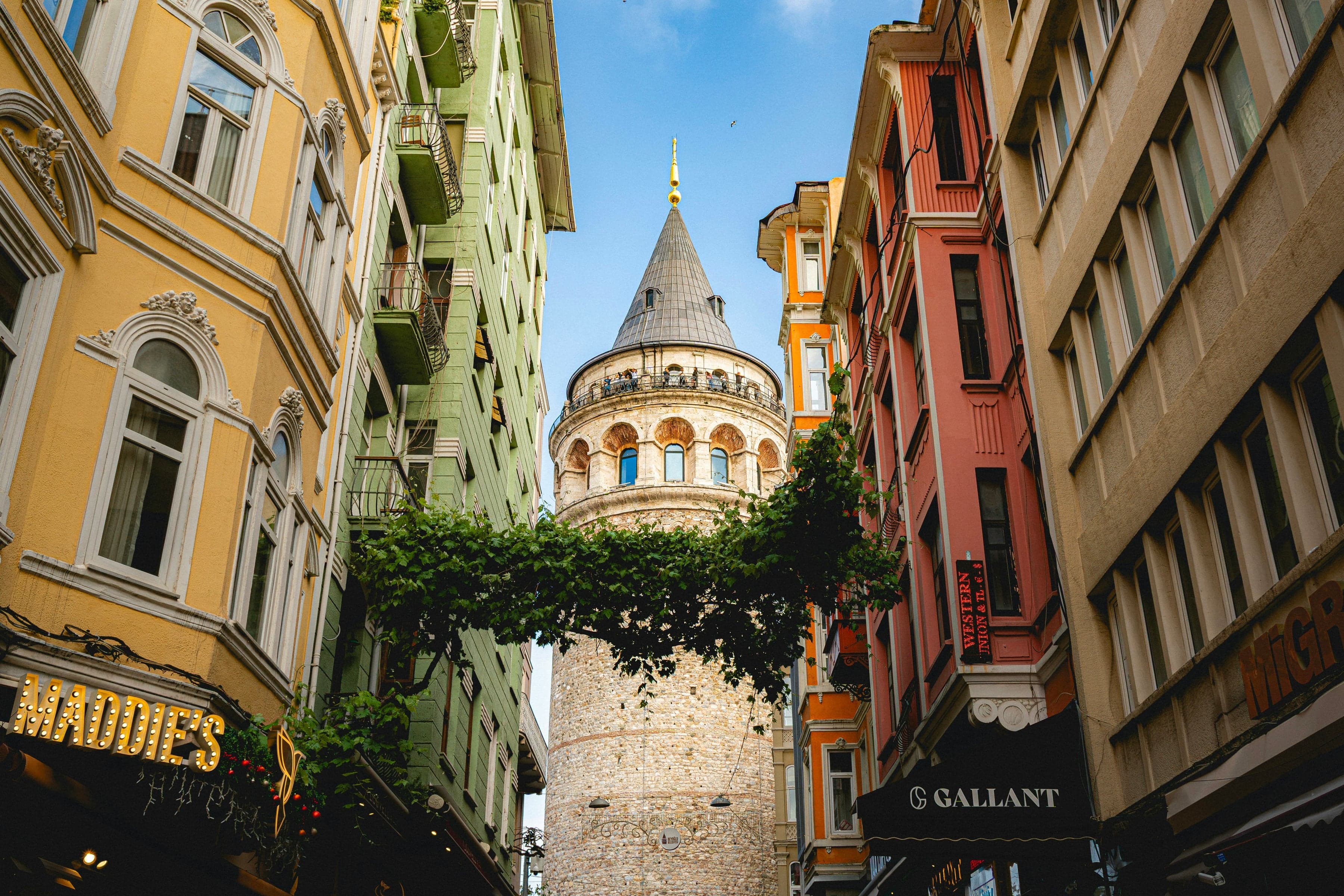
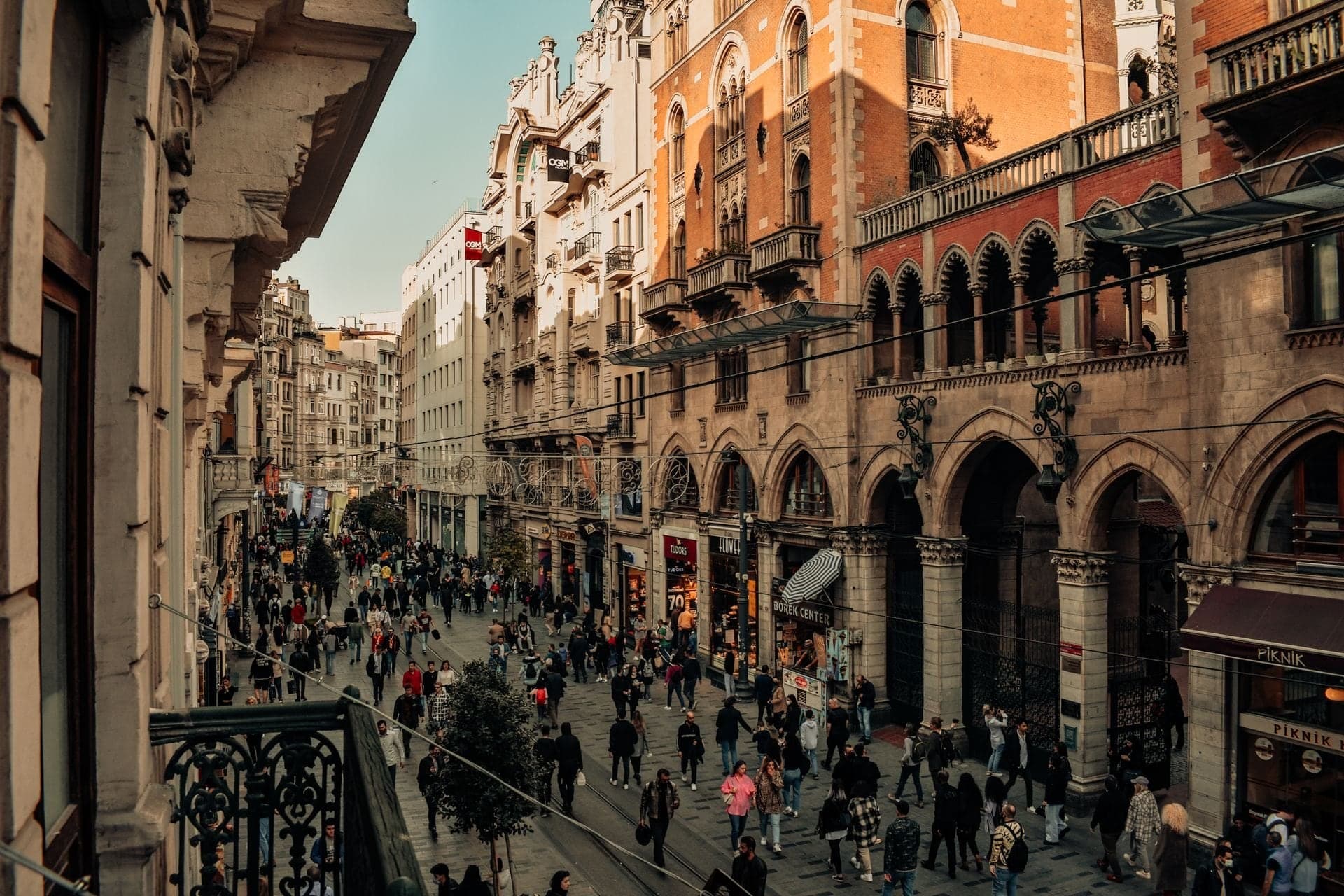
Climb from the Galata Bridge up the bankers' street and the Camondo Stairs to Galata Tower and the Mevlevi Lodge, then along Istiklal Avenue's churches, arcades and palace gates to Taksim Square.
Start · Galata Bridge: The Crossing to the Other Side
DirectionsStops
- 1
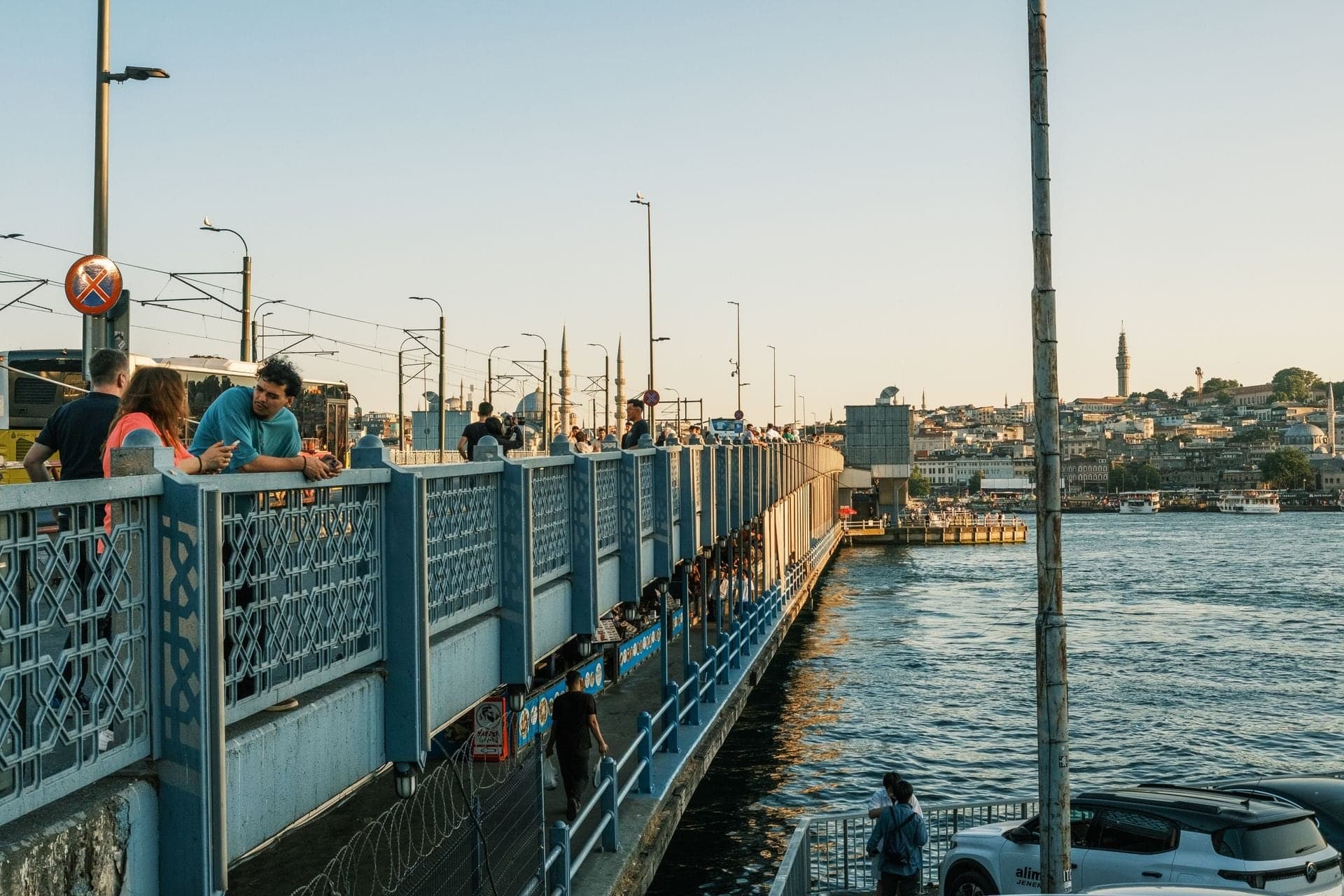
Galata Bridge: The Crossing to the Other Side
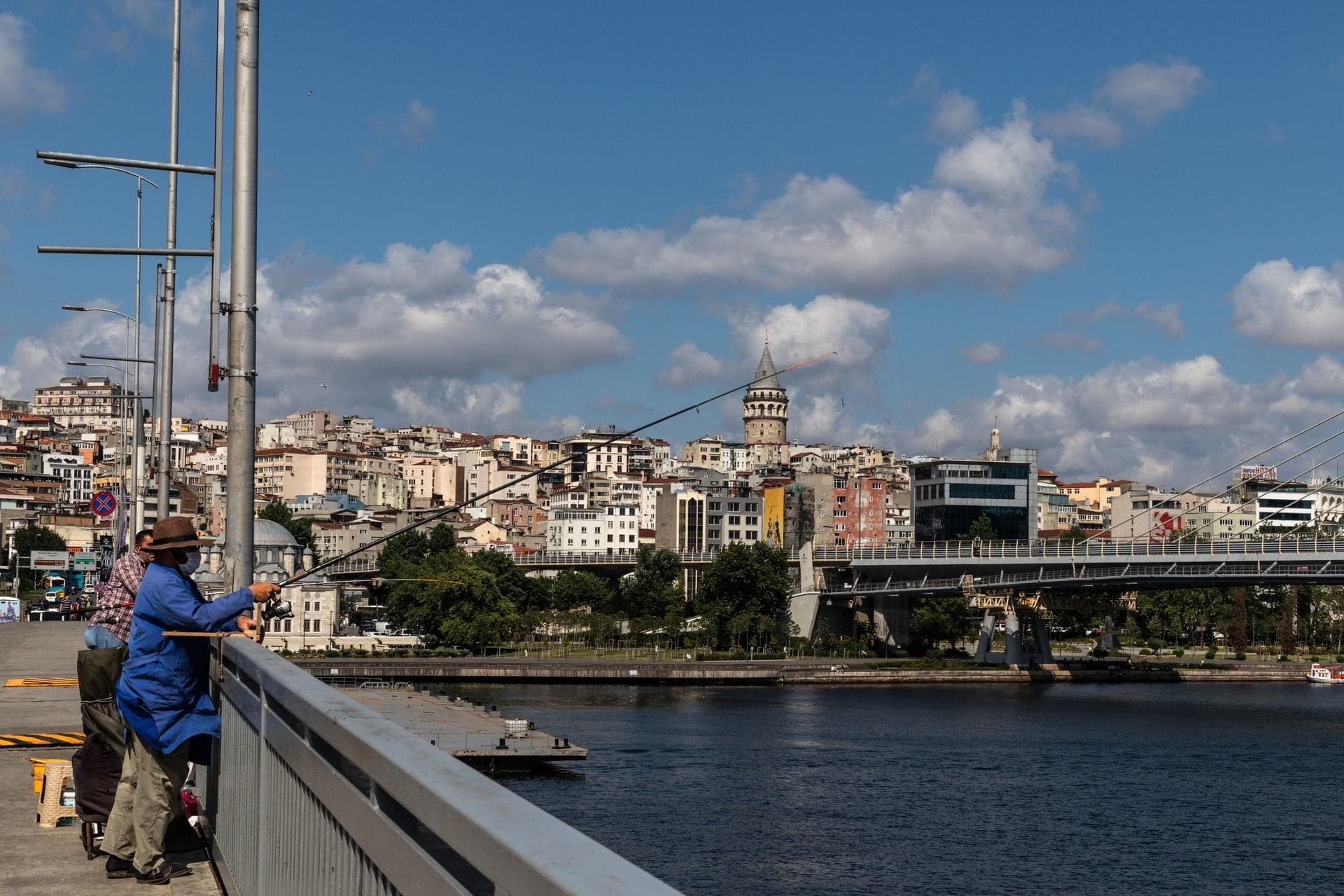
A bridge with two decks. The Galata Bridge crosses the Golden Horn on two decks. On one shore, the old city's mosques; on the other, the hill of Galata and its tower.
- 2
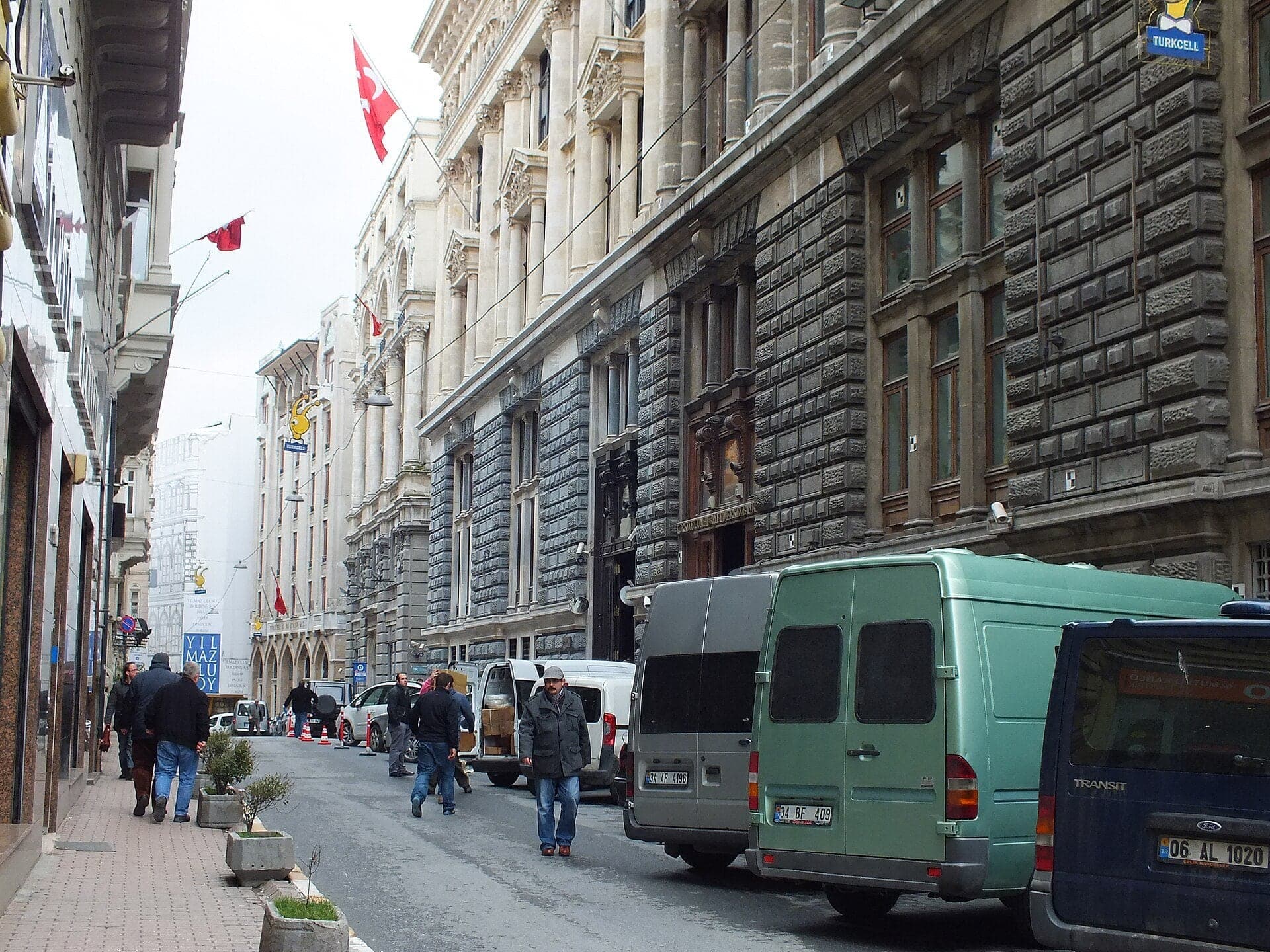
Bankalar Caddesi: A Bank with Two Faces
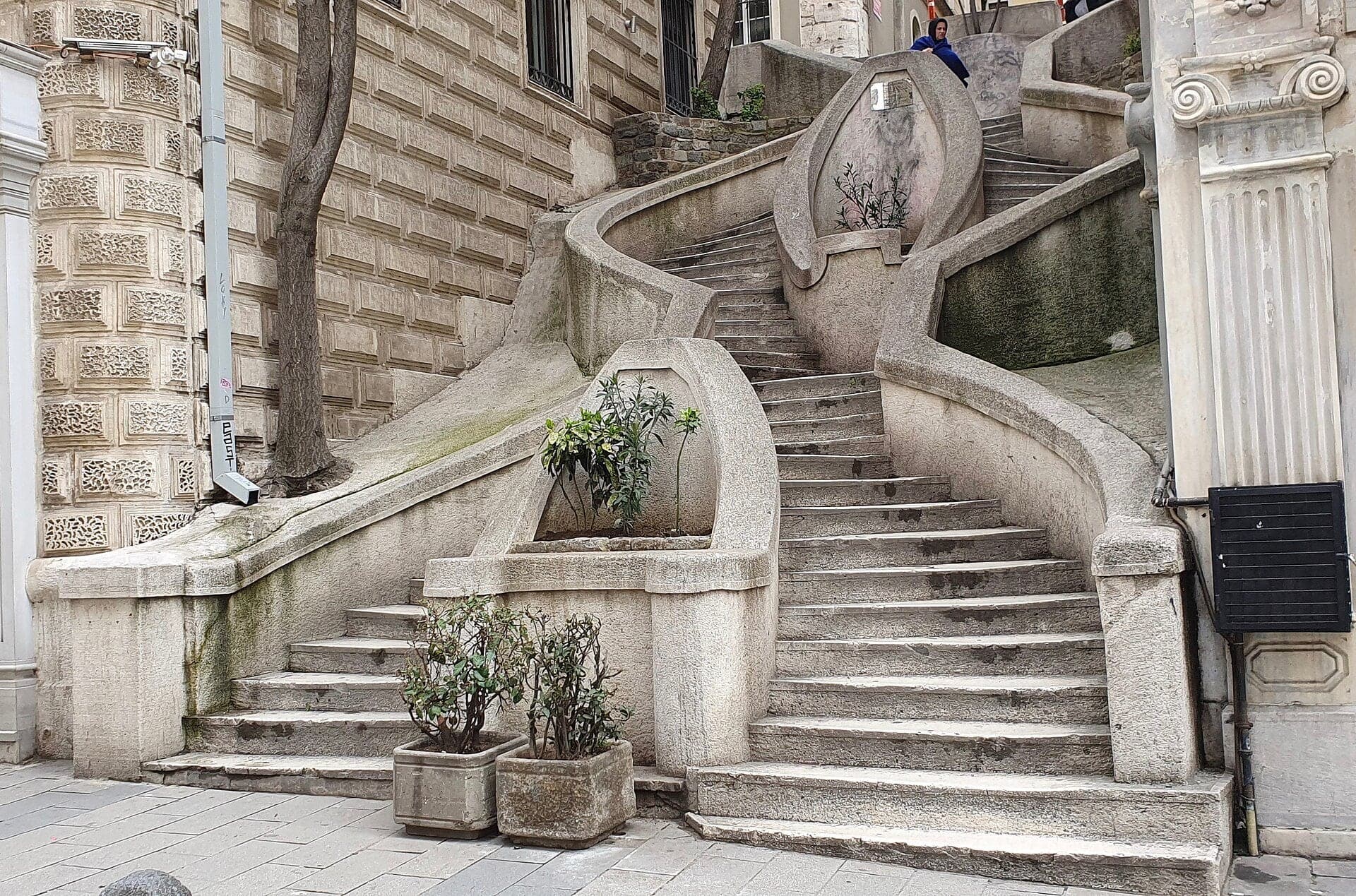
The Ottoman Bank and its stairs. The Ottoman Bank shows Pera a classical European face. Beside it, the curving Camondo Stairs climb toward the tower.
- 3
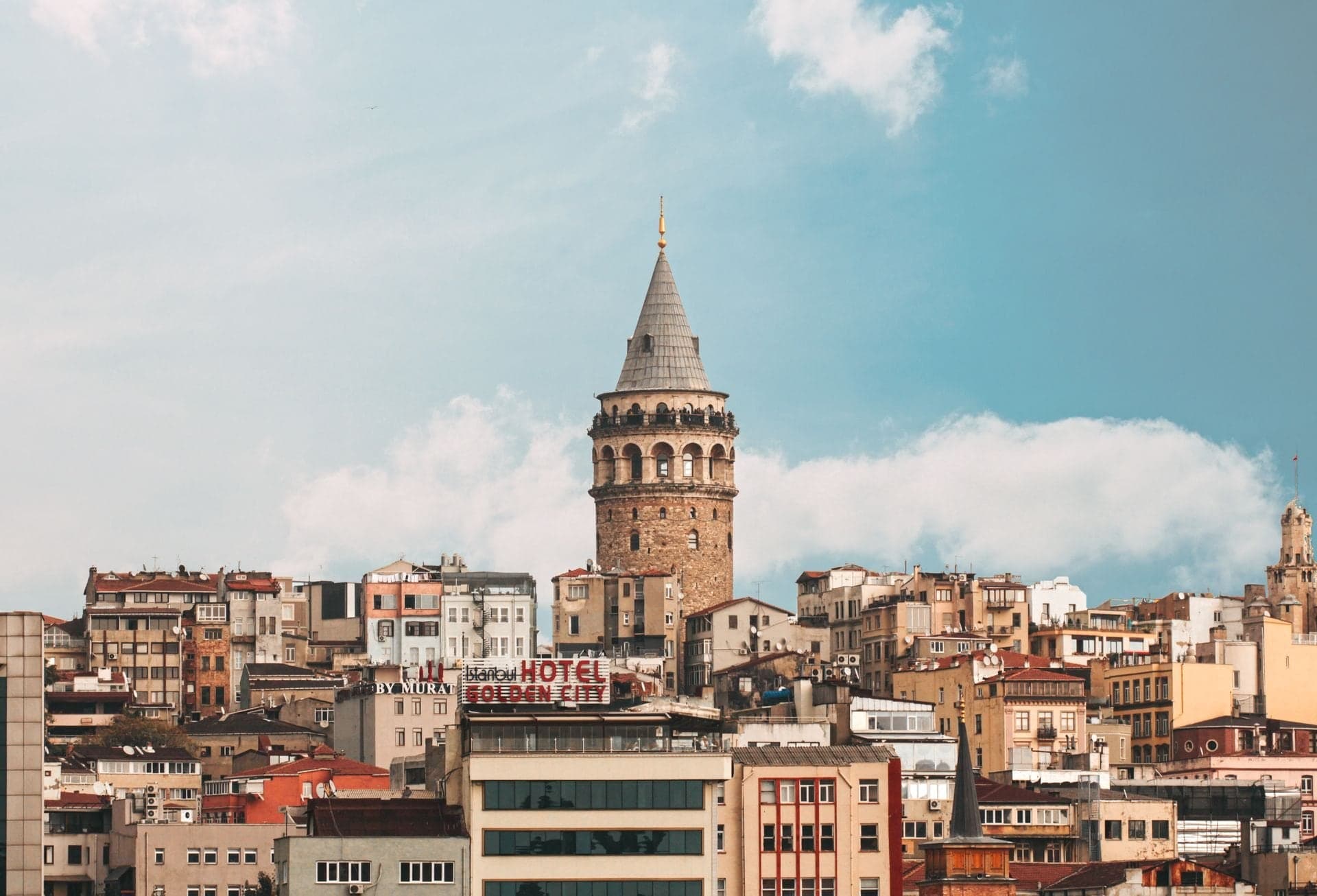
Galata Tower: The Tower That Kept Losing Its Cap
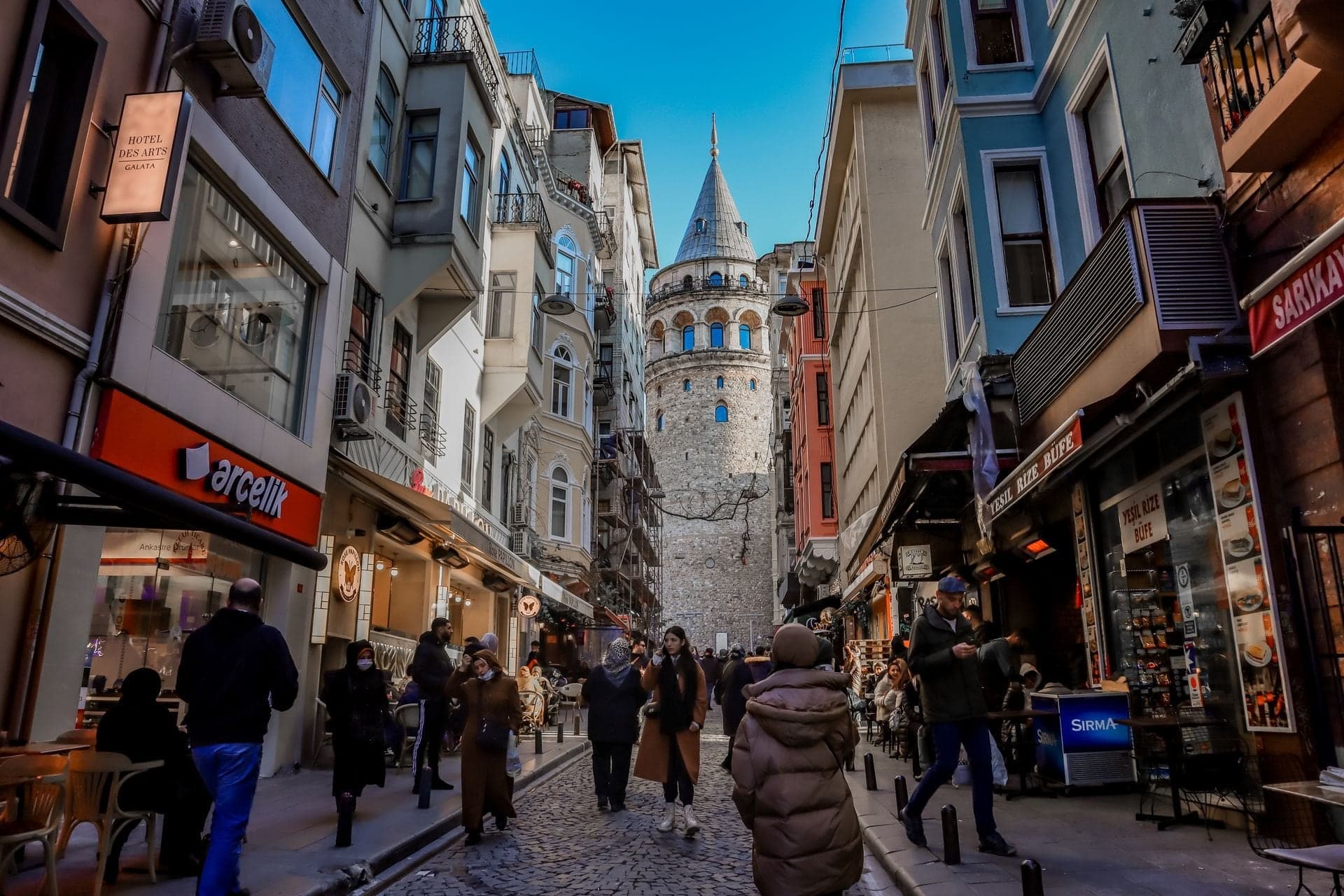
The tower of the Genoese walls. The Genoese built Galata Tower as their walls' high point. Fires and a storm kept taking its cap.
- 4
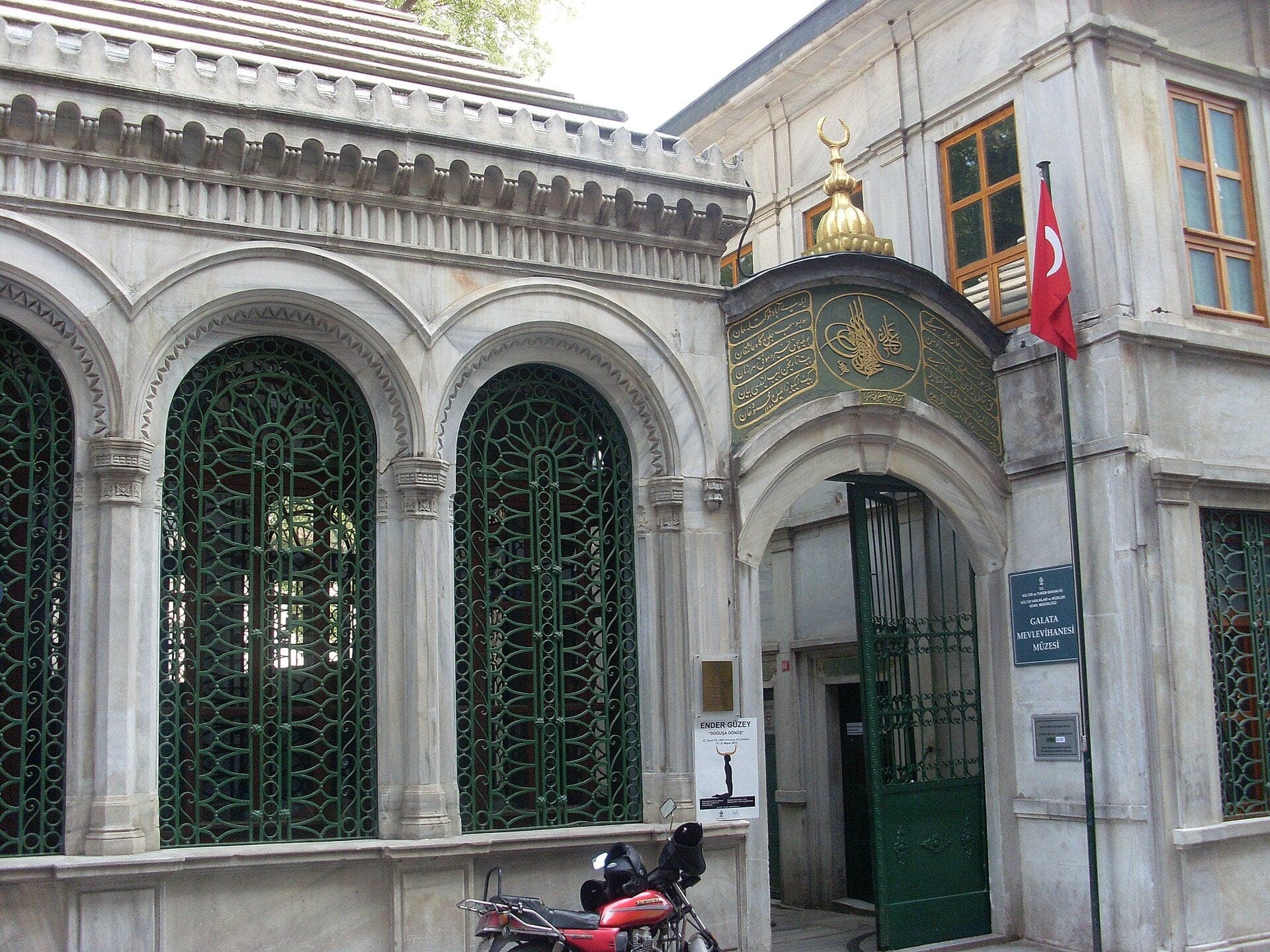
Galata Mevlevi Lodge: The Poet's Street
The whirling dervishes' old lodge. Istanbul's oldest Mevlevi lodge stands behind a gate up this street. A poet sheikh is buried inside.
- 5
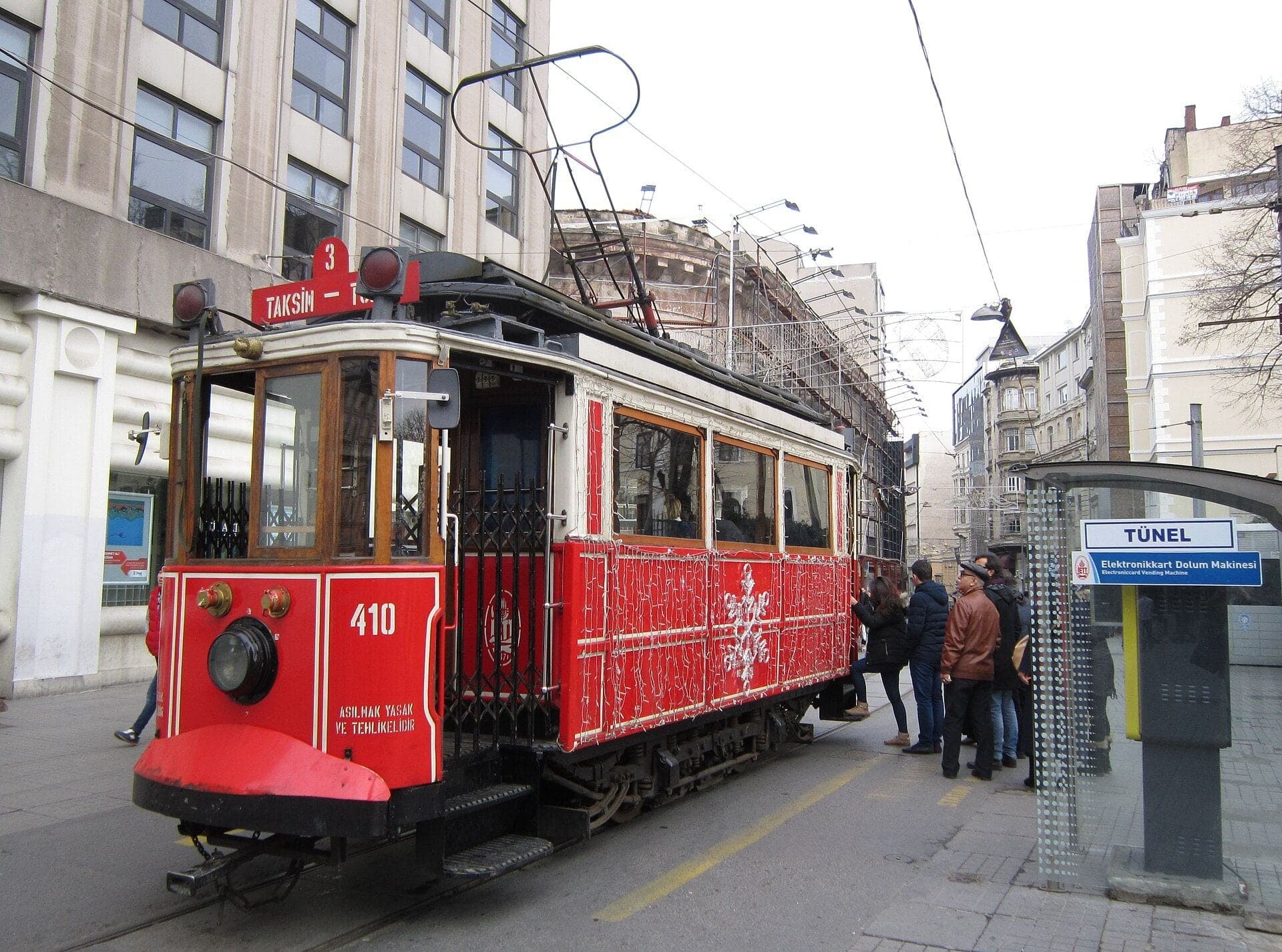
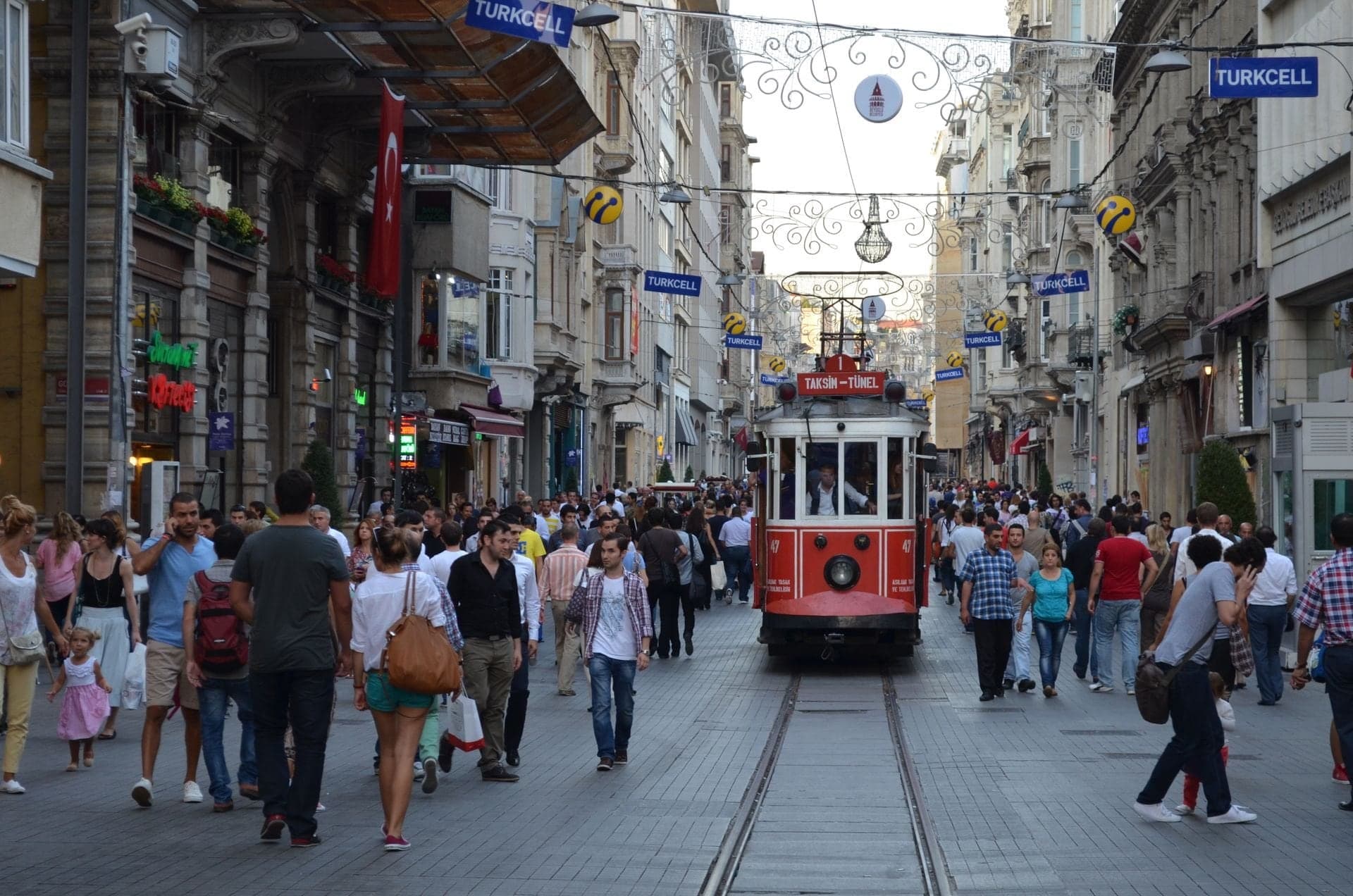
Tunel Square: Where Istiklal Begins
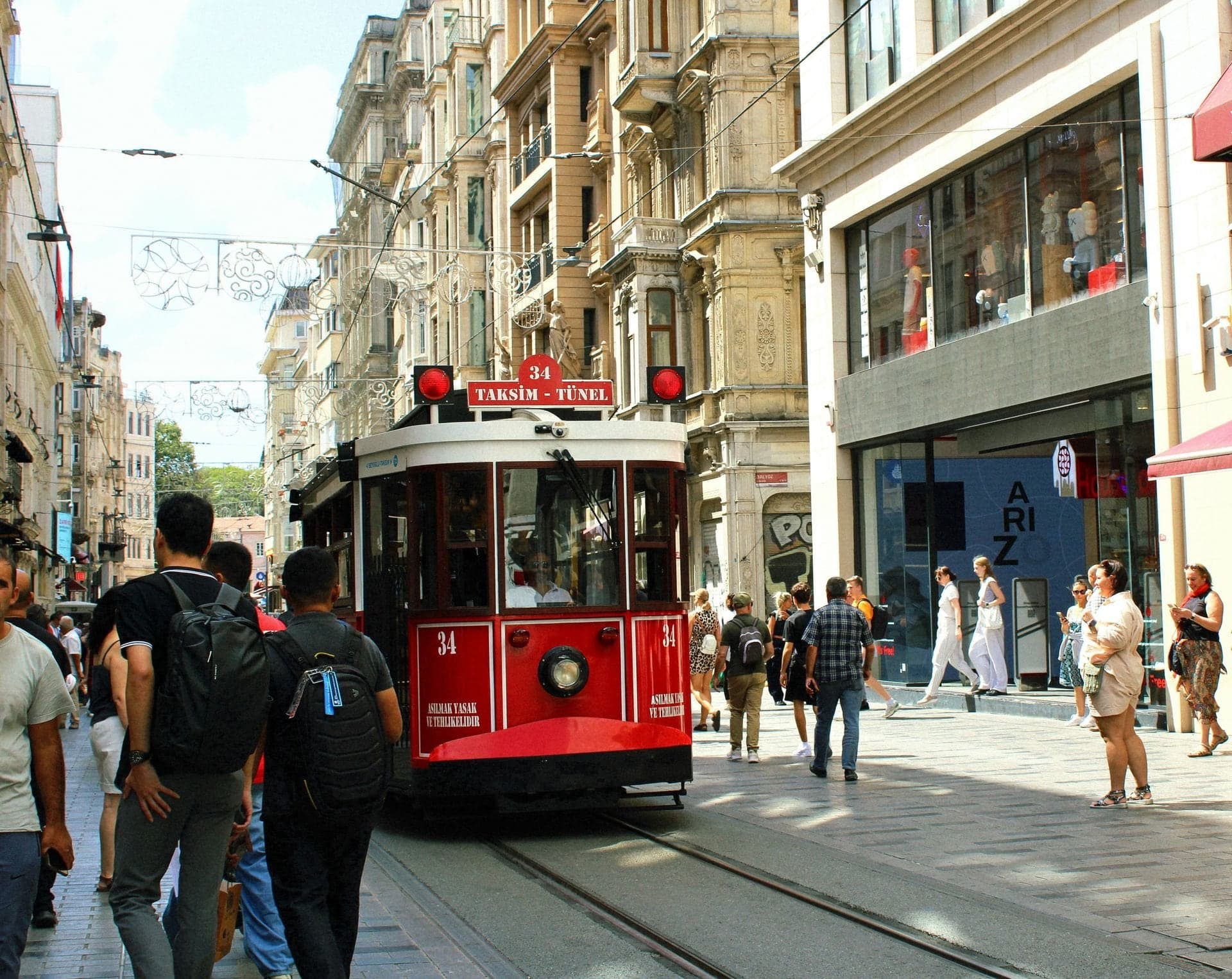
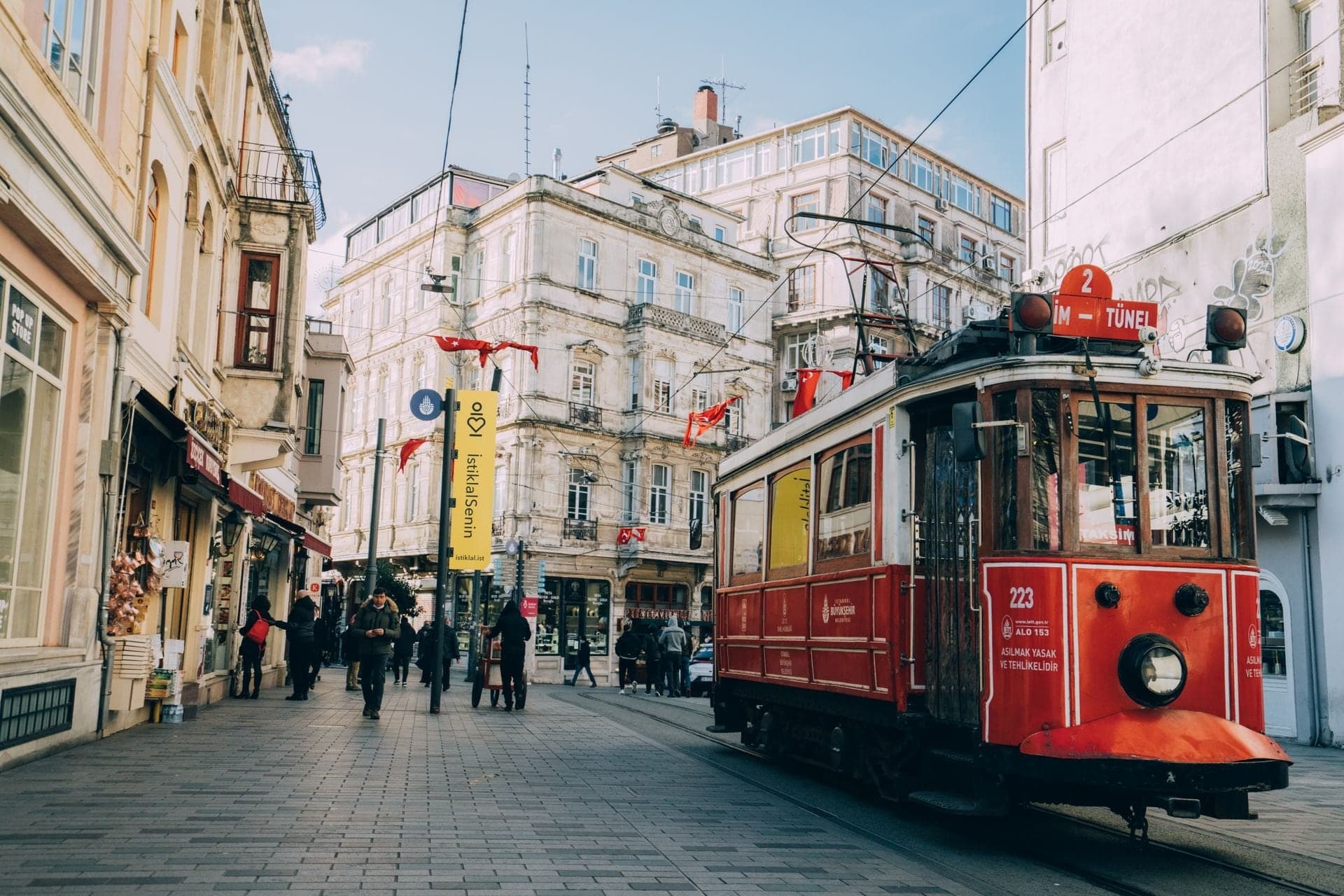
The top of the old funicular. An underground funicular from 1875 climbs the hill beneath this square. Istiklal Avenue and its red tram begin here.
- 6
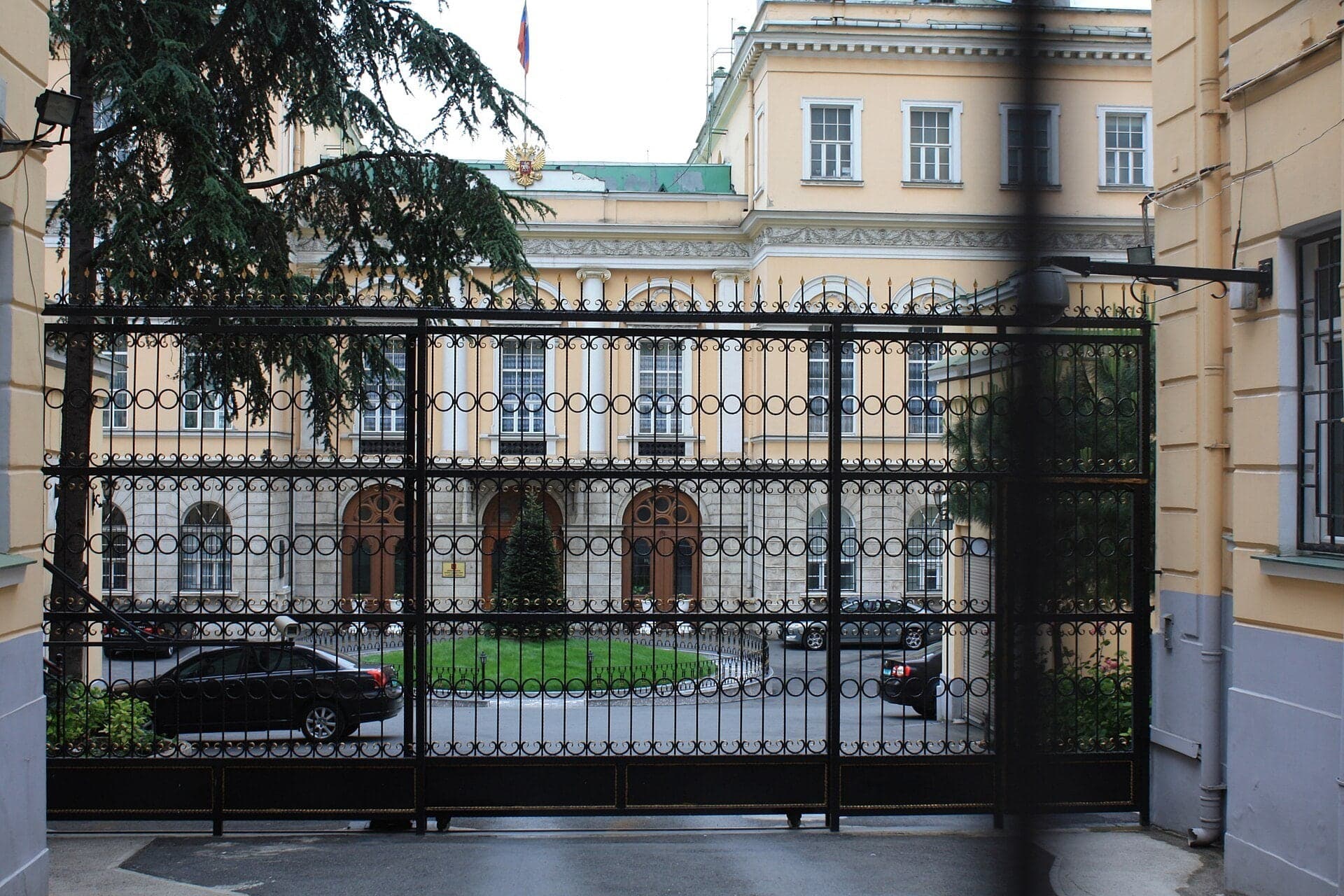
Russian Palace and Narmanli Han
Russia's old embassy and a han. A palace built for Russia's embassy stands back behind its forecourt. Down the avenue, Narmanli Han kept only its front.
- 7
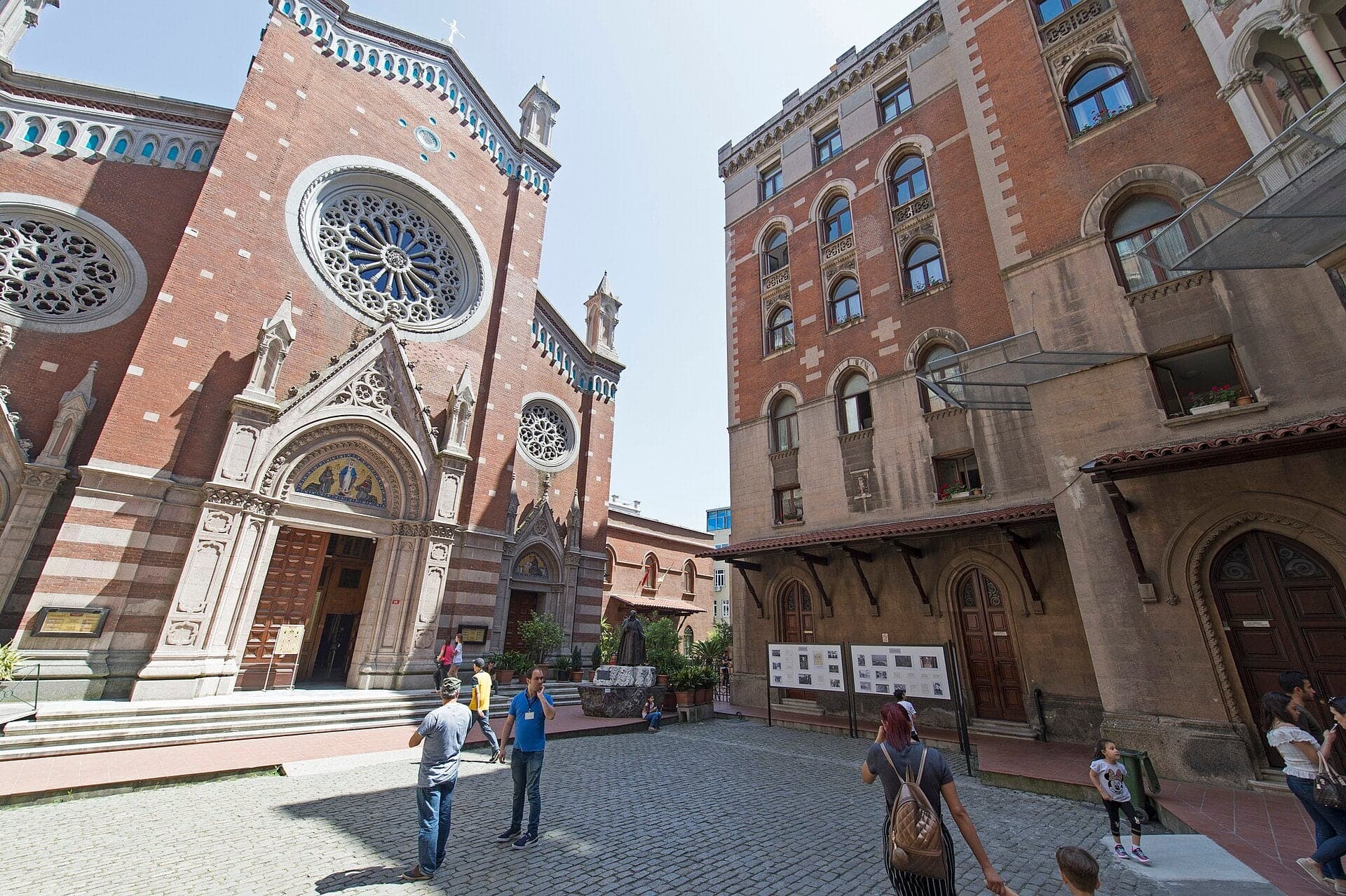
Saint Anthony of Padua: The Church Rebuilt for a Tram
A red-brick church set back. A red-brick neo-Gothic church stands back behind twin street blocks. The old church came down for a tram line.
- 8
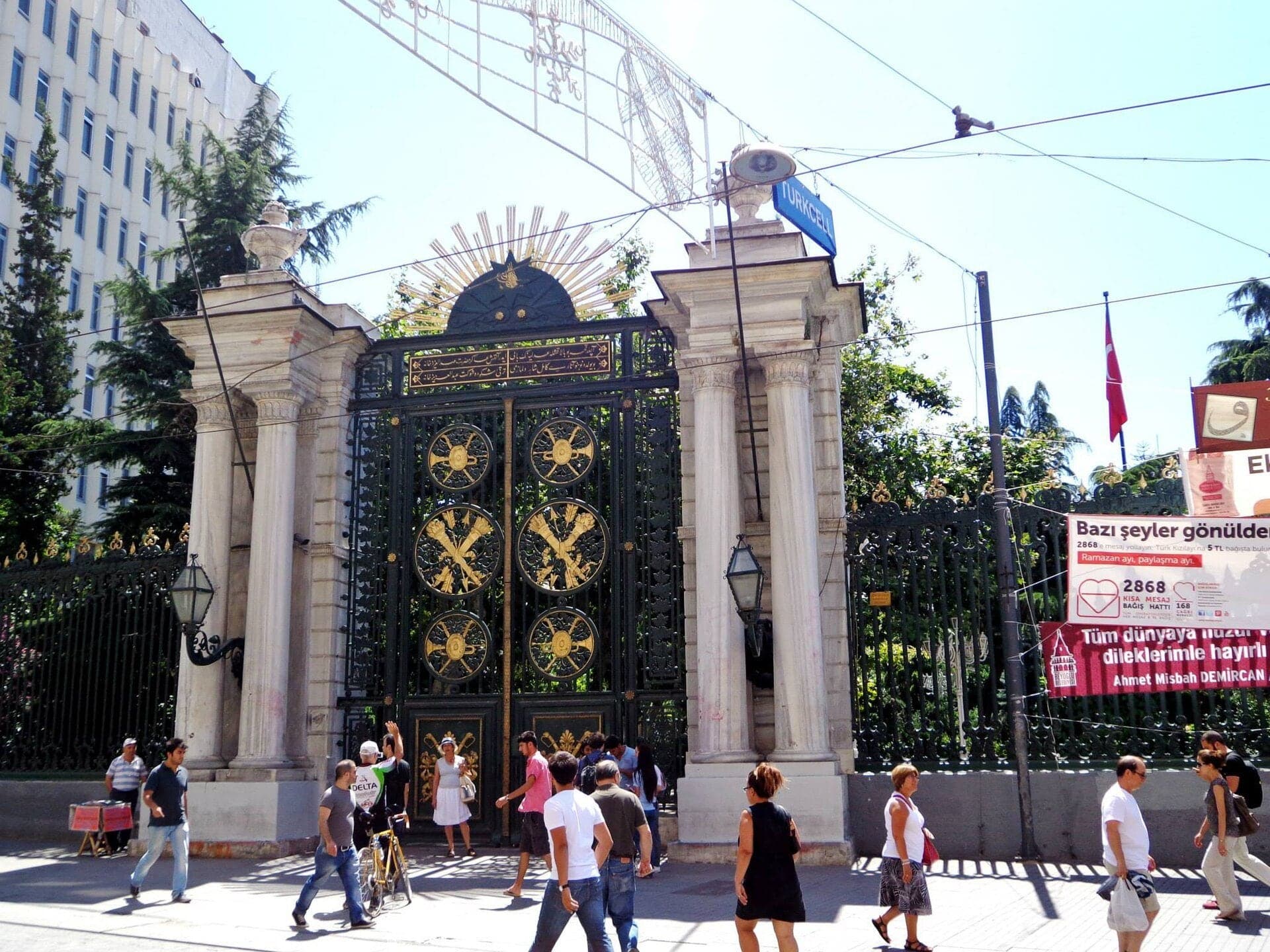
Galatasaray Square: Where the Great Fire Stopped
Where the great fire stopped. The great Pera fire of 1870 burned out at this school's gates. Galatasaray has taught in French since 1868.
- 9
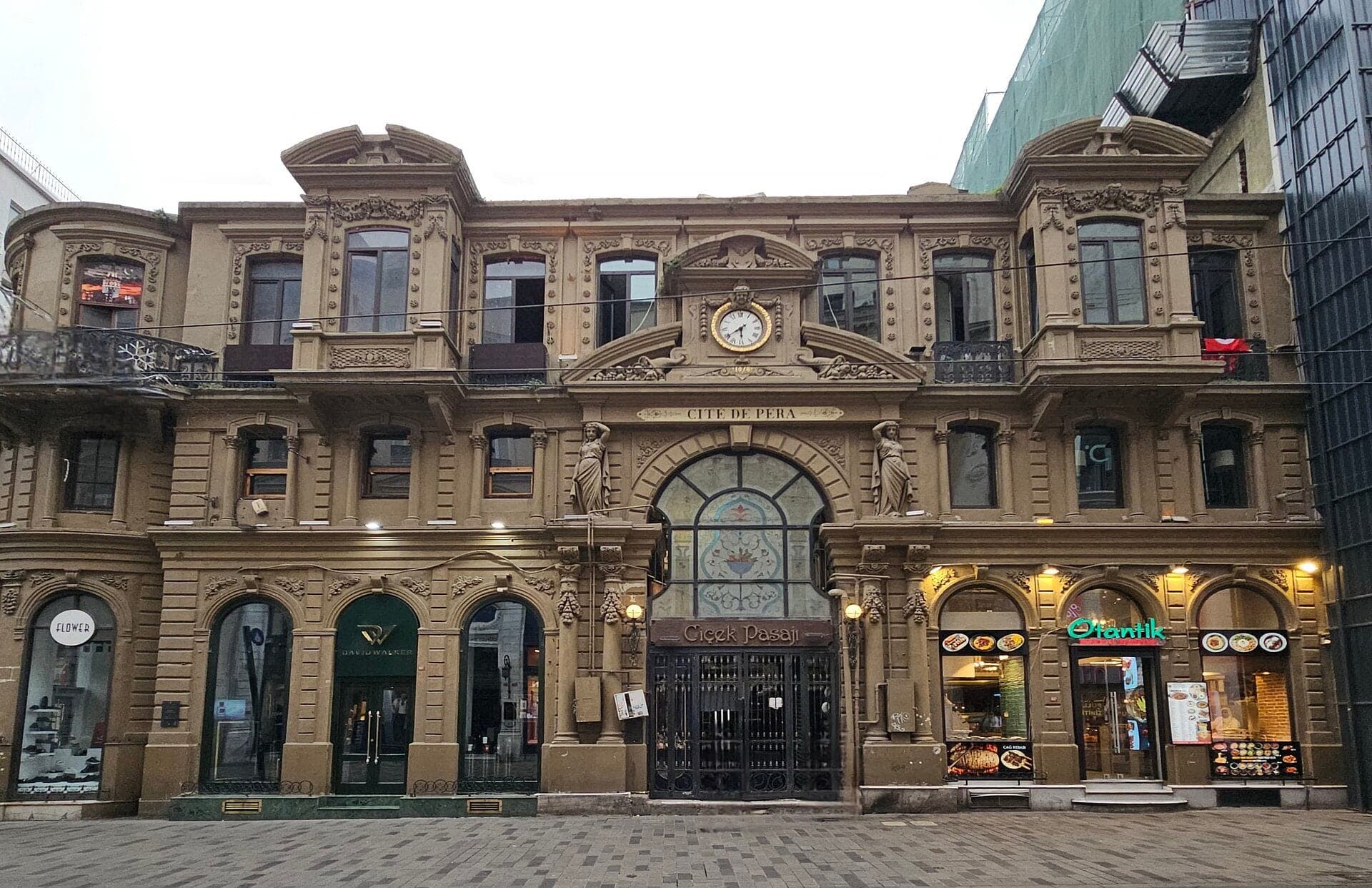
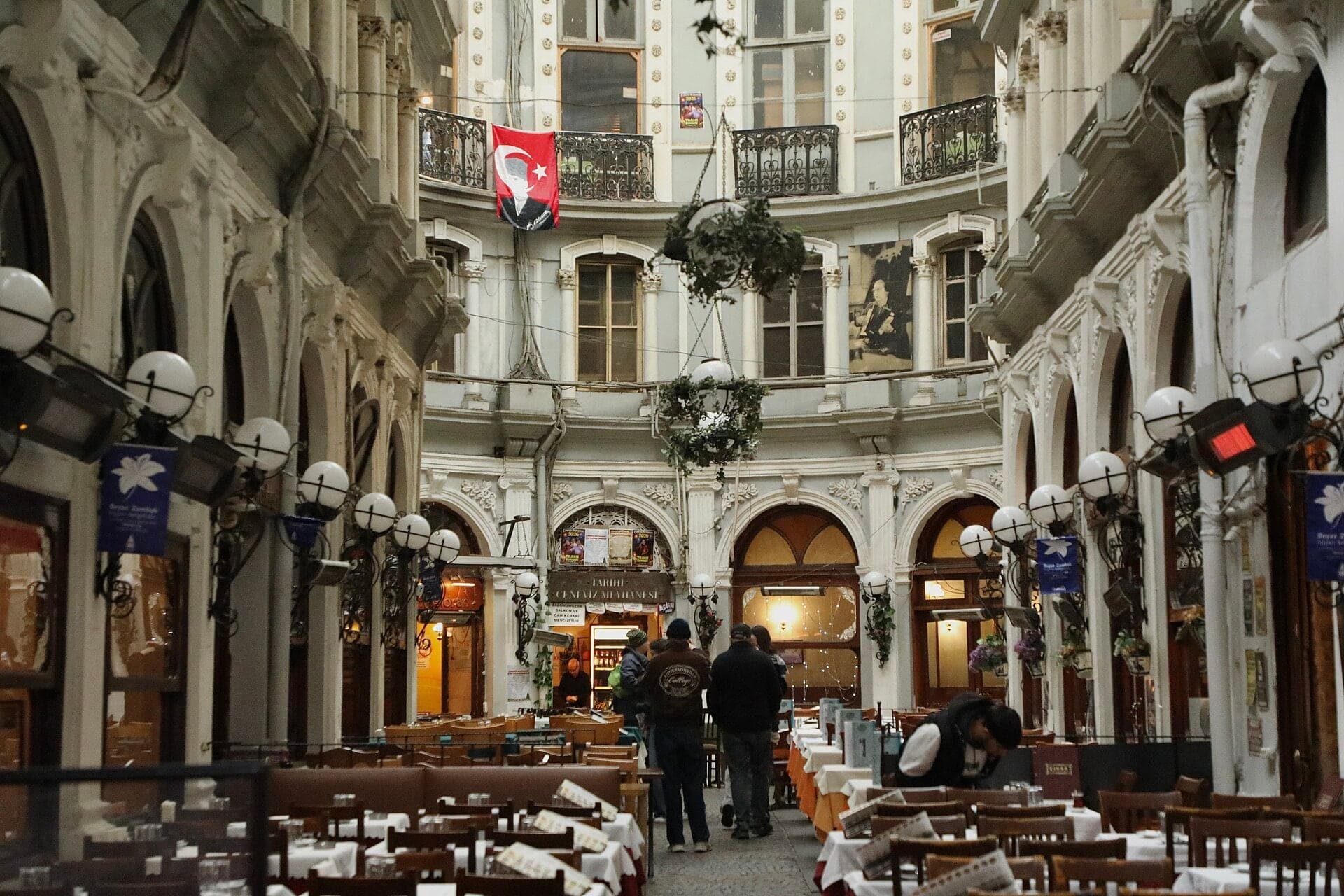
Cicek Pasaji: The Flower Passage
A flower passage on Istiklal. The Cite de Pera rose in 1876 where a burned theater stood. Florists named it, taverns took it over, and it fell in 1978.
- 10
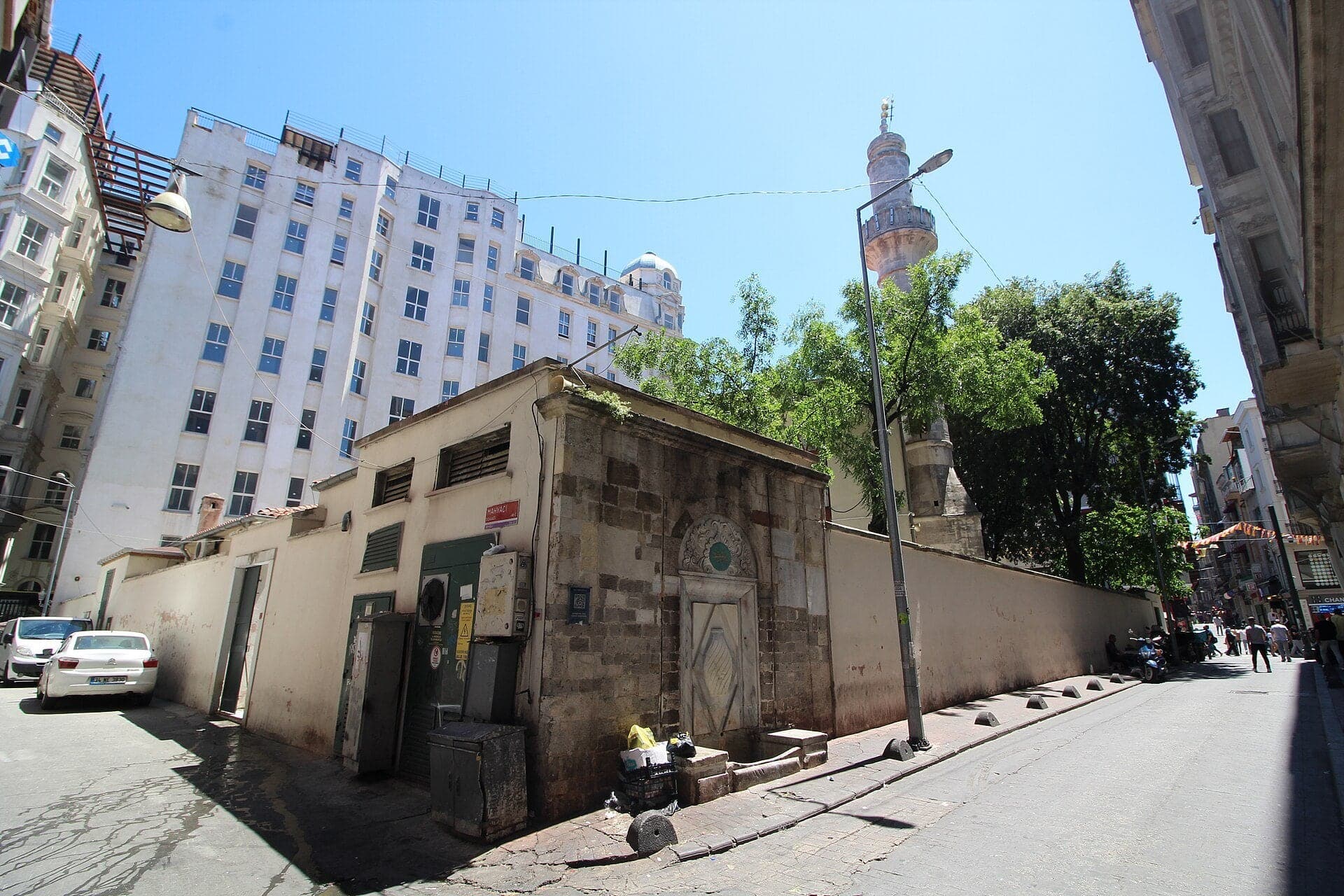
Aga Camii: The Mosque Older Than the Avenue
Older than the avenue itself. An officer of the Galata Palace founded this mosque in 1596. It is older than the avenue around it.
- 11
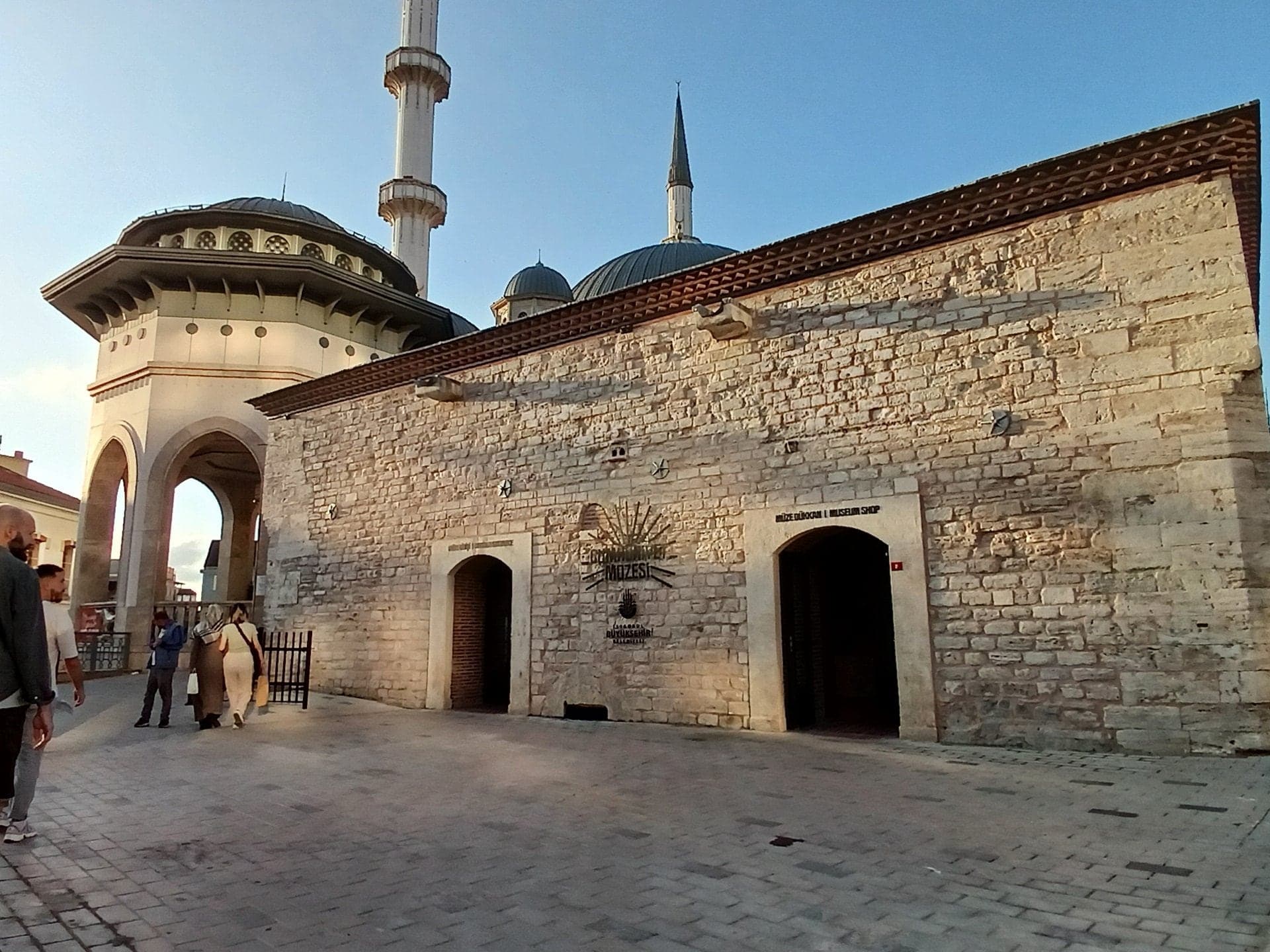
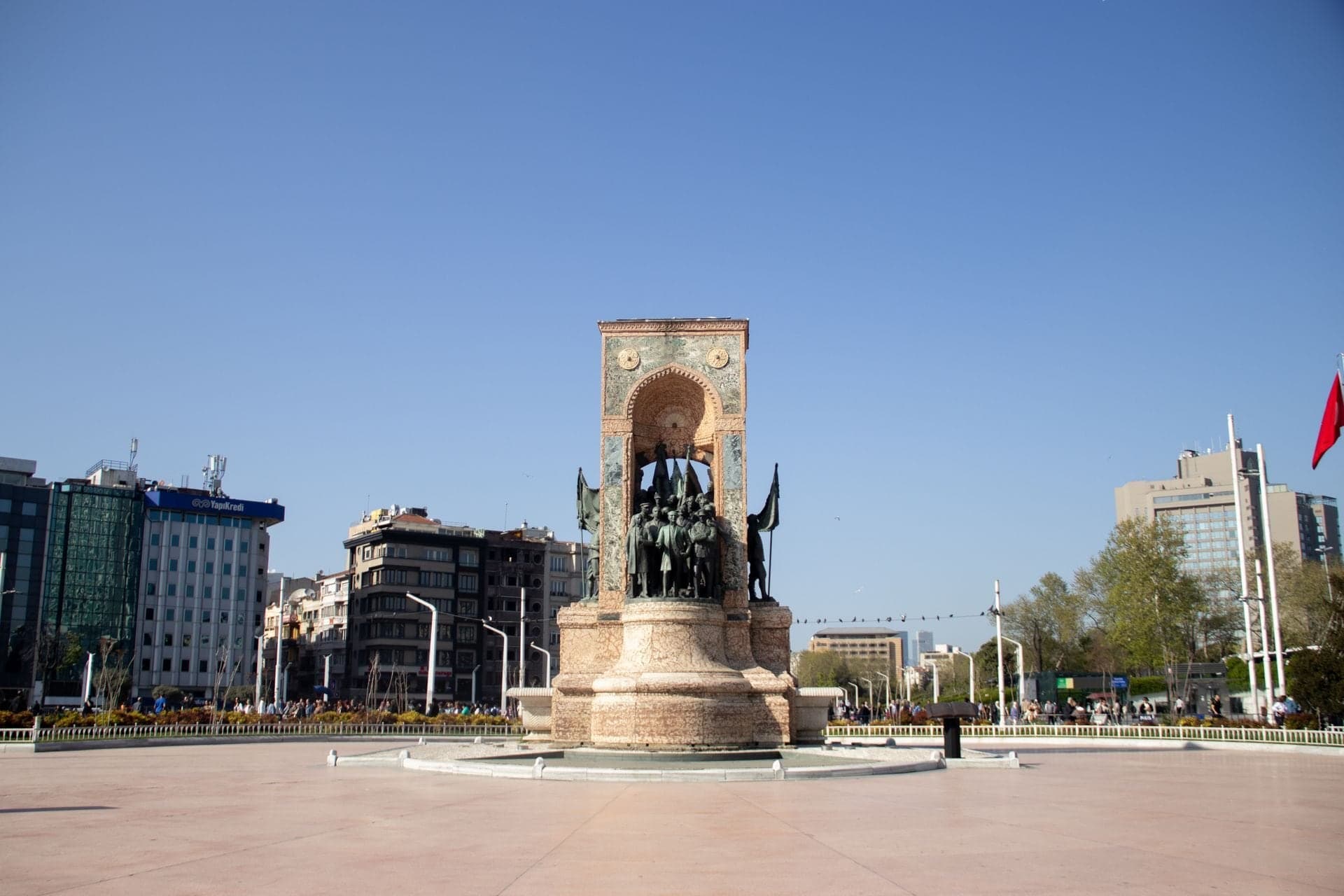
Taksim Square: The House That Divided the Water
The water house of Taksim. Taksim's eight-sided stone water house of 1732 gave the square its name. The Republic Monument stands beyond it.
Details
Best Time to Visit
Tuesday to Sunday, in the morning: the Galata Mevlevi Lodge, SALT Galata and the Republic Museum at Taksim are all closed on Mondays, and the tower's queue and Istiklal's crowds build through the day. Istiklal is at its busiest in the evenings and at weekends. Avoid 1 May and late June, when the police can close Taksim and the avenue.
Pro Tips
- •Getting to the start: take the T1 tram to Karakoy, or to Eminonu at the other end of the bridge, or a ferry to Karakoy or Eminonu pier. The T1 runs from 06:00 to midnight, every 2 minutes at peak (Metro Istanbul, checked 5 October 2026). The first stop is on the Galata Bridge's upper deck, on the sidewalk facing up the Golden Horn, near the Karakoy end: if you start at Eminonu, simply walk across.
- •Galata Tower: 30 euros for foreign visitors, open every day from 08:30 into the late evening, last entry 22:00; MuzeKart is valid for Turkish citizens only; under-18s must come with a parent. Expect a queue. Checked 5 October 2026.
- •Galata Mevlevi Lodge Museum: 7 euros for foreign visitors, Tuesday to Sunday 09:00 to 18:30, ticket office closes 17:30, closed on Mondays. There is no official public schedule for the sema (the whirling ceremony): ask the museum before you plan around one. Checked 5 October 2026.
- •SALT Galata, in the old Ottoman Bank at stop 2, is free: Tuesday to Saturday 11:00 to 19:00, Sunday 11:00 to 18:00, closed on Mondays, on the first two days of both Eids, on 1 January and on 1 May. Checked 5 October 2026.
- •The Republic Museum in the Taksim water house: Tuesday to Sunday 10:00 to 18:00, ticket office closes 17:30, closed on Mondays; 570 lira for foreign visitors, cards only; free under 10 and over 65. Checked 5 October 2026.
- •Can't manage stairs at the underpass? At the end of the bridge, cross Tersane Caddesi on the zebra crossing just to the left instead. It has no lights, so wait for a clear gap. The Camondo Stairs that follow have no step-free alternative on the route.
- •Aya Triada: from Taksim, go back to the top of Istiklal and a short way down Meselik Sokagi, on the avenue's south side, to the church's garden gate for the full view of its front and towers. Its opening hours are not officially published.
- •Saint Anthony of Padua and the Aga Camii are free. The church is usually open outside Mass; the mosque is open outside prayer times, with modest dress and shoes off.
- •The walk ends on Taksim Square, by the M2 metro and the F1 funicular down to Kabatas. To go back down to Karakoy, the Tunel funicular leaves from Tunel Square, at the bottom of Istiklal.
Safety & Precautions
- •The route is not step-free: stairs down into and up out of the Karakoy underpass, about forty steps on the Camondo Stairs (with a handrail), and the steep cobbles of Galip Dede Caddesi.
- •On the Galata Bridge, fishermen cast lines and hooks over the sidewalk: watch your head and your step. The bridge can close to pedestrians as well as cars from 01:30 to 04:30 on maintenance nights (as in August 2025).
- •The Karakoy underpass was renovated in 2024, but its opening hours are not published: walk it by day.
- •On Istiklal the red tram runs down the middle of the avenue every few minutes: stay at the edges, where the stops are, and watch for it.
- •Galata Mevlevi Lodge Museum: check the official page before you go; it has closed for whole weeks without notice, most recently 29 September to 5 October 2026. Checked 5 October 2026.
- •Taksim, Istiklal and the transport around them can be sealed on 1 May (in 2026 the square was closed from 05:00, Taksim and Sishane metro stations were shut, and the Tunel and the Istiklal tram were suspended) and around Pride in late June (on 21 June 2026 barriers went up around Taksim, Istiklal down to Tunel Square and Karakoy).
- •In August 2024 the Turkish press reported visible cracks in the Cicek Pasaji's walls and ceiling and a stalled restoration; no later update was found. The stop works from the street.
- •The Russian consulate is closed to visitors and may have crowd barriers and security in front: keep to the avenue and be discreet with cameras.
- •Galip Dede Caddesi, the tower square and Istiklal are very crowded: keep bags closed and in front of you.
Travel advisory: Exercise Increased Caution (Level 2).
Gallery
Related Reading
Go deeper on what you'll see, hear, and walk through.
Overview
Best Self-Guided Walking Tours in Istanbul (2026)
3 min
Overview
Istanbul Travel Guide: Days, Transport, Season, Safety, Budget
8 min
Overview
One Day in Istanbul: A Walkable Morning-to-Evening Itinerary
8 min
Thematic
Best Culture Walking Tours in Istanbul (2026)
2 min
Thematic
Istanbul: A City Written and Rewritten by Empires
9 min
Companion
Saint Anthony of Padua and the Plural City of Galata and Pera
7 min
Deep dive
Galata Tower: The Watchtower of a Foreign City Inside Istanbul
7 min
Read
What to Eat in Istanbul: Dishes, Origins, and How to Order
7 min
Read the walk
The full story of Galata Tower and Istiklal: The Climb from the Golden Horn, in words. Prefer to listen? Play it narrated, from home or on location.
Introduction
Istanbul, in Turkey, is a city split by water. On one side of the Golden Horn, the inlet that was its harbor, stand the old city's palaces and great mosques. On the other side rises a steep hill the Byzantines called Pera, the other side. The Genoese walled a town on its lower slope and crowned it with a tower. Later came bankers on the lower slope, and embassies, churches and theaters on the ridge above.
This walk climbs with them. Over eleven stops and about two and a half kilometres, a mile and a half, it starts on the Galata Bridge, passes under the junction at Karakoy, follows the bankers' street to a famous flight of stairs, rounds Galata Tower and goes up past a dervish lodge to the head of Istiklal Avenue. Then it follows the avenue along the ridge to Taksim Square, where the water for these hills was divided. Allow about an hour and a half, longer if you go up the tower or into the lodge, both ticketed. Nearly all the climbing comes in the first half, with stairs and steep cobbles.
Two names come back along the way: the Camondos, a banking family whose name is on a staircase, and Seyh Galib, a poet whose name is on a street.
And one thing to watch for as you climb: fire. Again and again on this hill, it cleared the ground for what you see.
1. Galata Bridge: The Crossing to the Other Side
Welcome to Galata, and to the Galata Bridge. If you have just walked our Grand Bazaar walk, it ended across this water, at the New Mosque. Stop by the rail near the Karakoy end of the bridge, where you can see both shores.
Look first across the water, toward the old city. Along the old city's skyline you can pick out the New Mosque at the water's edge and, higher up on its ridge, the cascade of domes of the Suleymaniye. Between you and them runs the Golden Horn, the inlet that was the city's harbor.
Now turn to the hill on this side of the water. The Byzantines called it Pera, which means across, the other side. The Genoese held a walled town on its slope, and the stone tower at the top of it, the one with the pointed grey cap, is our third stop. Everything on this walk is uphill from here, until the ridge.
The bridge under your feet is a bascule bridge, with a span that can open, and it was finished in nineteen ninety-four by a Turkish company. It works on two levels. On top run the road and the tram. Underneath, along the water, is a long deck of restaurants and cafes. Along the rail, fishermen usually line up with their rods, and their lines drop past the lower deck to the water.
Bridges here do not last forever. The one before this was a floating bridge from nineteen twelve. It carried the city across for eighty years, until it was damaged by fire in nineteen ninety-two. That is the first fire on this walk. It will not be the last.
Follow the route off the bridge and down the stairs into the pedestrian underpass beneath the junction, then up again into the lanes of Karakoy. The underpass has several signed exits, so keep to the route's line. Next, the bankers' street.
2. Bankalar Caddesi: A Bank with Two Faces
Walk on along the street and stop on the pavement, just short of the foot of the stairs.
This is Bankalar Caddesi. Bankalar means banks, and this was Galata's bankers' street. Its older name was Voyvoda Caddesi.
Across the street stands the old head office of the Imperial Ottoman Bank. The architect Alexandre Vallaury designed it, and it opened with a ceremony in eighteen ninety-two. It stayed the bank's headquarters until nineteen ninety-nine, and since twenty eleven it has been Salt Galata, a cultural center that is free to enter and open every day but Monday. Next door stands its twin, built for the tobacco monopoly company and bought by Turkey's central bank in nineteen thirty-four.
Look at the front facing you. It is classical, in the European manner: this is the face the bank turned toward Pera, the European quarter up the hill. The back of the building, turned toward the Golden Horn and the old city, is dressed differently, with Ottoman-style detail. One building, two faces, each addressed to the side of the city it looked at.
Now the stairs just ahead. Two flights curve up around a narrow planted island, parting and meeting again. These are the Camondo Stairs, named for a family of Sephardic Jewish bankers. Abraham Salomon Camondo was born in this city in seventeen eighty-one, and in eighteen thirty-two he inherited the bank his brother had founded. Streets, buildings, staircases and baths were named after him.
You may hear that he built these steps so his grandchildren could walk to school. No record shows it, and the story fits badly with his life: in eighteen sixty-nine he followed his grandsons to Paris, and he died there in eighteen seventy-three. He was brought back and buried in the family tomb at Haskoy, here in Istanbul.
Follow the route up the Camondo Stairs and on up the lanes above. Next, the tower.
3. Galata Tower: The Tower That Kept Losing Its Cap
Walk on up the lane to where it opens onto the square, and stop there with the tower before you. Galata Tower is ticketed, and the view from its gallery is worth the climb if the queue allows. The details are on this stop's card, and the square works just as well.
The Genoese built it in a hurry in thirteen forty-eight, as the high point of the walls around their town, and they called it the Tower of Christ. The ground here is already about thirty-five metres above the sea.
Read it from the bottom up. The lower part, in rough stone, up to about the second or third floor, is Genoese work. The floors above it are Ottoman, repaired after an earthquake in fifteen oh nine. Then comes the ring of the gallery, and on top, the pointed grey cap. The whole tower stands about sixty-two and a half metres.
That cap has the busiest history of all. From the seventeen hundreds, the tower was given over to fire watchers, who looked out over the city for smoke, and from eighteen seventy-four it was an alarm post of the new fire brigade. Yet the tower kept losing its own hat. A fire burned the cap in seventeen ninety-four. Another fire took it in eighteen thirty-one, and it came back with a pointed cap. A storm tore that one off in eighteen seventy-five. The cap you see went on in the nineteen sixties, in reinforced concrete and a little less pointed than before, and the tower reopened in nineteen sixty-seven.
On this hill, fire was one of the great rebuilders, and you will meet it again on the avenue.
Follow the route round the tower's far side and past a surviving stretch of the old Genoese wall, then on up the hill. Next, the dervishes' lodge.
4. Galata Mevlevi Lodge: The Poet's Street
Walk on up Galip Dede Caddesi and stop in the street, a little below the top. Ahead on the right, near the top of the street, a gate leads into the Galata Mevlevi Lodge, the house of an order of dervishes. It is a museum now: ticketed, closed on Mondays, and worth a visit. The details are on this stop's card. From the street you see only the gate and the walls; the lodge's hall stands well back behind the buildings.
First, look back down the street you have just climbed: steep, narrow, cobbled and lined with shops.
The lodge was founded in fourteen ninety-one, on part of a pasha's hunting estate, and it is the oldest lodge of the Mevlevi order in the city. The Mevlevi are the order known for the sema, the turning ceremony of the whirling dervishes. Like a mosque, the lodge lived on an endowment, set up by a deed of fourteen ninety-one, and it had its own music and its own poets.
One of them was Seyh Galib, a poet and its sheikh in the late seventeen hundreds. At his request the sultan renewed the lodge in seventeen ninety-one and ninety-two. Galib is buried in its tomb, and the street you are standing in carries his name. The hall inside is later, rebuilt in eighteen fifty-nine and sixty. In the graveyard lies another famous name: the man who founded the first Turkish printing press, moved here in nineteen forty-two.
In nineteen twenty-five the young Republic closed the dervish lodges by law. This one reopened in nineteen seventy-five as a museum of classical Ottoman poetry, and it has been the lodge's own museum since twenty eleven. It sometimes hosts a sema, but no official schedule is published, so ask at the museum.
Follow the route on up to the top of the street. Next, the head of Istiklal Avenue.
5. Tunel Square: Where Istiklal Begins
Walk on out into the open square at the top of the street, and stop there, clear of the tram tracks. This is Tunel Square, named for what runs beneath it. Close by, a station entrance leads down to the Tunel, an underground funicular railway that runs from here to Karakoy, at…
Full narration for this stop unlocks with the tour.
6. Russian Palace and Narmanli Han
Walk on up the avenue and stop at its edge, in front of the gateway and the forecourt behind it. Behind the gate, across the forecourt, stands a palace built for Russia's embassy and finished in eighteen forty-five. Today it is Russia's consulate general, and it is closed to…
Full narration for this stop unlocks with the tour.
7. Saint Anthony of Padua: The Church Rebuilt for a Tram
Walk on to the twin red-brick buildings with an arched gateway between them, and stop at the edge of the avenue in front of the arch. Through the arch, about forty metres back across a courtyard, stands the Church of Saint Anthony of Padua. It is usually open to visitors…
Full narration for this stop unlocks with the tour.
8. Galatasaray Square: Where the Great Fire Stopped
Walk on into the open square where the avenue bends, and stop near the monument in the middle. Find the tall stone gateway with its green iron gates, with the tram line passing right in front of it. That is the gate of Galatasaray High School. Galatasaray means Galata Palace.…
Full narration for this stop unlocks with the tour.
9. Cicek Pasaji: The Flower Passage
Walk on along the avenue to the grand stone front with an arched entrance, beside the mouth of a narrow market street, and stop there, outside the arcade. Look up over the arched entrance for the words Cite de Pera. This is the Cicek Pasaji, the Flower Passage. It was built in…
Full narration for this stop unlocks with the tour.
10. Aga Camii: The Mosque Older Than the Avenue
Walk on up the avenue and stop at its edge, across the tram line from the mosque with the single minaret. This is the Aga Camii, the Aga Mosque, and it is older than the avenue around it. Its inscription, now lost, gave the year fifteen ninety-six. It was built by Huseyin Aga,…
Full narration for this stop unlocks with the tour.
11. Taksim Square: The House That Divided the Water
Walk on out of the end of the avenue into Taksim Square, and stop beside the low eight-sided stone building. This is the Taksim Maksemi, a water house, and it gave the square its name: taksim means division. Sultan Mahmud the First built it in seventeen thirty-two, at the end…
Full narration for this stop unlocks with the tour.