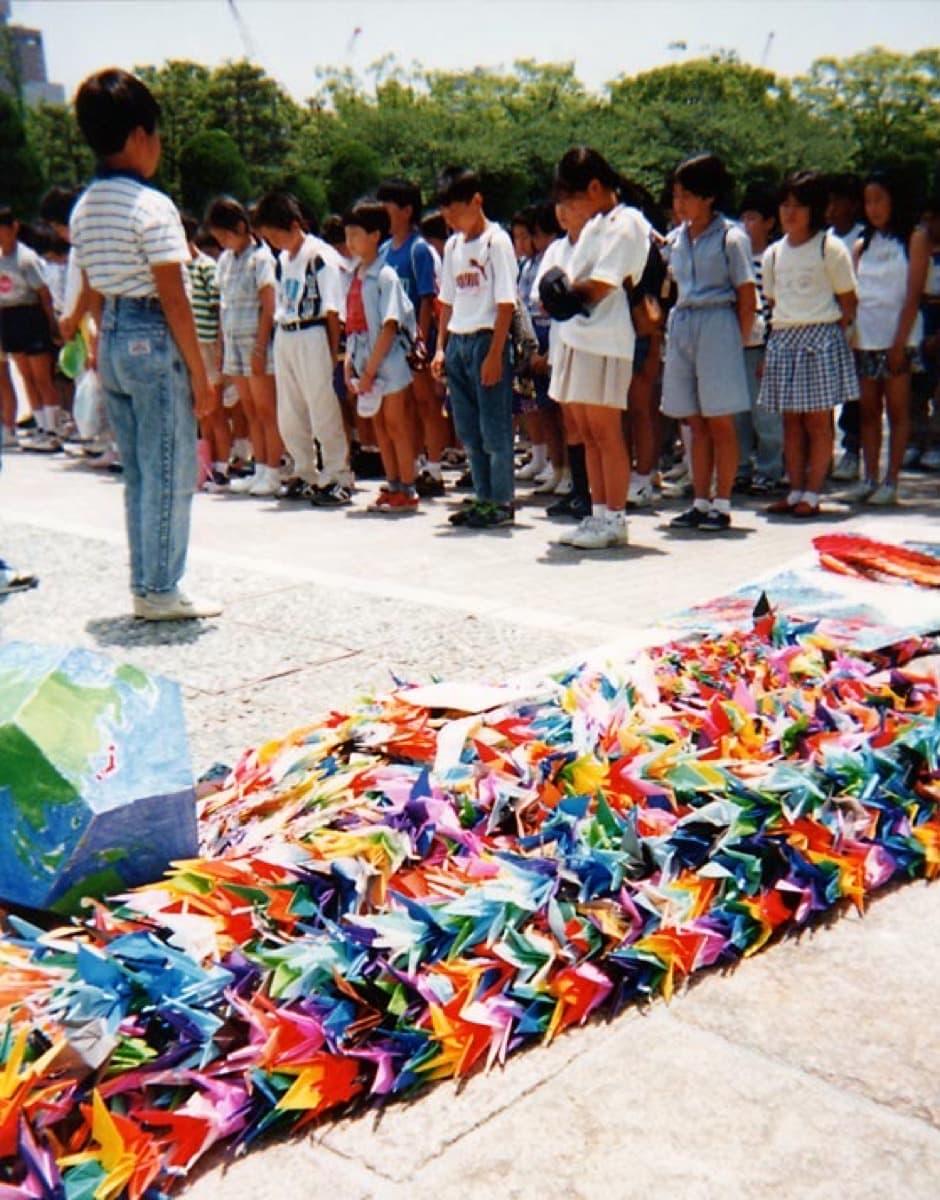
In the Hiroshima Peace Memorial Park stands a monument crowned by the figure of a girl holding a paper crane above her head, and around it hang thousands upon thousands of folded cranes sent from every corner of the world. This is the Children's Peace Monument, and it is the most tender place in the park. It exists because of one girl, Sadako Sasaki, and it was built not by the state but by her classmates and other schoolchildren. Knowing the true story turns the endless cranes from a pretty ritual into something exact and unbearable: the grief of children for children, folded into paper, ten thousand times over.
The girl and the bomb
Sadako Sasaki was a young child in Hiroshima when the atomic bomb was dropped on the sixth of August 1945. She survived the blast itself, but the radiation stayed in her. Years later she developed leukemia, the radiation-caused cancer that killed so many survivors, and she died on the twenty-fifth of October 1955, at the age of twelve. Her illness and death were part of a wave of delayed deaths that showed the bomb did not stop killing when the fires went out. It went on killing, quietly, for years, in the bodies of children who had lived through it.
What Sadako did in her final months is why she is remembered.
The thousand cranes
Hear a stop from this walk
Hiroshima Peace Memorial Museum: The City Bears Witness
There is a Japanese tradition that folding a thousand paper cranes grants the folder a wish. In her hospital bed, Sadako set herself to fold them, working through her illness toward one thousand, and her wish was not for herself but for a world at peace and free of nuclear weapons. She folded nearly a thousand cranes before she died. The image of a dying child patiently folding paper birds, wishing not to be saved but for the world to be spared, moved everyone who heard it, and it moved her classmates most of all.
Built by children, for children
After Sadako's death, her classmates could not let the loss rest. They began a campaign, joined by schoolchildren across Japan, to raise money for a monument, not just for Sadako but for all the children the bomb had killed. Their fundraising built it. The Children's Peace Monument was unveiled on the fifth of May 1958, Japan's Children's Day, designed by the artists Kazuo Kikuchi and Kiyoshi Ikebe. At its top stands the figure of a girl lifting a wire crane to the sky, with figures of a boy and a girl beside her representing the child victims. Beneath hangs a bronze crane that rings like a wind chime against a peace bell, both donated by the Nobel laureate Hideki Yukawa. At the base is carved the children's own vow: this is our cry, this is our prayer, for building peace in the world.
That the monument was built by children gives it a moral force nothing official could match. It is a memorial made by the generation that survived, for the generation that did not.
Where it sits in the park
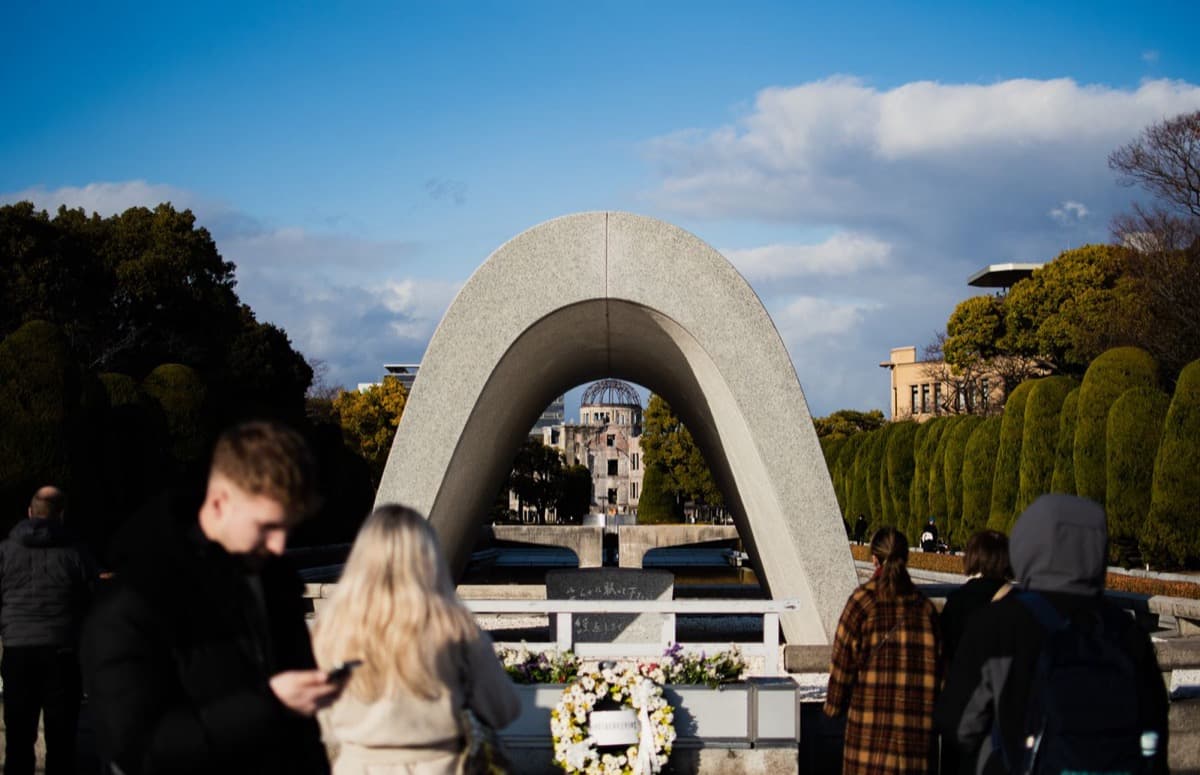
The monument is one stop on a walk through a landscape entirely devoted to memory. Roamer's The Peace Memorial: Hiroshima and the Bomb reads the whole park, from the Atomic Bomb Dome, the skeletal building left standing as witness, to the cenotaph that holds the register of the victims' names. The Children's Peace Monument is where that vast history narrows to a single child and a paper bird, and it is often where visitors are most undone. The companion walk Hiroshima Rebuilt reads the living city that grew back, including the survivor trees that lived through the blast.
Reading it in place
Come to the Children's Peace Monument with Sadako's story in mind. Look at the cranes, the real ones sent by children from all over the world, and remember that the first thousand were folded by a dying twelve-year-old wishing for peace. Read the vow at the base. It was written by children, and it was meant. Give the monument quiet and time; this is a place for stillness, not photographs alone.
The monument anchors Roamer's The Peace Memorial: Hiroshima and the Bomb. To plan a day, see one day in Hiroshima, and for the full set of routes, browse Hiroshima walking tours.
Sources
- Wikipedia, Children's Peace Monument: Sadako Sasaki, her death on 25 October 1955 from radiation-caused leukemia at age twelve, the folding of nearly a thousand paper cranes and the tradition that a thousand cranes grant a wish, the fundraising campaign by schoolchildren including Sadako's classmates, the unveiling on 5 May 1958, the designers Kazuo Kikuchi and Kiyoshi Ikebe, the figure of the girl with a wire crane and the child figures, the bronze crane and peace bell donated by Hideki Yukawa, and the inscription at the base.
- Roamer tour transcript, The Peace Memorial: Hiroshima and the Bomb (hiroshima-peace-park), fact-audited: the Children's Peace Monument and Sadako's cranes.
Ready to experience it?
The Peace Memorial: Hiroshima and the Bomb
90 min · 2 km · easy
More from Hiroshima
Explore more at your own pace.
Hiroshima Travel Guide: How Many Days, Getting Around, Miyajima, When to Go (2026)
One Day in Hiroshima: A Respectful, Walkable Itinerary (2026)
What to Eat in Hiroshima: A Food Guide (2026)
Itsukushima Shrine: The Miyajima Shrine Built Over the Sea So It Would Not Defile a Sacred Island
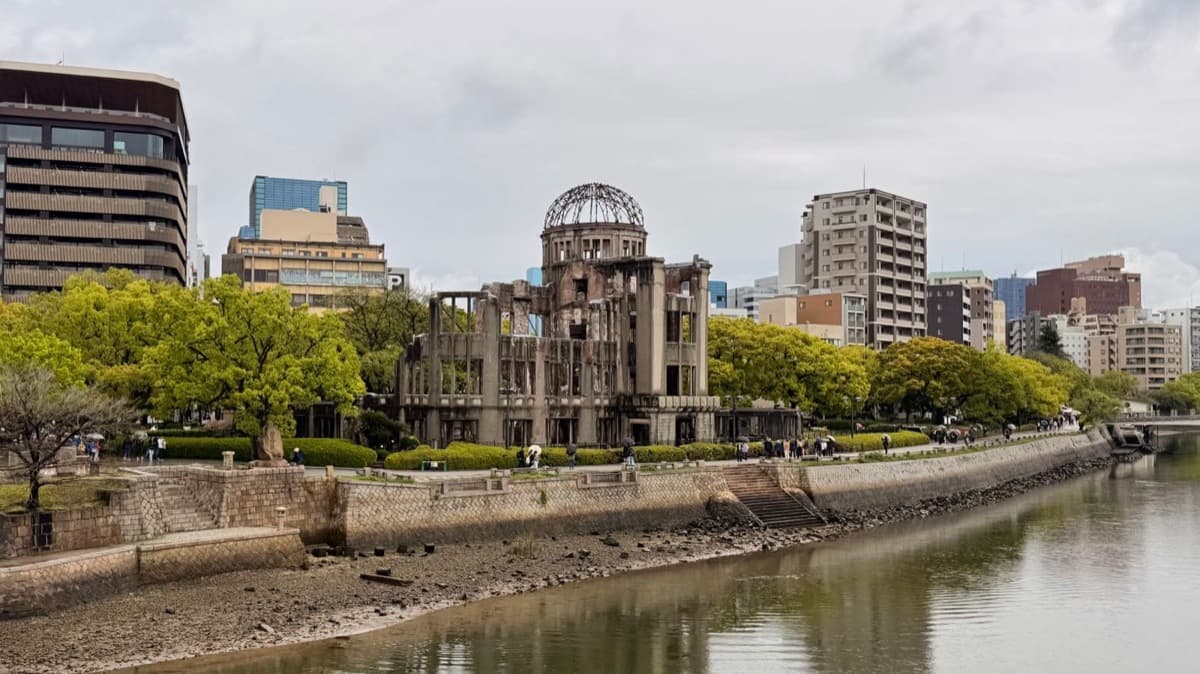
The Atomic Bomb Dome: Why Hiroshima Kept One Ruin Standing