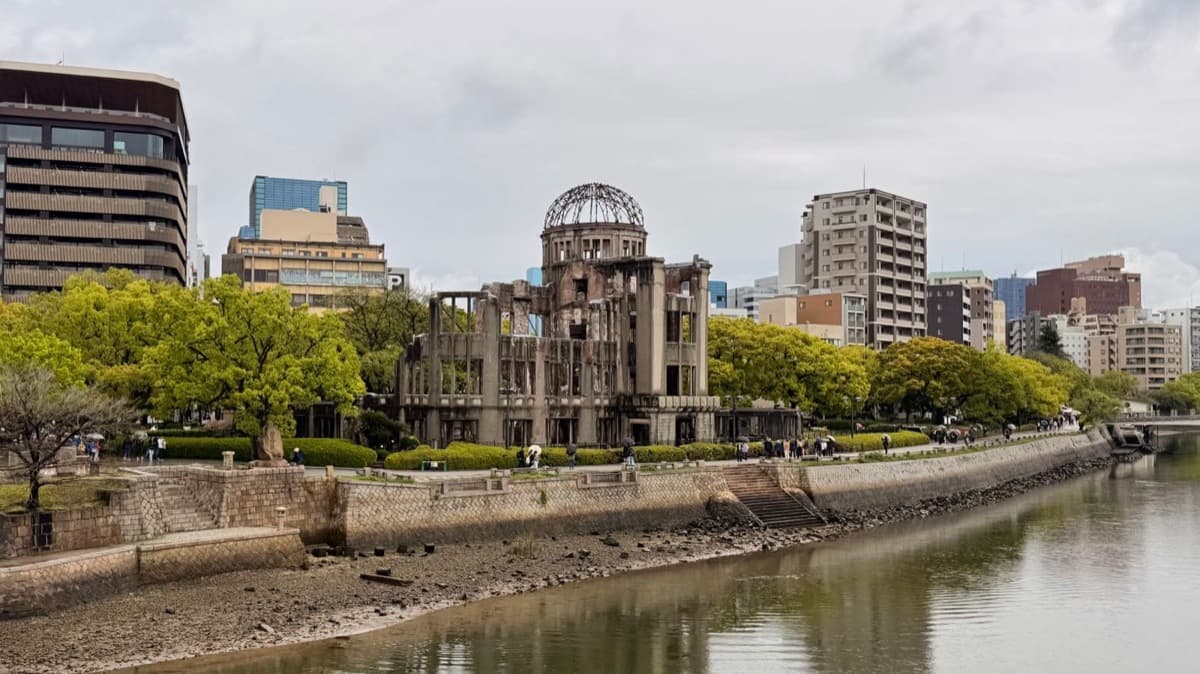
Hiroshima chose to preserve the Atomic Bomb Dome unrepaired, exactly as the blast left it, because a building that survived by the pure geometry of the airburst became the city's deliberate act of protest and its argument against ever repeating that morning. Almost every city destroyed in war clears the rubble and builds over the wound. Hiroshima did the opposite with one structure. It kept the ruin standing, added nothing, made nothing whole, and turned its own ground zero into an argument written in broken concrete and iron.
To understand why this particular shell endured while a whole district was flattened, you have to start with what it was before.
A Czech architect's copper dome
Before the sixth of August, 1945, the building was the Hiroshima Prefectural Industrial Promotion Hall. It was designed by the Czech architect Jan Letzel and completed in April of 1915. Letzel gave it a copper dome and a European elegance that stood out in the commercial center of the city, and for three decades it did ordinary civic work, hosting exhibitions and housing offices along the Motoyasu River. It was a building about commerce and display, not death. That is worth holding onto, because the fame it now carries has nothing to do with what it was built for.
The geometry that left it standing
Hear a stop from this walk
Hiroshima Peace Memorial Museum: The City Bears Witness
The reason the Dome is still there is a matter of angles, and it is grim to say plainly. The weapon detonated almost directly overhead. The blast center was roughly 150 metres to one side and about 600 metres straight up, which means the force did not arrive as a horizontal wave the way it did elsewhere in the city. It came down on this building at a steep, nearly vertical angle.
That difference decided everything. Across Hiroshima, walls met a sideways shock and were flung flat. Here the pressure pushed down rather than across, and some of the outer walls and the skeletal ribs of the dome held their footing under it. The building survived not because it was stronger but because it stood in the one place where the blast pressed vertically. Everyone inside was killed. The structure that endured is, in the most literal sense, a record of the shape of the explosion.
Preservation as protest
For years after the war the ruin was a problem the city argued over. Some residents wanted it gone. It was painful to look at, a daily reminder standing in the middle of a city trying to live again, and there were serious calls to demolish it. In the end Hiroshima decided to keep it, and to keep it in a very specific way: unrepaired, exactly as the blast left it. Nothing was added. Nothing was reconstructed into wholeness. The choice was not to restore a building but to freeze a moment.
That distinction is the whole meaning of the place. A restored monument tells you a story about recovery. An unrestored ruin refuses that comfort. What you see from the promenade that circles it is preservation used as a form of protest, the city insisting that the evidence stay visible rather than be tidied into the past.
The name the world knows
Locally the structure is called the Genbaku Dome, from the Japanese words for the atomic bomb. In December of 1996 it was registered on the UNESCO World Heritage List, recognized as a stark and enduring symbol of the hope for peace and the abolition of nuclear weapons. That listing was not without controversy at the time, but it fixed the Dome's status as a global reference point rather than a purely national one, a ruin that argues on behalf of everyone.
Where it sits in the walk
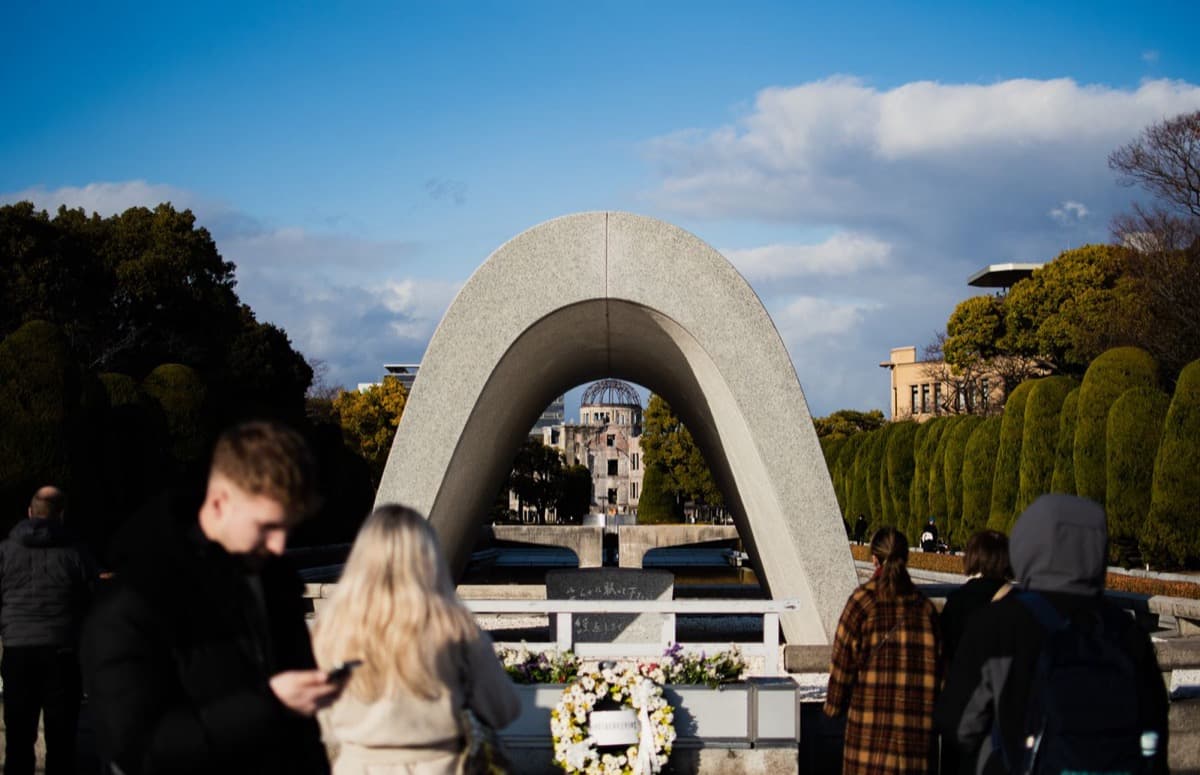
The Dome is not a stop you pass through. It is the object the entire Hiroshima Peace Memorial Park was arranged around. The park runs on a single deliberate axis, north to south, and the Dome anchors its northern end. Walk south from it and the memorial reveals itself as one continuous argument. There is the Aioi Bridge, the T-shaped span whose distinctive form made it the visual aiming point for the bombing. There is the hypocenter a short distance away, the point on the ground directly beneath the airburst, marked today by only a modest plaque beside a clinic on a working street. Further along the axis stand the Children's Peace Monument, the Flame of Peace, and the Cenotaph, whose low arch is aligned so that from the right spot you see the Flame framed within it and the Dome beyond, three things in one straight line.
Stand at the Cenotaph and look north and you understand why the Dome had to be kept. The entire park is aimed at it. Remove the ruin and the sightline points at nothing.
How to see it well
The Dome is viewed only from the outside. It is fenced, and you walk the promenade around it rather than entering. That is not a limitation to work around. It is the intended experience: you circle a wound you cannot touch. Early morning, soon after the park opens, gives you the quiet and the soft light the place asks for. Every sixth of August the surrounding grounds fill with memorial crowds, so if you want stillness, choose another day.
Give it time before moving on. The Dome does its work slowly, and it earns the silence. When you are ready to follow the axis south, from the aiming point to the ground beneath the blast to the register of the dead, the self-guided walk through the Hiroshima memorial park carries the same line the city itself drew: from the object of witness to the response it demands.
Sources
- Hiroshima Peace Memorial (Genbaku Dome), Wikipedia. Confirms Jan Letzel as the Czech architect, April 1915 completion, the 150 metre horizontal and 600 metre vertical blast geometry, and December 1996 UNESCO inscription.
- The Story of the Atomic Bomb Dome, City of Hiroshima official site. The municipal account of the preservation decision and the building's original use.
- Aioi Bridge, Wikipedia. Confirms the T-shaped bridge was the aiming point for the bombing because its shape was easily recognized from the air.
- Hiroshima Peace Memorial Park, Wikipedia. Confirms the Cenotaph is aligned to frame the Peace Flame and the A-Bomb Dome in a single ceremonial sightline.
- UNESCO World Heritage List entry for the Hiroshima Peace Memorial. The official basis for its inscription as a symbol of the hope for peace.
Ready to experience it?
The Peace Memorial: Hiroshima and the Bomb
90 min · 2 km · easy
More from Hiroshima
Explore more at your own pace.
Hiroshima Travel Guide: How Many Days, Getting Around, Miyajima, When to Go (2026)
One Day in Hiroshima: A Respectful, Walkable Itinerary (2026)
What to Eat in Hiroshima: A Food Guide (2026)
Itsukushima Shrine: The Miyajima Shrine Built Over the Sea So It Would Not Defile a Sacred Island
The Children's Peace Monument: Sadako, the Paper Cranes, and a City's Vow