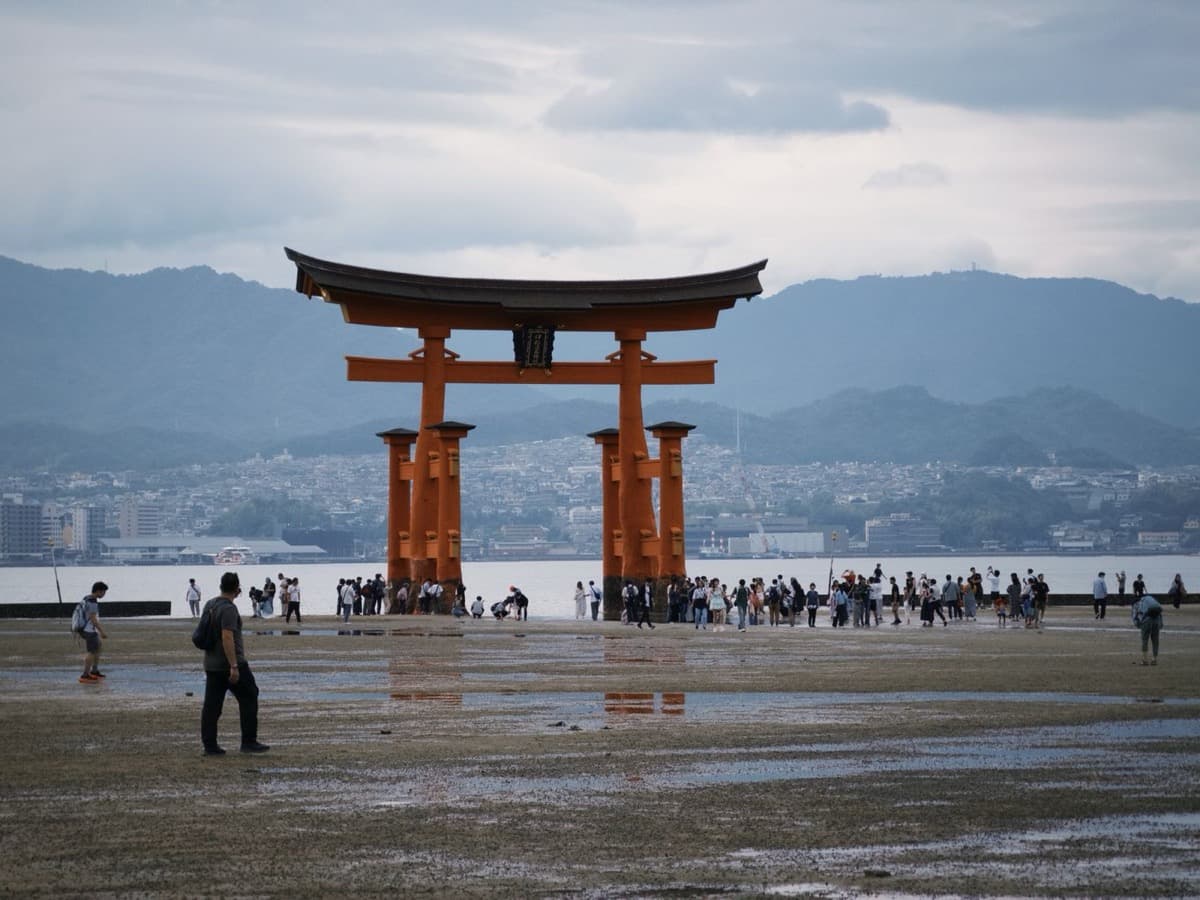
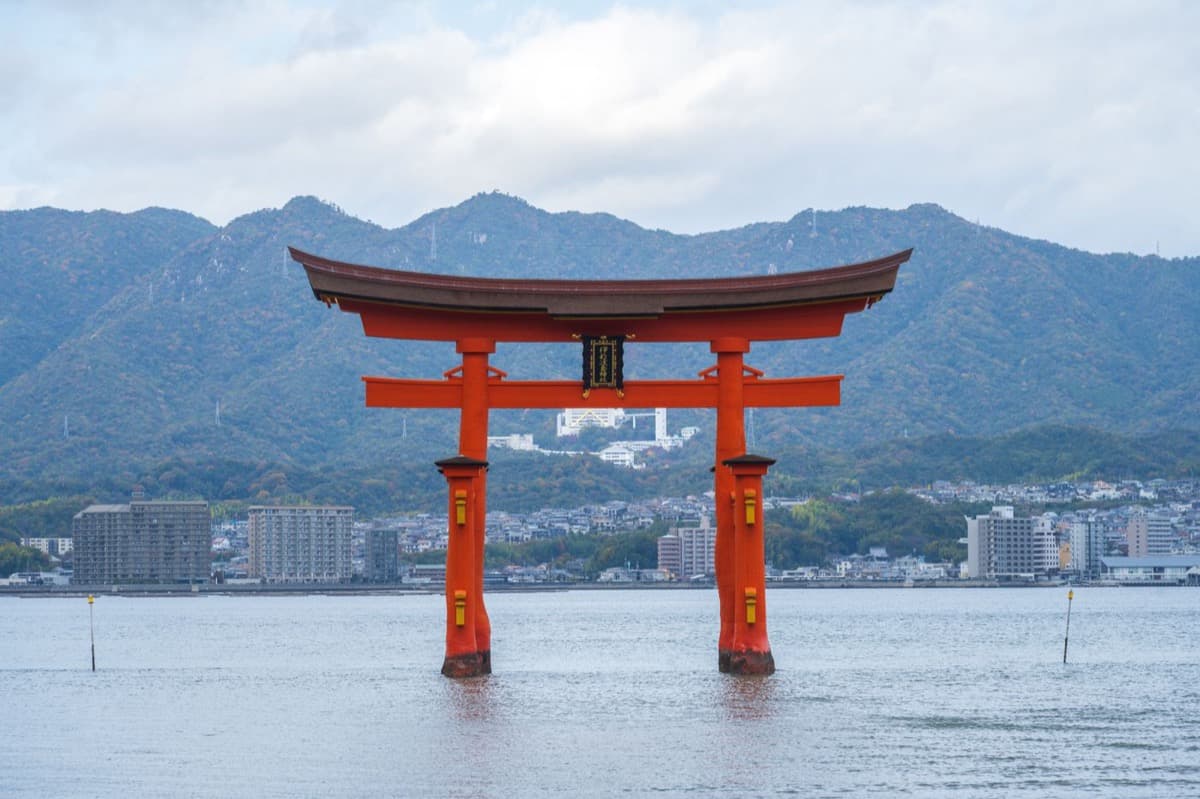
The great vermilion gate at Miyajima appears to float on the sea, yet it is not buried in the seabed and not anchored to the earth. It holds itself up by its own tremendous weight, resting on a bed of stakes driven into the tidal flat, standing on the tideline as a threshold to an island so sacred that people once believed no one should set foot upon it. Understanding that single fact changes how you read everything on the island of Itsukushima.
Locals and the Miyajima Tourist Association call it the O-torii, the great gate. The tourist association gives its overall height as about 16.6 metres, with main pillars roughly 13.4 metres tall, and it sits out on the tidal flat in front of Itsukushima Shrine. At high tide the sea slides in beneath it and the gate seems cut loose from the ground, drifting on the water. At low tide the sea pulls back and you can walk out across the wet sand, right up to the base, and lay your hand on pillars thicker than you can reach around. Most travelers cross the Seto Inland Sea from Hiroshima to see exactly this, the gate that changes character with the tide.
The trick is that there is no trick
The detail that surprises almost everyone is structural. The gate is not sunk into the seabed. It is not embedded, not cemented, not pinned. It stands by weight alone, resting on a foundation of stakes driven into the tidal flat, a system called senbon-gui, the thousand pillars. The main pillars are camphor wood, chosen because camphor resists rot in the salt and the damp far better than most timber. The gate distributes its enormous mass across that bed of stakes and simply presses down, holding its footing against wind and tide by physics rather than by burial.
That is a strange way to build the most important structure on a sacred island, until you understand what the gate is for. A torii has no wall and no door. It is a threshold, a marker of the boundary between the ordinary world and a holy one. On Miyajima the logic runs deeper than usual, because the island itself, whose proper name is Itsukushima, was long regarded as a deity. It was kept so pure that ordinary people were not permitted to be born or to die on its ground. Since 1878, no births or deaths have been permitted near the shrine, and traditionally pregnant women and the seriously ill crossed back to the mainland. If the island is the shrine, then the gate cannot stand on it. It has to stand out in the water, on the tideline, neither fully on the holy ground nor off it. You pass through it by boat when the tide is high, or across the sand when the tide is low, and either way you cross from the human world into the divine.
Nine gates on one spot
Hear a stop from this walk
Mount Misen: The Summit and the Flame
The gate you photograph today is not ancient in its timber, though the tradition is. It is the ninth gate to stand on this site, raised in 1875, in the eighth year of the Meiji era. Salt, wind, and the sea are relentless, and over the centuries the gate has been rebuilt again and again on the same stretch of tideline. A torii has marked this spot since the time of Taira no Kiyomori, the powerful warrior aristocrat of the twelfth century who lived from 1118 to 1181 and who shaped the shrine into the elegant over-water form still standing behind the gate. His work on the shrine dates to 1168, so while the wood you see is from the Meiji era, the idea of a threshold in the sea here is more than eight hundred years old.
The gate is also a living object that needs care. From June 2019 to December 2022 the O-torii went through a major renovation, the largest in decades, and for more than three years it stood wrapped in scaffolding and white sheeting while crews reinforced the pillars, which had been eaten at by seawater and termites, and repainted the timber in vermilion. Travelers who arrived in that window found the island's signature view hidden behind a construction shell. If you are reading this now, the scaffolding is long gone and the gate stands clear again, but it is worth knowing that what looks eternal is in fact maintained, plank by plank, generation by generation.
How to read it when you are there
The gate rewards a little planning, because the sea decides what you will see. Check the day's tide chart before you cross. At low tide you can walk out across the flat and stand at the base of the pillars, which is the only way to feel the scale of the thing, the camphor trunks looming over you, the barnacles and the wet sand underfoot. At high tide you step back and watch it appear to float, the classic postcard, best in the softer light of early morning or late afternoon. Many people time a day on the island to catch both, arriving around one tide and leaving around the other.
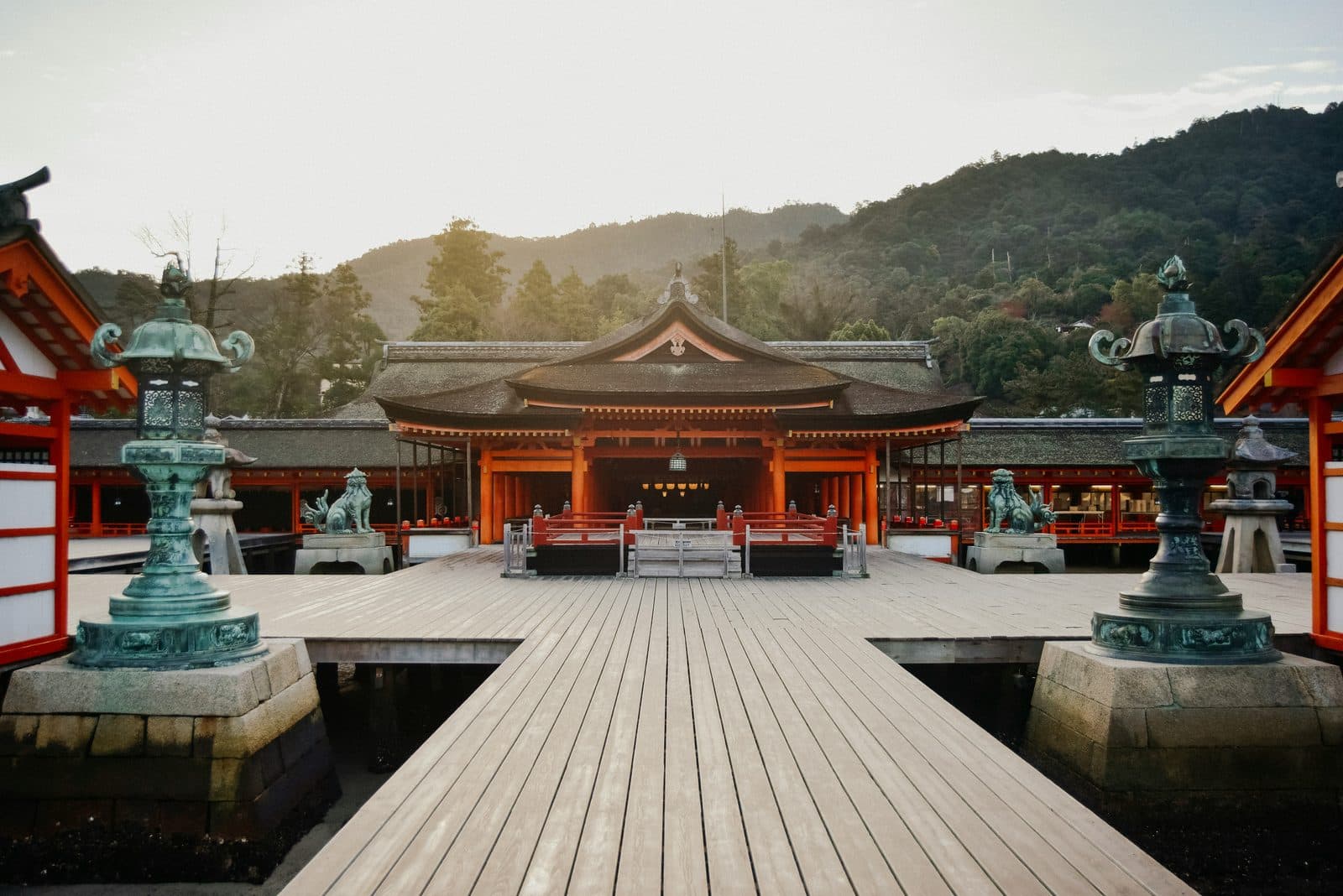
Stand with the gate a while and let it teach you the rest of the island. Behind it, Itsukushima Shrine repeats the same idea at the scale of a building: vermilion halls raised on stilts over the water so worshippers never touch the sacred ground. UNESCO inscribed the shrine as a World Heritage Site in 1996, recognizing exactly this fusion of architecture and natural setting. Everything on Miyajima, the deer that wander unafraid because no blood may be shed here, the shrine that hovers above the tide, the pagoda and the temple on the slopes above, is an answer to one question the gate asks first: how do you come close to something this holy without trespassing on it.
Watch the water decide whether it floats. That slow tidal argument, played out beneath a gate held up by nothing but its own weight, is the whole reason to make the crossing. When you are ready to walk the rest of the island, from the deer on the shore up to the eternal flame on Mount Misen, the highest point of the island, the self-guided tour picks up here at the gate and carries you to the summit. You can find the full route on the Hiroshima page.
Sources
- Itsukushima Shrine, Wikipedia: the shrine's history since 1168, the purity taboo dating to 1878, Mount Misen as the island's summit, and the camphor-wood gate.
- O-torii Gate, Miyajima Tourist Association: official dimensions, the 1875 gate as the ninth on the site, and that it is supported by its own weight.
- The Reiwa Renovation of the Great Torii Gate, Dive Hiroshima (official tourism): confirms the June 2019 to December 2022 renovation.
- Three-and-a-half-year Miyajima shrine gate renovation officially completed, Get Hiroshima: renovation timeline, pillar reinforcement, and scaffolding removal.
- Itsukushima Shinto Shrine, UNESCO World Heritage Centre: 1996 World Heritage inscription.
Ready to experience it?
Miyajima: The Floating Shrine
180 min · 4 km · moderate
More from Hiroshima
Explore more at your own pace.
Hiroshima Travel Guide: How Many Days, Getting Around, Miyajima, When to Go (2026)
One Day in Hiroshima: A Respectful, Walkable Itinerary (2026)
What to Eat in Hiroshima: A Food Guide (2026)
Itsukushima Shrine: The Miyajima Shrine Built Over the Sea So It Would Not Defile a Sacred Island
The Atomic Bomb Dome: Why Hiroshima Kept One Ruin Standing