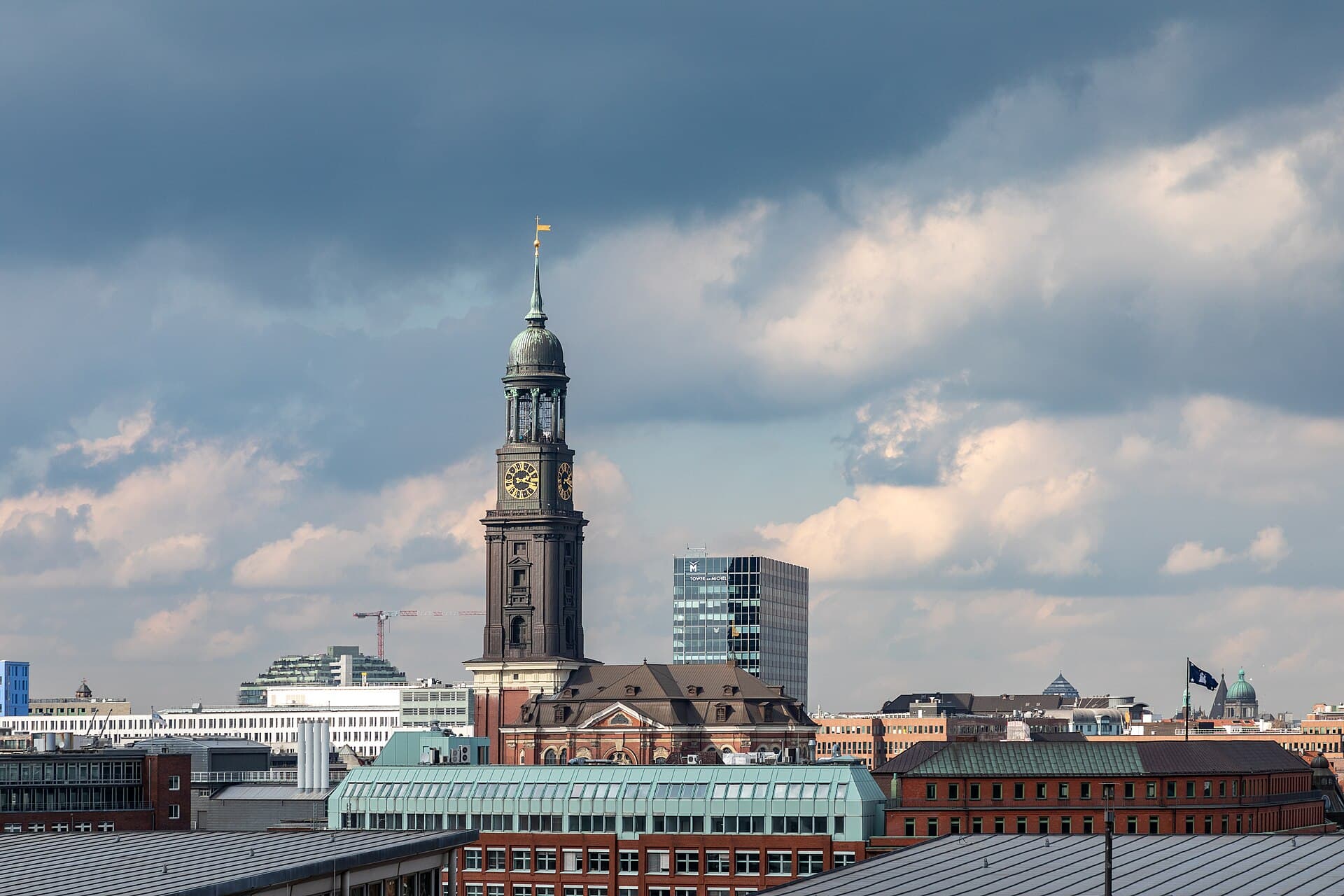
Stand at the foot of St. Michaelis, the Baroque Protestant church every Hamburger simply calls Der Michel, and the first thing to understand is that its copper spire was never meant only to be admired. It was built to be found. A merchant city that lived by the sea needed a landmark a ship's captain could pick out from the water, and this one hundred thirty-two metre tower, sheathed entirely in copper, was exactly that: a seamark for vessels coming up the River Elbe toward the port. The clock faces are eight metres across, the largest in Germany. But the church earns its place in Hamburg's story less for its size than for a stubborn habit the city has kept for centuries. When the Michel burned, or was struck, or was bombed, Hamburg raised it again. Every time.
A landmark you could steer by
To read the Michel correctly, picture the approach from the river rather than the square. A captain working up the Elbe toward Hamburg's harbour was navigating a tidal estuary, and the copper tower rising above the city gave a clear, fixed bearing. That is the practical logic behind the whole building. Decoration and devotion came bundled with a working function: the spire told sailors they had arrived. For a self-governing city of merchants whose entire prosperity moved on water, a visible point on the skyline was not vanity. It was infrastructure.
The copper covering matters here too. Copper weathers to that pale sea-green over time, which makes the spire legible against a grey northern sky, and it has been the tower's material through its successive rebuildings. Today there is an observation deck at one hundred six metres up the tower, and the view rewards the climb, but the original audience for this height stood on a deck below, watching for the moment the Michel came into sight.
Built, burned, struck, and raised again
Hear a stop from this walk
Mahnmal St. Nikolai: The Church Kept as a Warning
The church you see is not the first Michel, or even the second in any simple sense. The first was built between 1647 and 1669. On the tenth of March, 1750, lightning struck the tower and destroyed it. A second church was inaugurated in 1762, and its tower completed in 1786. That building burned in 1906 and was rebuilt. It was then damaged in the bombings of 1944 and 1945 during the Second World War, and rebuilt once more.
Set those dates in a line and a pattern comes clear. Across nearly four centuries, the Michel has been undone by almost every kind of catastrophe a European city can suffer: a random bolt of lightning, an accidental fire, and deliberate wartime destruction. Each time, Hamburg chose the same answer. It cleared the wreckage and built the spire back up, copper and all, so that the skyline the city knew was restored. That repetition is the point. The Michel is not a single moment of architecture preserved under glass. It is a record of decisions, made again and again, to keep a particular tower standing where sailors expected it.
Two churches, two answers
The most revealing way to understand the Michel is to hold it against another church a short walk away, the ruined St. Nikolai. Both were shaped by fire and by the Second World War. St. Nikolai lost its spire in Hamburg's Great Fire of 1842, was rebuilt, and was then gutted by Allied bombing on the twenty-eighth of July, 1943, during the campaign known as Operation Gomorrah. The nave was demolished in 1951. What remains, the tower and some broken walls, was deliberately left as a ruin. Hamburg keeps it that way on purpose, as a Mahnmal, a memorial that is also a warning, so that no one forgets what the war brought and what Germany set loose to bring it.
The Michel is the counterweight. Where St. Nikolai is preserved broken, the Michel is rebuilt whole. One church the city restores every time it falls; the other it holds in permanent ruin. A city that governs itself gets to make that kind of choice, and Hamburg made both at once. Standing in front of the Michel with St. Nikolai in mind, you are looking at a deliberate pairing: pride in what a merchant republic built, set beside a clear-eyed refusal to hide what its century helped set loose. Neither church means as much alone as the two mean together.
Standing in front of it
The one thing to carry into the square is this: the Michel was a working object before it was a monument. Look up at the copper and imagine it not from where you stand but from the deck of a ship on the Elbe, still an hour from the quay, watching for the tower to confirm the city was there. That is what the spire was for. Everything else, the Baroque interior, the giant clock faces, the observation deck, sits on top of that first, plain job of being findable from the water.
If you want the view, the deck at one hundred six metres is open for a modest admission, and the church itself is free to enter. But the deeper reward is understanding why a self-made city of merchants poured this much into a single silhouette. It was building the landmark that told its own ships they were home.
The Michel is the closing stop on Roamer's self-guided audio walk through Hamburg's merchant history, a seven-stop route that starts at the palace-like Rathaus, passes the chamber of commerce, the dammed Binnenalster lake, the Great Fire site, and the ruined St. Nikolai before ending here at the seamark. Walking it in order lets the two churches, one rebuilt and one preserved broken, land the way the city intended. Browse the full set of Hamburg walking tours, or start planning from the Hamburg city page and take the route at your own pace.
Sources
- St. Michael's Church, Hamburg (Wikipedia): construction dates from 1647 onward, the 1750 lightning strike, the 1906 fire, wartime damage, spire height, copper covering, and the eight-metre clock faces.
- Hauptkirche St. Michaelis official site (st-michaelis.de): the church's own account of its history, the observation deck, and visitor information for the tower and crypt.
- St. Nicholas Church, Hamburg (Wikipedia): the Great Fire of 1842, the 1943 Operation Gomorrah bombing, the 1951 demolition of the nave, and the decision to preserve the tower as a memorial.
- Roamer tour "The Republic of Merchants" (fact-audited tour transcript): the framing of the Michel as a seamark and the contrast between the two churches within Hamburg's merchant history.
Ready to experience it?
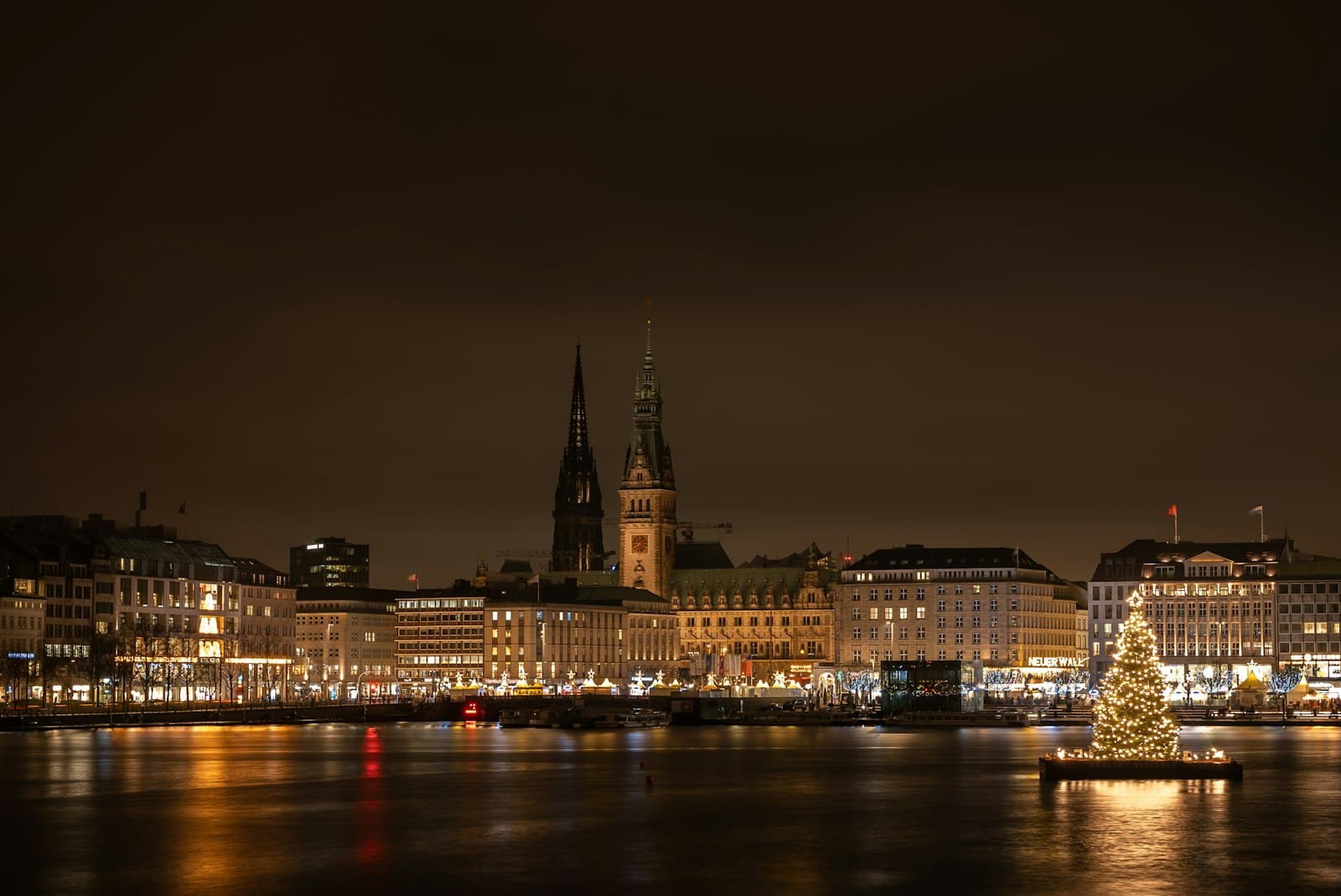
Rathaus and Altstadt: The Republic of Merchants
100 min · 2.9 km · easy
More from Hamburg
Explore more at your own pace.
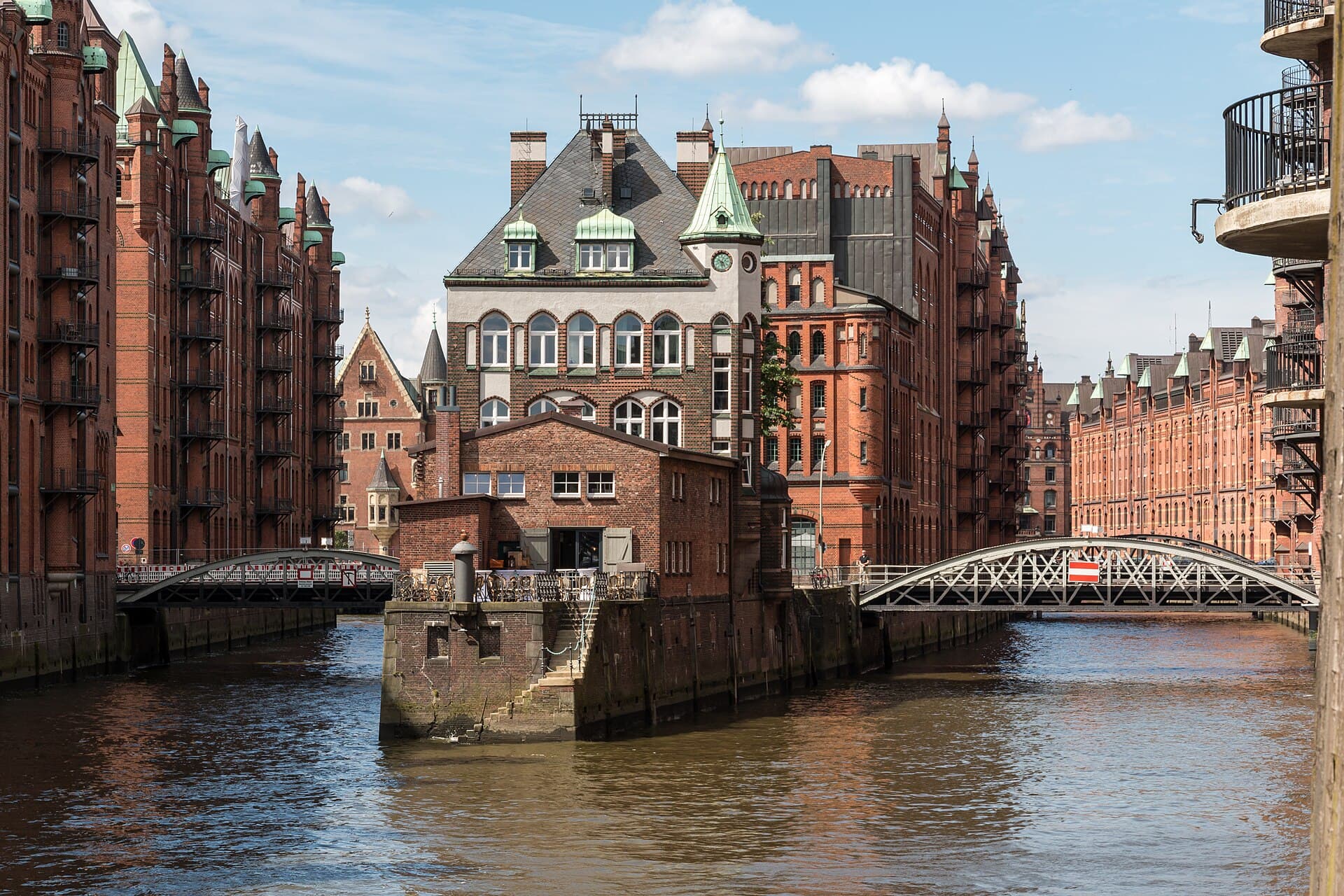
Hamburg, the Free Port of Merchants: A Republic Built on Trade and the Tide
Hamburg's Speicherstadt: Reading a Port Through Brick on Oak Over Water
On the Grosse Freiheit, Where the Beatles Grew Up
The Hamburg Rathaus: A Palace Built by a Republic With No Throne
The Chilehaus: Reading Hamburg's Brick Ship