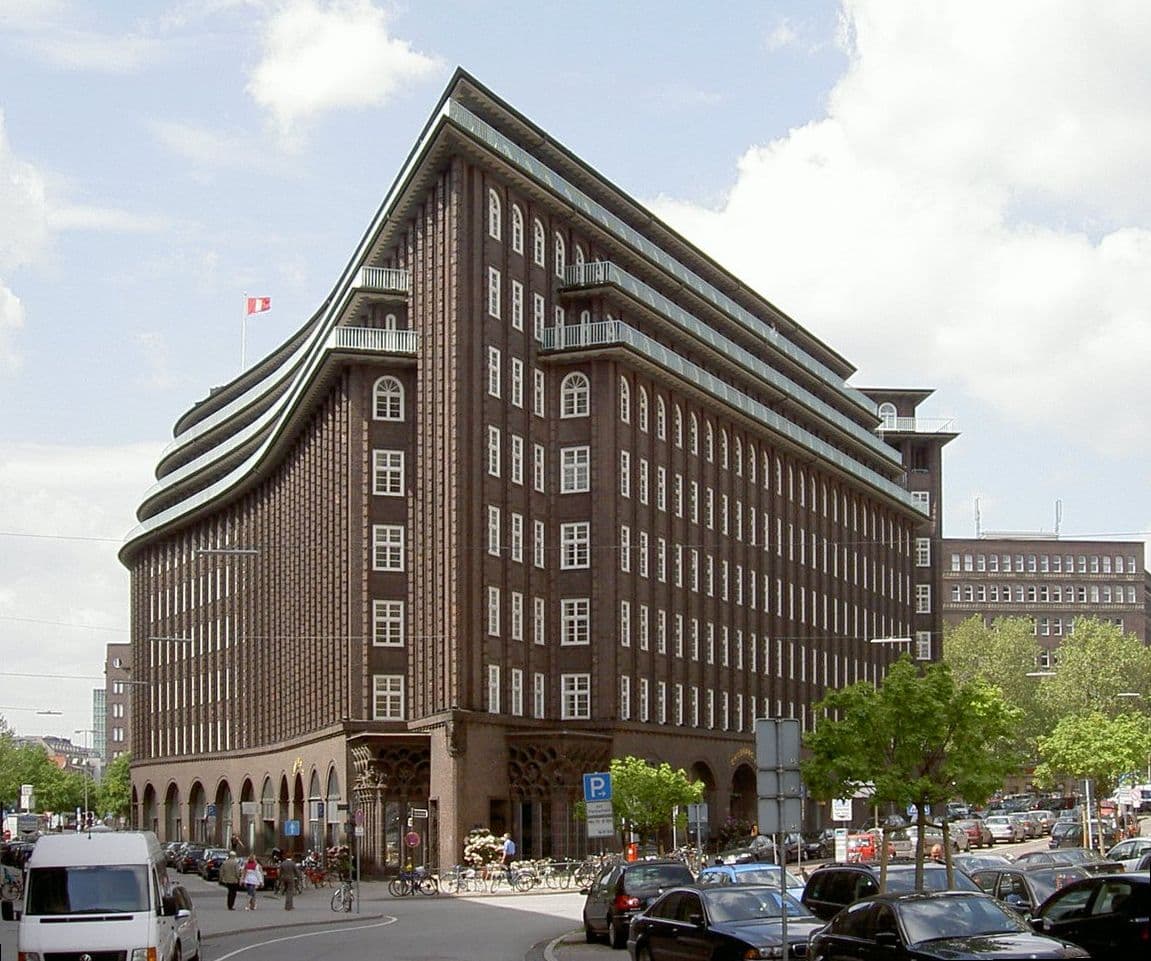
Walk toward the eastern corner of the Chilehaus, where two brick facades rush together at an acute angle, and a ten-storey office block resolves into the shape of a ship's prow cutting through the city. That single gesture, brick shaped like a vessel, is the thing to understand standing in front of this building. Designed by the architect Fritz Höger and built between 1922 and 1924 in Hamburg's Kontorhaus District, the Chilehaus takes a humble port material, dark clinker brick, and turns it into a statement about the sea, about trade, and about a city whose wealth came off the water.
The Corner That Reads as a Prow
Most buildings ask you to look at their front. The Chilehaus asks you to look at its edge. The famous view is from the east, where the two long walls converge so sharply that the corner nearly comes to a point. From close range and at an angle, the effect is unmistakable: a bow, a hull, a ship driving forward through the streets of a harbour town. It is not a decorative flourish tacked onto a rectangular box. The whole massing of the building bends toward that corner, and the upper storeys step back in tiers so the prow seems to rise as it advances.
This is architecture designed to be experienced on foot, from the pavement, at walking pace. You cannot see the ship from a photograph taken head-on, and you cannot see it from across a wide plaza. You have to stand near the point and look along the converging walls. That is worth remembering: the Chilehaus rewards the pedestrian, not the passing car, which is exactly the kind of building a walking route is built to reveal.
Brick That Stopped Being Storage
Hear a stop from this walk
The Chilehaus: Brick as a Ship's Prow
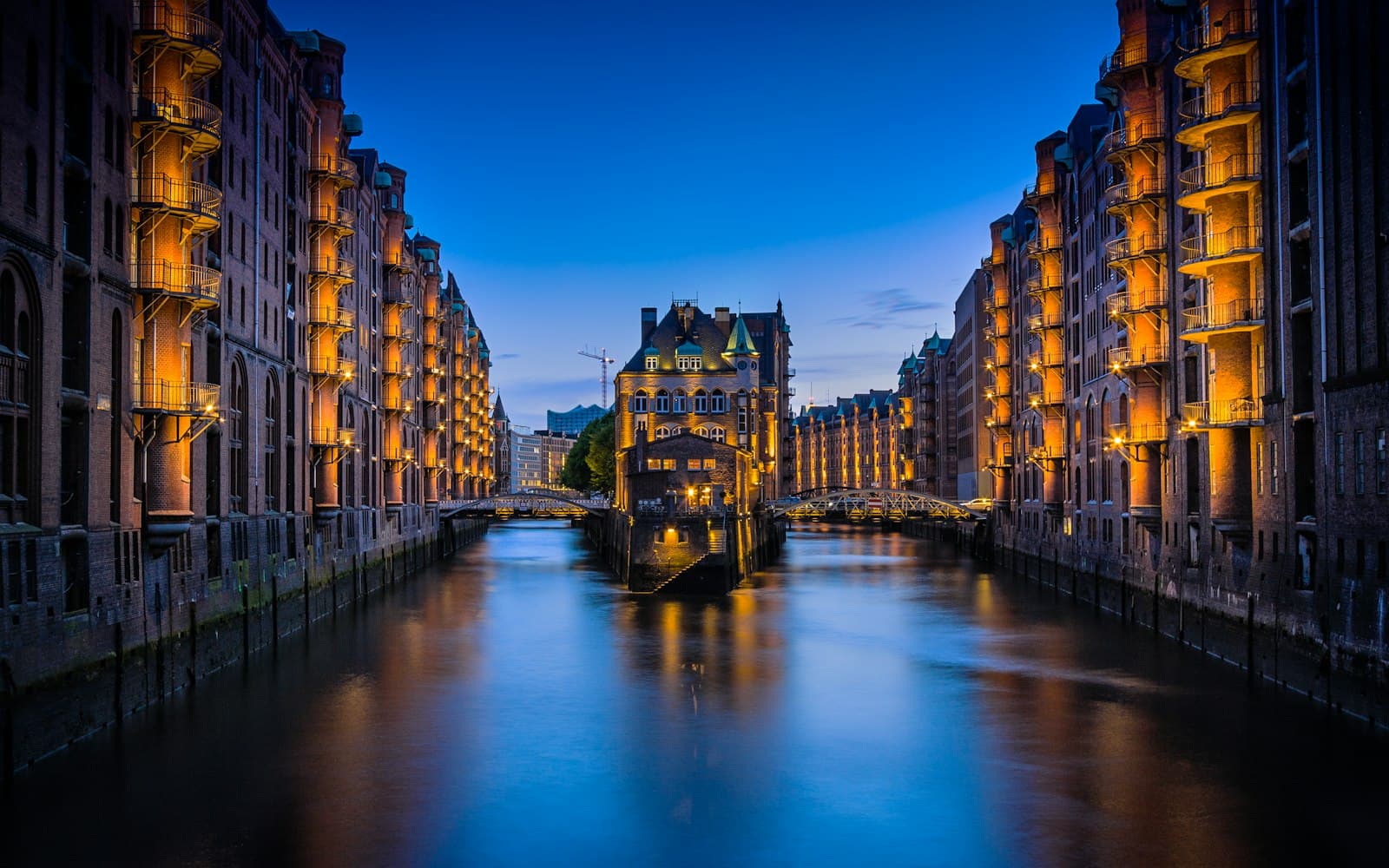
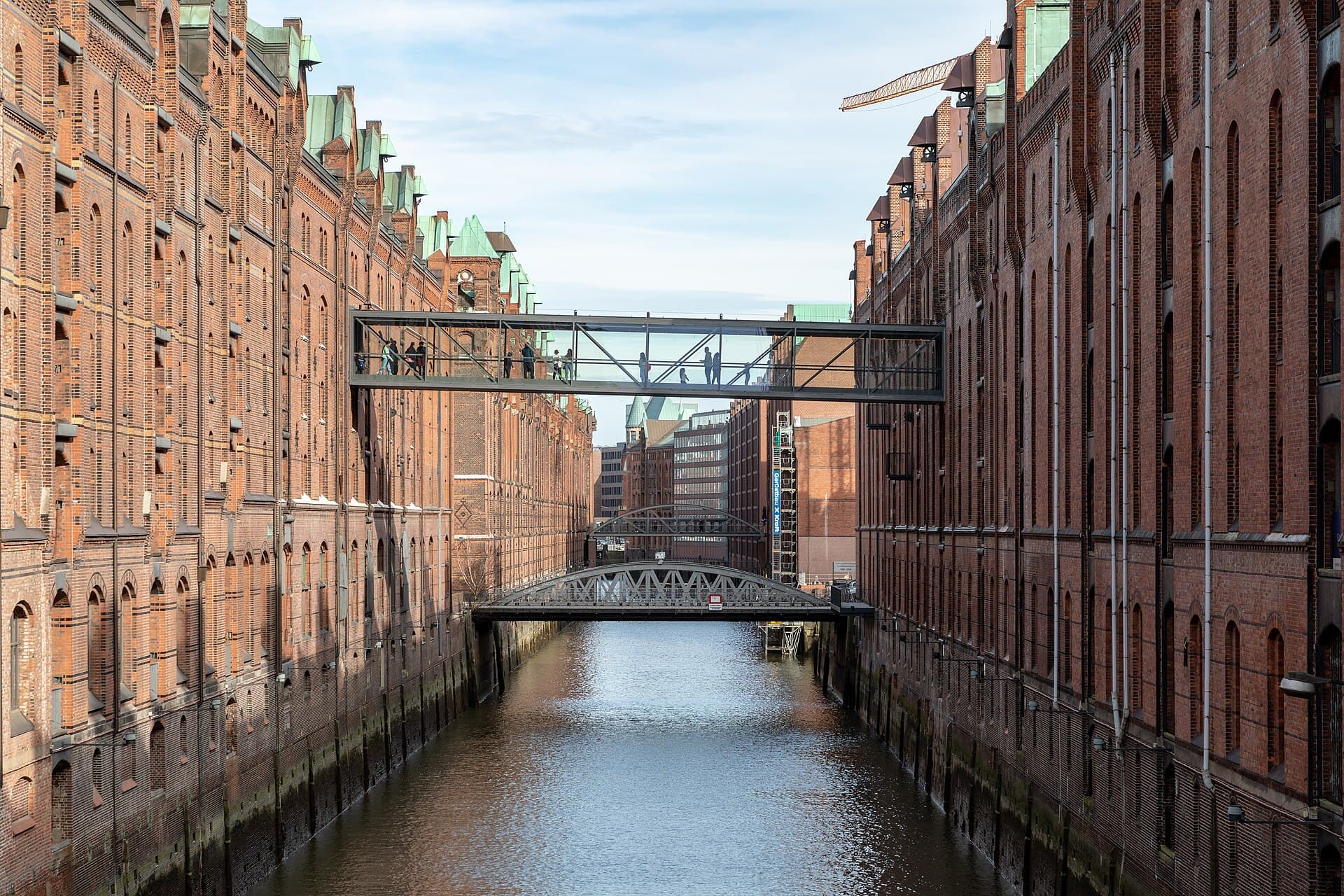
To read the Chilehaus properly, it helps to know what it is answering. A few hundred metres west sits the Speicherstadt, Hamburg's vast red-brick warehouse district, where the same material was used for pure storage: lofts, winches, canal-facing doors, cargo hauled off barges and packed away without ceremony. Brick there is functional and repetitive, a tool for holding coffee, tea, tobacco, and spices.
The Chilehaus is what happens when that same brick stops merely holding cargo and starts making an argument. It is a masterpiece of what Germans call Backsteinexpressionismus, Brick Expressionism, and it is faced in roughly 4.8 million dark clinker bricks. Clinker is brick fired hard, until it darkens and vitrifies, and the surface catches light in restless, shifting patterns rather than lying flat. Look at how the facades are not smooth planes but sculpted texture, with brick laid to throw shadow and articulate the tiers. The building moves in the changing light of a northern port sky. It is expressive where the warehouses are plain, ambitious where they are practical.
That shift, from storage to statement, is the real subject here. Both are brick. Both belong to the same harbour economy. But one is a machine for cargo and the other is a piece of civic ambition dressed in the same material.
The Money Came From Nitrate
The building's name is the tell. It is called the Chilehaus, the Chile House, and the reason sits several thousand kilometres from Hamburg. It was commissioned by the shipping magnate Henry B. Sloman, whose fortune came from trading Chilean saltpetre, a nitrate mineral. So a Hamburg office block, faced in German clinker and shaped like a European ship, is named after a South American mineral, because the trade in that mineral is what paid for it.
That naming is not a curiosity. It is the entire economic logic of the port made visible in a single word. Hamburg's wealth was never local. It flowed in from distant coasts, from cargoes landed and re-exported, from goods that most of the merchants who profited had never seen grow. The Chilehaus is a monument to that long-distance trade, financed by nitrate hauled across an ocean, and it wears its origin openly on its address.
A Modern Answer to an Old Problem
There is one more thing to understand at ground level, and it is literally underground. The Speicherstadt warehouses stand on countless oak logs driven into the soft, waterlogged marsh of the former Elbe islands, timber that survives because it stays permanently soaked and never meets the air that would rot it. The Chilehaus faces the same difficult ground, the same soft earth near the Elbe, but it solves the problem in a newer way. Rather than oak, it rests on modern reinforced-concrete pilings driven some 16 metres deep.
So the building is a hinge in more than one sense. Above ground it turns brick from storage into expression. Below ground it turns the old timber-pile solution into a modern concrete one. Same marsh, same weight problem, a twentieth-century answer instead of a nineteenth-century one. The Chilehaus sits at the seam between two ways of conquering the same wet ground.
Why It Shares a World Heritage Listing
In 2015, the Chilehaus was recognised as part of a UNESCO World Heritage Site, inscribed jointly with the neighbouring warehouse district under the name Speicherstadt and Kontorhaus District with Chilehaus. That pairing is deliberate and instructive. UNESCO did not list the ship-prow office block on its own, as an isolated architectural marvel. It listed it together with the storage district next door, because the two only make full sense as a pair: the warehouses that held the cargo, and the office houses, the Kontorhäuser, where the paperwork and the profit of that same trade were managed.
Read that way, the Chilehaus is not just a beautiful corner. It is the commercial brain of a system whose muscle is the Speicherstadt. Standing in front of it, you are looking at the desk side of the harbour, the place where the money made from moving goods across the world was counted and directed, built in the same brick as the lofts that held those goods.
Walk It in Context
The Chilehaus is free to look at from the street, and it takes only a few minutes to walk up to the eastern corner and see the prow appear. But it means far more when you have just come from the warehouses it answers and can carry the contrast in your head. That is exactly the sequence the Hamburg walking tours on the app are built around, and the Chilehaus sits as the fifth stop on the Speicherstadt route, the hinge between storage and spectacle. Walk it in order, from the customs canal to the oak-borne warehouses to this brick ship, and the single corner stops being a photo opportunity and becomes the turning point of a whole story about brick, water, and trade. Explore more routes through Hamburg to plan the wider walk.
Sources
- Chilehaus, Wikipedia: architect Fritz Höger, 1922 to 1924 construction, Brick Expressionism, the 4.8 million clinker bricks, and the Sloman saltpetre commission.
- Speicherstadt and Kontorhaus District with Chilehaus, UNESCO World Heritage List (2015 inscription): the joint listing that pairs the office district with the warehouses.
- The Chilehaus, Hamburg's official tourism site (hamburg.com): construction 1922 to 1924, ship's-prow corner, and the World Heritage designation.
- Roamer tour, The City of Warehouses on Oak (Hamburg Speicherstadt): fact-audited stop-by-stop narration used as the primary source for this article.
Ready to experience it?
Speicherstadt: The City of Warehouses on Oak
105 min · 4 km · easy
More from Hamburg
Explore more at your own pace.
Hamburg, the Free Port of Merchants: A Republic Built on Trade and the Tide
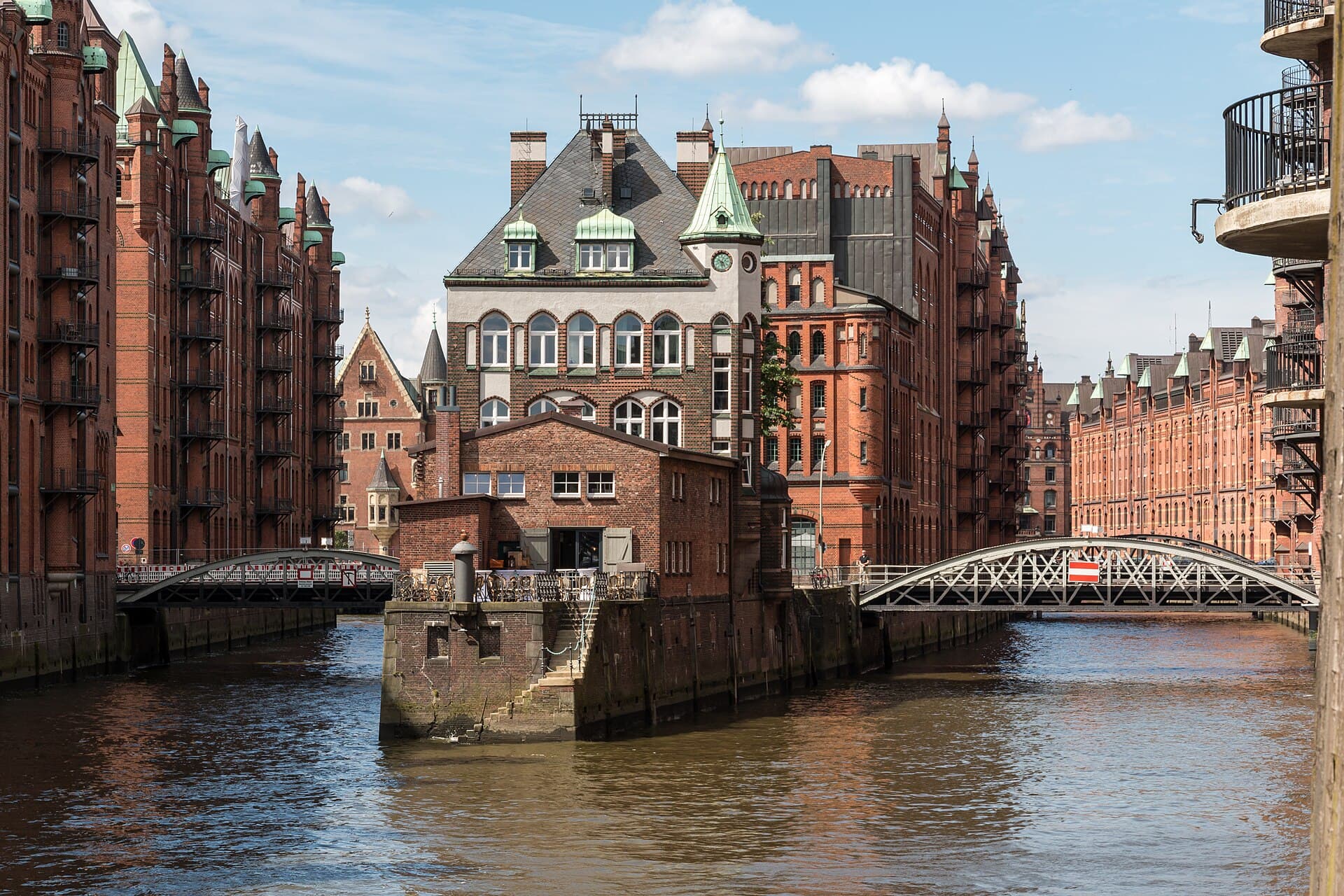
Hamburg's Speicherstadt: Reading a Port Through Brick on Oak Over Water
On the Grosse Freiheit, Where the Beatles Grew Up
The Hamburg Rathaus: A Palace Built by a Republic With No Throne
Der Michel: How Hamburg's Copper Spire Guided Ships Home