The Speicherstadt is the grammar of Hamburg's port made physical: red brick laid on oak piles over tidal water, a district raised to dodge a tax. Learn to read that one sentence and the rest of Hamburg's harbor explains itself, from a customs canal to a ship-prow office block to a concert hall crowned with a glass wave. This is a walk about one material, and about what a proud free city was willing to do to keep trading.
Start with the bargain, not the beauty
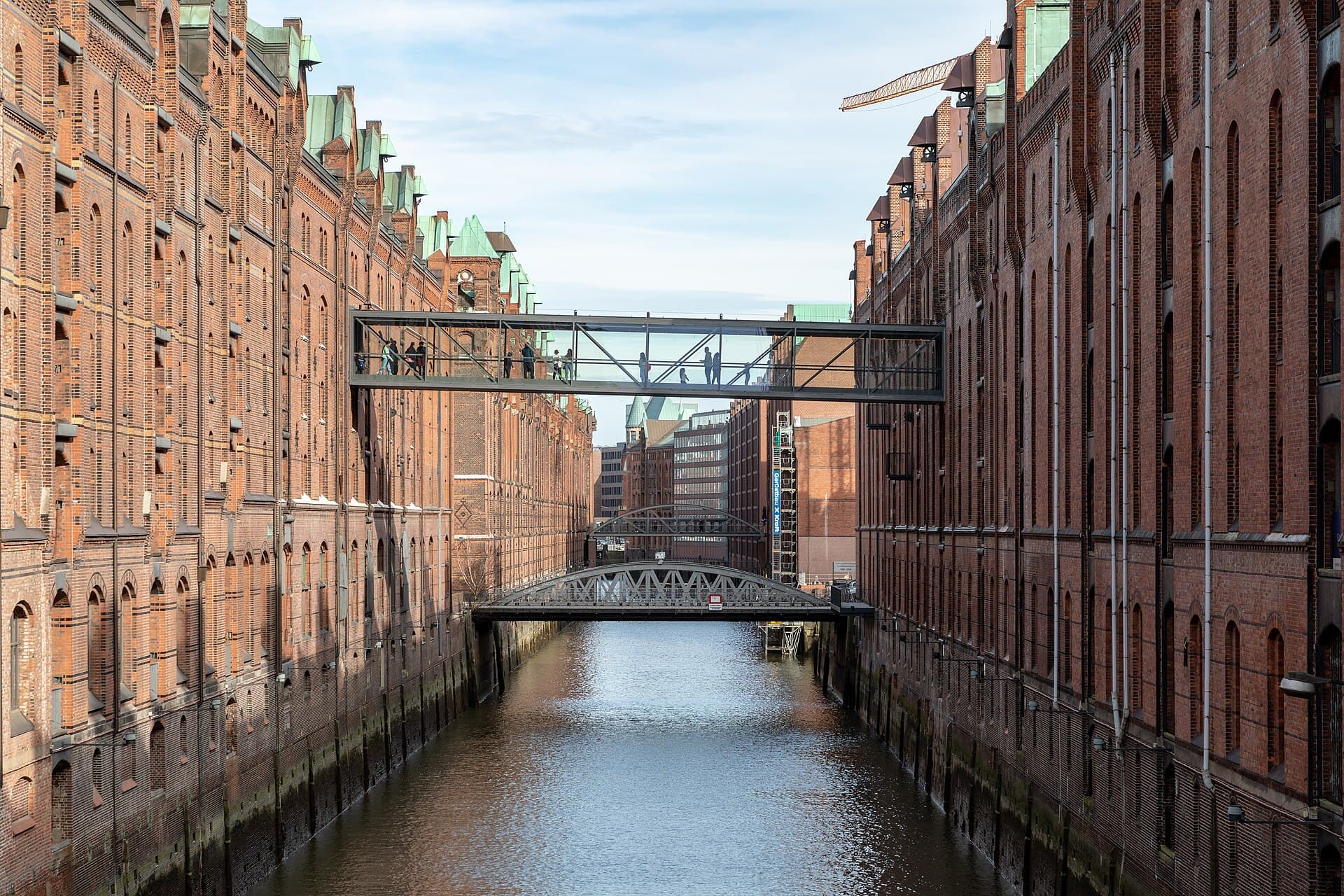
Speicher means warehouse. Speicherstadt means, quite literally, the city of warehouses. What you see around you is roughly one and a half kilometers of dark red brick, laced with canals and ranked in tall neo-Gothic gables and turrets like a fortress built for cargo. It is easy to read as timeless and romantic. It is neither. The district is younger than the electric light bulb, and it exists because of a tax.
For centuries Hamburg was a free city that ran its own customs. In the year eighteen eighty-one it agreed to fold into the German customs union, a bargain that took effect on the fifteenth of October, eighteen eighty-eight. Hamburg gave up its ancient independence, and in exchange it kept one thing: a single tax-free harbor zone where goods could be landed, stored, and sent onward without paying duty. The Speicherstadt is that bargain made physical. Construction ran in phases from about the year eighteen eighty-three all the way to nineteen twenty-seven, and the district opened as a free-port zone in eighteen eighty-eight. Coffee and tea, tobacco and spices, cocoa, and carpets moved through these brick lofts, waiting to be re-exported without ever crossing a customs line.
That framing changes what you notice. Every gable, every winch, every canal-facing door was designed for one purpose: storage at industrial scale. On the fifth of July, twenty fifteen, the district was inscribed as a UNESCO World Heritage Site, jointly with the nearby office quarter, under the name Speicherstadt and Kontorhaus District with Chilehaus. The picturesque skin covers a ruthlessly practical engine, purpose-built to conquer a marsh and answer a question about tariffs.
The engineering hidden under the romance
Hear a stop from this walk
The Chilehaus: Brick as a Ship's Prow
The Speicherstadt is commonly described as the largest warehouse district in the world where the buildings stand on timber-pile foundations. That qualifier is the whole story. This ground is soft, waterlogged marsh, the old Elbe islands, and you cannot set heavy brick warehouses on mud. So the builders drove countless oak logs down into the soft ground, a forest of timber piles, and stood the district on top of them.
Here is the counterintuitive part. Oak in open air rots. Oak kept permanently soaked, sealed away from oxygen below the water table, does not. The wet marsh that made building hard is the very thing that preserves the wood. The district floats on a submerged forest that survives precisely because it never dries out.
Then look at the canals threading between the buildings. In Hamburg a canal like this is called a Fleet, and these Fleete are not ornamental pools. They are tidal arms of the Elbe, rising and falling with the sea, and that was the design. A barge could slide in on the tide, and goods were hoisted straight up into any storey through loft doors on the water side, lifted by external winches mounted on the canal-facing walls. This is why the tour asks you to walk the water side of the warehouses, not just the streets. Every warehouse has two faces: a polite street-side address for clerks and paperwork, and a working water-side face studded with loft doors and hoists, built for cargo, not for show. That split is the honest signature of the place.
How the grammar builds, stop by stop
Once you can read brick, oak, and tide, the rest of the route becomes a sequence, not a list. The walk opens at the Zollkanal by the Brooksbrücke, the customs canal that formed the tax boundary and did the quiet work of a moat until the year two thousand three. It functioned as a wet border between the taxed old town and the tax-free harbor. At the opening ceremony in eighteen eighty-eight, Kaiser Wilhelm the Second is recorded to have set the symbolic keystone at the Brooksbrücke, marking Hamburg's entry into the German customs territory.
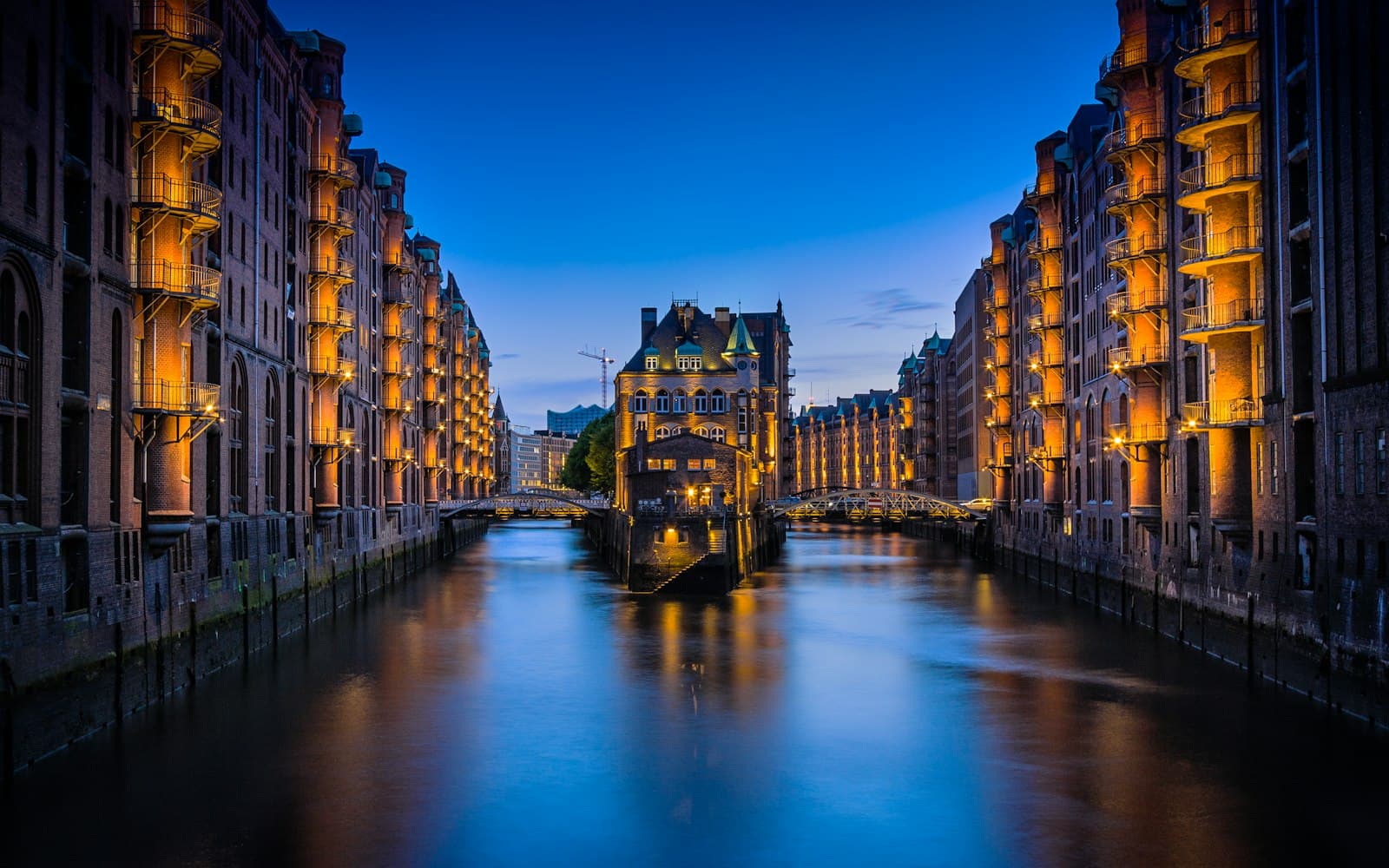
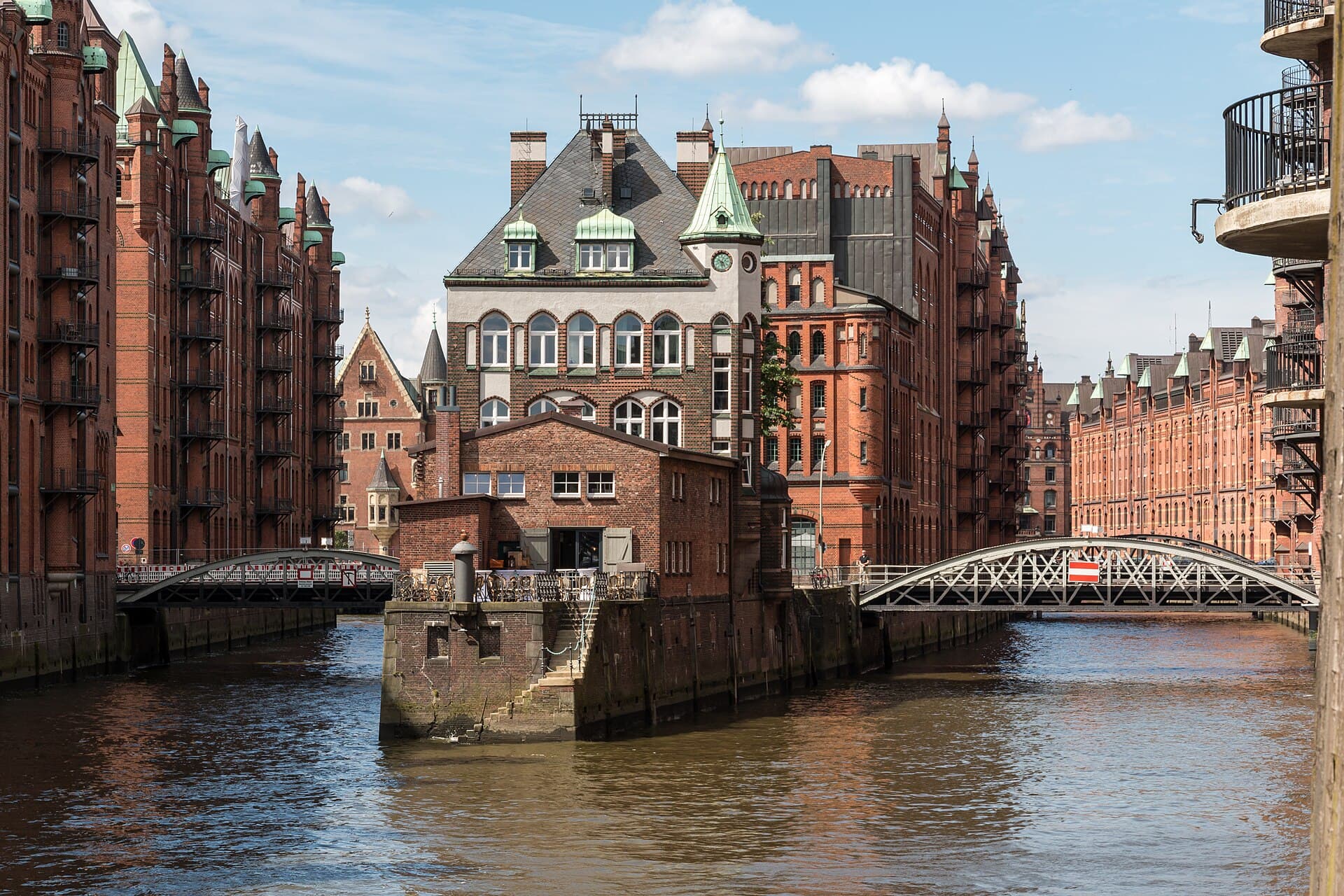
From the Speicherstadt itself the district shows you its most human building. The Wasserschloss, ringed by water on two sides where the canals meet near the Poggenmühlenbrücke, looks like a small castle moored at a junction. It was built in the early twentieth century as a service house for the winch keepers and watchmen who maintained the freight hoists, and it was the only part of the entire district usable as a genuine residence. Even the most romantic building here is really about work. It is commonly called the most-photographed spot in the Speicherstadt, so take the picture, but hold that truth in mind.
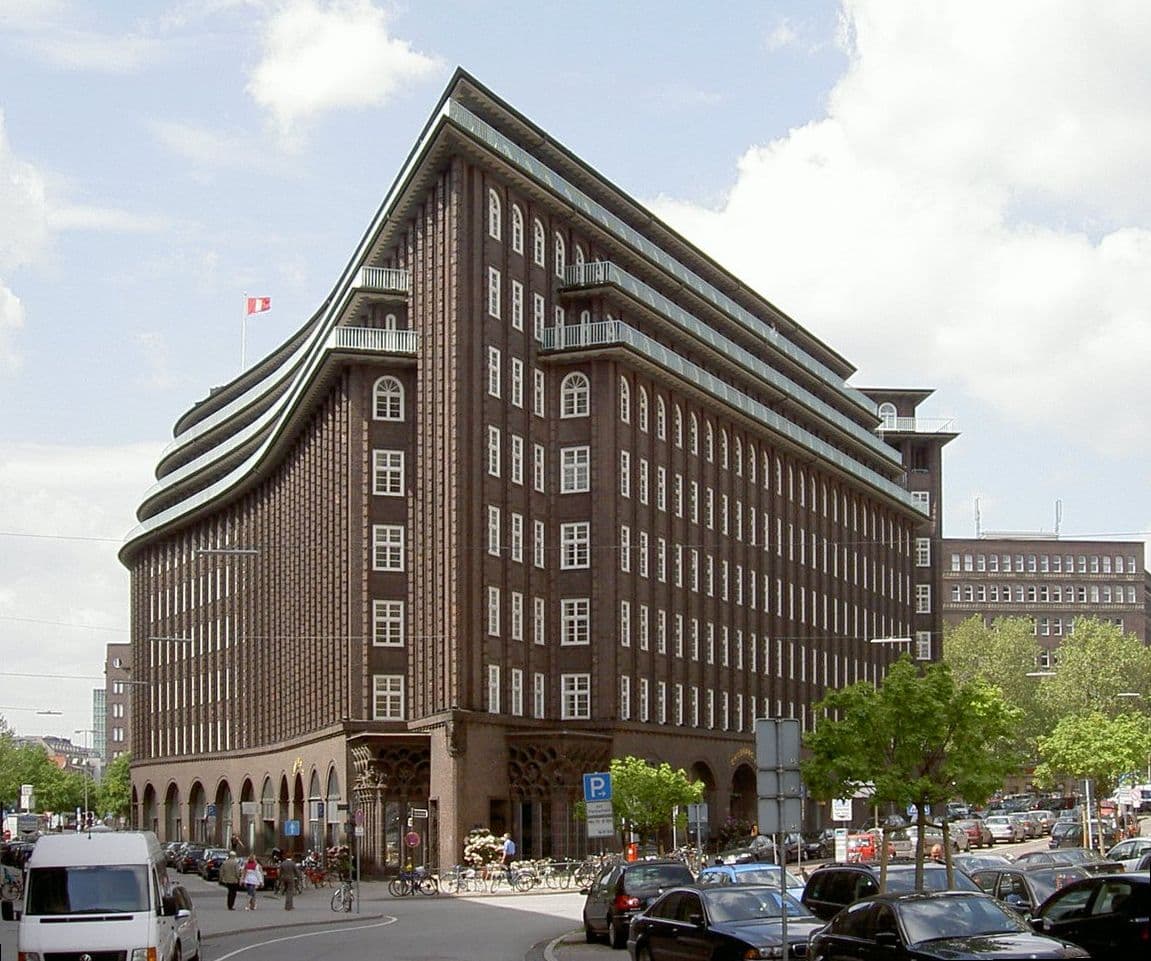
Then brick stops being mere storage. At the Chilehaus, a ten-storey office building, or Kontorhaus, two facades rush together at the eastern corner and resolve into the shape of a ship's prow cutting forward through the city. It was built between the years nineteen twenty-two and nineteen twenty-four, designed by architect Fritz Höger, and faced in about four point eight million dark clinker bricks: a landmark of what Germans call Backsteinexpressionismus, Brick Expressionism. Its money tells the port story too. It was commissioned by shipping magnate Henry B. Sloman, whose fortune came from trading Chilean saltpetre, which is exactly why it is called the Chile House. One detail to keep straight: unlike the oak-borne warehouses, the Chilehaus rests on modern reinforced-concrete piles driven some sixteen metres deep. It is part of the same twenty fifteen UNESCO inscription.
The walk ends where the grammar reaches its last sentence. HafenCity conquers the flood not with piles but by rising above it, lifting entire streets and squares onto artificial mounds called Warften, more than seven and a half metres above the normal high tide, across roughly two hundred and twenty hectares. And the Elbphilharmonie transfigures the whole idea: a rippling glass superstructure set on top of Kaispeicher A, a nineteen sixty-three brick warehouse that once stored cocoa, tea, and tobacco. It opened on the eleventh of January, twenty seventeen, designed by Herzog and de Meuron, reaching one hundred and eight metres at its highest point. Its public Plaza, about thirty-seven metres up, is generally free to visit with a timed ticket, and from there the whole walk lays itself out below: customs canal, oak-borne warehouses, ship-prow corner, raised new ground, and the tides moving through all of it.
That is the payoff of walking the Speicherstadt in order. One material, laid on wood over water, spells out storage, then commerce, then spectacle. If you want more routes across the city, browse Hamburg walking tours or start from the Hamburg city page and let the brick do the talking.
Sources
- UNESCO World Heritage Centre, "Speicherstadt and Kontorhaus District with Chilehaus" (inscription details and the twenty fifteen listing name).
- Wikipedia, "Speicherstadt" (construction phases, timber-pile foundations, Fleete, and free-port history).
- Wikipedia, "Chilehaus" (Fritz Höger, Henry B. Sloman, Brick Expressionism, clinker-brick count, and concrete piling).
- Wikipedia, "Elbphilharmonie" and "HafenCity" (opening date, Herzog and de Meuron, Kaispeicher A, Plaza height, Warften, and site area).
- Roamer tour transcript, "The City of Warehouses on Oak" (fact-audited stop narration for the Hamburg Speicherstadt route).
Ready to experience it?
Speicherstadt: The City of Warehouses on Oak
105 min · 4 km · easy
More from Hamburg
Explore more at your own pace.
Hamburg, the Free Port of Merchants: A Republic Built on Trade and the Tide
On the Grosse Freiheit, Where the Beatles Grew Up
The Hamburg Rathaus: A Palace Built by a Republic With No Throne
Der Michel: How Hamburg's Copper Spire Guided Ships Home
The Chilehaus: Reading Hamburg's Brick Ship