Speicherstadt: Warehouses, Canals and the Chilehaus
80 min · 2.5 km · easy
Hamburg did not build a dike around its new harbor quarter. It raised the quarter instead. HafenCity's own infrastructure page says diking the whole area was deliberately rejected as costly and ecologically questionable; the new streets lie 7.8 to 8.5 meters above sea level, while the historic quays they replaced sit at 4.0 to 5.5 meters, low enough for the tide to reach. HafenCity and the Elbphilharmonie: Old Harbor, New City walks that idea in thirteen stops, about 2.4 km and 80 minutes, from the Mahatma-Gandhi-Brücke past the Elbphilharmonie and east to the memorial at the Hannoverscher Bahnhof.
HafenCity covers 157 hectares of former port and industrial land and enlarged Hamburg's city center by 40 percent. The Senate decided to build it in 1997 and adopted the masterplan on 29 February 2000. About 11,000 people live there now.
The first modern basin
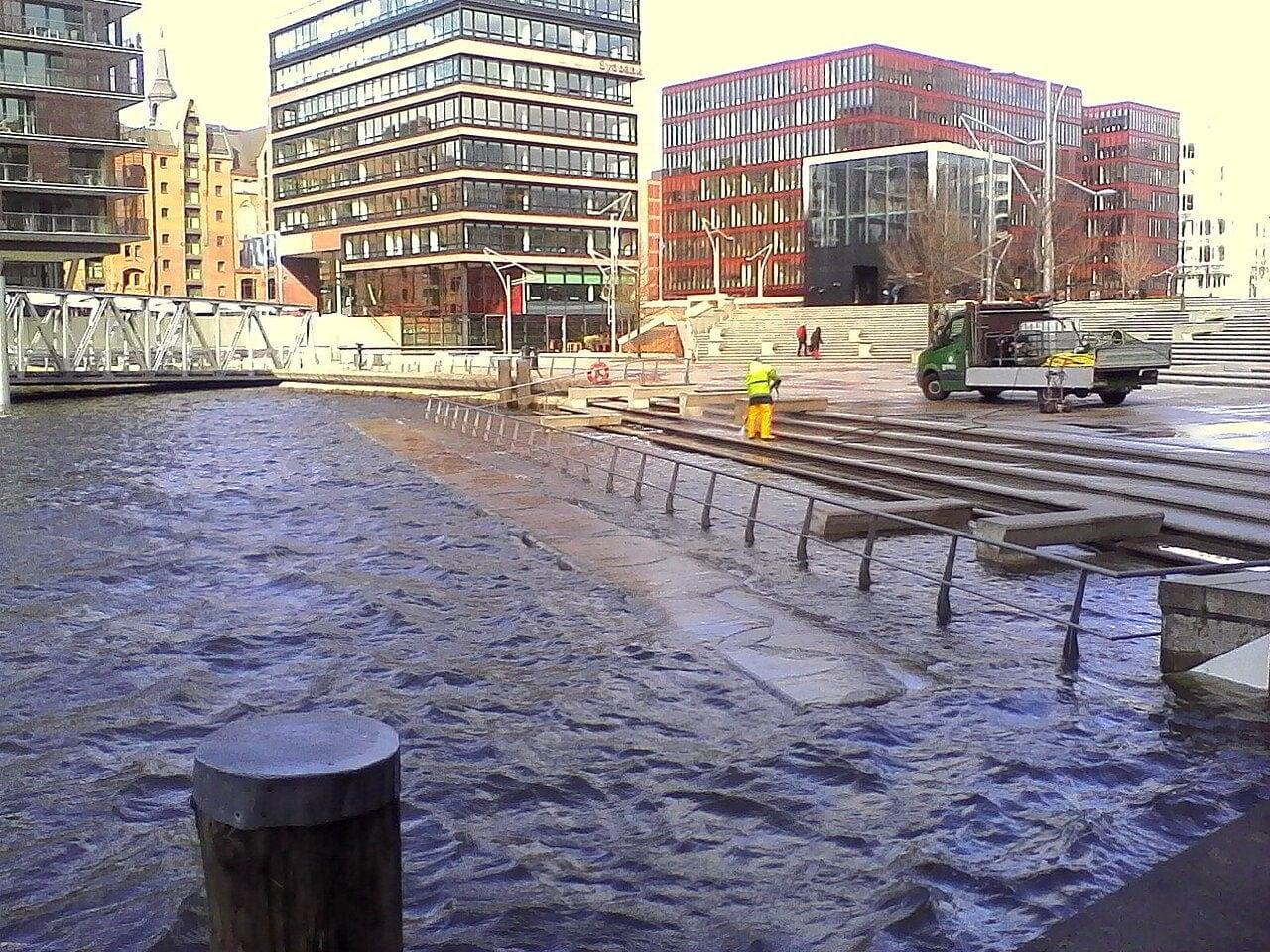
Stop 1, the Mahatma-Gandhi-Brücke, crosses the mouth of the Sandtorhafen, finished in 1866 as Hamburg's first artificial harbor basin. Before it, ships moored at posts in the river and unloaded into barges; here steamships came straight up to new quay walls and were loaded by crane, a system HafenCity's history page calls the most modern in the world. Today the basin is a museum-ship harbor, its pontoons open to the public all day, cleared when a storm surge above 4 meters is forecast.
A warehouse under a glass building
Hear a stop from this walk
Kehrwiederspitze
Stop 2 is the forecourt of the Elbphilharmonie. Herzog and de Meuron built it on Kaispeicher A, a tea, cocoa and tobacco warehouse put up in the 1960s by Werner Kallmorgen, gutted until only its brick facade remained. The foundation stone was laid on 2 April 2007; the Plaza, the public level 37 meters up between the brick base and the glass above, opened on 5 November 2016, and the concert halls on 11 and 12 January 2017. The building's own project history gives the cost to the city as 789 million euros, against 272 million in 2007. Its highest point is 110 meters above sea level, about 102 meters above the street. Since 5 October 2026 a Plaza ticket costs 5 euros, or 3 euros reduced, open daily from 10:00 to midnight. Even its ground floor stands 8.5 meters above sea level.
Standing on the hill
At Am Kaiserkai, stop 3, you can see the principle. The street at the pin lies at about 7.9 meters; the quay below at 4.4 to 4.9. The buildings' lowest storey, where a basement would be, is a watertight flood storey with gates, and the promenades in front can be overrun. The city's flood leaflet says the promenades are affected from a water level of 4.30 meters and the area can be closed from 5.50. In the storm flood of February 1962 the St. Pauli gauge reached 5.70 meters and 315 people died in Hamburg; at that level these quays would be under water, and the warft streets would stay dry.
The Dalmannkai, opened in 2009 as HafenCity's first finished quarter, was built plot by plot: its fifteen buildings came from 27 developers and 26 architecture offices, on housing plots sold at fixed prices to the best use concept rather than the highest bidder. Vasco-da-Gama-Platz, stop 4, is its small neighborhood square with a basketball court. The Magellan-Terrassen, stop 5, step down to the water like an amphitheater, 5,600 square meters designed by EMBT of Barcelona; the Marco-Polo-Terrassen, stop 6, give the walk's best whole view of the Elbphilharmonie across the Grasbrookhafen.
River, mall, pirate
At the Strandkai, stop 7, the Elbe opens between buildings; one of Hamburg's first halls for emigrants stood on this quay. The Überseequartier, stop 8, finally opened its southern half with the Westfield mall on 8 April 2025, under a glass roof by Werner Sobek that keeps off rain without closing the street. Until 9 January 2027 the Candy Christmas market fills the square, daily from 11:00, free.
From the Busanbrücke, stop 9, look for Kaispeicher B, a brick warehouse of 1878 and 1879, now a private maritime museum, and for the statue of the pirate Klaus Störtebeker. The city says the pirates were executed here on the Grasbrook on 20 October 1401, and that the execution made Störtebeker a legend; the stories told about him since are exactly that.
The station square
East of Shanghaiallee, the brick Hildebrandtblock, stop 10, was a building of the Harburger Gummi-Kamm-Compagnie, a rubber and comb maker, kept as the seed of the new Lohsepark quarter. Lohseplatz, stop 11, was the forecourt of the Hannoverscher Bahnhof, the station of the railway that crossed the Elbe southward from 1872. A sunken path, the Fuge, runs from it through the Lohsepark, stop 12, along the line of the old tracks.
It ends at stop 13, the listed remains of platform 2. From this station, between 1940 and 1945, more than eight thousand Jews, Sinti and Roma from Hamburg and northern Germany were deported in twenty transports, to Belzec, Lodz, Minsk, Riga, Auschwitz and Theresienstadt. The memorial foundation says only a few hundred survived. Since May 2017 a memorial table and twenty panels with the deportees' names stand along the tracks. The memorial is free and open at all times; the information pavilion on the Lohseplatz opens daily from April to October and by appointment in winter.
Walking it
The walk starts about 200 meters from the end of our Speicherstadt walk and 415 meters from U3 Baumwall; it ends 250 meters from U4 HafenCity Universität. It enters nothing ticketed. In a storm surge the promenades and the Sandtorkai can flood, so check warnings from 15 September to 31 March. The tour is free to start in the Roamer app: the introduction and first stop play in full, every later stop plays a short preview. For the warehouses next door, read our Speicherstadt companion; for the port's longer story, Hamburg, the free port of merchants. More routes are on the Hamburg walking tours page.
Ready to experience it?
Speicherstadt: Warehouses, Canals and the Chilehaus
80 min · 2.5 km · easy
More from Hamburg
Explore more at your own pace.
Best Architecture Walking Tours in Hamburg (2026)
Hamburg, the Free Port of Merchants: A City Built on Trade and the Tide
On the Große Freiheit, Where the Beatles Grew Up
The Hamburg Rathaus: Built Like a Castle for a Parliament, Not a King
The Chilehaus: Reading Hamburg's Brick Ship