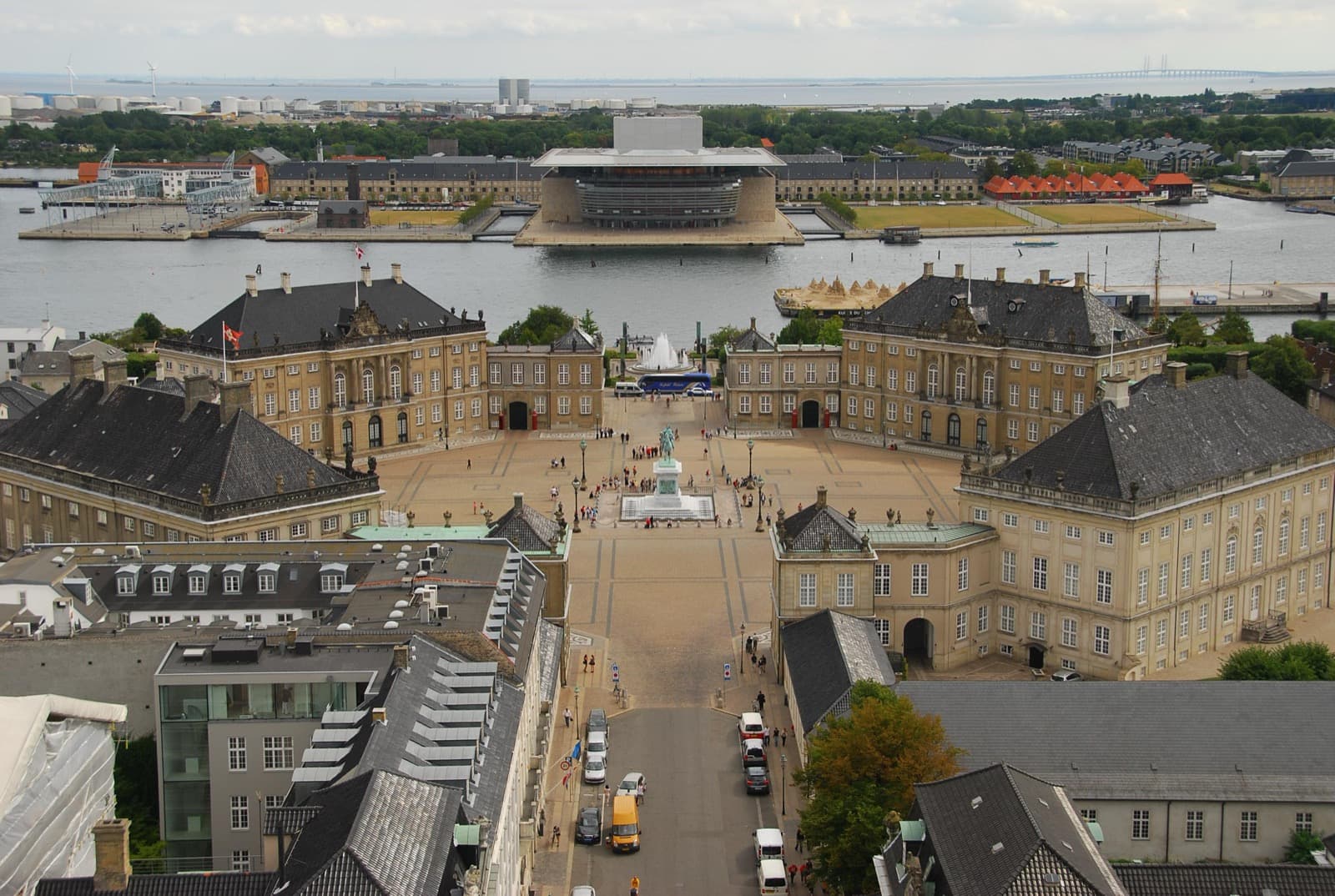
Stand at the centre of Amalienborg and you are standing inside a decision. Four identical rococo palaces face each other across an octagonal square, an equestrian king rides at the middle, and the whole arrangement lines up on an axis: one way to a great domed church, the other way to the harbour. Nothing here grew by accident. Amalienborg is the deliberate heart of Frederiksstaden, a royal district planned in the mid-eighteenth century, and it is the clearest single proof of the idea that carries this entire walk. This is the Copenhagen a king drew on purpose, and the octagon is where the drawing is easiest to read.
A square that began with a jubilee
Amalienborg's four palaces went up under King Frederik the Fifth, and the reason was ceremonial as much as practical. The founding of Frederiksstaden was tied to a jubilee in the late seventeen forties, marking three hundred years since the House of Oldenburg came to the Danish throne. The planning year of seventeen forty-nine sits at the root of everything you see around the square. A dynasty wanted a monument to itself, and instead of one grand palace it commissioned a whole quarter, laid out in matching rococo blocks around a geometric centre.
At that centre rides Frederik the Fifth himself. The equestrian statue is the work of the French sculptor Jacques Saly, begun in the seventeen fifties and unveiled in seventeen seventy-one, after roughly two decades of work. A French hand shaping a Danish king at the middle of a planned octagon tells you how this quarter was meant to be understood: as royal order, imposed and composed, not left to chance.
One detail complicates the picture in a useful way. The royal family did not always live here. They moved into Amalienborg only after Christiansborg Palace burned in seventeen ninety-four. The palaces were built as a showpiece of aristocratic town-planning, and a fire turned them into a home. The monarch still winters here, which is why you can watch the changing of the guard. If you time your walk for late morning, the Royal Life Guards march down from Rosenborg and change the watch at noon each day, a living remnant of the court the square was built to frame.
Reading the axis
Hear a stop from this walk
Kastellet: The Green Star Fortress
The gift of Amalienborg to a walker is that it makes the rest of the route legible. Notice how the square is oriented. Look one way and the sightline runs to the great dome of the Marble Church; look the other and it opens toward the water. Frederiksstaden is widely regarded as one of the finest planned rococo quarters in Europe, and standing on the axis you can feel why. Everything answers to a line.
That line points, first, to a story about ambition and money. The church that closes the axis is formally Frederik's Church, though everyone calls it the Marble Church. Its foundation stone was laid by Frederik the Fifth on the thirty-first of October seventeen forty-nine, the same royal year as the district around it. Then it stalled. Budgets were cut, the architect Nicolai Eigtved died in seventeen fifty-four, and the church stood as an open ruin for well over a century. What a king could not finish, finance did: in eighteen seventy-four the financier Carl Frederik Tietgen bought the incomplete ruins and paid for their completion, and the church was at last inaugurated on the nineteenth of August eighteen ninety-four, nearly a hundred and fifty years after that first stone. Its dome, about thirty-one metres across and resting on twelve columns, is described as the largest church dome in Scandinavia. There is a small honesty in the nickname, too. The building was meant to be almost entirely marble, but limestone was substituted to save money, so the Marble Church is only partly marble.
Where the plan begins, and where it ends
The intention did not start at Amalienborg. It started at a square. Kongens Nytorv, the King's New Square, was laid out by King Christian the Fifth in sixteen seventy as part of a grand expansion of the fortified city. Where the medieval town had grown in a tangle, a king imposed a circle, a broad round place with streets radiating outward in the spirit of the royal planning then fashionable in Paris. At its centre stands an equestrian Christian the Fifth, raised in sixteen eighty-eight and made by the French sculptor Abraham-Cesar Lamoureux, the king cast as a laurel-wreathed Roman at the hub of the wheel he had drawn. It is the oldest equestrian statue in Scandinavia.
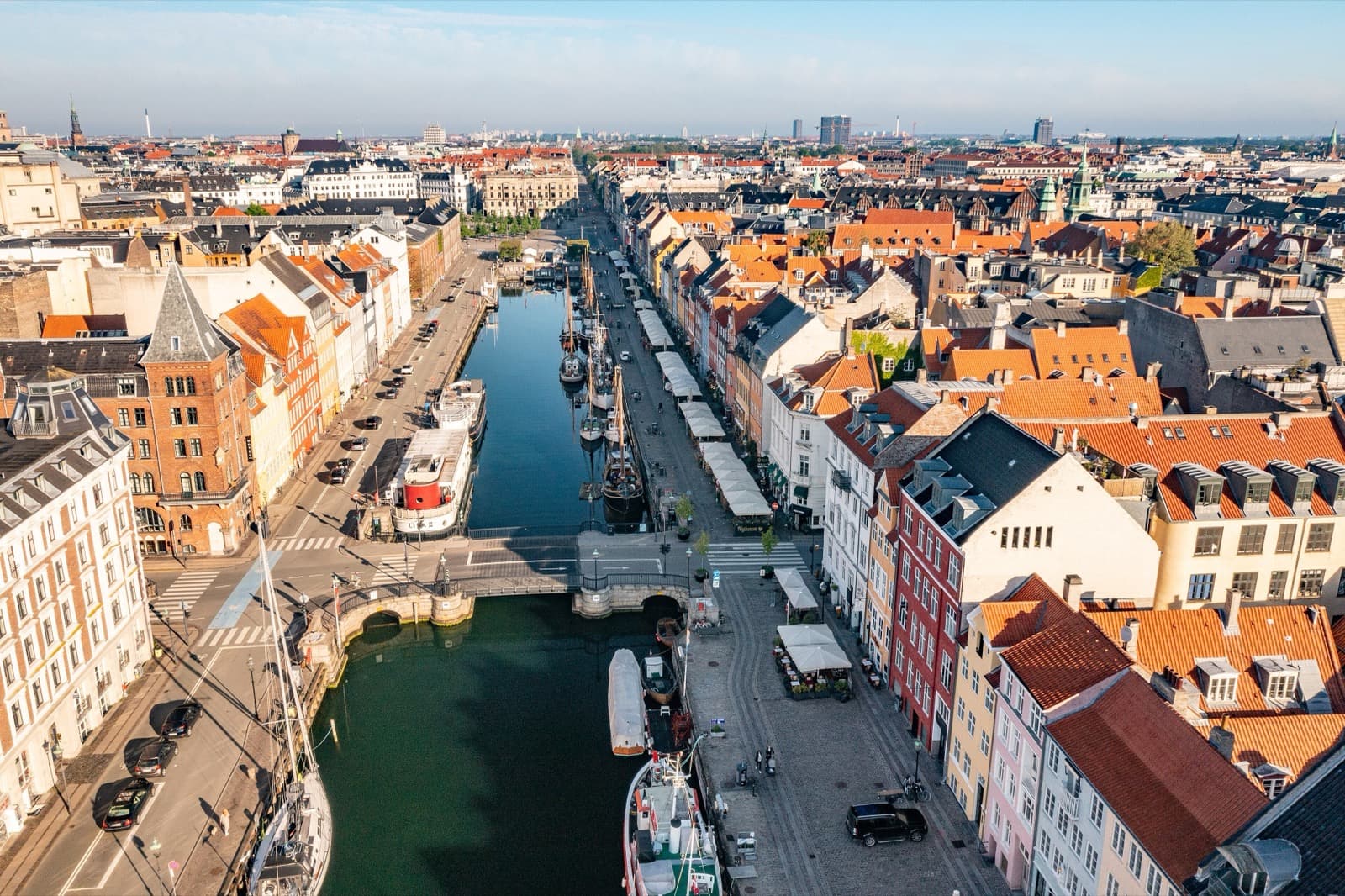
From that circle the same king dug a canal. Nyhavn, the New Harbour, was cut between about sixteen seventy and sixteen seventy-five so cargo could reach the city's core, its digging done by Danish soldiers and by Swedish prisoners of war taken in the Dano-Swedish war of sixteen fifty-eight to sixteen sixty. The painted merchant houses came later, and the oldest of them, number nine, dates from sixteen eighty-one. For generations this was a rough sailors' quarter of taverns and lodgings, the postcard prettiness a much later coat of paint. Hans Christian Andersen lived on the quay, at number sixty-seven from eighteen forty-eight to eighteen sixty-five.
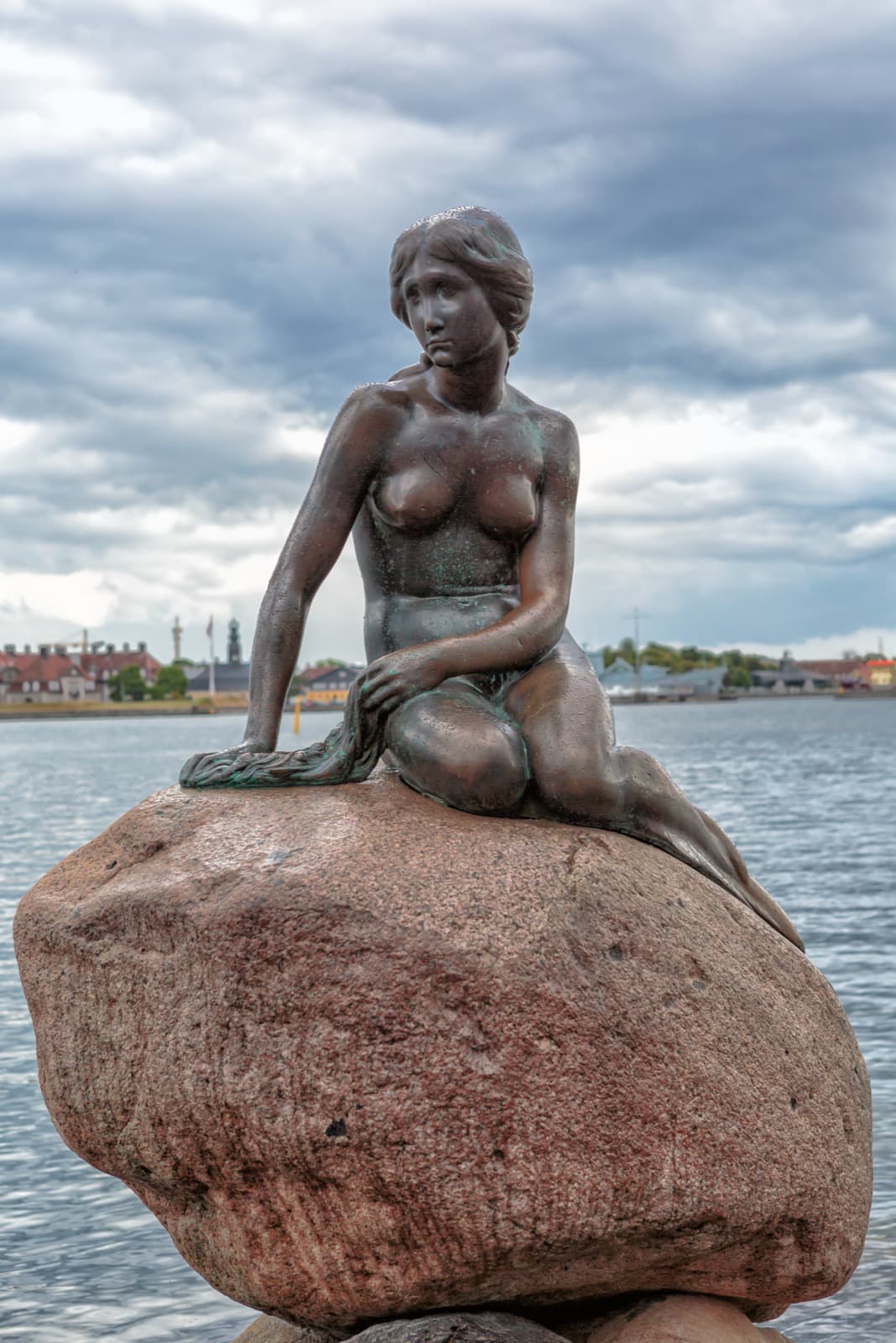
Past Amalienborg and the Marble Church the plan gives way to older and harder ground. The Gefion Fountain, a gift of the Carlsberg Foundation inaugurated on the fourteenth of July nineteen oh eight, dramatises the Norse legend of a goddess ploughing the island of Zealand loose from Sweden, marked plainly as legend. Beyond it lies Kastellet, a five-bastion star fortress built between sixteen sixty-two and sixteen sixty-four under Frederik the Third, still active military ground and open to you as a park. Its harbour front carries a graver memory: in October nineteen forty-three ordinary Danes ferried about seven thousand Jews across the Sound to neutral Sweden, an extraordinary rescue that was not complete, since about four hundred and eighty-two people, mostly elderly and sick, were caught and deported to Theresienstadt. The walk closes on a rock with the Little Mermaid, a bronze about one and a quarter metres tall, sculpted by Edvard Eriksen and unveiled on the twenty-third of August nineteen thirteen, drawn from Andersen's eighteen thirty-seven tale and looking out to sea.
That is the reward of beginning at Amalienborg: you learn to read the whole city as a plan, and then to feel where the plan runs out. This is a self-guided route, about four kilometres over roughly seven stops, so you set the pace and linger where the design deserves it. For more context and companion reading, see our guide to Copenhagen walking tours, or start planning from the Copenhagen city page and walk the octagon for yourself.
Sources
- Amalienborg, Wikipedia. Founding of Frederiksstaden around the Oldenburg tercentenary, the four palaces, Saly's equestrian statue unveiled in 1771, the changing of the guard, and the move after the 1794 Christiansborg fire.
- Frederik's Church (the Marble Church), Wikipedia. Foundation stone of 1749, Eigtved's death in 1754, the long stall, Tietgen's purchase of the ruins in 1874, the 1894 inauguration, and the limestone substitution.
- Kongens Nytorv and Nyhavn, Wikipedia. Christian the Fifth's 1670 square, the equestrian statue of 1688 as the oldest in Scandinavia, the New Harbour canal, and Andersen's residence at number 67.
- Kastellet, Copenhagen, Wikipedia, and the Rescue of the Danish Jews, Yad Vashem and the USHMM Holocaust Encyclopedia. The star fortress and the October 1943 crossing to Sweden, with about 482 deported to Theresienstadt.
- The Little Mermaid (statue), Wikipedia. Eriksen's 1913 bronze, its commission by Carl Jacobsen, and its source in Andersen's 1837 fairy tale.
Ready to experience it?
Nyhavn: The Royal Quarter and the Harbour of Coloured Houses
90 min · 3.9 km · easy
More from Copenhagen
Explore more at your own pace.
The Rebuilt Capital: How Copenhagen Kept Raising Itself from Fire
Christiansborg Palace and the Island Where Copenhagen Began
The Copenhagen Cathedral That Was Rebuilt from a Bombardment
Freetown Christiania: Copenhagen's Free Town on the Old Ramparts
Rosenborg Castle: The Fairytale Fortress That Kept Denmark's Crown Jewels