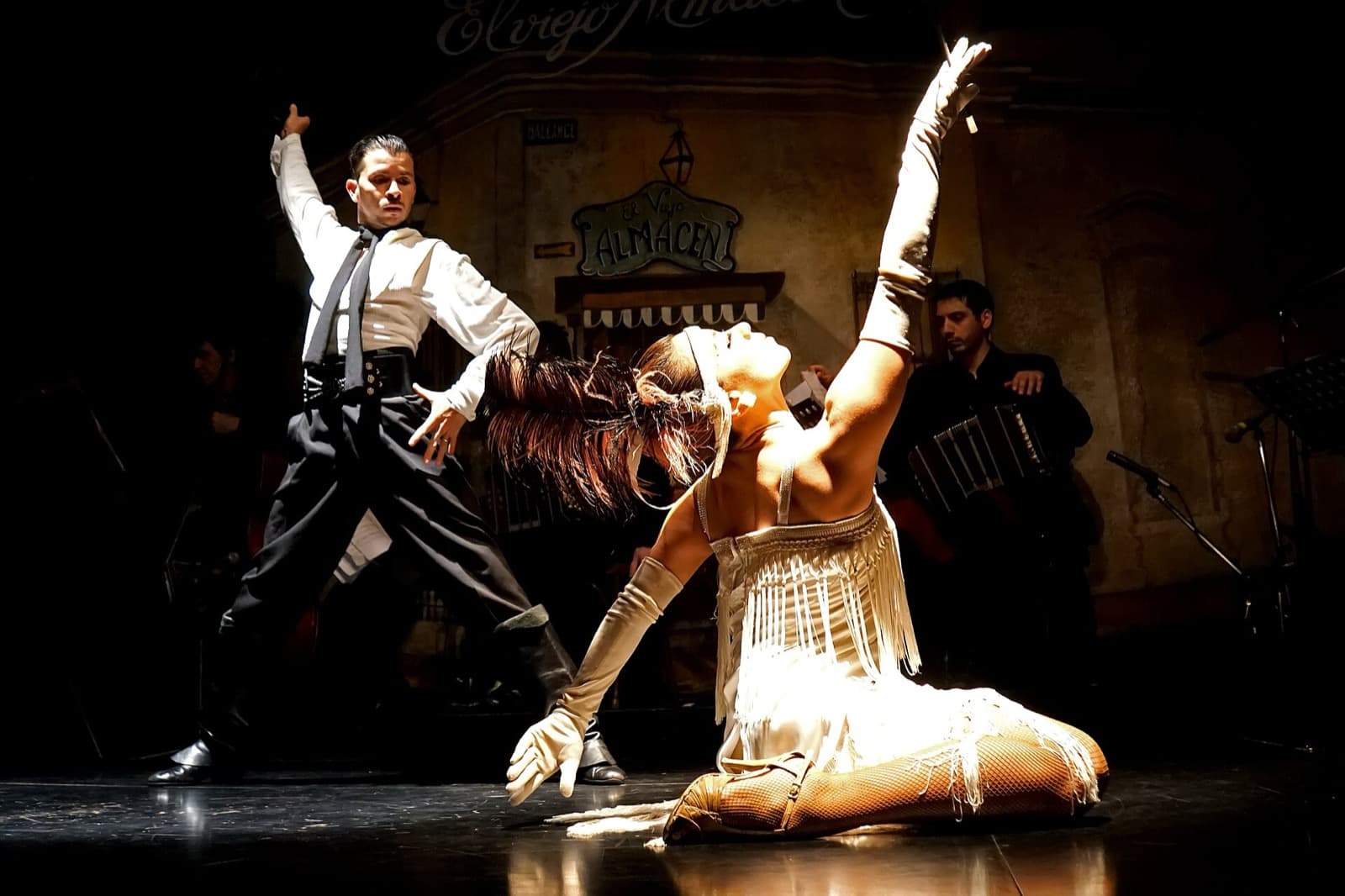
Tango was not born at one address, and Plaza Dorrego is where you feel why. Stand on the cobbles of this small square on a Sunday, watch a couple dance to a bandoneon while the antiques fair crowds around them, and you are watching a music and dance that grew from the working-class immigrant life of many River Plate barrios at once. The dancers perform on a specific corner in San Telmo, but the tradition they carry has no single birthplace. Hold that idea as you walk, because it is the key to reading the entire quarter, a barrio where nearly every surface turns out to be a second use.
The square with no fixed name
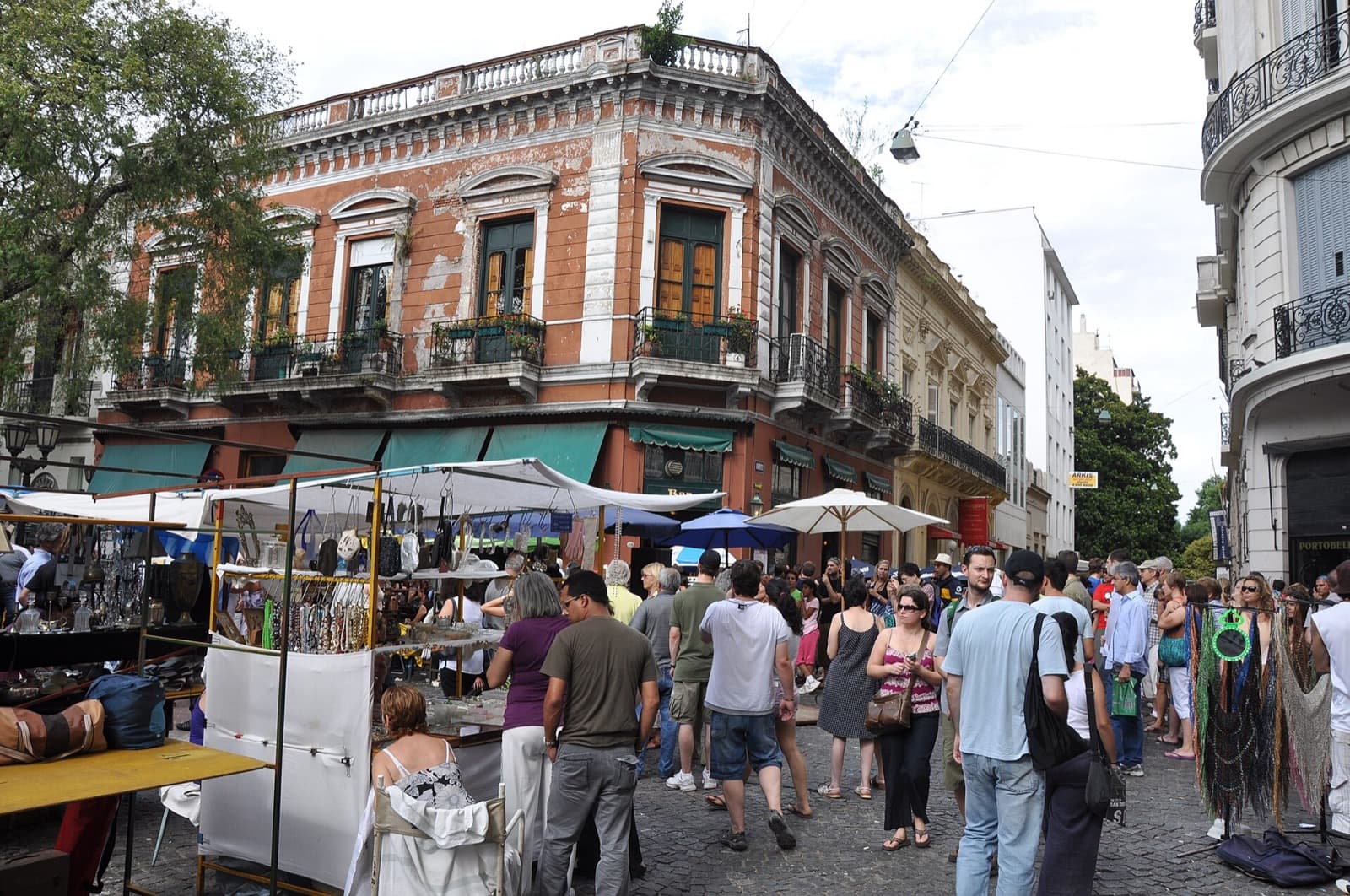
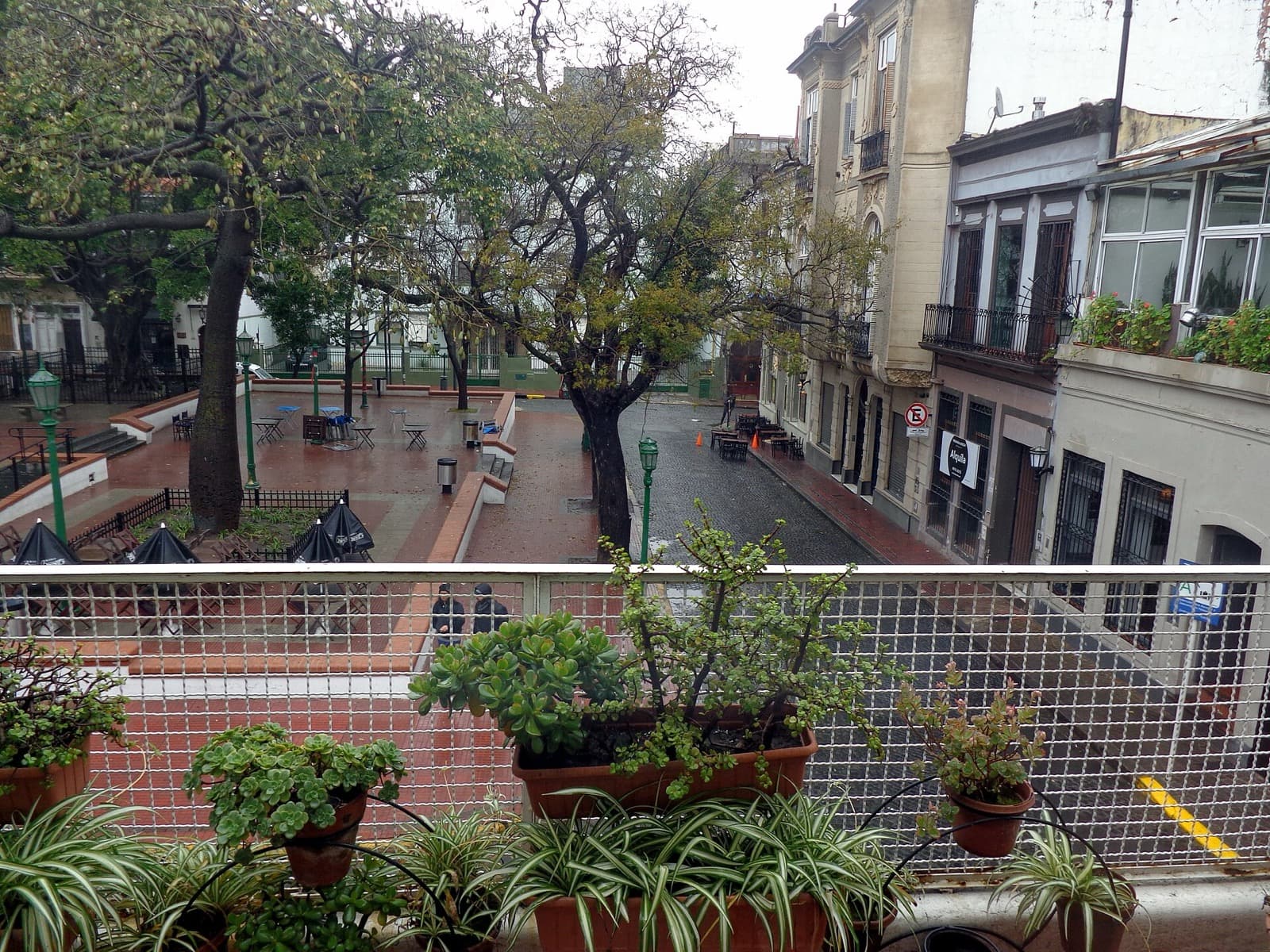
Plaza Dorrego is a small, old square at the corner of Humberto Primo and Defensa, ringed by low colonial facades. Spanish-language sources trace its origins to fifteen eighty-six, when it was the Alto de las Carretas, the high ground where wagons halted, and describe it as the second-oldest square in the city after the Plaza de Mayo. Its name kept changing. It was the Alto de San Pedro, then the Plaza del Comercio in eighteen twenty-two, and it took its present form in nineteen hundred five. Through the eighteen hundreds, when San Telmo was a leading residential neighbourhood, this square was its central gathering place.
Come on a Sunday and the plaza vanishes beneath the Feria de San Telmo, the antiques fair, its stalls spilling down Calle Defensa. You hear it before you see it: old silver and glass clattering, bargaining, and somewhere the sound of a bandoneon. The fair uses the space exactly as the wagons and residents once did, as common ground. That is the theme of the whole walk in miniature. A square that held wagons in the sixteenth century now holds the Sunday crowd, and the dancing on its stones is a living ritual rather than a museum piece pinned to a plaque.
Why tango claims no single corner
Hear a stop from this walk
Parque Lezama: Where the City Is Said to Have Begun
Tango emerged in the late nineteenth century, from the eighteen eighties, along the River Plate, in the impoverished port and working-class immigrant districts of Buenos Aires and, across the water, Montevideo. The neighbourhoods Argentine history ties to its early years include La Boca, San Telmo and Boedo. So when someone tells you tango was born on this exact corner, hold it lightly. The birthplace is tradition, claimed by several districts at once, not one settled spot.
What is settled is the mixture. Tango blended the local milonga, the Spanish and Cuban habanera, the candombe carried by African-Argentines descended from formerly enslaved people, and the European musical forms immigrants brought with them. Around nineteen hundred it was widely regarded as disreputable, danced in the poorer margins of the port city. Then dancers and orchestras carried it to Paris, London and Berlin, and it returned respectable, and famous. UNESCO inscribed tango on the Representative List of the Intangible Cultural Heritage of Humanity in two thousand nine, at its committee session in Abu Dhabi, on a joint nomination by Argentina and Uruguay, describing a fusion of European immigrants, descendants of African slaves, and native criollos.
That joint listing matters. The heritage of tango is shared across the River Plate between two countries because the music itself never belonged to one place. Watch the Sunday dancers with that in mind. What they perform grew in barrios exactly like this one, out of the everyday lives of the people the wealthy left behind. This is why Plaza Dorrego, rather than any single monument, is the honest place to begin. The square holds a tradition that refuses a fixed address, in a barrio built on second uses.
The barrio of second uses
Once you accept that tango has no single birthplace, the rest of San Telmo reads the same way. A block from the square, the Mercado de San Telmo opened in February eighteen ninety-seven, designed by the engineer-architect Juan Antonio Buschiazzo to feed the European immigrants then arriving. Its Italianate facade of round arches hides an interior of iron beams and glass, and today its aisles sell produce alongside antiques, the working market layered over the tourist one.
The turn of the walk comes at El Zanjon de Granados, at Defensa 755, where the ground literally opens. On the surface it is an Italianate house finalized around eighteen thirty, later a crowded tenement. In nineteen eighty-five an amateur historian and chemical engineer named Jorge Eckstein set out to restore it and instead found the city underneath: brick tunnels that once channelled a stream, cisterns, and colonial foundations. The restoration took roughly seventeen years and removed more than one hundred thirty truckloads of debris, turning up French tiles, African pipes and English china. Everywhere else you have to imagine the layer beneath the visible one. Here you can walk down into it.
Around the corner, the Parroquia San Pedro Telmo gives the barrio its name. The Jesuits began it in seventeen thirty-four, and after their expulsion in seventeen sixty-seven the work continued for generations, the towers not completed until eighteen seventy-six. It honours San Pedro Gonzalez Telmo, the patron saint of sailors, in a district worked by the people who came off the ships and stayed. Nearby, the Pasaje de la Defensa carries the barrio's hardest turn: the Ezeiza family mansion whose owners fled in eighteen seventy-one, during the yellow fever epidemic that killed over ten thousand people and drove the wealthy north. The great house then filled with immigrant families, said by some accounts to number as many as thirty-two, before becoming today's gallery of antique and craft shops.
Walk it at your own pace
The route ends at Parque Lezama, a park on a bluff where tradition holds Pedro de Mendoza made the first, failed founding of Buenos Aires on the second of February fifteen thirty-six, before Juan de Garay refounded it permanently on the eleventh of June fifteen eighty. Even the city's cradle is a story kept as legend rather than settled fact, which is a fitting close for a barrio you read by looking beneath the surface.
The full self-guided audio tour runs seven stops over about ninety minutes and one and a half kilometres, and each stop stands on its own, so you can linger at Plaza Dorrego as long as the dancing holds you. Sunday brings the fair and the street tango together with the crowds. A weekday morning gives you the same cobbles quiet, the market at its everyday rhythm, and the working church open for reflection. To plan the wider city, browse more Buenos Aires walking tours, or start with the overview of Buenos Aires and let the barrio's grain lead you from one second use to the next.
Sources
- Tango, UNESCO Intangible Cultural Heritage of Humanity: confirms the two thousand nine inscription at Abu Dhabi and the joint Argentina and Uruguay nomination.
- Plaza Dorrego, Gobierno de la Ciudad de Buenos Aires and Wikipedia: origins as the Alto de las Carretas, name changes, and the second-oldest-square tradition.
- El Zanjon de Granados official history: Jorge Eckstein's rediscovery of the buried tunnels and the multi-year restoration.
- Roamer San Telmo audio tour, fact-audited transcripts: verified detail on the Mercado de San Telmo, Parroquia San Pedro Telmo, Pasaje de la Defensa, and Parque Lezama.
Ready to experience it?
San Telmo: The Cobblestones Where Tango Was Born
85 min · 1.5 km · easy
More from Buenos Aires
Explore more at your own pace.
Buenos Aires: The City That Keeps Rewriting Itself in Public
The Tomb of Eva Perón and the Recoleta Cemetery That Outshone the Living
The White Headscarves at the Center of Plaza de Mayo
Casa Rosada: The Pink House That Faces the Founding Square
Plaza Dorrego: The Small Square Where San Telmo Comes to Life