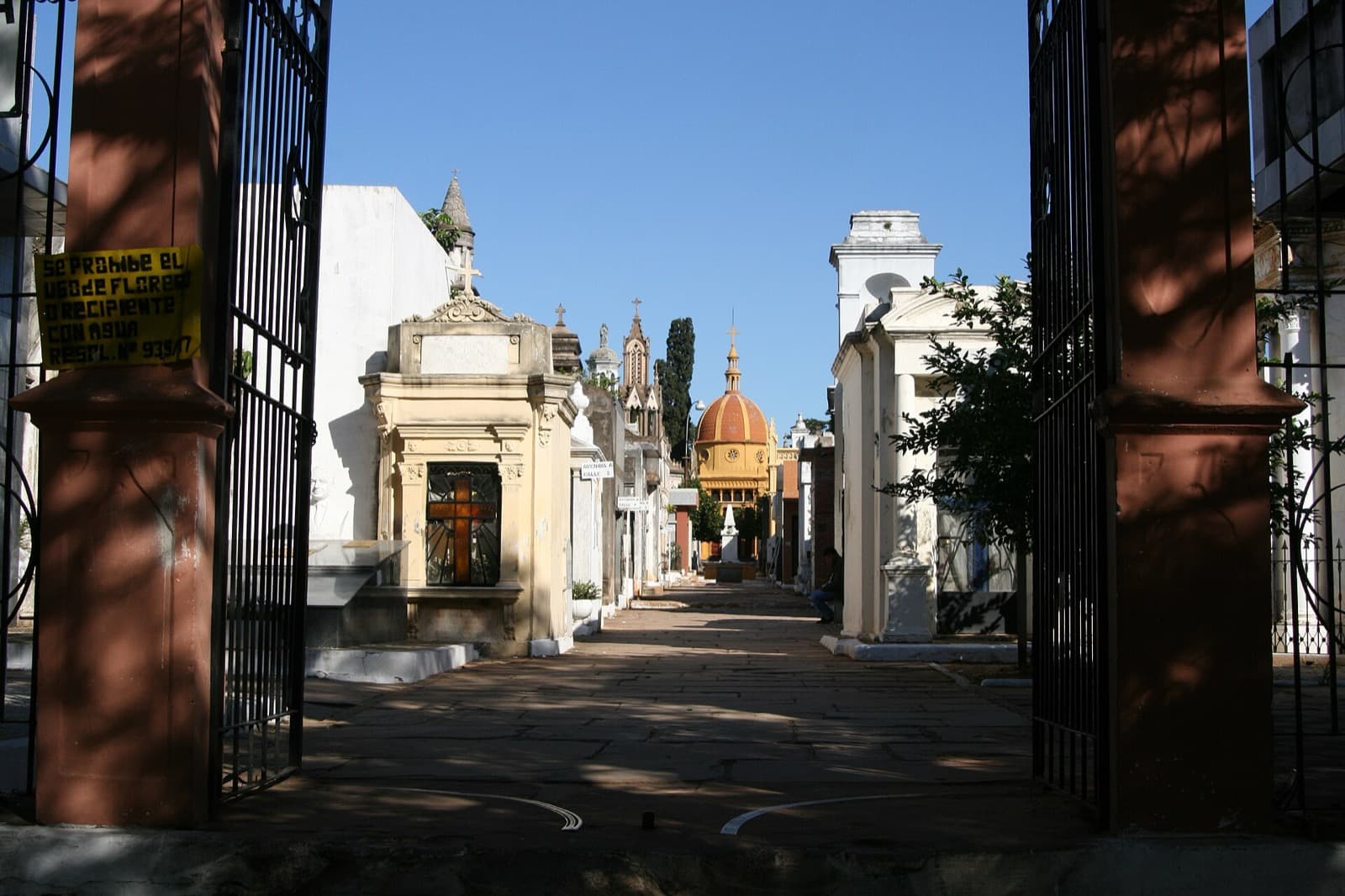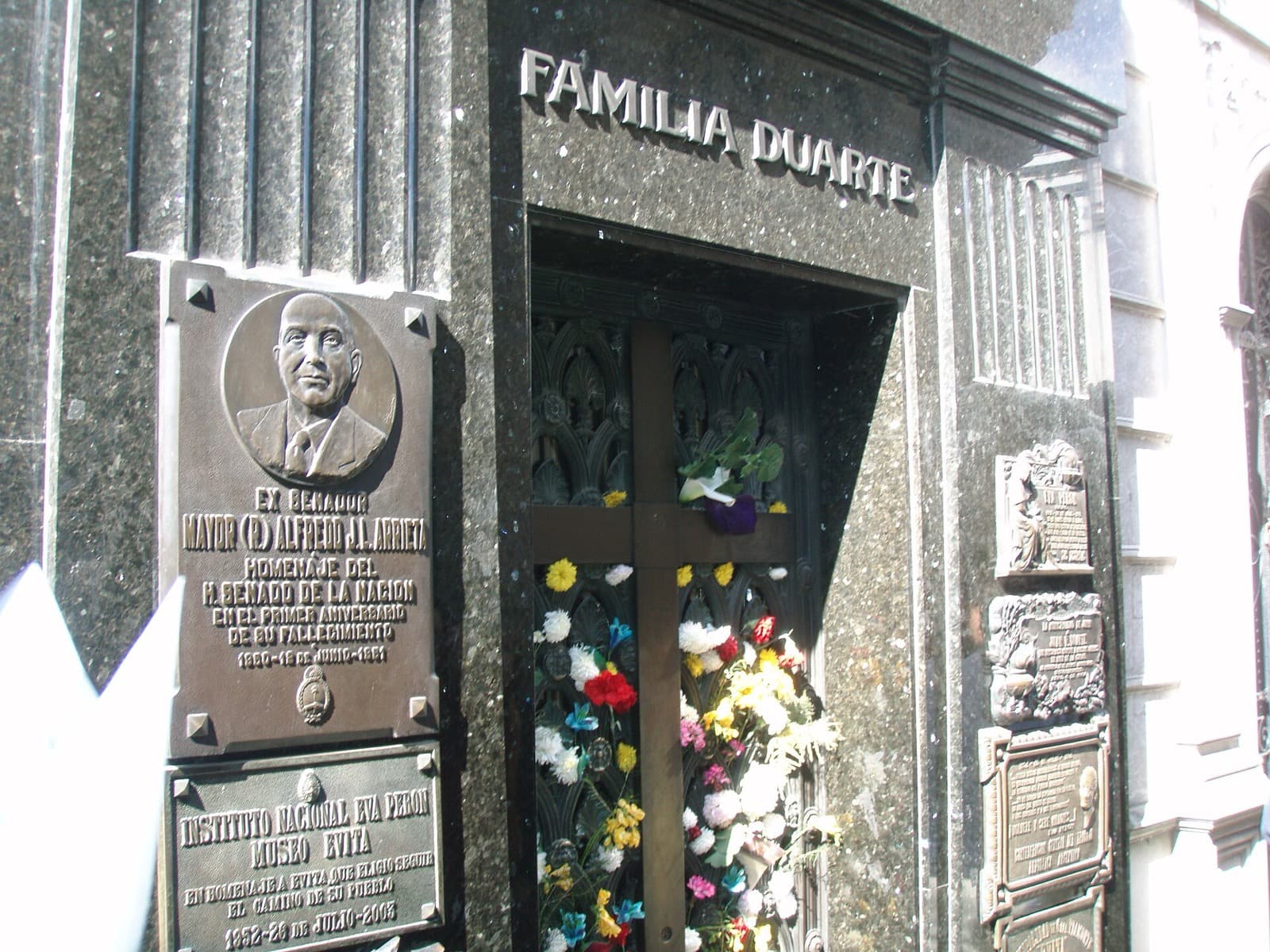
The landowning families of Argentina raised a marble city for their dead in Recoleta grander than much of the living city around it, and the longest queue in that necropolis of presidents leads not to a statesman but to Eva Perón, an outsider the old elite would never have admitted among them while she lived. That single fact holds the whole neighbourhood together. Walk in through the Doric gate expecting a cemetery, and you find instead a gridded city of temples, pyramids and Art Nouveau chapels, where wealth competed in stone long after the people inside had died. Then you reach a plain vault marked Duarte, find it by the flowers left against it, and the marble city quietly reorders itself around the woman it was built to exclude.
The gate into a city of the dead
Recoleta Cemetery was inaugurated on the seventeenth of November, 1822, the first public cemetery in Buenos Aires. The land had belonged to the Recollect friars, a religious community whose name gave the whole barrio its name, and where the gate now stands was once their garden and orchard on the outskirts of a small colonial town. A French civil engineer, Próspero Catelin, laid out the original grounds. Decades later, in 1881, the architect Juan Antonio Buschiazzo remodelled the cemetery and gave it the neoclassical gate you pass through today.
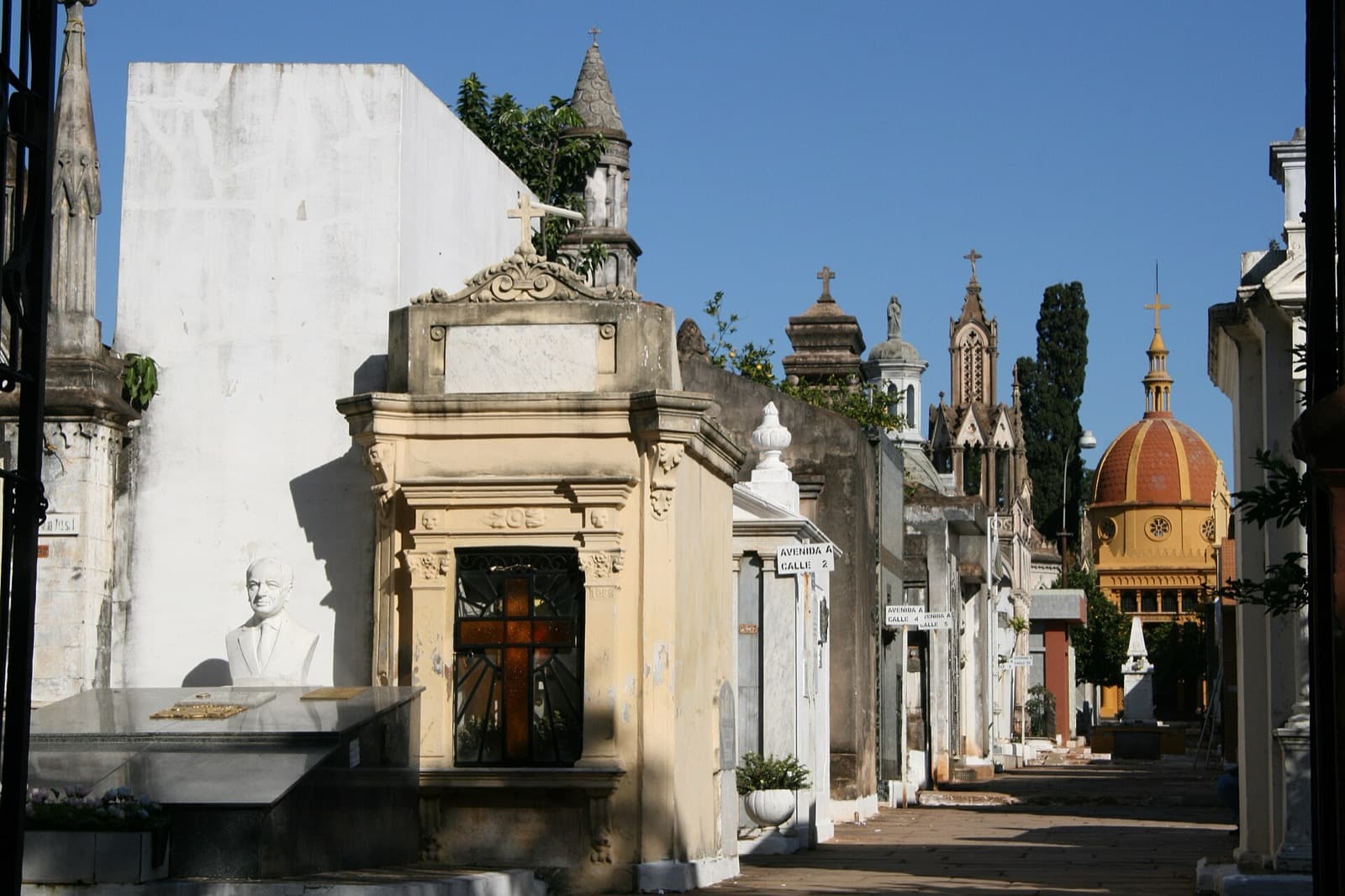
The scale is easy to miss until you are inside it. The cemetery covers about five and a half hectares and holds roughly four thousand seven hundred above-ground vaults, ninety-four of them declared National Historical Monuments. The styles run from Art Deco and Art Nouveau to Baroque and Neo-Gothic, and much of the marble was imported from Paris and from Milan in the decades around 1900. Buried here are presidents, the founder of the Argentine navy, Nobel laureates, and above all the families who made fortunes in grain and cattle and could afford to build in stone. The paradox announces itself at the threshold: a city of the dead built grander than the living city around it.
The outsider among the elite
Hear a stop from this walk
Floralis Generica: The Steel Flower and the Contemporary North
The Duarte vault is where the argument of the tour turns. Duarte was the family name of Eva Perón, known to millions as Evita, and this is one of the most visited graves in the whole cemetery. The irony is quiet but exact. In a necropolis full of statesmen and old money, the longest queue leads to a woman the traditional elite would never have welcomed among them.
Eva Perón died of cervical cancer on the twenty-sixth of July, 1952, wife of President Juan Perón. Peronism, the movement bound to their name, remains deeply divisive in Argentina to this day, which is why the tour tells this plainly, without celebration and without condemnation. What followed her death is genuinely extraordinary. Her embalmed body was displayed for roughly two years. Then, after Juan Perón was overthrown in the coup of 1955, a military commando removed the body and moved it in secret, eventually burying it under a false name, María Maggi de Magistris, in Milan, in Italy. It was exhumed in 1971 and taken to Perón in exile in Madrid, returned to Argentina in 1974, and only in October of 1976 was it finally interred here, in the Duarte vault, in a fortified crypt about five metres underground, sealed behind a steel door engineered to defeat any future theft.
Stand at that vault and the whole neighbourhood snaps into focus. Consider the distance her body travelled to reach this ground, and the fact that the outsider now draws the crowd the old families once kept out. Everything else on the walk is a variation on that reversal.
Reading the marble as a competition
Beyond the Duarte vault the inner avenues become sculpture. Turn one corner and meet a neoclassical temple with a pediment and columns; turn another and there is an Egyptian-style pyramid or an Art Nouveau chapel of sinuous stone and stained glass. Read these avenues as a rivalry: each vault answers the next, wealth speaking in stone. One tomb, the delicate Carrara-marble work of Rufina Cambáceres, an heiress born in 1883 who died young in 1902, carries a famous story that she was buried alive, a victim of catalepsy. The tour is careful to name it as popular urban legend, disputed and unconfirmed, folklore rather than fact. What is certain is the marble, and the fortune it represents, spent not on the living but on memory.
Where the paradox resolves
The walk does not stay among the dead. Step out of the gate and the low, whitewashed Basílica del Pilar stands beside it, opened on the twelfth of October, 1732, the second-oldest church in Buenos Aires, built for those same Recollect friars. It came first; the fashionable barrio grew up around it. Cross to the green slopes of Plaza Francia and Plaza Intendente Alvear, where a craft fair prominent since the 1960s fills the paths on weekends and the Gran Gomero, a rubber fig traditionally dated to the late eighteenth century, spreads a canopy roughly fifty metres across on branches so heavy that metal props hold them up, one shaped like a straining Atlas.
Then climb Avenida Alvear, only about seven blocks and the most aristocratic street in the city, begun in 1885 on a plan inspired by Baron Haussmann's Paris. Here the same families spent above ground as they had below it, raising French-academy palaces now serving as the French and Brazilian embassies and the Park Hyatt hotel. Further north the walk finally turns public. The Floralis Genérica, a stainless-steel flower twenty-three metres tall and eighteen tons in weight, was gifted to the city by the architect Eduardo Catalano and installed in 2002, engineered to open by day and close at night, a monument to no family at all. The route ends at the National Museum of Fine Arts, founded in 1896, holding more than thirteen thousand works including Goya, Rembrandt, Van Gogh, Rodin and Manet, in a former waterworks pump house, admission free.
That is the resolution the anchor stop sets up. A barrio that spent fortunes on private tombs and private palaces ends in something shared and free, and the outsider buried in the Duarte vault is the hinge the whole story turns on. If this paradox pulls at you, the full eight-stop route reads it one marble avenue at a time. Browse more Buenos Aires walking tours or start planning from the Buenos Aires city page.
Sources
- Eva Perón, Wikipedia. Biography, death in 1952, and the post-coup history of her body's concealment and 1976 reinterment.
- The post-mortem kidnapping of Eva Perón, Buenos Aires Herald. Detailed account of the body's removal, false burial in Milan, and return to Argentina.
- La Recoleta Cemetery, Wikipedia. Foundation date, layout by Próspero Catelin, Buschiazzo's 1881 remodel, and the count of National Historical Monument vaults.
- Basilica of Our Lady of the Pillar, Buenos Aires, Wikipedia. The 1732 opening and the church's role as the colonial root of the barrio.
- Floralis Genérica, Wikipedia. Eduardo Catalano's 2002 gift, the sculpture's dimensions, and its opening-and-closing mechanism.
Ready to experience it?
Recoleta Cemetery: The City of the Dead That Outshone the Living
90 min · 3 km · easy
More from Buenos Aires
Explore more at your own pace.
Buenos Aires: The City That Keeps Rewriting Itself in Public
Tango on Plaza Dorrego: Why San Telmo Has No Single Birthplace
The White Headscarves at the Center of Plaza de Mayo
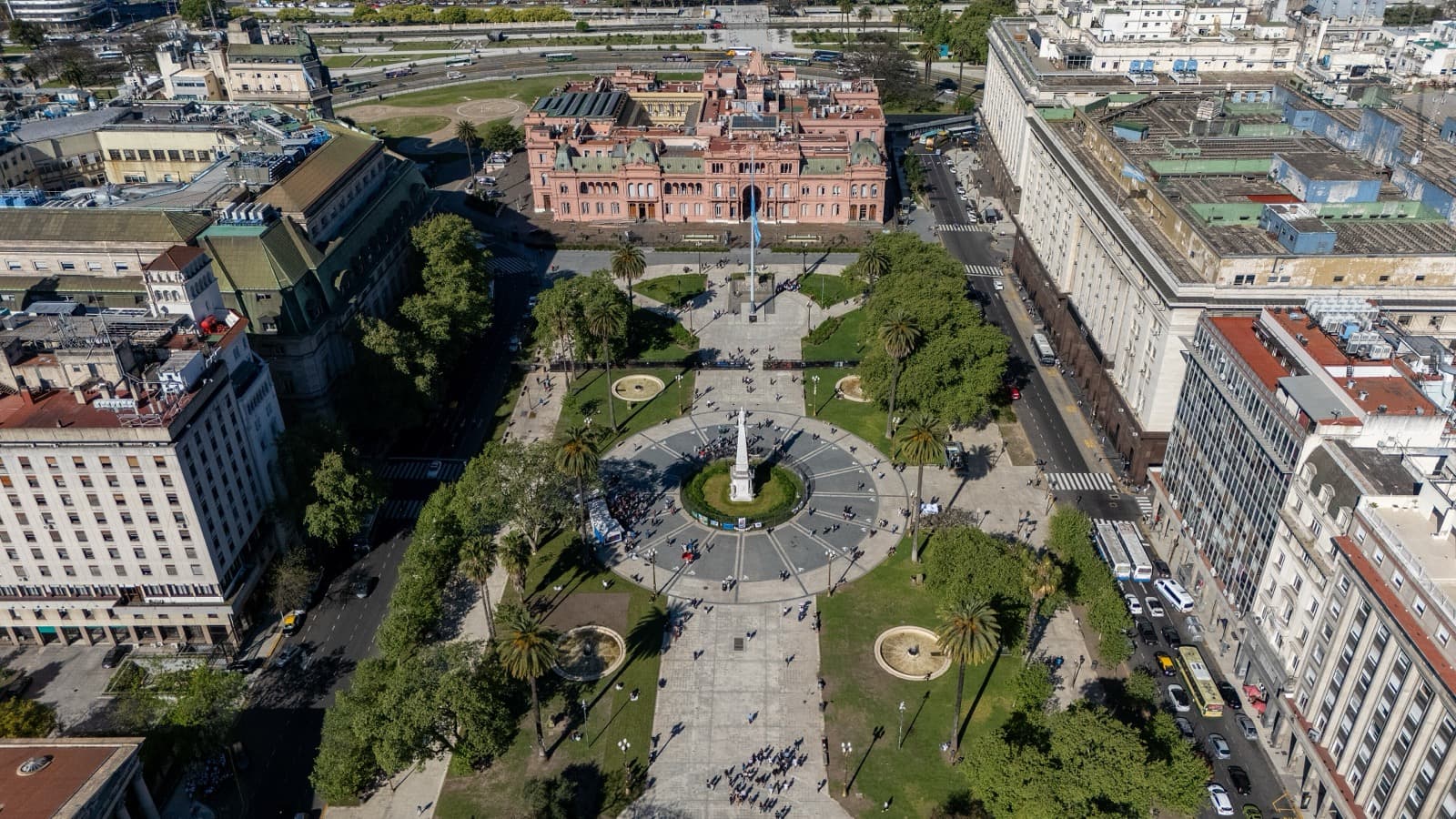
Casa Rosada: The Pink House That Faces the Founding Square
Plaza Dorrego: The Small Square Where San Telmo Comes to Life