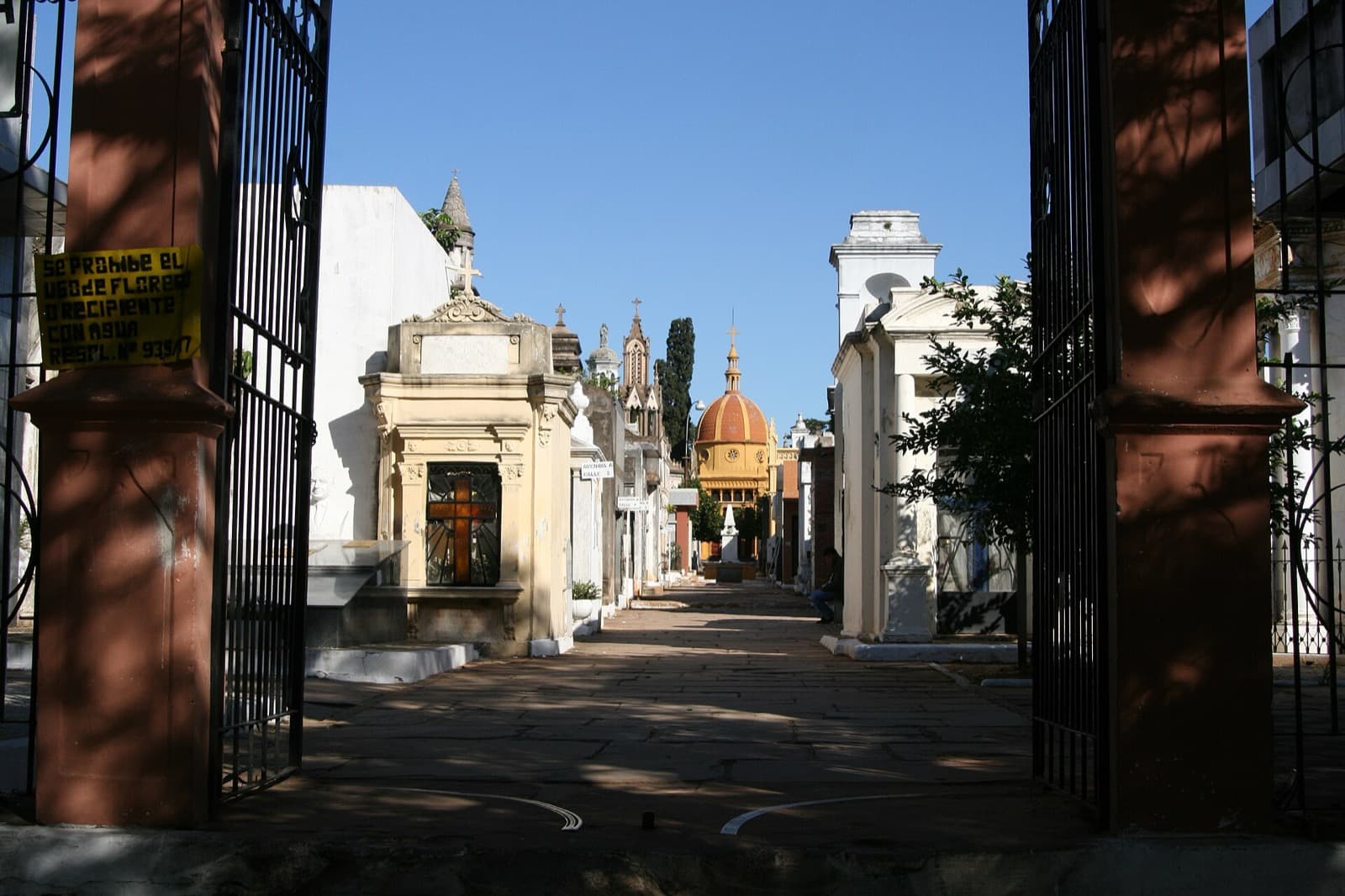
The Doric gate of Recoleta Cemetery is the threshold to Argentina's first public cemetery, a gridded city of marble that the landowning families of Buenos Aires built on the old garden of a religious order. Stand in front of it and you are looking at the entrance to what functions less like a graveyard than a small city: tall Doric columns, sober and classical, and behind them paved avenues that run in a grid between rows of mausoleums. Some look like miniature temples. Some look like chapels. You could genuinely lose your way among them. Before you walk in, it helps to understand exactly what this gate marks and why the families who built the necropolis competed in death as they had in life.
What the gate actually marks
Recoleta Cemetery was inaugurated on the seventeenth of November, 1822, as the first public cemetery in Buenos Aires. That date matters, because it makes the cemetery a product of a particular moment: the young republic organizing civic death away from the churchyard, on ground that had until recently been the edge of town.
The land had belonged to the Recollect friars, a religious community whose name, in Spanish los recoletos, gives the whole barrio its name. Where you now stand was once their garden and orchard, on what were then the outskirts of the city. After the order left the site, the ground was reorganized for burial. A French civil engineer, Prospero Catelin, laid out the original grounds. The gate you are looking at, however, is later. In 1881 the architect Juan Antonio Buschiazzo remodelled the cemetery and gave it this neoclassical entrance and the gridded avenues that make the interior feel like streets. So the gate is not the origin of the cemetery. It is a second-generation face, added almost six decades after the first burials, when Buenos Aires was becoming rich enough to want its necropolis to look the part.
That layering is the first thing to read here. The friars' quiet garden came first. Then a public cemetery. Then, as the city's fortunes swelled, a grand classical gate placed in front of it all.
The scale behind the columns
Hear a stop from this walk
Floralis Generica: The Steel Flower and the Contemporary North
Pass the numbers through your mind before you pass through the gate. The cemetery covers about five and a half hectares and holds roughly 4,700 above-ground vaults. Ninety-four of them are formally declared National Historical Monuments, a designation that treats individual tombs as protected heritage in their own right. That is an unusual density of protected architecture for a single walled enclosure.
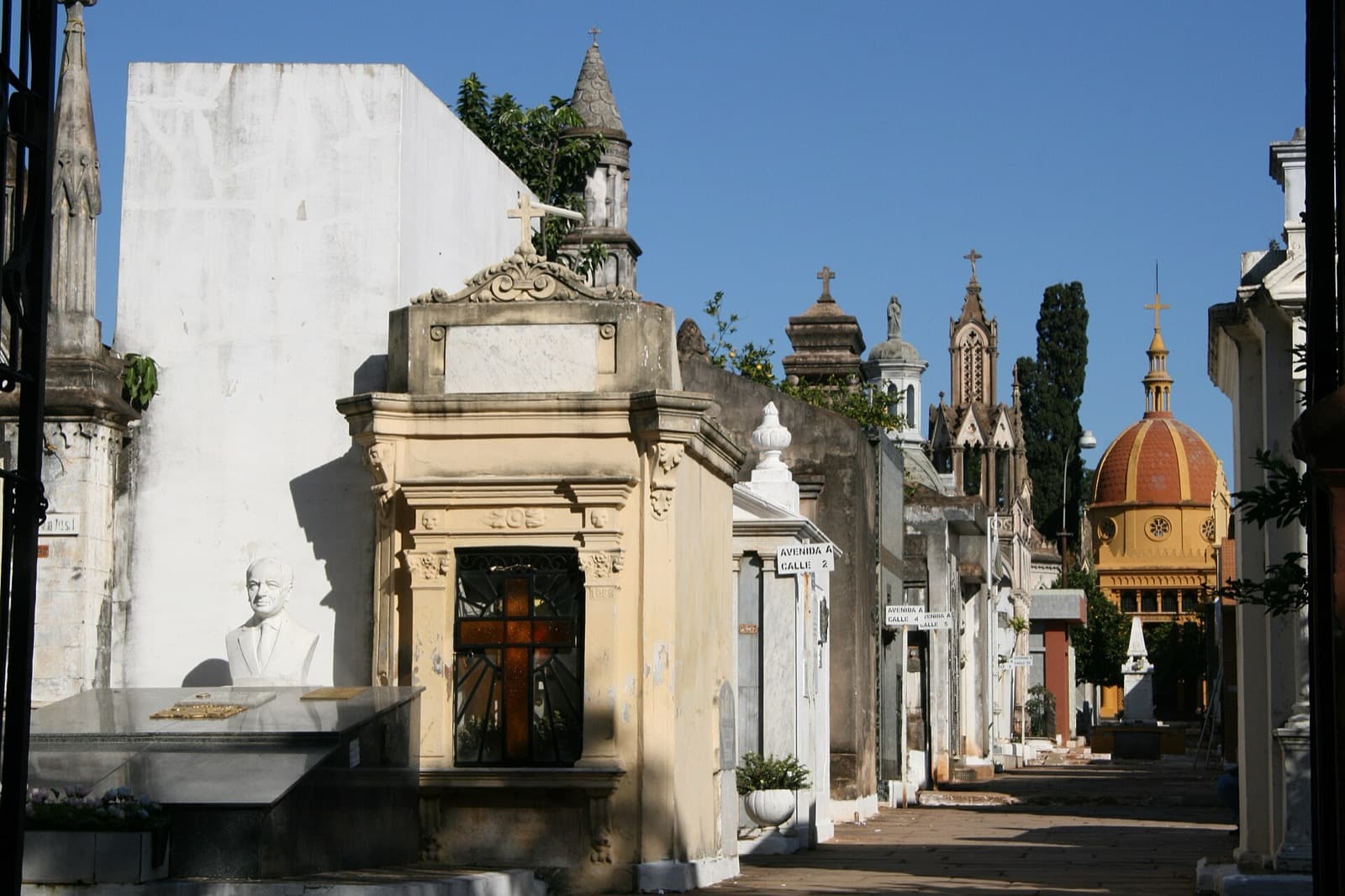
The styles inside run the full nineteenth and early twentieth century range: Art Deco, Art Nouveau, Baroque, Neo-Gothic, neoclassical temples with pediments and columns. Much of the marble was imported from Paris and from Milan, mostly in the late nineteenth and early twentieth centuries, and the finest pieces were shaped by noted sculptors. This was not local stone quarried nearby. It was European material shipped across the Atlantic so that families in Buenos Aires could build European monuments for their dead.
Buried behind the gate are presidents, the founder of the Argentine navy, Nobel laureates, and above all the landowning families who could afford to build in stone. That last group is the key to the paradox of the place. The fortunes came from grain and cattle, from the great export boom that styled Buenos Aires the Paris of South America, and a share of those fortunes went here, into vaults that answer one another down the avenues. Read the interior as a competition held in marble: each family building a little grander than the next, wealth still speaking long after the people inside had died.
The one thing to understand standing here
If you take a single idea through this gate, take the paradox that the cemetery was built grander than much of the living city around it. A narrow, immensely rich class spent lavishly on memory, on private stone temples for private names, on a scale that the ordinary streets of the period could not match. The gate frames that. Its calm classical columns promise order and restraint. The city of the dead behind them is anything but restrained.
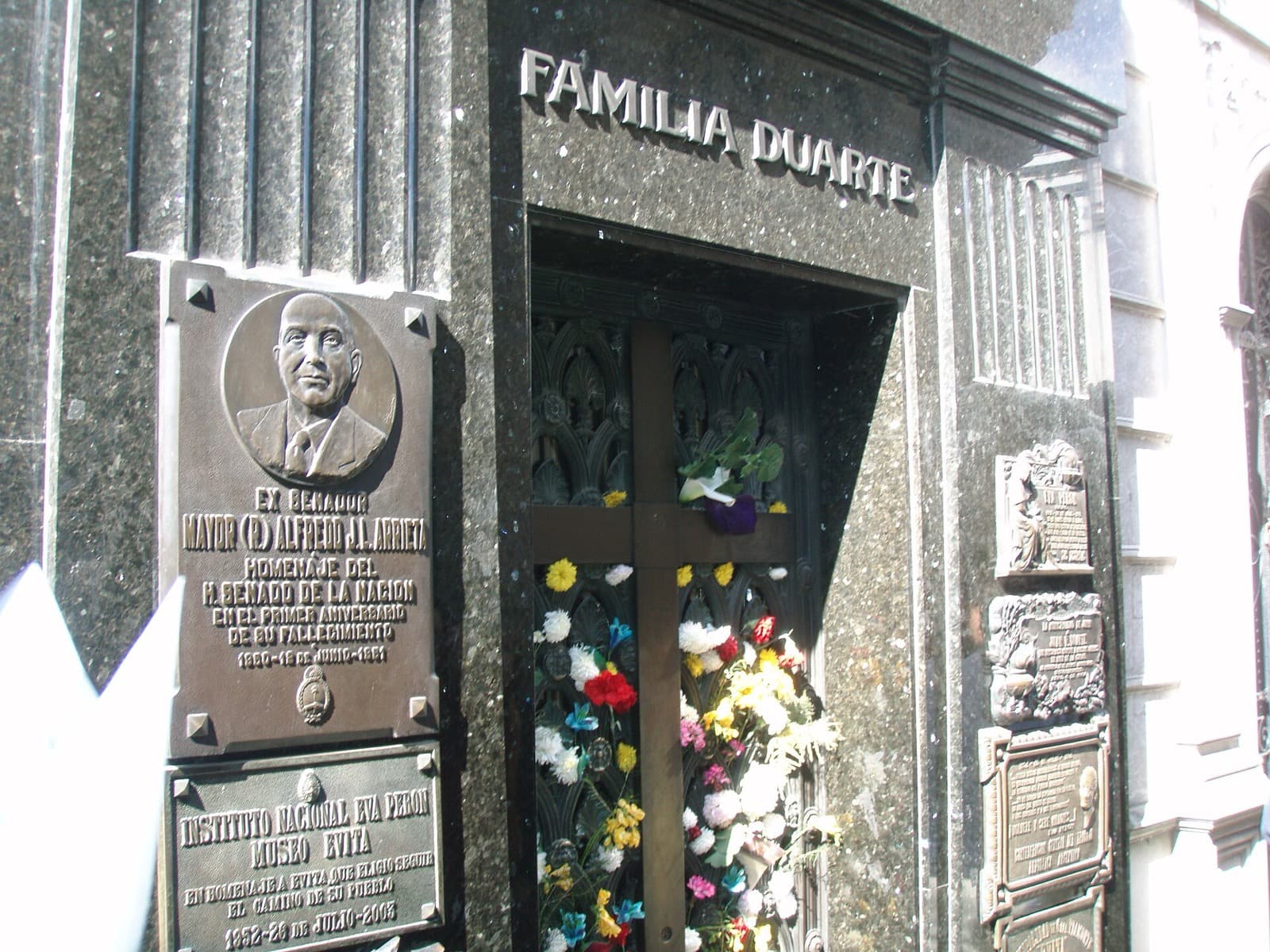
There is a second, quieter irony worth carrying inside, though it belongs to the stops beyond this one. In a necropolis full of presidents and old families, the most visited grave is not a statesman's. It belongs to Eva Peron, an outsider the traditional elite would never have admitted among them while she lived. Her body was buried in the family vault only in 1976, after a long and secret journey abroad. That the longest queue in this cemetery of the establishment leads to someone the establishment scorned is the sharpest expression of everything the gate introduces. You will reach the Duarte vault a few stops in.
A practical note that also tells you something about the present. Charging foreign visitors to enter began only recently, on the fourth of April, 2022. Argentine residents, students and retirees still enter free. So this remains a civic space for the city's own people, with a card reader at the gate for everyone else. Carry a working card, pick up or photograph a map, and keep some quiet in reserve. For all its beauty, this is a place of the dead. Walk it the way the neighbors do.
Walking it in order
The gate is the opening move of a longer walk that reads the same paradox one stop at a time: from the marble avenues out to the colonial church that came first, the leisured squares, the avenue of French palaces, a giant steel flower, and a national art museum that is finally free to all. If you are planning the day, the Buenos Aires walking tours guide sets this route among the city's others, and the Buenos Aires page gathers the neighborhoods you can string together on foot.
The self-guided Recoleta audio walk begins right here, at the Doric gate. Stand a moment before the columns, let the grid of marble open in front of you, and start stop one. The story of the city of the dead is best heard while you are standing inside it.
Sources
- La Recoleta Cemetery, Wikipedia. Overview of the 1822 inauguration, Catelin and Buschiazzo, hectares, vault count and the ninety-four protected monuments.
- Recoleta Cemetery, Buenos Aires City Tourism (official, turismo.buenosaires.gob.ar). Official visitor information, entry policy and heritage designation.
- Eva Peron, Wikipedia. Background on the Duarte vault and the 1976 reinterment referenced as the necropolis's most-visited grave.
- Basilica of Our Lady of the Pillar, Buenos Aires, Wikipedia. Context on the Recollect friars whose garden became the cemetery grounds.
Ready to experience it?
Recoleta Cemetery: The City of the Dead That Outshone the Living
90 min · 3 km · easy
More from Buenos Aires
Explore more at your own pace.
Buenos Aires: The City That Keeps Rewriting Itself in Public
Tango on Plaza Dorrego: Why San Telmo Has No Single Birthplace
The Tomb of Eva Perón and the Recoleta Cemetery That Outshone the Living
The White Headscarves at the Center of Plaza de Mayo
Casa Rosada: The Pink House That Faces the Founding Square