Look down at the pavement around the May Pyramid in Plaza de Mayo and you will find a ring of white headscarves painted into the stones, one after another, tracing a circle. This is a memorial, and it is the quietest and gravest thing on Argentina's founding square. It also happens to be the key that unlocks the whole walk across this ground, because the same paving that carries these painted headscarves carried the birth of a republic, the glory of a populist movement, and the machinery of state terror. Reading this single ring is the fastest way to understand why Plaza de Mayo is not a monument to one moment but a stage a nation keeps returning to.
A ring painted where women walked
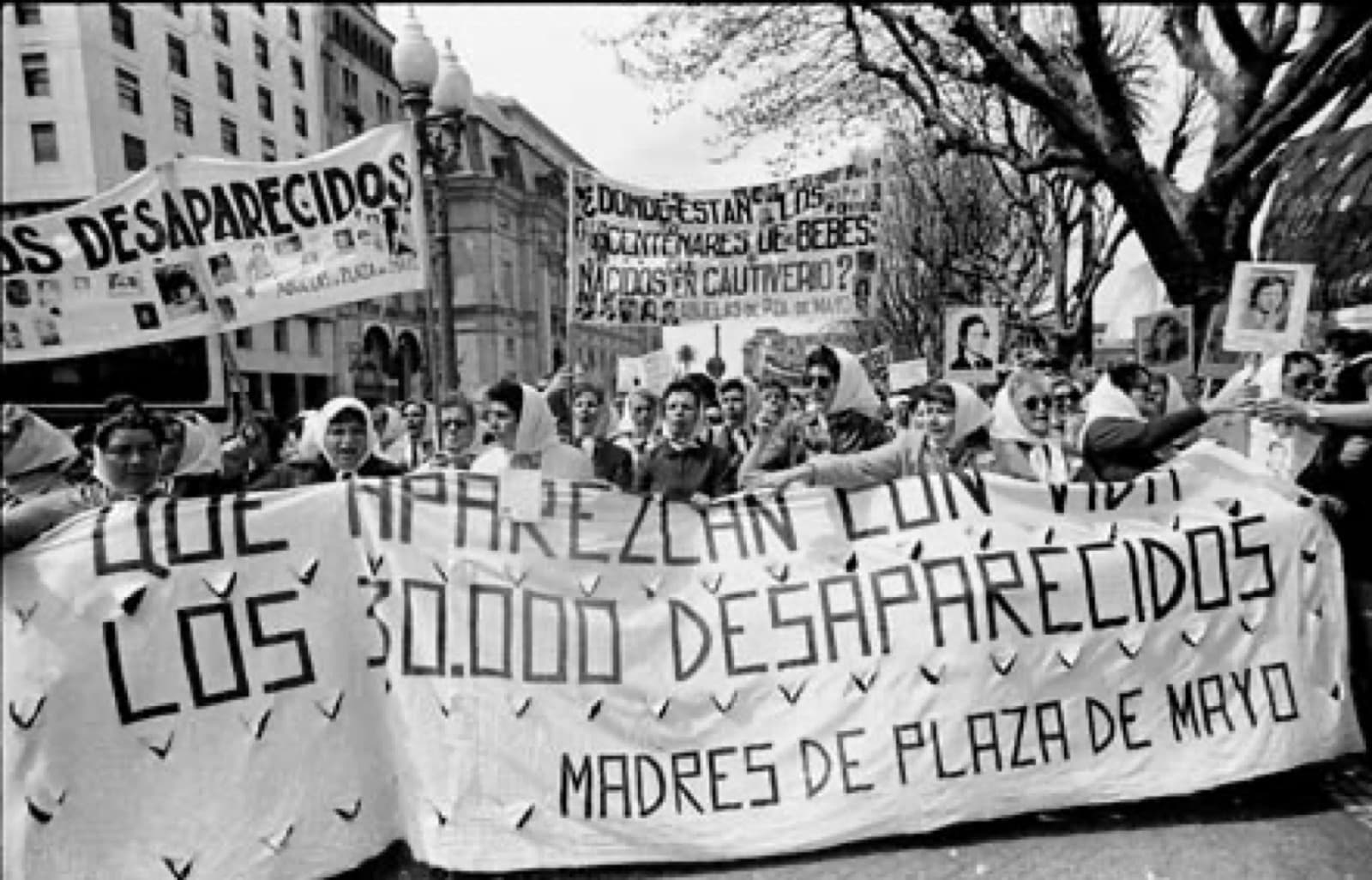
The headscarves belong to the Madres de Plaza de Mayo, the Mothers of the Plaza de Mayo. During the last military dictatorship, which ruled from 1976 to 1983, thousands of people were seized and never seen again. Argentines call them los desaparecidos, the disappeared. On the thirtieth of April, 1977, fourteen mothers, called together by Azucena Villaflor, gathered on this square to demand news of their children. Told by the police to keep moving, they walked two by two in a slow circle around this pyramid, and they settled on Thursdays. That October, at a pilgrimage to Lujan, they tied their children's cloth nappies over their hair so they could recognise one another in the crowd, and the nappy became the white headscarf. Before the year was out, three of the founding mothers, Villaflor herself, Esther Ballestrino and Maria Ponce de Bianco, had been kidnapped and murdered for doing exactly this.
About the scale of the loss, it is worth holding two figures side by side. The national truth commission, known by the title of its report Nunca Mas, meaning Never Again, documented eight thousand nine hundred sixty-one named disappearances and identified three hundred forty secret detention centres, and it noted plainly that the true number could be higher. Human-rights organisations usually estimate the toll at around thirty thousand. The commission delivered its report to President Alfonsin on the twentieth of September, 1984. The painted circle you are standing over is not decoration. It is the path those women wore into the square, made permanent.
Why the memory sits exactly here
Hear a stop from this walk
National Congress: The Other End of the Axis
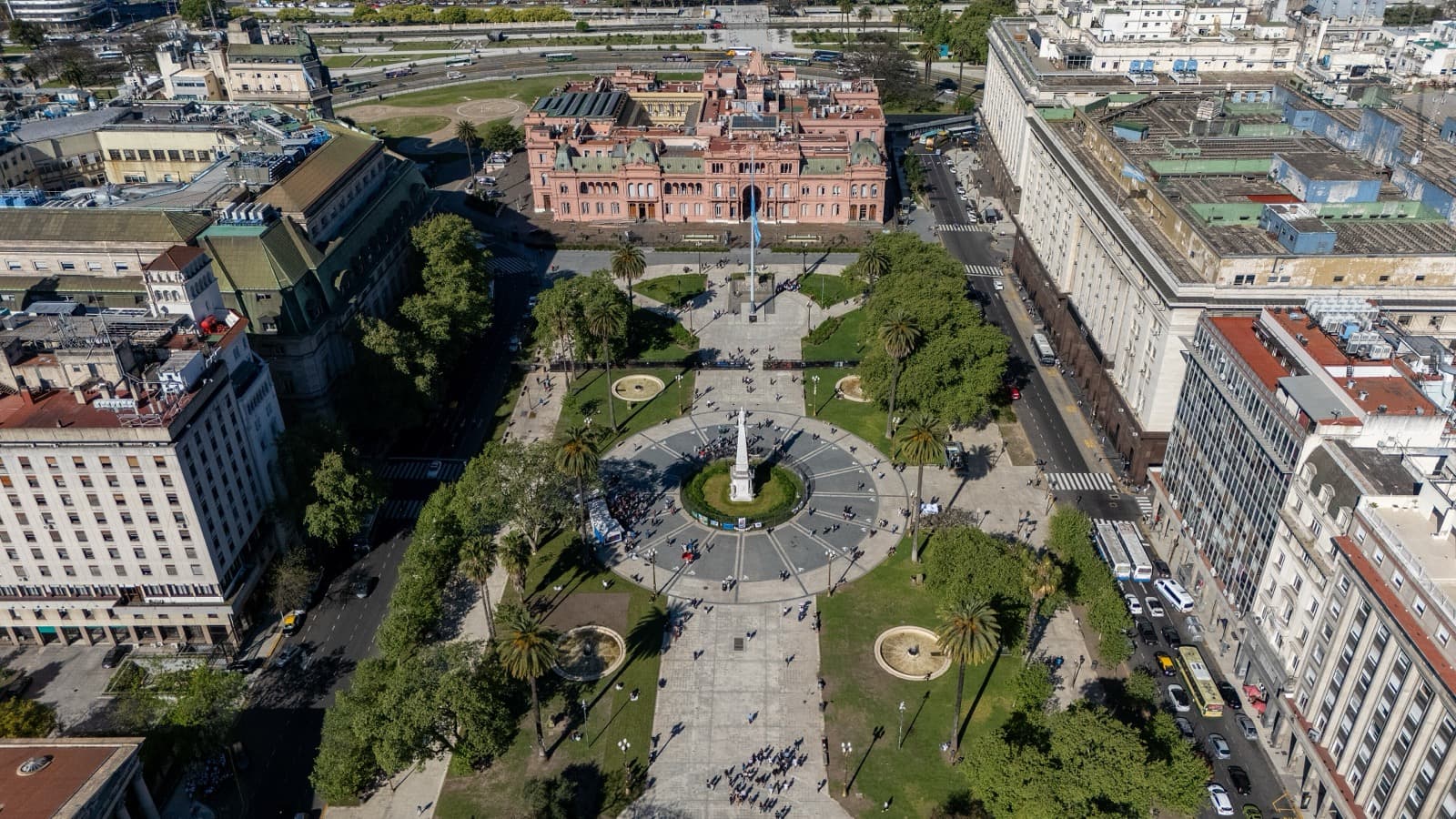
The Mothers did not choose this square by accident, and understanding that choice is what makes the rest of the walk cohere. Plaza de Mayo is the oldest continuous stage in Argentine public life. Its origins reach back to the general Juan de Garay, who refounded Buenos Aires here in 1580 and laid out its main square. The colonial fort rose beside it from 1594, and the open ground in front of the fort became the parade ground before the seat of Spanish power. It took its modern open form in 1884, after a dividing colonnade called the Recova was pulled down during the modernization ordered by the mayor Torcuato de Alvear. At its center rises the Piramide de Mayo, a slim white obelisk raised in 1811 for the first anniversary of the May Revolution and the oldest patriotic monument in the city.
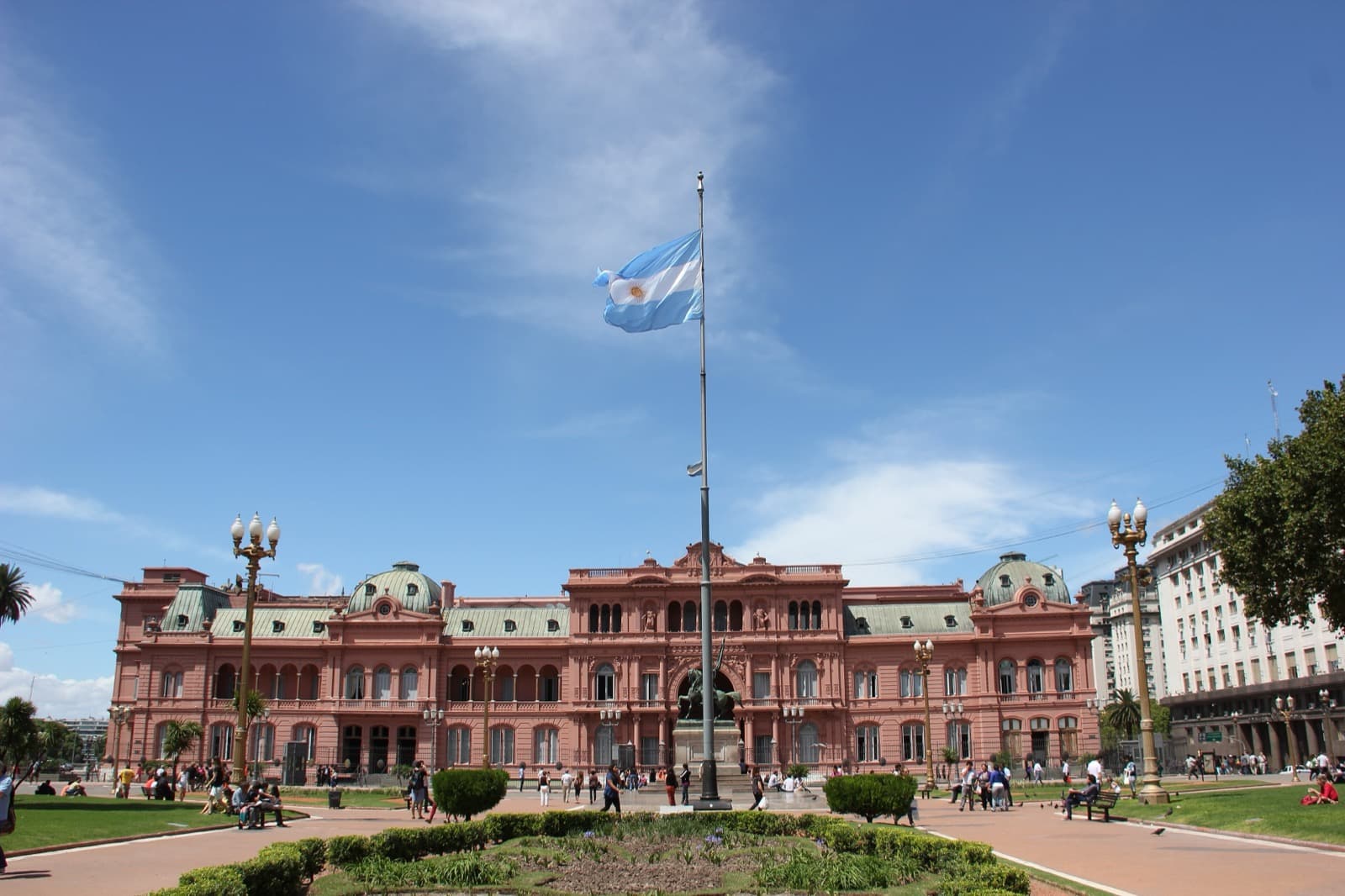
So when the Mothers began circling this pyramid, they placed their grief at the literal origin point of the nation. That is the argument the whole tour makes clear. Power has always faced this square, and this square has always answered back. The pink Casa Rosada on the eastern edge rises over the layered remains of a colonial fort begun in 1594, and its balcony is the country's most charged site of political address, most famously associated with the Peronist movement and with Eva Peron. The white arcaded Cabildo on the western side is the only major survivor of the plaza's colonial civic center, and it survived because of what happened inside it: on the twenty-second of May, 1810, citizens gathered here in an open town council that voted the Spanish viceroy out, and three days later a new junta took power, still governing formally in the name of the captive Spanish king. Independence itself was declared in 1816, far to the north, at Tucuman. To the north, the Metropolitan Cathedral wears a temple front of twelve columns and holds the mausoleum of General Jose de San Martin, the Liberator, guarded by three figures for the three nations he helped free.
Stand at the headscarves and you are surrounded by the founding institutions of the country, and the Mothers walked among them demanding that the state account for its own citizens. That is the tension the tour is built to make you feel, stop by stop.
Where the walk goes from here
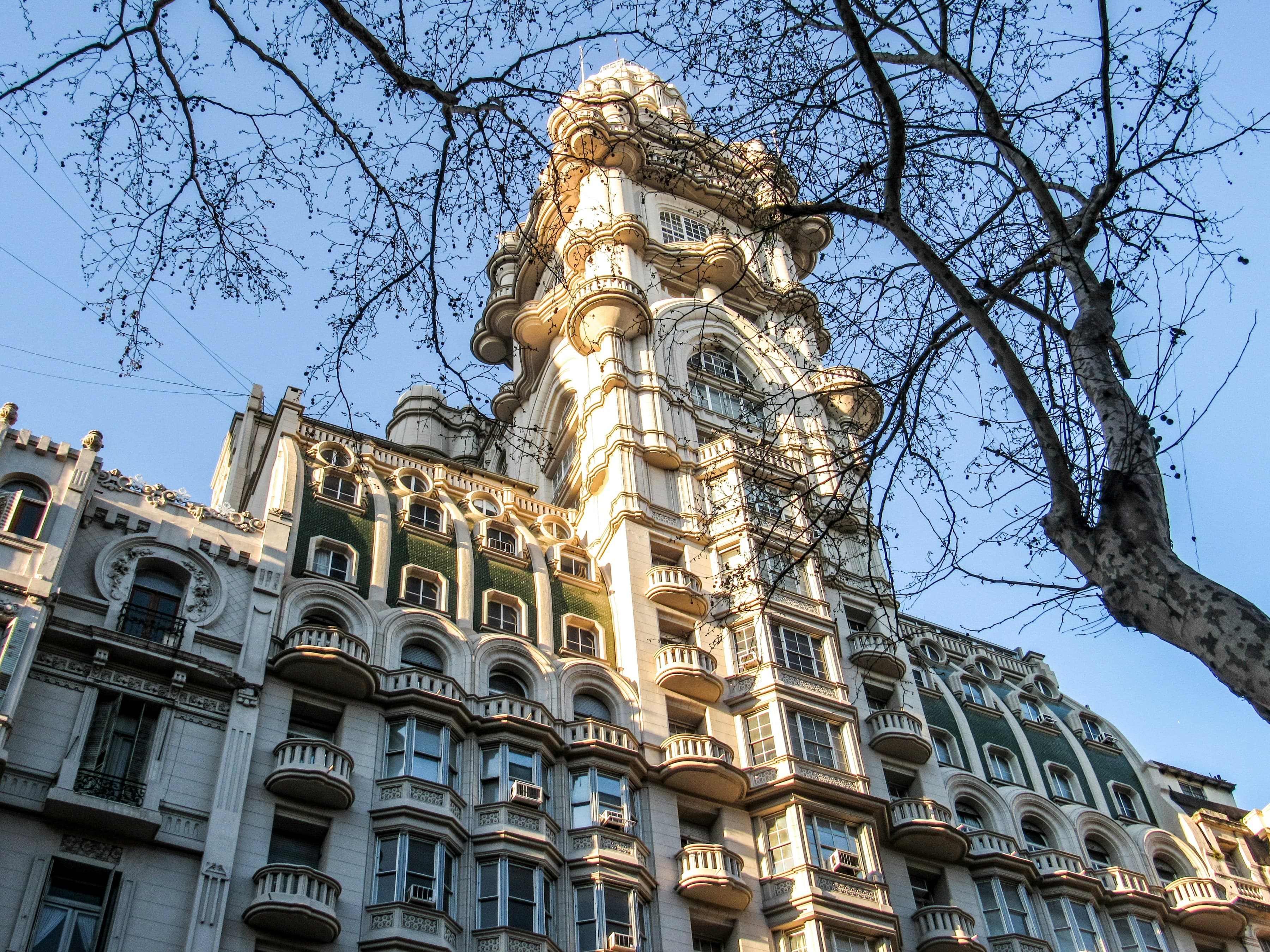
The route does not end at the pyramid. It turns west and climbs into a different mood entirely, and the contrast is the point. The Avenida de Mayo was cut on the model of the Parisian boulevards and inaugurated on the ninth of July, 1894, to link the plaza with the future Congress. It carried the first subway line in Buenos Aires, opened in 1913, the first underground in Latin America. Along it stands Cafe Tortoni, first opened in 1858, the emblem of the city's protected coffee-house tradition. Halfway along rises the Palacio Barolo, a hundred-metre tower built between 1919 and 1923 and structured as an homage to Dante's Divine Comedy, with hell at the base and a lighthouse beacon at the top standing for heaven. For more than a decade it was the tallest building in Buenos Aires, and for a few years the tallest in South America, until its architect's own twin, the Palacio Salvo in Montevideo, rose higher in 1928. The avenue ends at the domed National Congress, and in the gardens before it stands the Kilometro Cero, a four-faced stone block from which Argentina's national roads are measured.
Read together, the walk is one continuous line from the point where the country was refounded to the point where its laws are written and its roads are measured. The headscarves sit at the center of that line, insisting that the story of a nation is also the story of the people it lost. If you want the whole argument in your feet rather than on a page, this is a self-guided audio walk you take at your own pace, lingering where a story holds you and moving on when it does not.
You can see how this walk fits alongside the city's other routes on the guide to Buenos Aires walking tours, or start planning from the Buenos Aires city page. The square rewards a calm weekday morning, when the light is soft on the pink palace and the crowds are thin. When you reach the May Pyramid, look down at the painted circle, and let the rest of the plaza introduce itself.
Sources
- Infobae, "El dia en que 14 locas exigieron la aparicion de sus hijos" (30 April 2023). The first round of 30 April 1977, the move to Thursdays, and the nappy headscarf first worn at Lujan in October 1977.
- Comision Provincial por la Memoria, Iglesia de la Santa Cruz site record, and Pagina/12 (9 July 2005). The December 1977 kidnappings and the 2005 identification of the founding mothers.
- Infobae (20 September 2026) and Comision Provincial por la Memoria. The Nunca Mas report, its named-disappearance and detention-centre figures, and its delivery to President Alfonsin on 20 September 1984.
- Argentine government, Piramide de Mayo and Cabildo heritage pages (argentina.gob.ar), and the Buenos Aires city government on the 1580 founding. The pyramid of 1811 and the 1810 open town council.
- Argentine Ministry of Culture, "Visperas de la Revolucion" (cultura.gob.ar). The open town council of 22 May 1810 and the junta of 25 May.
- Casa Rosada official history (casarosada.gob.ar). The colonial fort of 1594.
- Argentine government, Avenida de Mayo and Palacio Barolo heritage pages, Buenos Aires city government on Subte Line A, and Perfil on the Barolo centenary. The 1894 boulevard, the 1913 subway line, and the Dante-structured tower completed in 1923.
- La Nacion (24 September 2024). The Kilometro Cero monolith.
Ready to experience it?
Plaza de Mayo: The Square Where a Nation Keeps Being Made
90 min · 2.1 km · easy
More from Buenos Aires
Explore more at your own pace.
Buenos Aires: The City That Keeps Rewriting Itself in Public
Tango on Plaza Dorrego: Why San Telmo Has No Single Birthplace
The Tomb of Eva Perón and the Recoleta Cemetery That Outshone the Living
Casa Rosada: The Pink House That Faces the Founding Square
Plaza Dorrego: The Small Square Where San Telmo Comes to Life