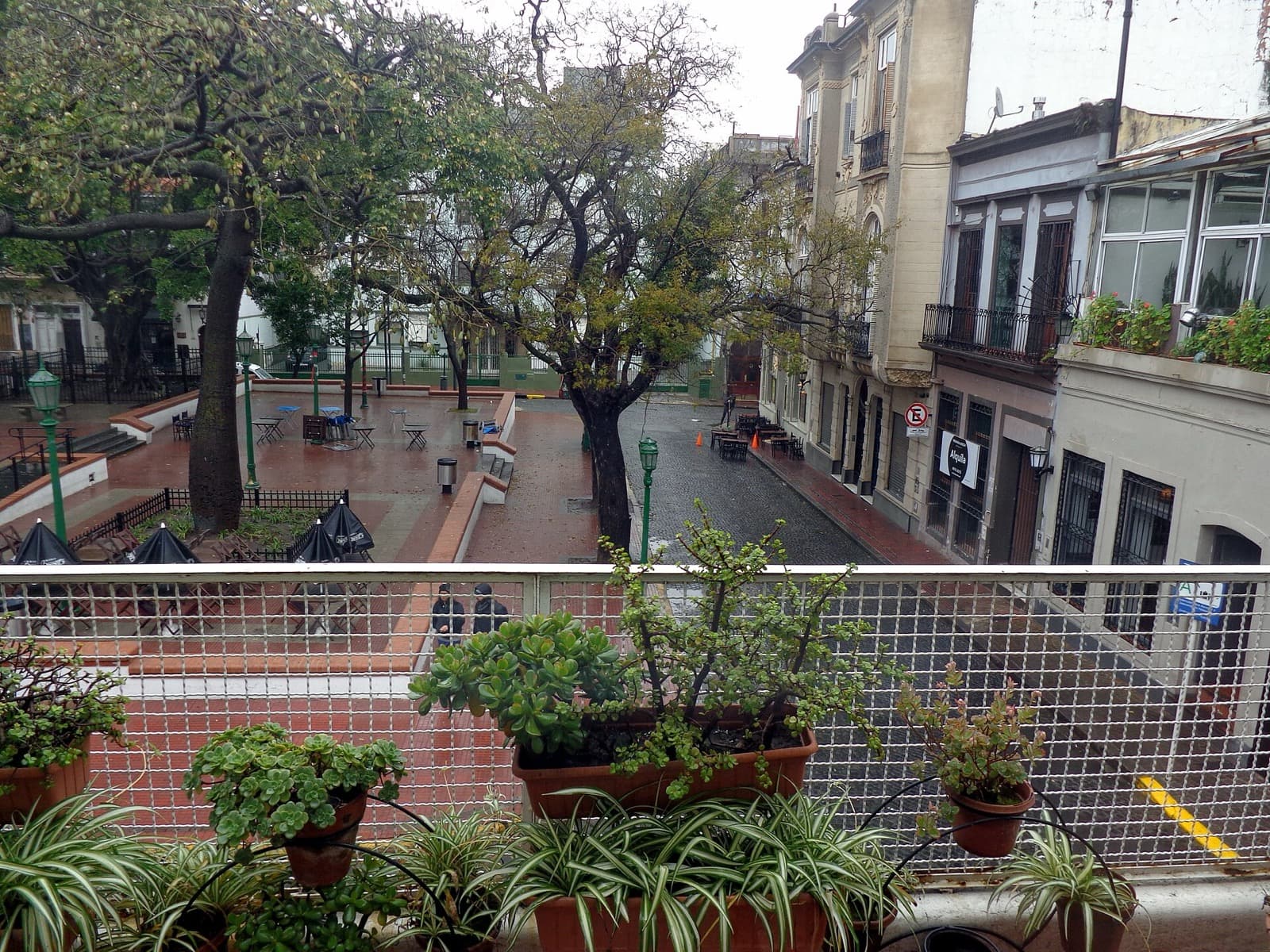
Plaza Dorrego is a small, old square at the corner of Humberto Primo and Defensa in San Telmo, and its importance is not in its size but in what it has always been: common ground. Wagons once halted here on the high ground above the port. Residents of the oldest surviving quarter of Buenos Aires gathered here through the nineteenth century. Today the square disappears every Sunday under an antiques fair and the sound of a bandoneon, as couples dance tango on the stones for whoever stops to watch. To stand in front of Plaza Dorrego is to read one small space that the city has reused, again and again, for four centuries.
A square older than almost anything around it
Spanish-language sources describe Plaza Dorrego as the second-oldest square in the city, after the Plaza de Mayo, and trace its origins to fifteen eighty-six. Back then it was not a plaza at all but the Alto de las Carretas, the high place where the wagons stopped. The name tells you what the ground was for. Ox-carts hauling goods up from the river needed a level halt on the rise, and this corner served. That is worth holding onto as you look at the low facades around you: this was a working piece of the port city long before it was a monument to anything.
The names changed with the centuries, the way street names always do in a growing city. It was the Alto de San Pedro. Then, in eighteen twenty-two, it became the Plaza del Comercio, the square of commerce, a name that again points at trade rather than ceremony. It took its current form, and presumably its current name, in nineteen hundred five. Through the eighteen hundreds, when San Telmo was the main residential neighbourhood of Buenos Aires, this square was its central gathering point. People met here, traded here, walked here. The Sunday crowd you see now is not a modern invention grafted onto an old space. It is the same use, carried forward.
The Feria de San Telmo, and why it is not just shopping
Hear a stop from this walk
Parque Lezama: Where the City Is Said to Have Begun
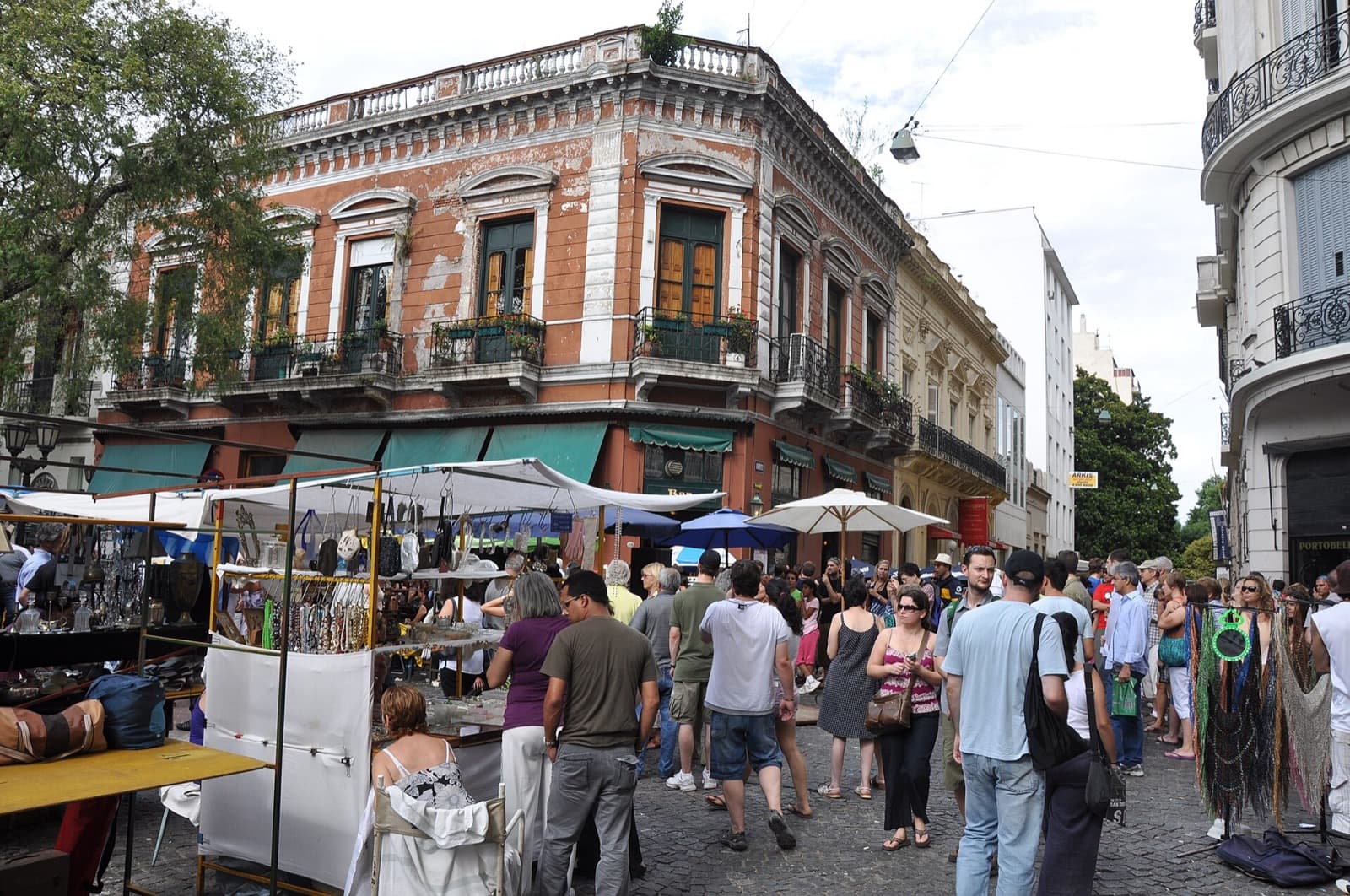
Come on a Sunday and Plaza Dorrego vanishes beneath the Feria de San Telmo, the antiques fair. Its stalls crowd the square and spill down Calle Defensa, the street that runs through the barrio. You will hear the fair before you see it: the clatter of old silver and glass, the back-and-forth of bargaining, and somewhere the low breath of a bandoneon.
It would be easy to treat this as a shopping errand, a box to tick. That misses what is actually happening. The fair is living heritage, a weekly ritual that has turned this small square into a stage for the barrio's own traditions. The antiques matter less than the fact of the gathering. Watch how the fair uses the space, and you will see it uses it exactly as the wagons and residents once did: as common ground, open to whoever arrives. That continuity is the single thing to understand standing here. Plaza Dorrego is not a preserved relic behind a rope. It is a public room that the neighbourhood still lives in, and the Sunday crowd holds the square the way sixteenth-century wagons once did.
There is a practical note that comes with the crowd. In the crush of the Sunday fair, keep your bag closed and in front of you, and your valuables discreet. Ordinary big-city pickpocketing is the main risk here, nothing more dramatic, but a packed square rewards a little care. Many stalls also prefer cash in Argentine pesos, and a few will not take cards at all, so carry some if you plan to buy.
The corner where tango is easiest to hear
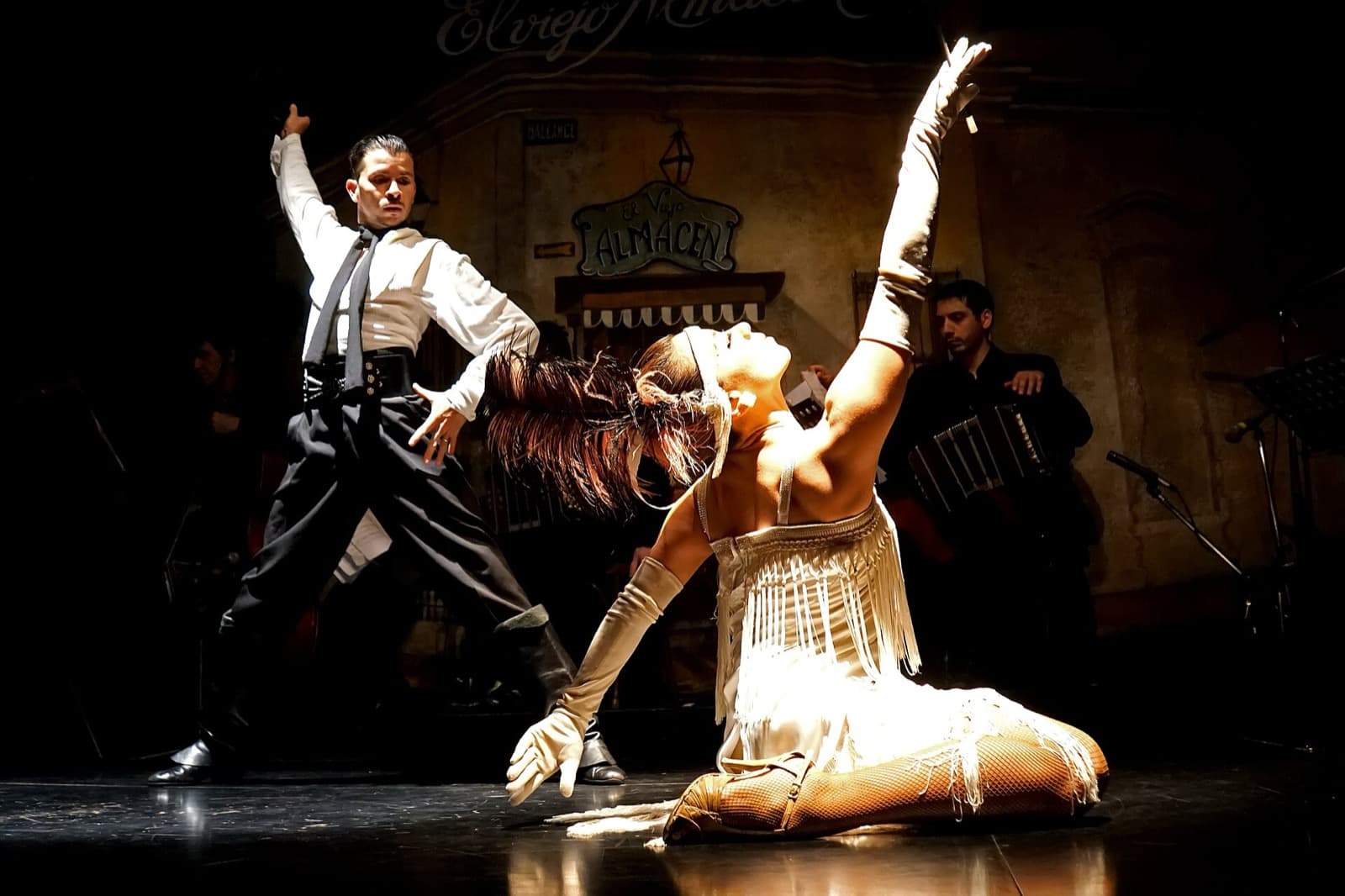
Plaza Dorrego is also one of the places where you are most likely to see tango danced in the open, and it repays a moment of honesty about what that means. Tango emerged in the late nineteenth century, from the eighteen eighties onward, along the River Plate, in the poor port and immigrant districts of Buenos Aires and, across the water, Montevideo. The neighbourhoods that Argentine history ties to its early years include La Boca, San Telmo and Boedo. So if someone tells you tango was born on this exact corner, hold that lightly. The precise birthplace is tradition, claimed by several districts at once, not one settled spot.
What is settled is the mixture. Tango blended the local milonga, the Spanish and Cuban habanera, the candombe carried by African-Argentines descended from formerly enslaved people, and the European forms that immigrants brought with them. Around nineteen hundred it was widely regarded as disreputable, danced in the poorer margins of the port city. Then dancers and orchestras carried it to Paris, London and Berlin, and it came back respectable and famous. UNESCO inscribed tango on the Representative List of the Intangible Cultural Heritage of Humanity in two thousand nine, at its committee session in Abu Dhabi, on a joint nomination by Argentina and Uruguay. The dancers you watch on the cobbles are not performing a museum piece pinned to a plaque. They are keeping a living tradition that grew in barrios exactly like this one.
Why this square is the whole barrio in miniature
Here is the idea to carry away from Plaza Dorrego, because it unlocks the rest of San Telmo. Almost every surface in this quarter is a second use. An aristocratic house became a tenement. A market built for immigrants still sells produce. A founding site is remembered as tradition rather than settled fact. Plaza Dorrego is that pattern at its clearest and gentlest: the square that held wagons in the sixteenth century now holds the Sunday crowd. Same ground, new life, no rupture.
That is why this is the right place to begin a walk. Once you have felt how the barrio reuses its own space, you start reading every street for the layer beneath the visible one. The immigrant market under iron and glass. The house where the floor lifts to show buried tunnels. The sailors' church that gives the neighbourhood its name. The great mansion that became a tenement after the yellow fever epidemic of eighteen seventy-one drove the wealthy north. The park where the city is said to have begun. Plaza Dorrego is the key that fits all of them.
If you want to walk it in order, at your own pace, our self-guided San Telmo audio tour begins right here on the square and follows the grain of the old city through seven stops. For the wider city, see our guide to Buenos Aires walking tours. Come Sunday for the fair and the tango at full voice, or a weekday morning for the same stones, quiet. Either way, start where the barrio has always started: on this small, old square, on common ground.
Sources
- Plaza Dorrego, Wikipedia. Names, dates, and the fifteen eighty-six origin as the Alto de las Carretas.
- Plaza Dorrego, Gobierno de la Ciudad de Buenos Aires (Casco Historico). Municipal history of the square and the Feria de San Telmo.
- Tango, UNESCO Intangible Cultural Heritage (RL/00258). The two thousand nine inscription on a joint Argentina and Uruguay nomination.
- Roamer San Telmo self-guided tour, fact-audited tour transcript. Route context and the barrio's "second use" reading of Plaza Dorrego.
Ready to experience it?
San Telmo: The Cobblestones Where Tango Was Born
85 min · 1.5 km · easy
More from Buenos Aires
Explore more at your own pace.
Buenos Aires: The City That Keeps Rewriting Itself in Public
Tango on Plaza Dorrego: Why San Telmo Has No Single Birthplace
The Tomb of Eva Perón and the Recoleta Cemetery That Outshone the Living
The White Headscarves at the Center of Plaza de Mayo
Casa Rosada: The Pink House That Faces the Founding Square