Antoni Gaudí knew he would not live to see this church finished. He worked on it anyway, and from 1914 he worked on almost nothing else. The Sagrada Família is not a building he completed. It is a book he left open, with one chapter finished, one facade built as a model for strangers, and the rest set down as instructions. Walk round it on the Sagrada Família and Sant Pau tour and you read that book across a century and a half, in more than one hand.
The chapter Gaudí finished
The church was begun in 1882 to a neo-Gothic plan by the architect Francisco de Paula del Villar, and its crypt, ten metres below ground, was the first part built. Gaudí took over the work in 1883, and from there it became the work of his life.
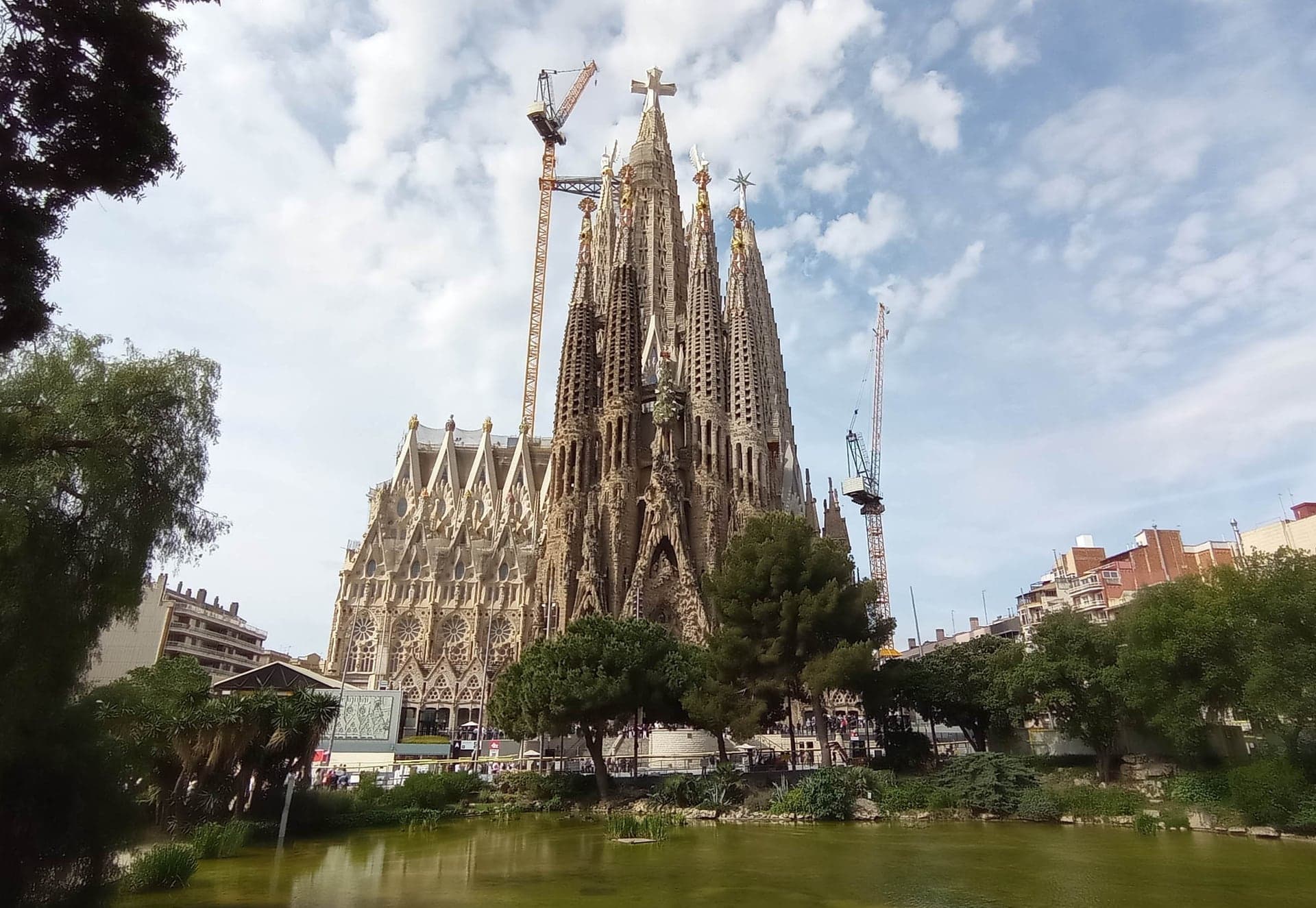
The one facade he was able to complete is the one most visitors walk past: the apse, on Carrer de Provença. The church's own explanatory booklets say it shows the passage from Villar's neo-Gothic to Gaudí's own style, which he first worked out on this wall. Its pinnacles, nearly fifty metres tall, carry the wild plants of the fields that once surrounded the site, and its gargoyles are snails, lizards, frogs, toads and snakes that carry rainwater off the roof. Gaudí is buried in the crypt below, in the Chapel of Our Lady of Carmel.
The model he built for strangers
Hear a stop from this walk
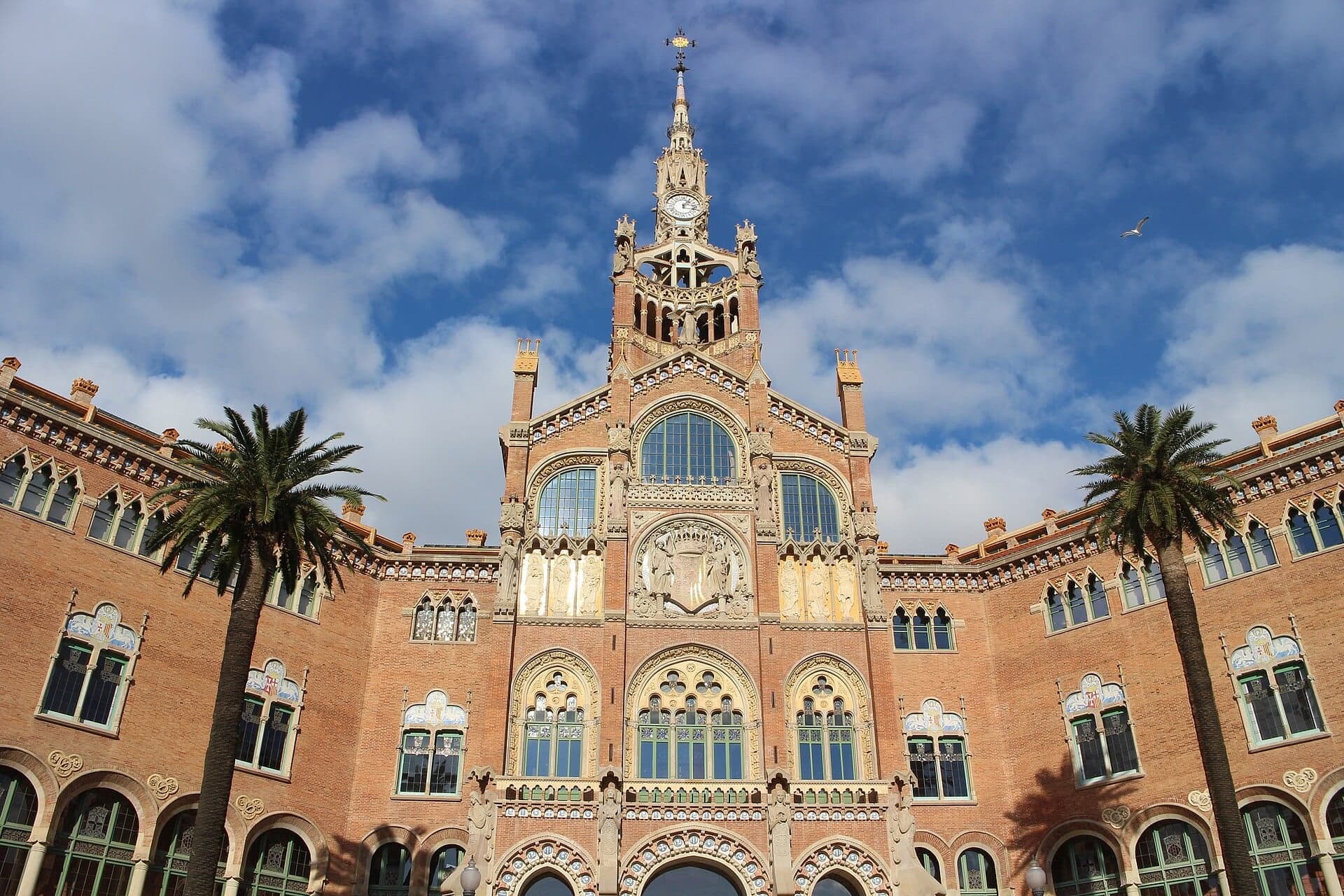
Sant Pau's Pavilions: A Hospital Until 2009
The facade everyone photographs is the Nativity, facing east onto Carrer de la Marina, begun in 1891. The booklets explain why it exists in the form it does: knowing he would never finish the whole temple, Gaudí chose to build one facade so that those who came after would know how to go on. Read it left to right as you face it: the portal of Hope for Joseph, Charity for Jesus in the middle, Faith for Mary. The stone looks grown rather than cut.
Its first tower, Saint Barnabas, was finished in November 1925, the only one of the church's eighteen towers Gaudí lived to see complete. On 7 June 1926 he was hit by a tram crossing the Gran Via; nobody recognised him, and he was taken to the old Hospital de la Santa Creu, where he died on 10 June. The other three Nativity towers were finished in 1930. The Nativity facade and the crypt were added to UNESCO's World Heritage list in 2005, joining the Gaudí works first listed in 1984.
The answer a later hand gave
Turn now to the west side, on Carrer de Sardenya. The Passion facade, telling Christ's death, was founded in 1954, and its towers went up in the 1970s. Gaudí had sketched it in 1911, ill in Puigcerdà, and left a brief that asked for harshness. As his disciple Puig i Boada recorded it, he wanted it to inspire fear, and was willing "to break arches, cut down columns, in order to give people an idea of how bloody the sacrifice is."
The sculptor who answered him was Josep Maria Subirachs (1927 to 2014), commissioned in 1986. He worked on the scenes from 1986 to 2010, the church says, "using his own language of sharp edges and exaggerated volumes". He gave one of the Evangelists Gaudí's face, and the soldiers' helmets echo the chimneys of Gaudí's Casa Milà. Where the Nativity is warm and overgrown, the Passion is bare and angular, so the visitor is left to decide whether that is a rupture in the book or the truest continuation of it.
Gaudí worked in the vocabulary of Catalan Modernisme, a grammar you can learn to read across the city; the invented language of Modernisme is the alphabet the Nativity facade is written in.
The chapters still being written
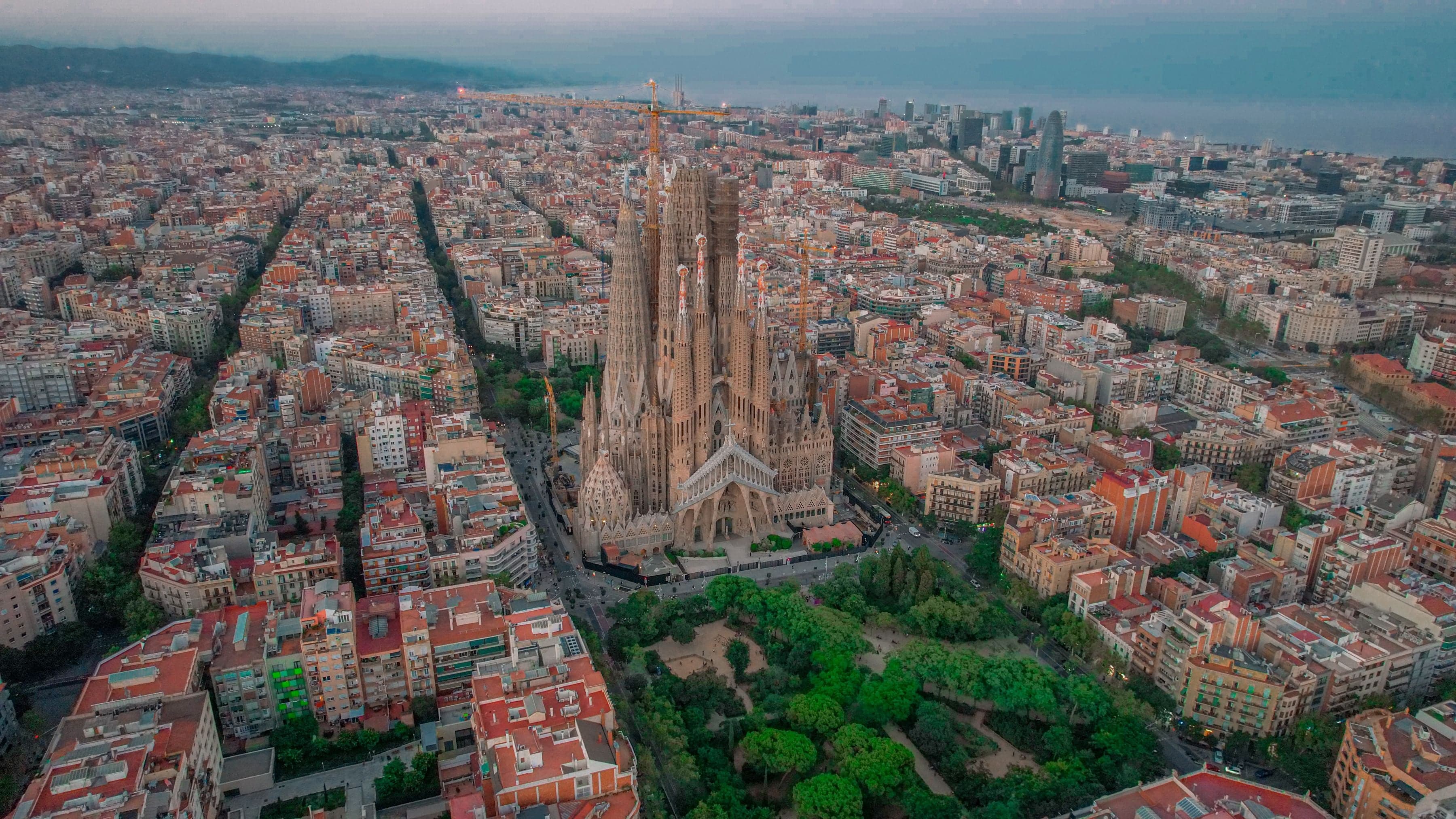
On 20 February 2026 the builders placed the upper arm of the cross on the Tower of Jesus Christ, completing the outside of the central tower at 172.5 metres and making the Sagrada Família the tallest church in the world. Pope Leo XIV blessed the tower on 10 June 2026, the centenary of Gaudí's death, and it was lit for the first time that night. Fourteen of the eighteen towers now stand.
That is not the end of the book. Work has moved inside the central tower, and the four towers of the Glory facade, the main front on Carrer de Mallorca, are still to come, at 120 metres each. Gaudí's plan carries a wide stairway over Carrer de Mallorca to that front, which would mean demolishing homes; in 2026 the city, the residents and the church were still negotiating, and the builders hope ten years will be enough to finish, without a date. The church counted 4,877,567 visitors in 2025, and says its income comes entirely from private sources, tickets and donations for a building that is still going up.
If you want to keep reading Barcelona in stone, the companion to this piece follows the avenue from the basilica to another Modernista building of the same decades, the Hospital de Sant Pau built as art. You can plan the walk from the Barcelona city page, the best walking tours of Barcelona, or the architecture walking tours of Barcelona.
The Sagrada Família rewards the visitor who reads it slowly. Arrive knowing which hand carved which face, and the church stops being a spectacle and becomes an argument between centuries about how to finish another person's sentence.
Sources
- Junta Constructora del Temple Expiatori de la Sagrada Família: history page, explanatory booklets 1 to 10, and news of 30 November 2025, 20 February, 24 March, 10 June, 24 July and 22 September 2026 (sagradafamilia.org)
- Basílica de la Sagrada Família blog, on the Nativity crane, Gaudí's last years and the Passion facade
- Roamer audio-tour fact dossier, "Sagrada Família and Sant Pau" (12 October 2026)
Ready to experience it?
Sagrada Família and Sant Pau: Four Façades and an Avenue
60 min · 1.5 km · easy
More from Barcelona
Explore more at your own pace.
Best History Walking Tours in Barcelona (2026)
Cerdà's Eixample: The Grid Madrid Imposed and the Buildings That Broke Its Rules
El Born vs the Gothic Quarter: How to Tell Barcelona's Two Old Towns Apart
The Gothic Quarter in Three Layers: Roman, Royal and Rebuilt
Casa Batlló's Hidden Rib-Cage: Sixty Catenary Arches Under the Dragon