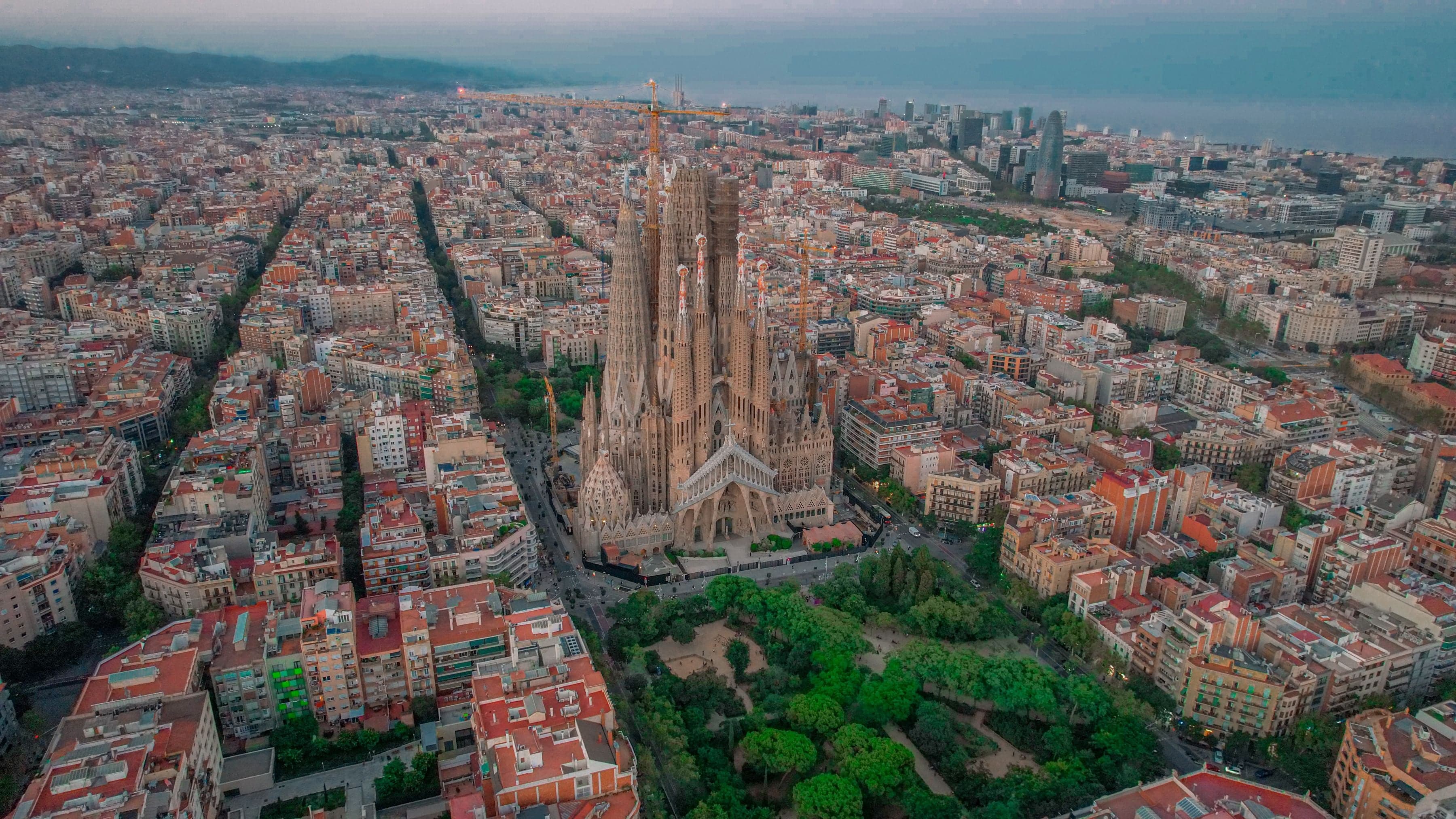
A loop round all four sides of the Sagrada Família, from the pond to the Nativity, the unfinished Glory front, Gaudí's school, the Passion and the apse, then up the Avinguda de Gaudí to the Hospital de Sant Pau.
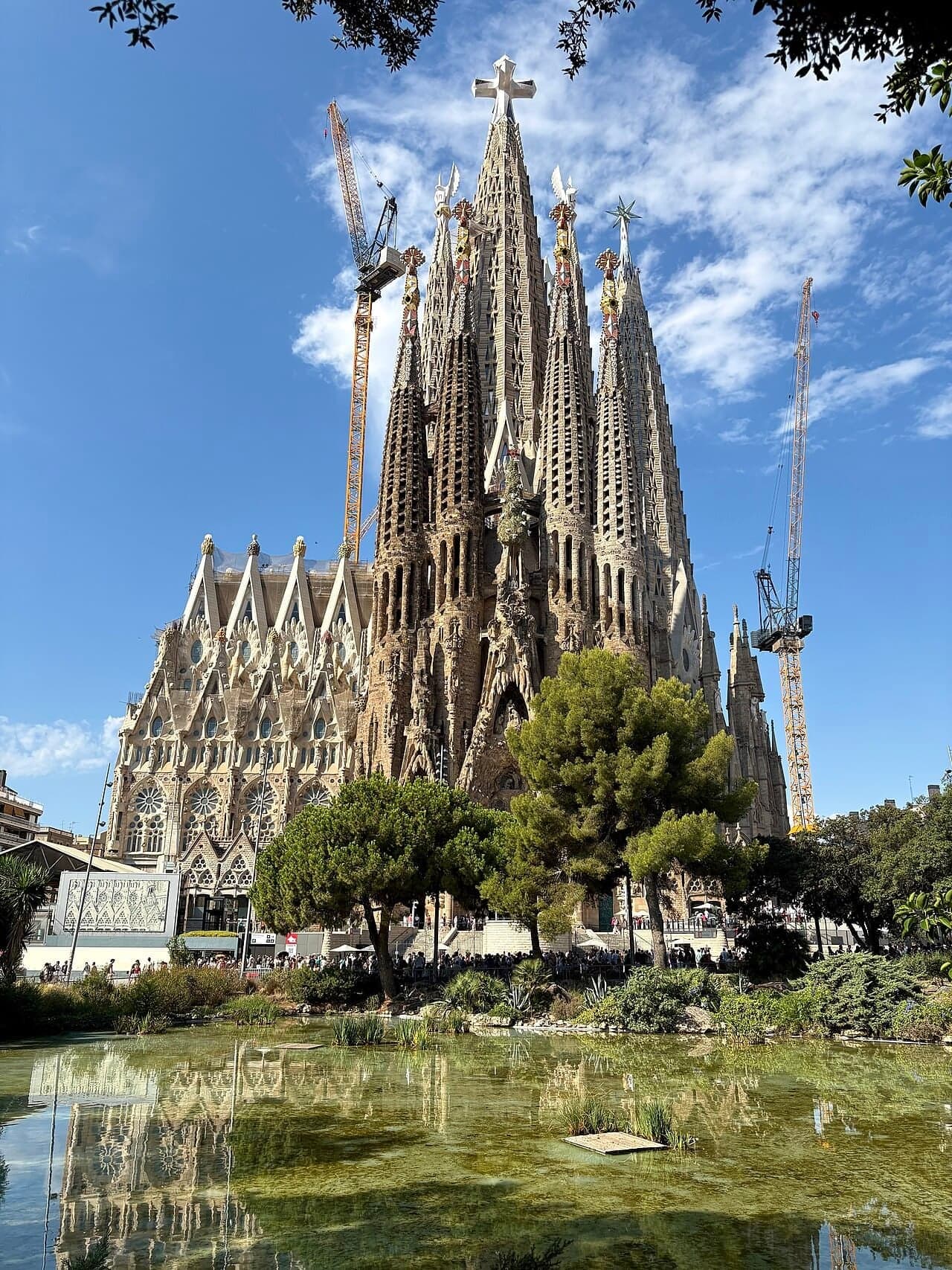
Start · Plaça de Gaudí: The Towers Across the Pond
DirectionsStops
- 1
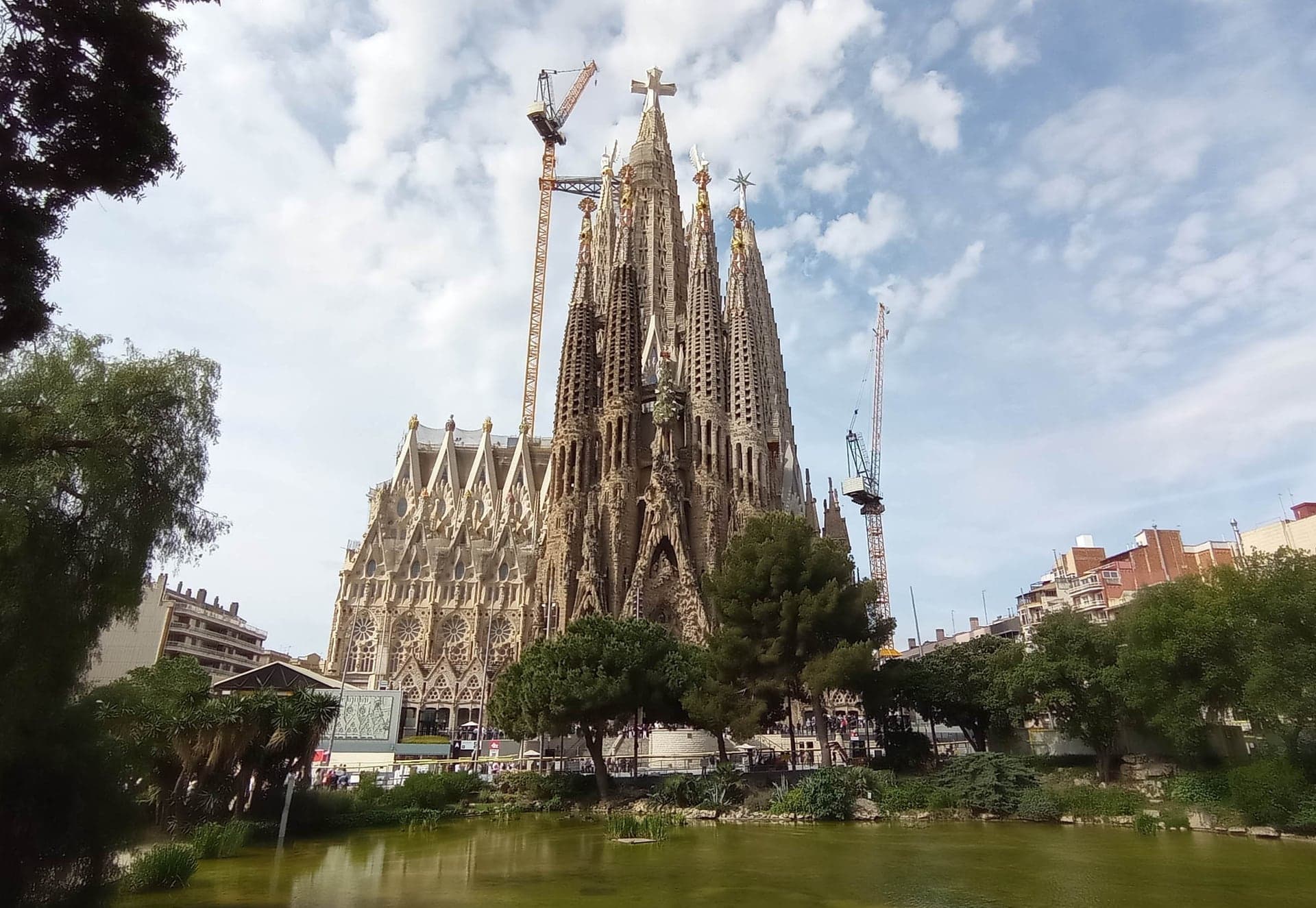
Plaça de Gaudí: The Towers Across the Pond
The Nativity towers seen across the pond, and how to read the eighteen towers Gaudí designed.
- 2
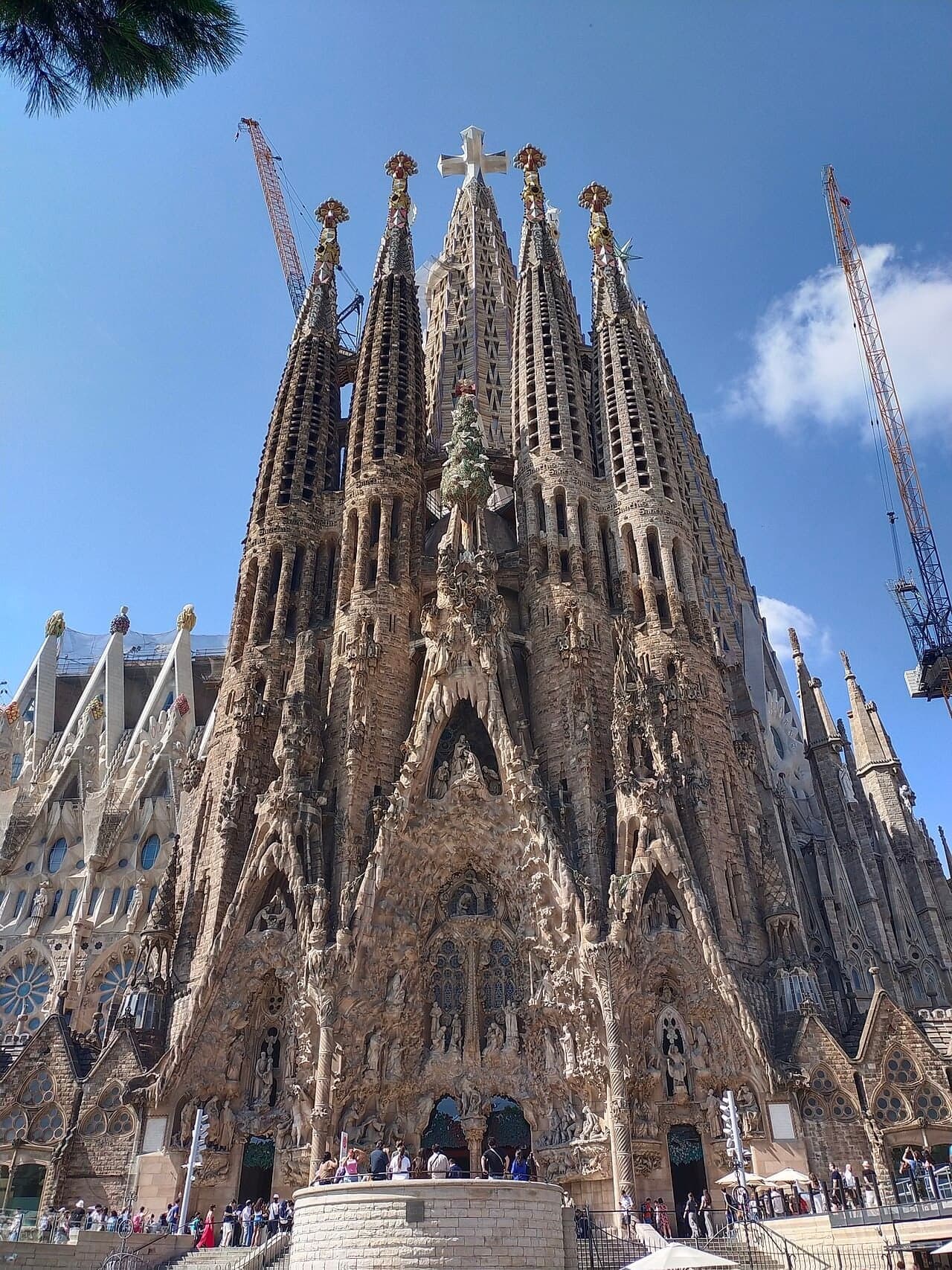
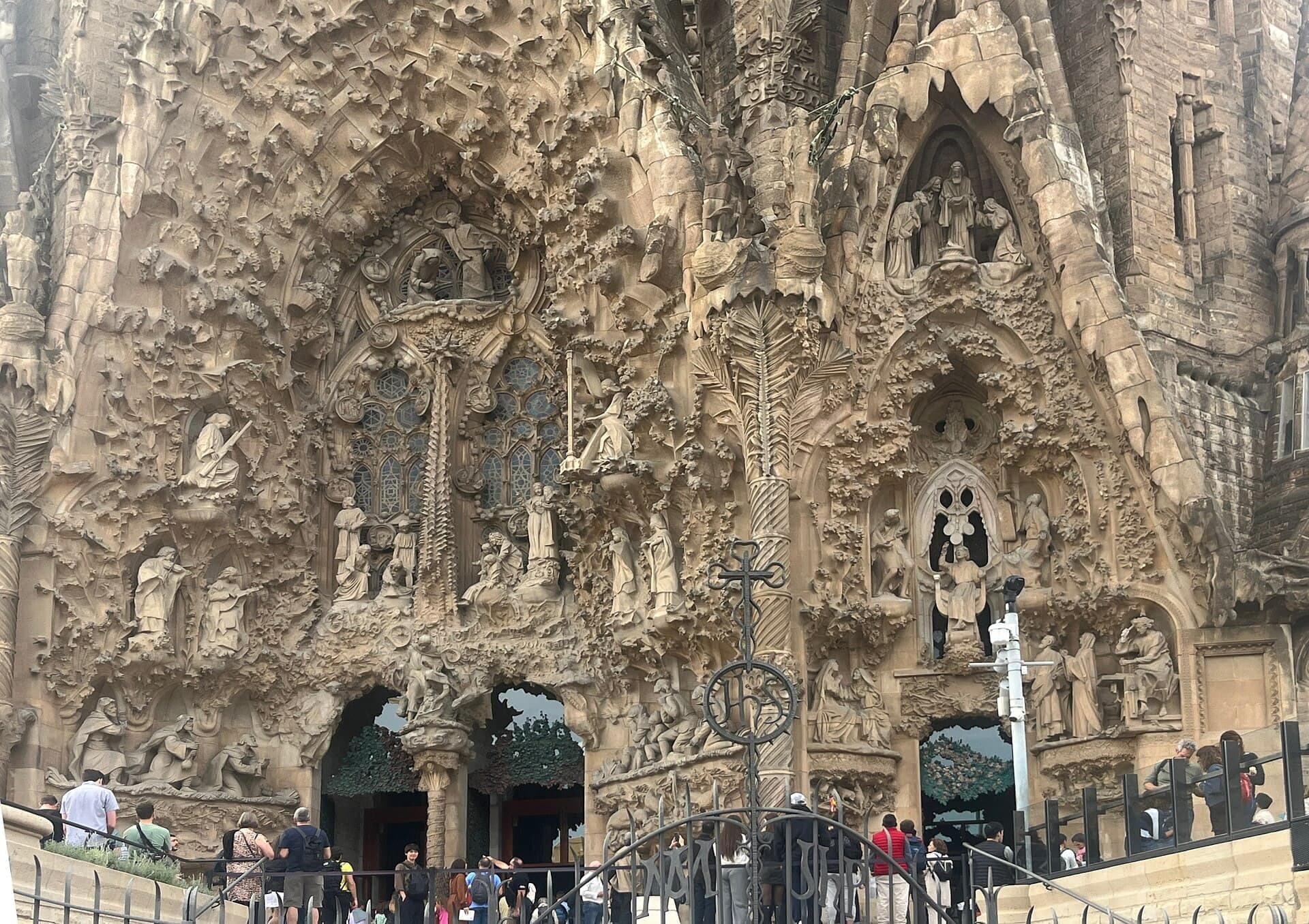
Nativity Façade: Gaudí's Model
Gaudí's model for the whole church, with three portals of Hope, Charity and Faith under the carved cypress.
- 3
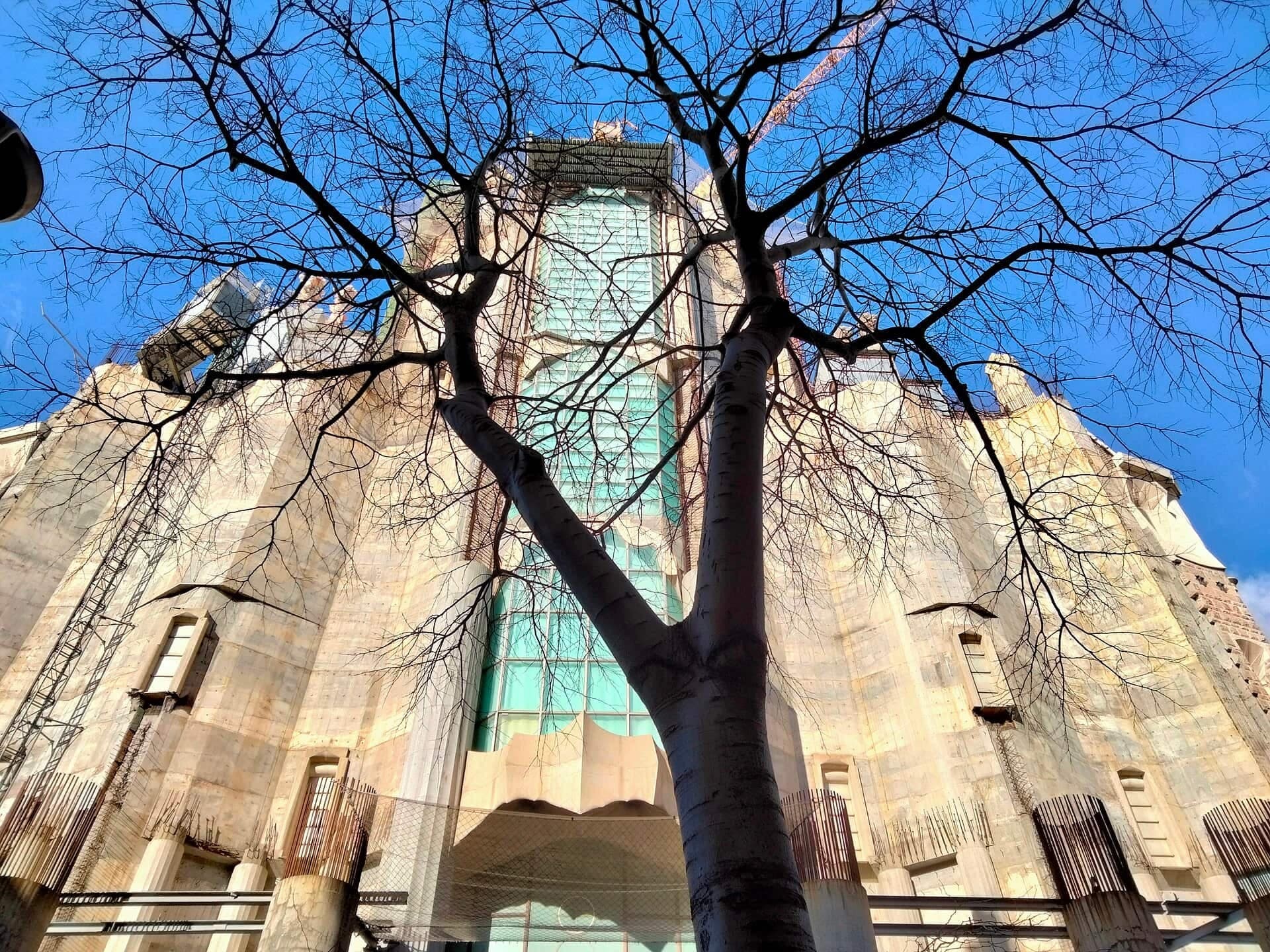
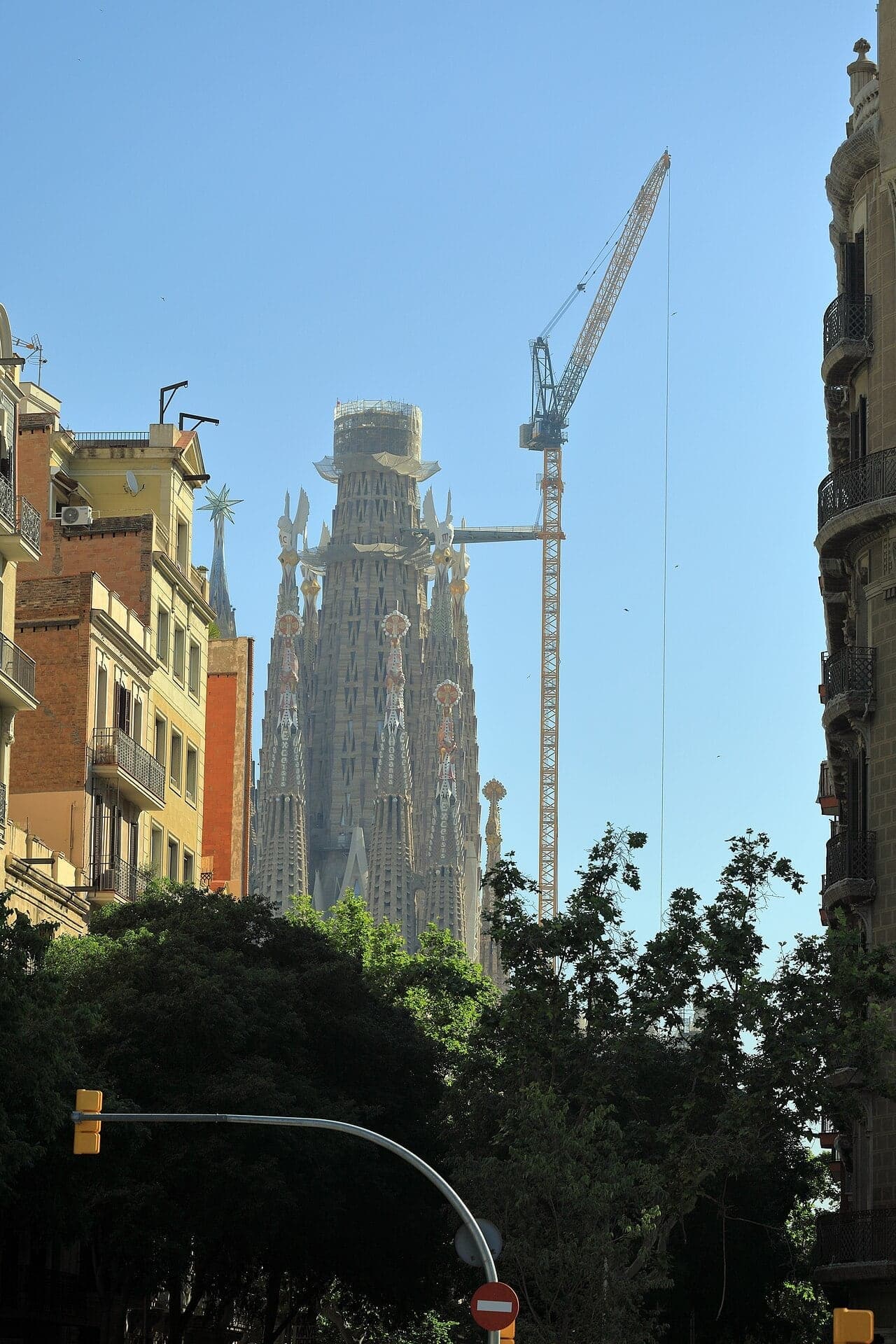
Glory Façade: The Front Door Still to Come
The main front of the church, still under construction, where a planned great stairway would cross Carrer de Mallorca.
- 4
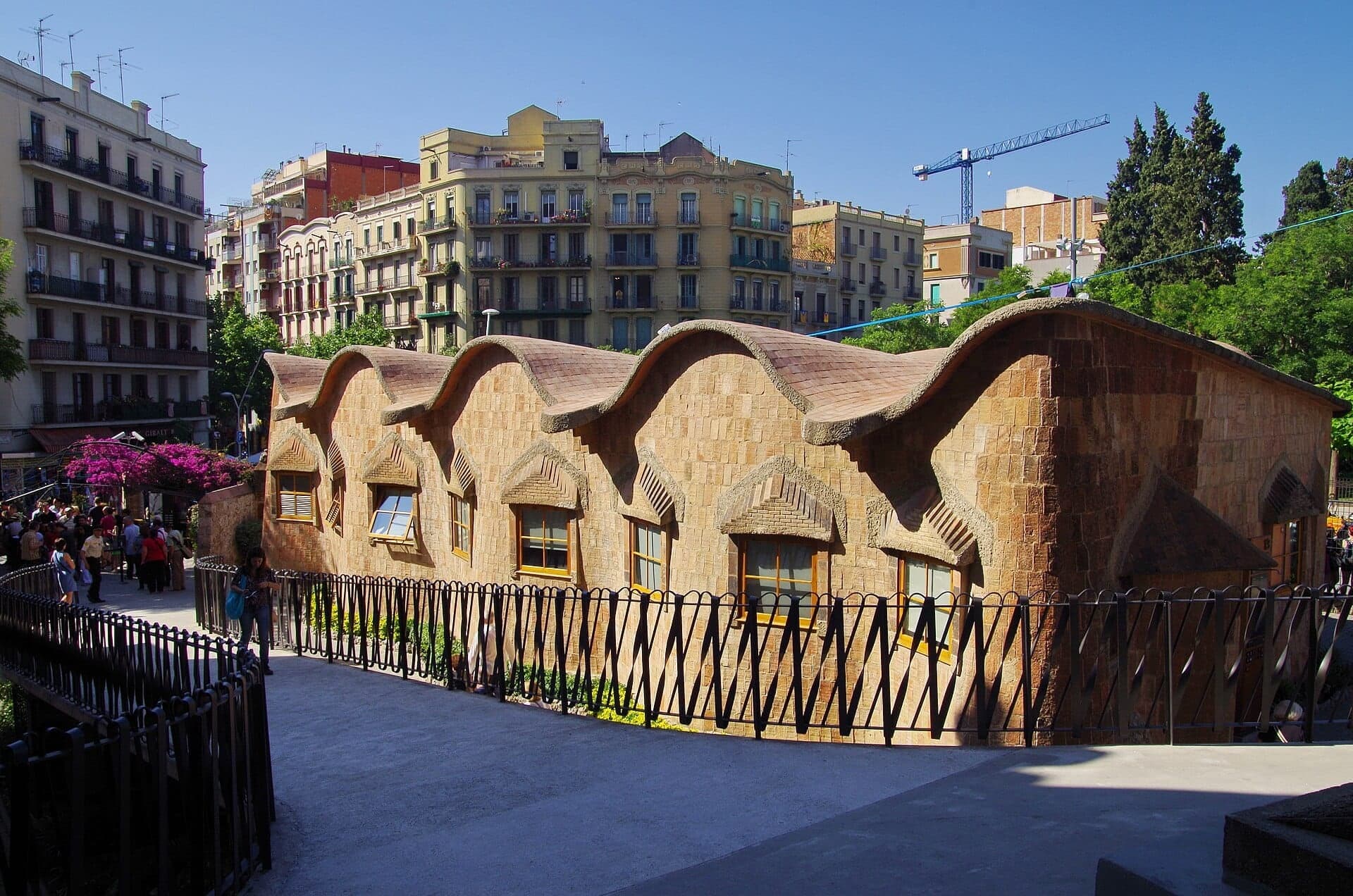
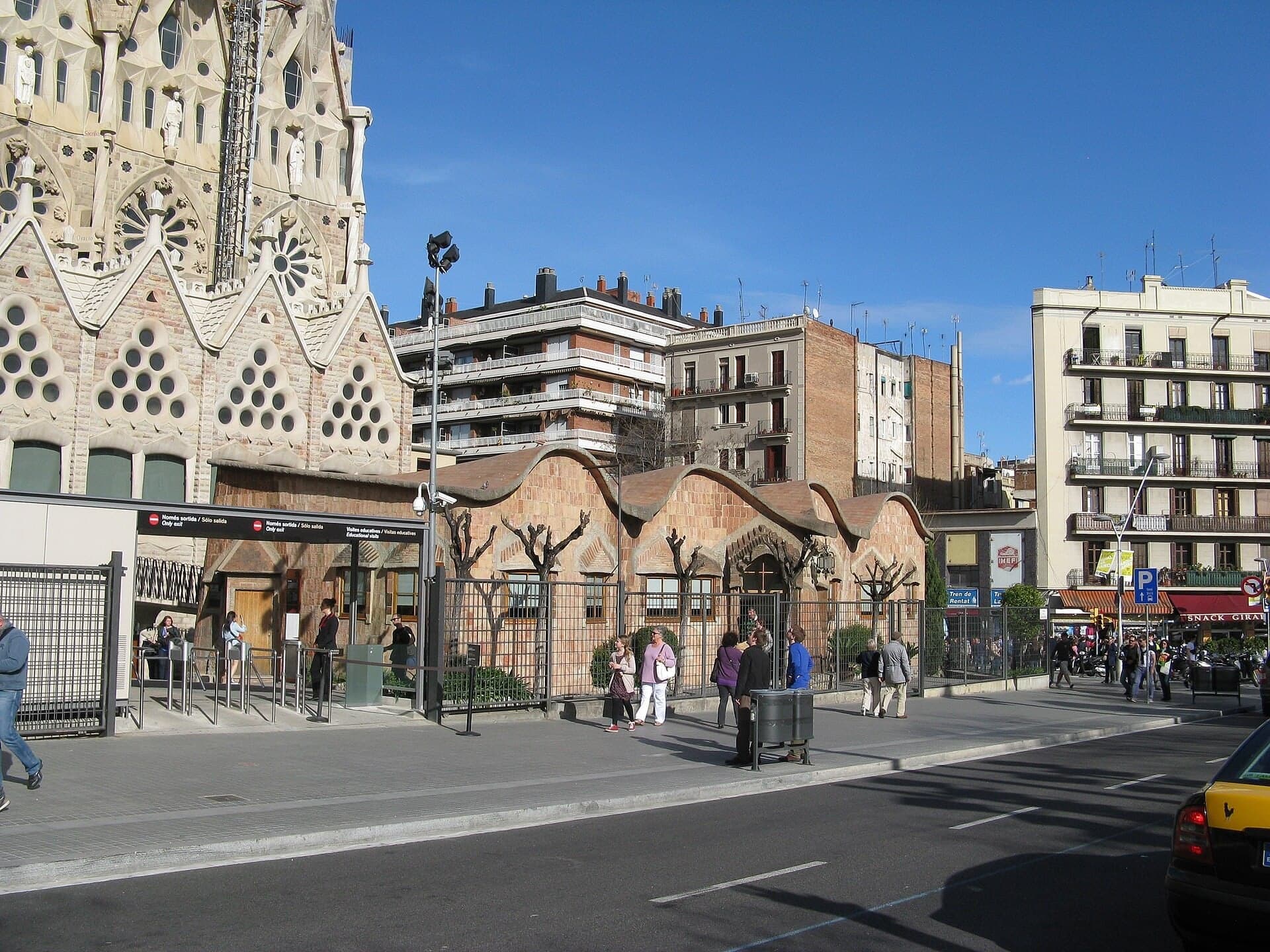
Sagrada Família Schools: A Roof of Straight Lines
A small brick school of 1909 with a roof of straight lines, rebuilt on this corner in 2002.
- 5
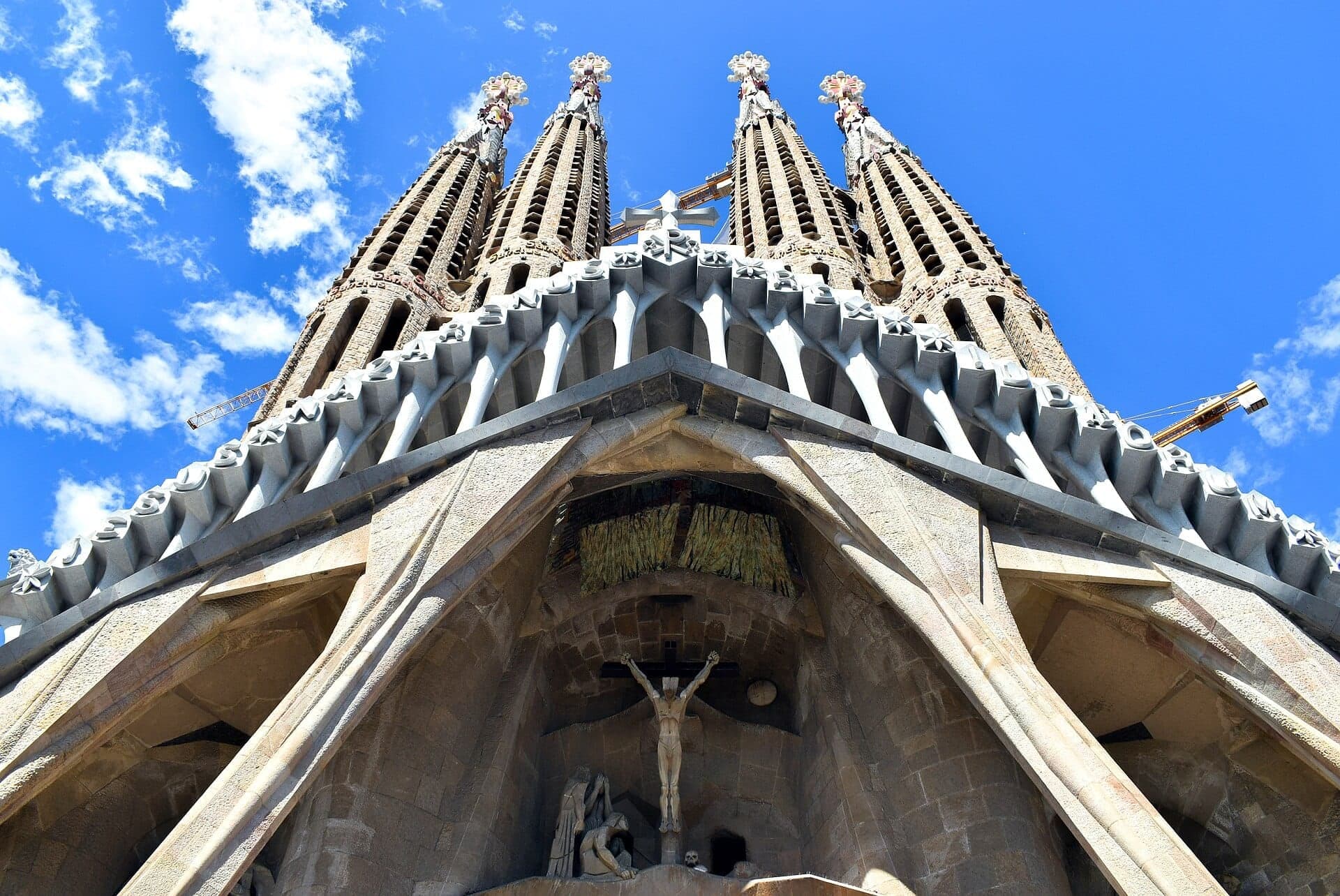
Passion Façade: Built to Inspire Fear
The stark west front of the church with Subirachs's Passion sculpture, under four towers of the 1970s.
- 6
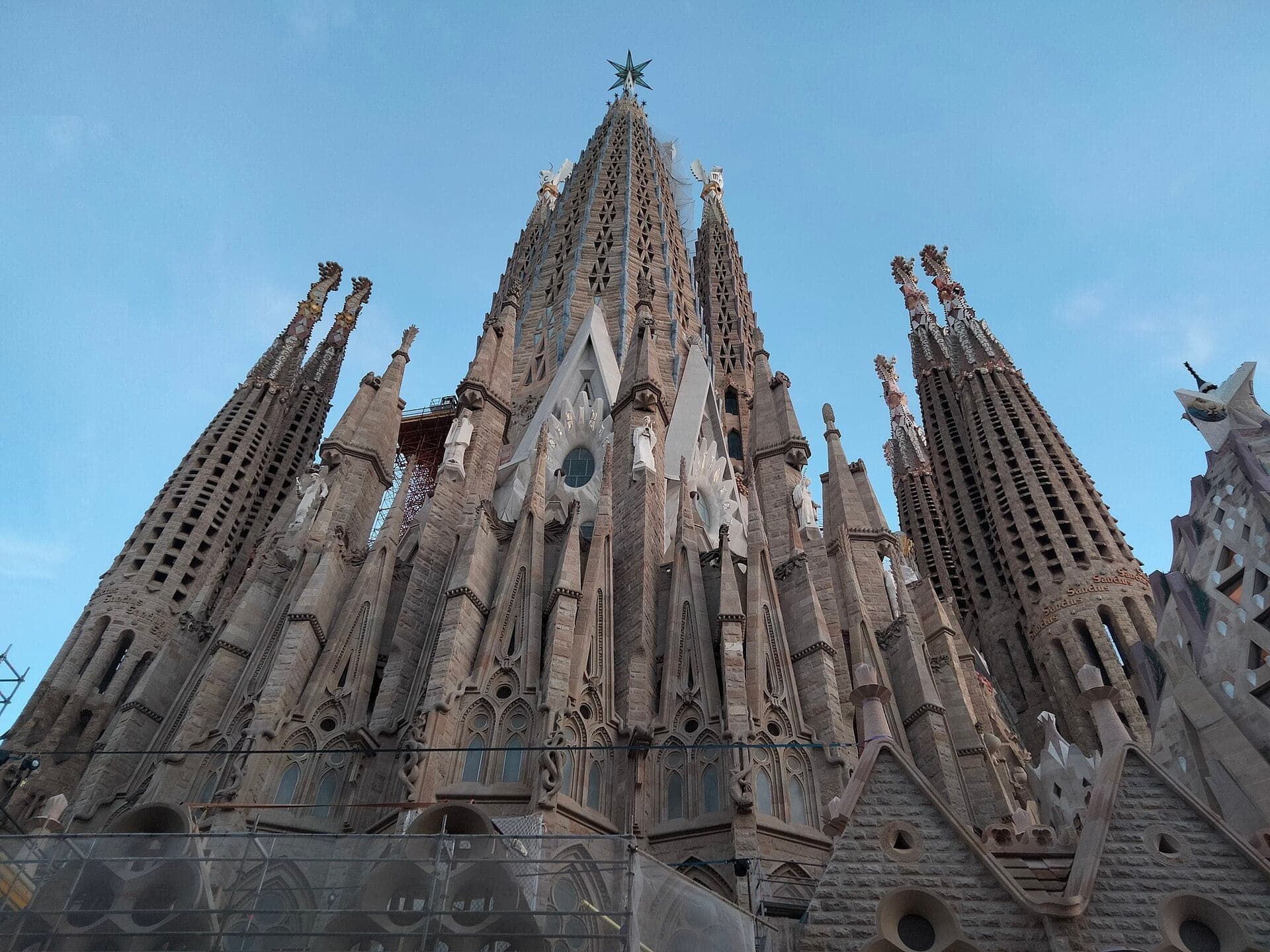
Apse: Where the Church Began
The rounded east end over the crypt, the only façade Gaudí was able to complete, with snails and lizards for gargoyles.
- 7
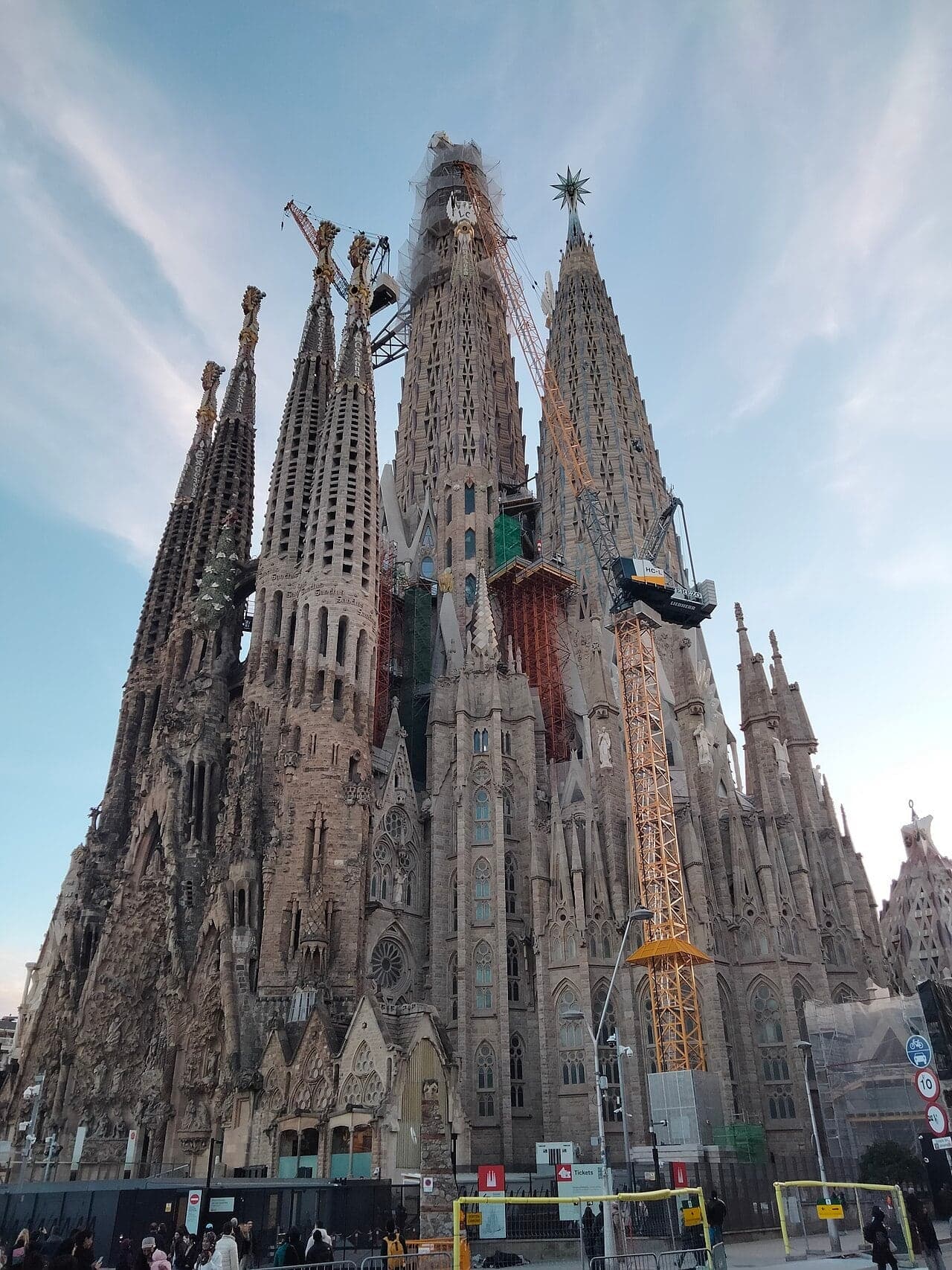
Avinguda de Gaudí: The Tower of Jesus Christ
Looking back down the avenue at the central towers, crowned since February 2026 by the cross of Jesus Christ.
- 8
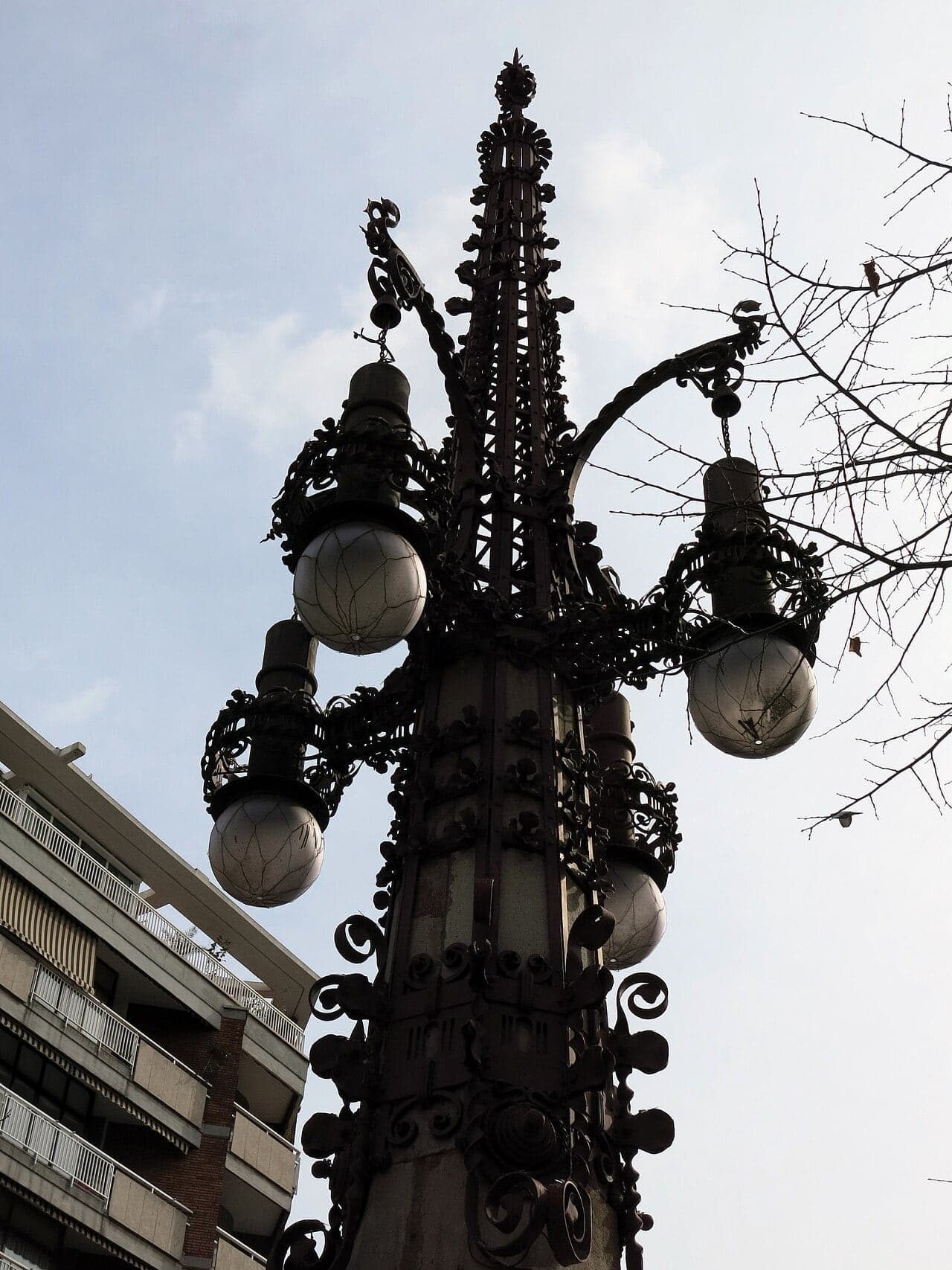
Avinguda de Gaudí: A Street Given to People
The middle of the pedestrian avenue between the basilica and Sant Pau, with Pere Falqués's lamps and its slant across the grid.
- 9
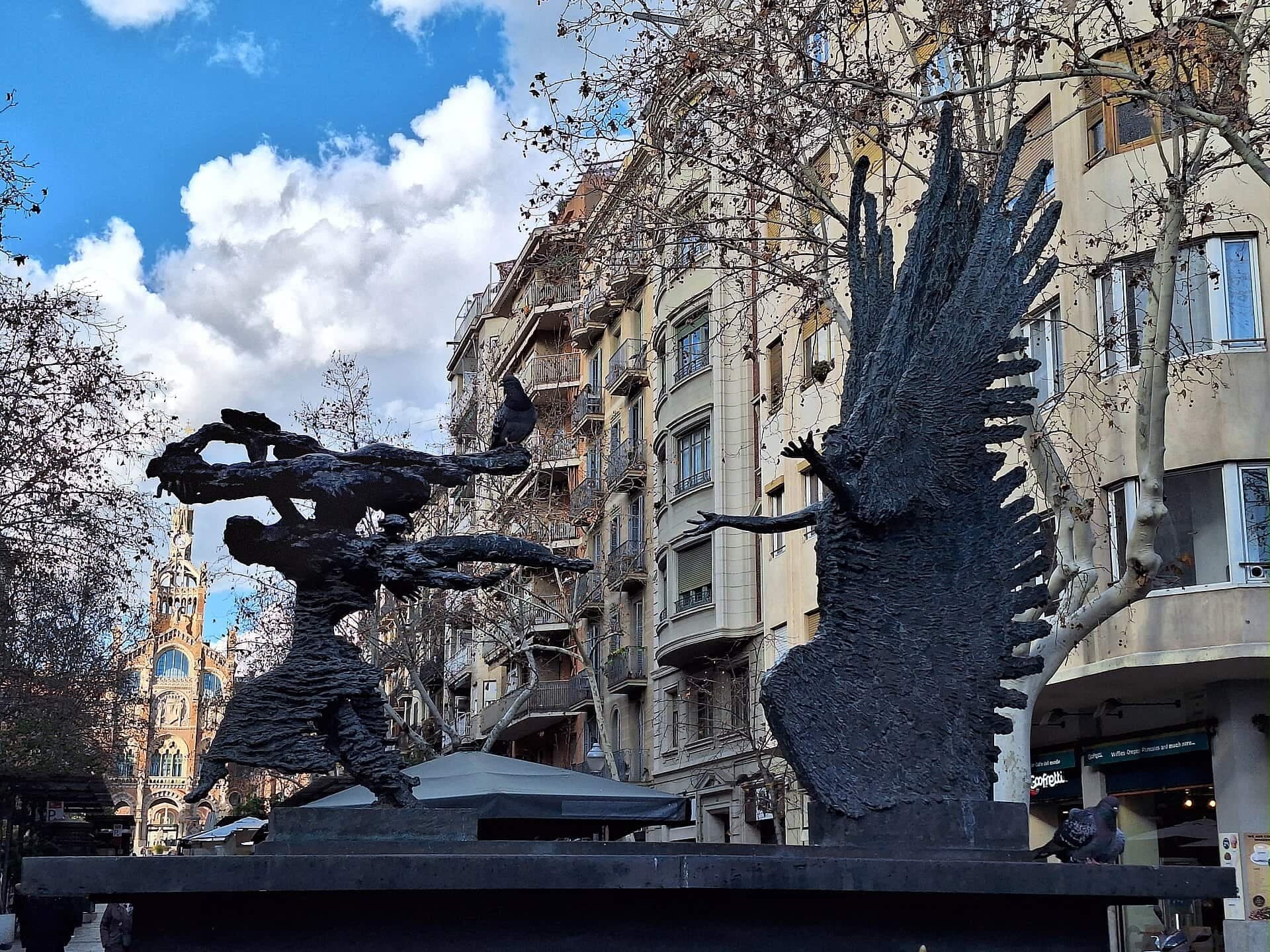
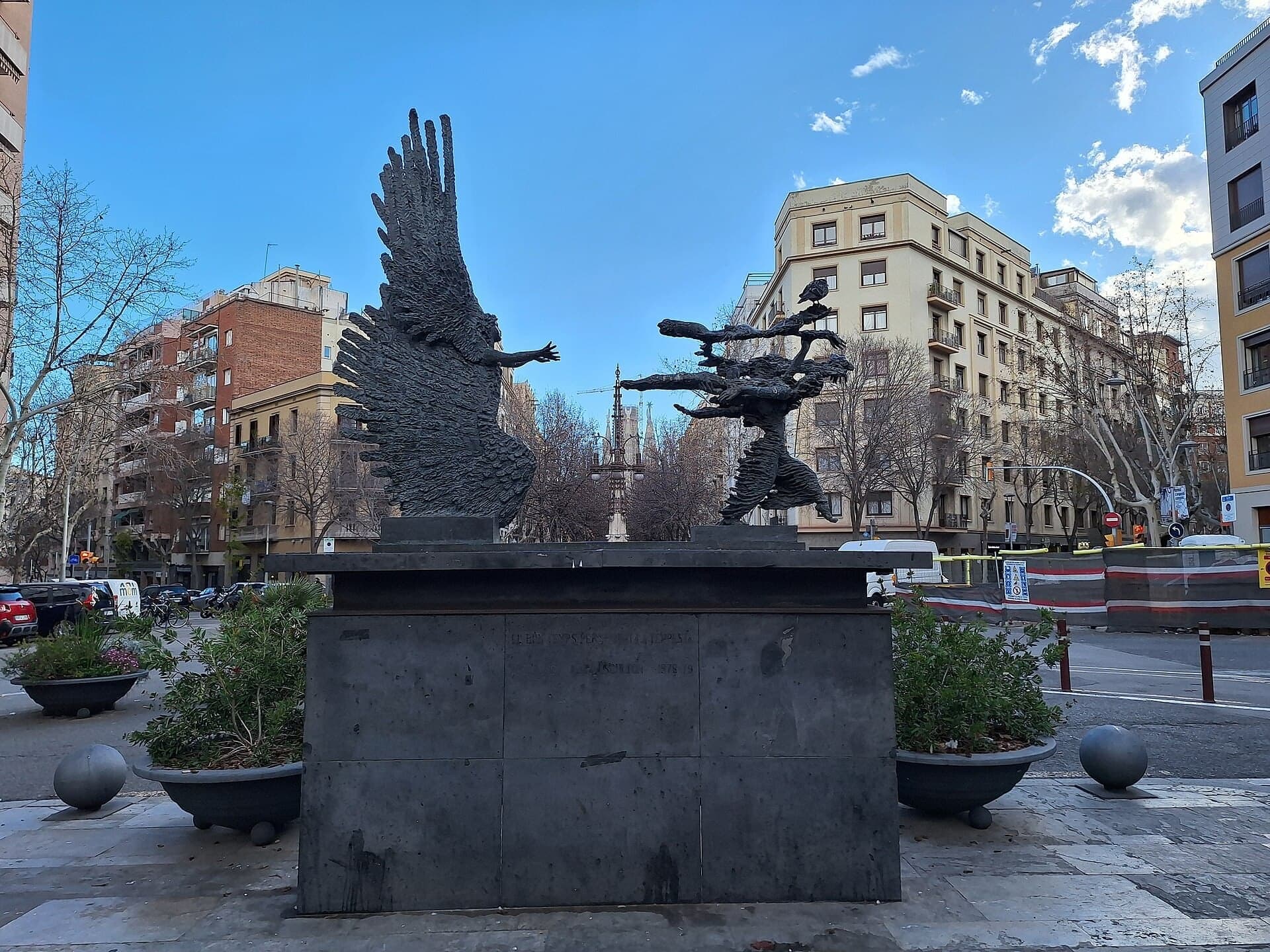
Avinguda de Gaudí: Fenosa's Bronze
A bronze by Apel·les Fenosa on the avenue, and a first look at a hospital founded in 1401.
- 10
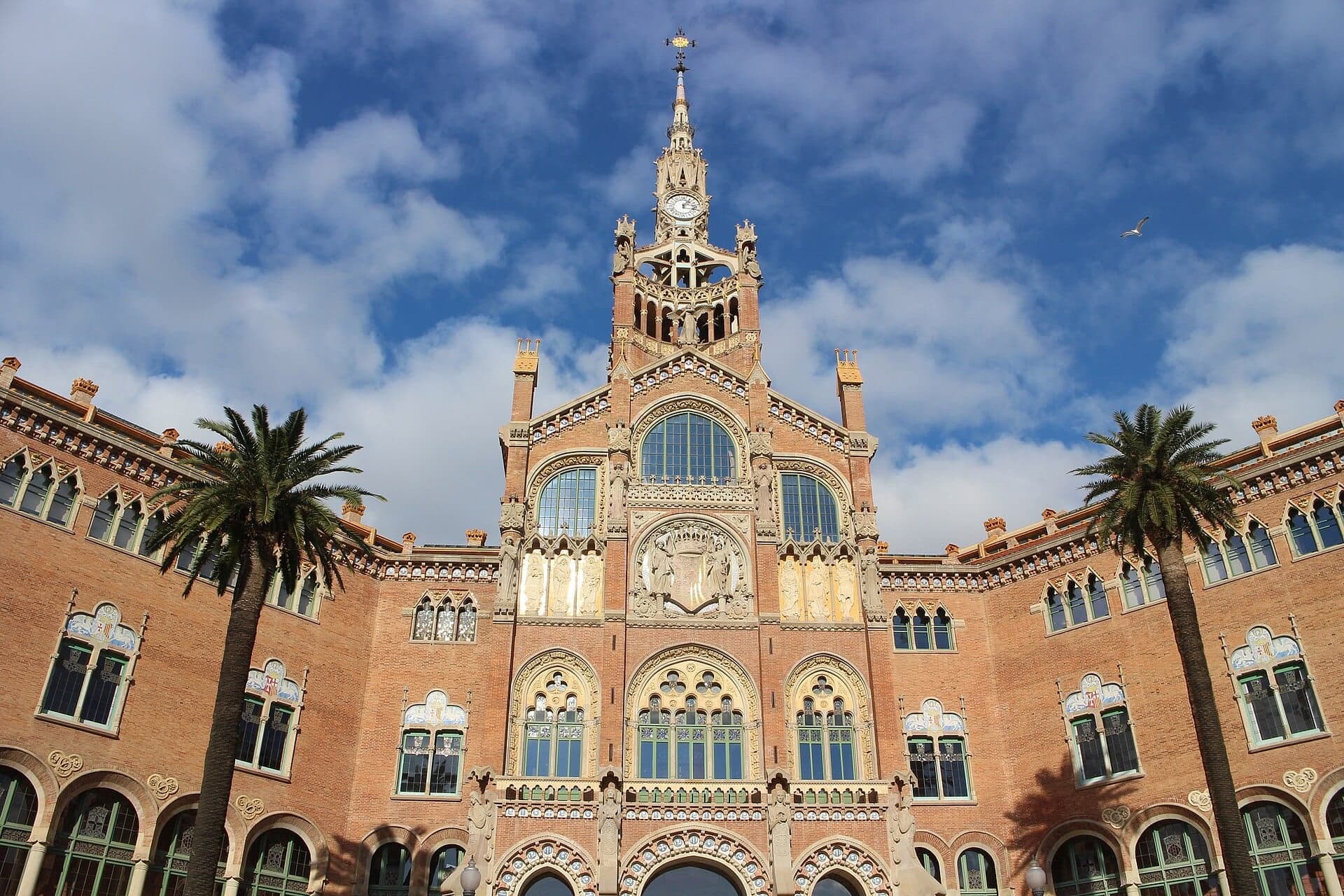
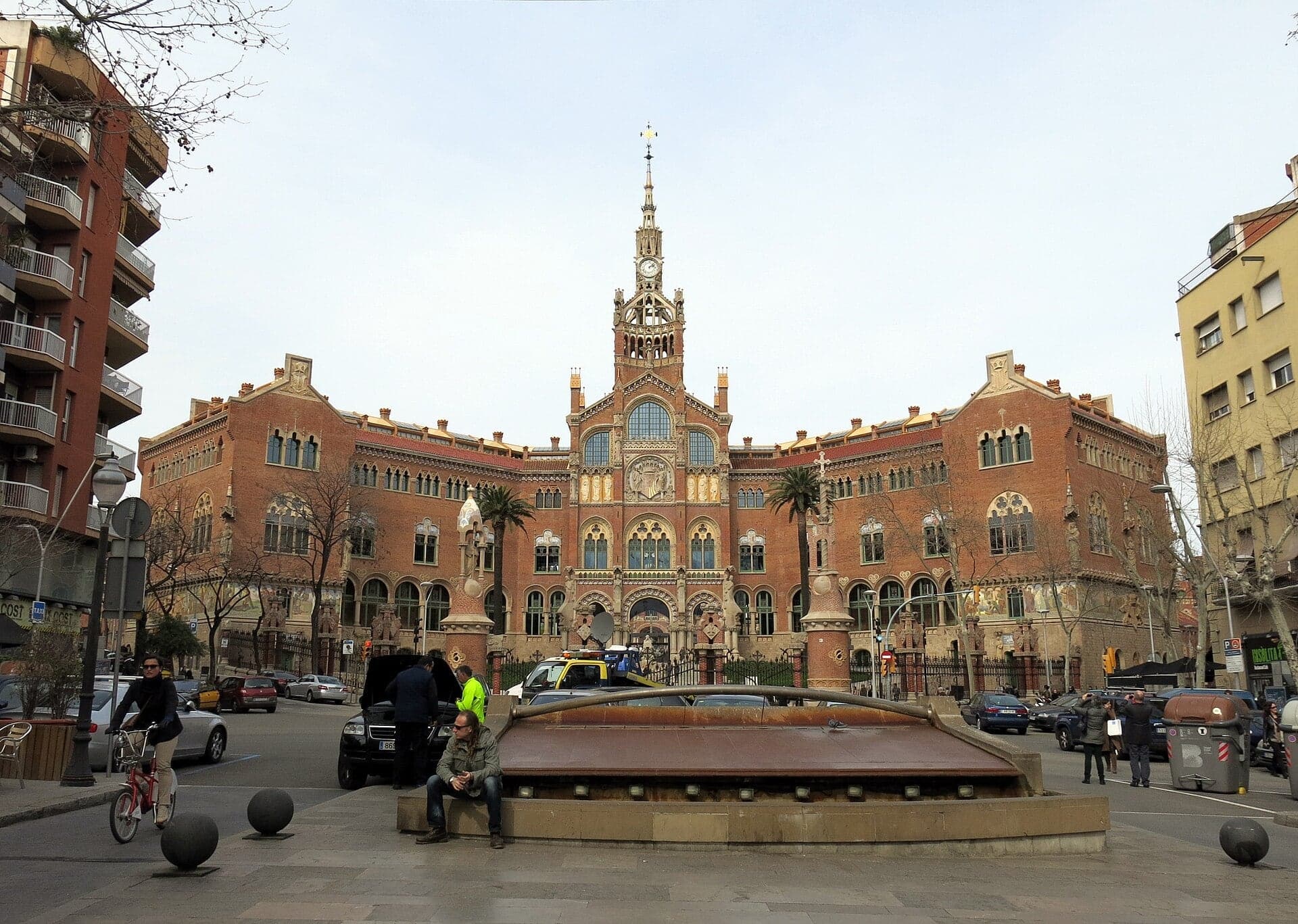
Hospital de Sant Pau: A Town of Pavilions
The front of Domènech i Montaner's hospital, a garden city of pavilions set on a cross, opened in 1930.
- 11
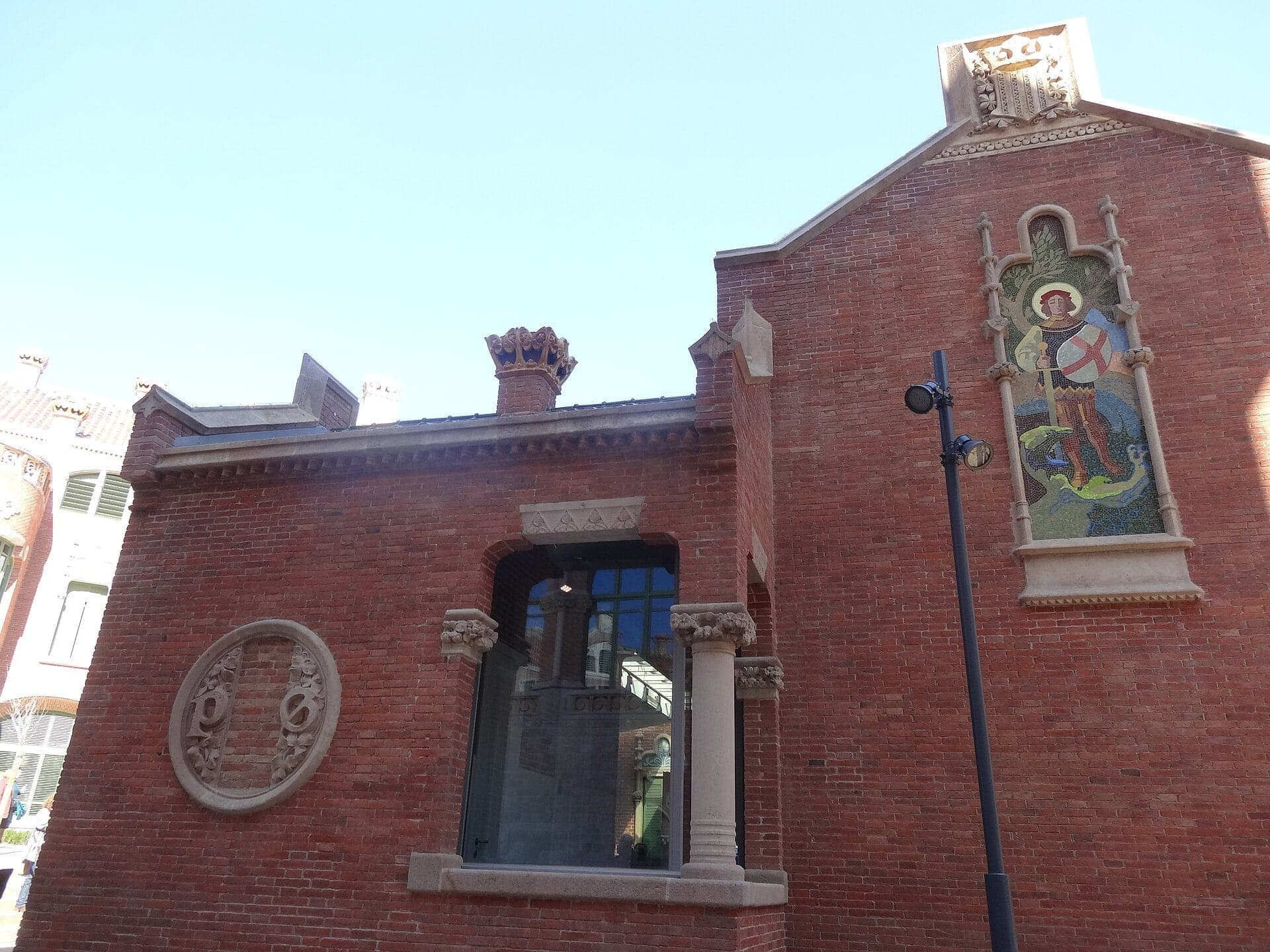
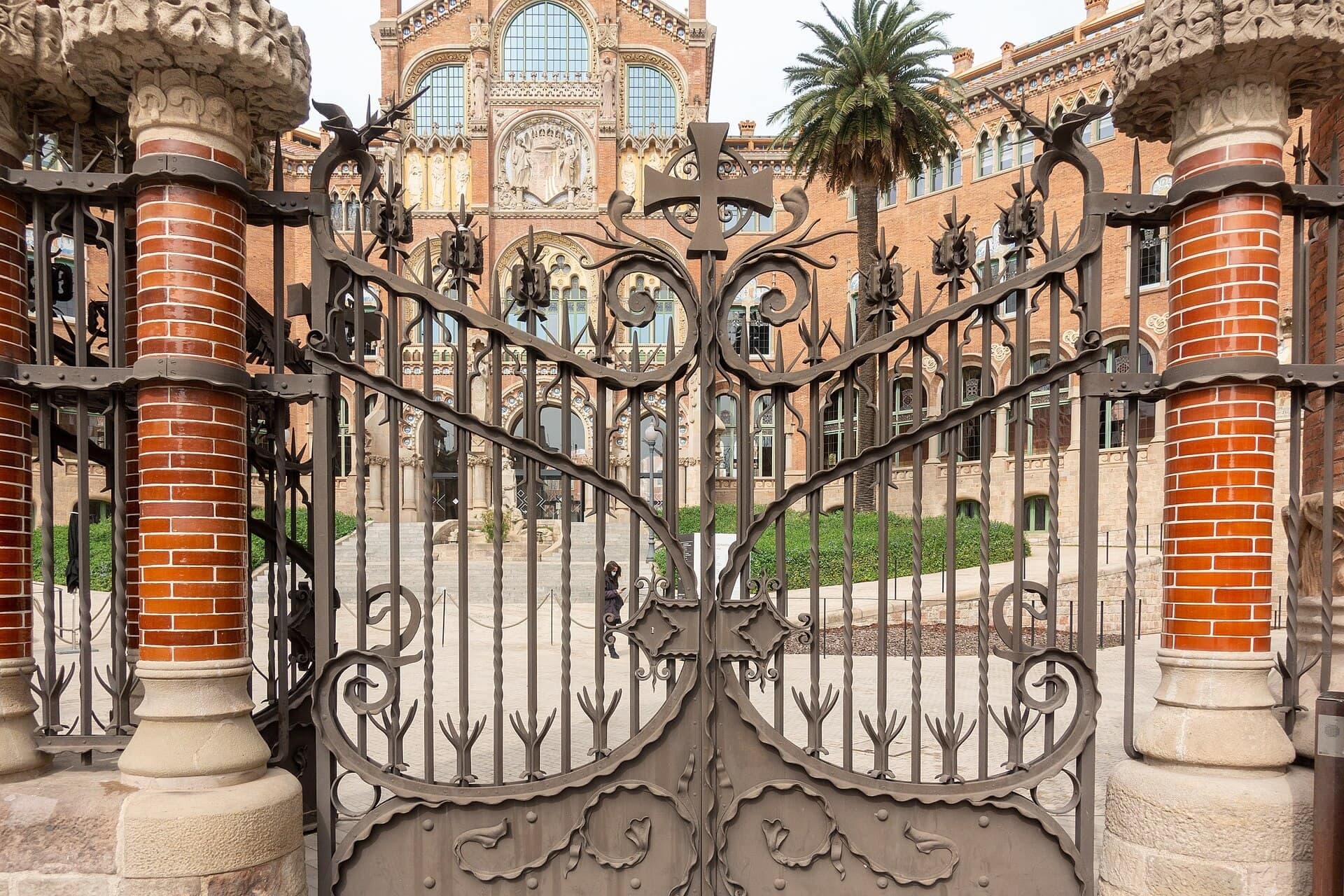
Sant Pau's Pavilions: A Hospital Until 2009
The pavilions of Sant Pau from the street, each built for its own medical specialty, where patients came until 2009.
Details
Best Time to Visit
A weekday morning, when the sun from the east lights the Nativity façade across the pond; or begin in the early afternoon to catch the sun on the west-facing Passion façade at stop 5. Both squares are open 24 hours. In leaf, from about May to November, trees screen parts of the views at stops 1 and 7; in winter the towers show down the Avinguda de Gaudí.
Pro Tips
- •Getting to the start: Metro lines L2 and L5 to Sagrada Família; the Mallorca / Marina exit is beside Plaça de Gaudí. Buses 19, 33, 34, D50, H10 and B24 also stop at the basilica. Checked 12 October 2026 at sagradafamilia.org.
- •Getting away: the walk ends by Sant Pau | Dos de Maig Metro station, line L5, a short walk along Carrer de Sant Antoni Maria Claret.
- •Basilica tickets (stop 2) are sold online only, about two months ahead, named, with photo ID at the door: 26 EUR, with towers 36 EUR. Book a slot that fits after or before the walk. Checked 12 October 2026 at sagradafamilia.org.
- •The basilica's first hour, 9:00 to 10:00, is a quiet hour: no audio without earphones. Shoulders covered and shorts or skirts to mid-thigh.
- •Sant Pau (stops 10 and 11): 18 EUR self-guided before 2 pm, 17 EUR after, open 9:30 to 18:30 until 31 October and 9:30 to 17:00 from November. Large bags are refused; lockers take 37 x 37 cm. Checked 12 October 2026 at santpaubarcelona.org.
- •Step-free: the only steps on the route are the ten at the end of the pond after stop 1; go round the other side of the pond instead. The avenue climbs gently, about 25 m in all.
- •Both the basilica and Sant Pau have closed at short notice for extreme-weather warnings: check the official sites on the day.
- •The joint exhibition The Sagrada Família and the Hospital de Sant Pau. A Living Memory is free on the Avinguda de Gaudí until 15 November 2026, 9:00 to 18:00, with banners along the avenue (stops 7 to 10) and display cubes at both ends. Checked 12 October 2026 at sagradafamilia.org and santpaubarcelona.org.
Safety & Precautions
- •Plaça de Gaudí, Carrer de la Marina by the entrances (stop 2) and the coach drop-offs on Carrer de Sardenya (stop 5) are among the most crowded places in the city: keep bags closed and in front of you.
- •At stop 2 stay out of the ticket queues and away from the entrance lanes; the walk works from the open street.
- •Stop 3 stands against people's homes on Carrer de Mallorca, beside Passatge de Paula Font: keep voices down and do not go into the passage. The Glory stairway is a live and sensitive question for the people who live here.
- •Works on the Glory side, the Chapel of the Assumption behind the apse and restoration on the Nativity towers bring hoardings, scaffolding and cranes; views at stops 1, 3, 4 and 6 change with them.
- •Leg 5 to 6 crosses Carrer de Sardenya and Carrer de Provença at the corner; the crossings' signals are not confirmed, so wait for a clear gap. Every other main-road crossing on the route has lights.
- •On the Avinguda de Gaudí, slow service lanes run along the edges and are crossed without markings, once on the way to stop 8 and twice just before stop 9: look both ways.
- •Stop 11 is on the pavement of Carrer de Sant Antoni Maria Claret, three lanes of one-way traffic: stay on the pavement.
- •The ten steps at the end of the pond have no handrail.
- •After 15 November 2026 the exhibition banners and cubes on the avenue are gone; stop 8 still works without them.
Travel advisory: Exercise Increased Caution (Level 2).
Gallery
Related Reading
Go deeper on what you'll see, hear, and walk through.
Overview
Barcelona Travel Guide: How Many Days, Getting Around, When to Go
6 min
Overview
Best Self-Guided Walking Tours in Barcelona (2026)
5 min
Overview
One Day in Barcelona: A Walkable Itinerary Around the Best of the City
6 min
Thematic
Best Architecture Walking Tours in Barcelona (2026)
3 min
Companion
Cerdà's Eixample: The Grid Madrid Imposed and the Buildings That Broke Its Rules
5 min
Deep dive
Hospital de Sant Pau: A Hospital Built as Art
5 min
Deep dive
Sagrada Família: The Stone Book Gaudí Left Unfinished
5 min
Read the walk
The full story of Sagrada Família and Sant Pau: Four Façades and an Avenue, in words. Prefer to listen? Play it narrated, from home or on location.
Introduction
Barcelona, the capital of Catalonia in Spain, has been building one church since eighteen eighty-two, and it is still not finished. This walk goes all the way round the Sagrada Família, the Holy Family, one side at a time, and each side belongs to a different age: the apse Gaudí completed, the Christmas front he built as a model, the stark Passion front, and the main front, which is still to be built.
Then a straight avenue carries you up to a second building of the same decades, the Hospital de Sant Pau, built as a garden of pavilions.
Three people matter along the way. Antoni Gaudí, who ran the church from eighteen eighty-three until his death in nineteen twenty-six. Josep Maria Subirachs, the sculptor of the Passion front. And Lluís Domènech i Montaner, the architect of Sant Pau.
The basilica and Sant Pau are both ticketed. This walk stays on free streets, and the ticket details are on the stops' cards.
The walk is eleven stops over about one and a half kilometers, just under a mile, and takes about an hour. It starts at the pond in Plaça de Gaudí, by the Sagrada Família Metro station, with ten steps down from the pond and a step-free way round. Then it climbs gently, about twenty-five meters, up the avenue to the Hospital de Sant Pau, and ends by the Sant Pau Dos de Maig Metro station.
1. Plaça de Gaudí: The Towers Across the Pond
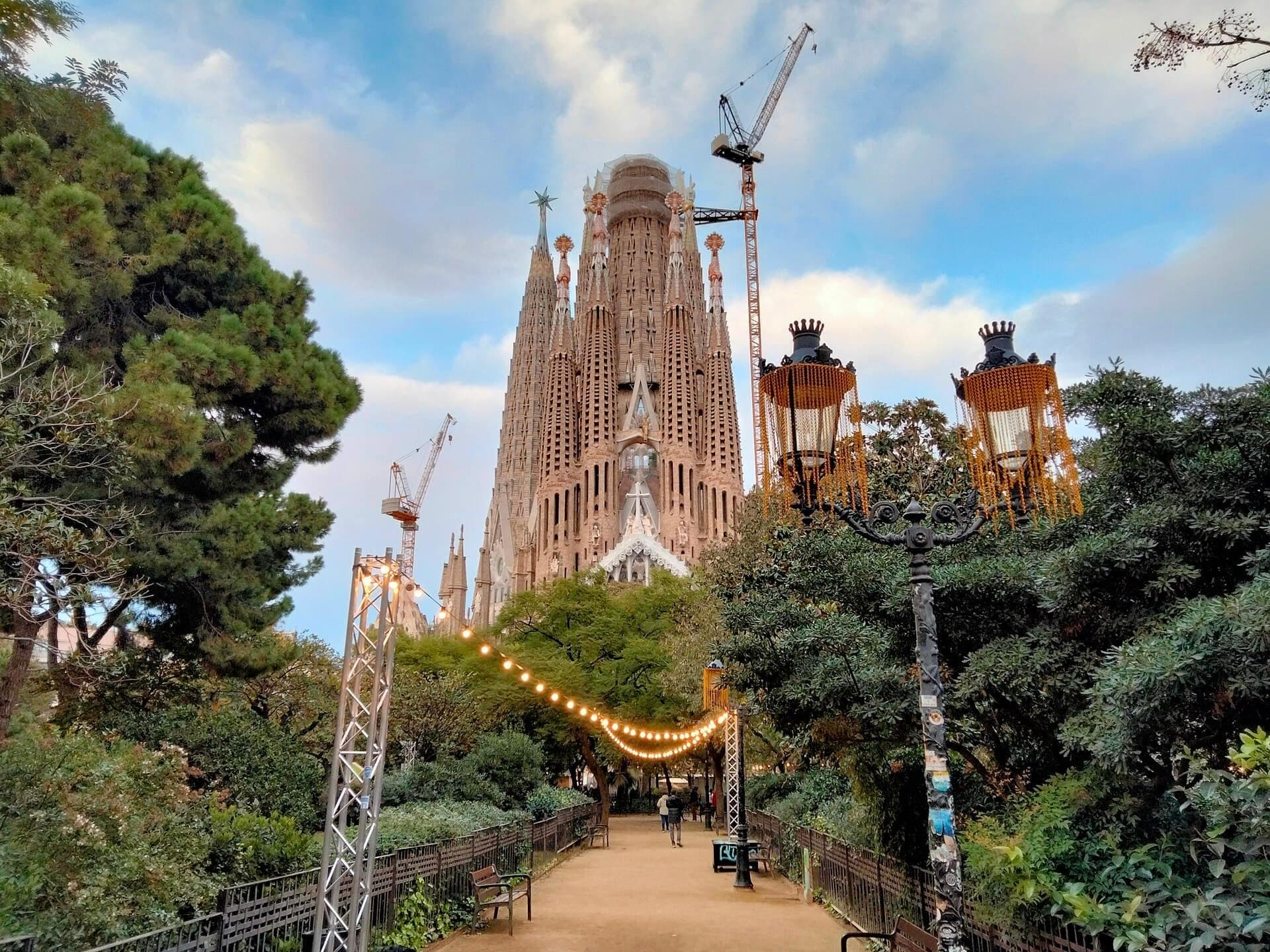
Welcome to Plaça de Gaudí, Gaudí Square, and to the walk. Across the pond is the east side of the Sagrada Família: the Nativity façade, the Christmas front, with its four tall bell towers rising out of a cliff of carved stone. While the shore trees are in leaf, from late spring into November, they screen the lower front and much of the towers from this spot, so look through the branches and over the water.
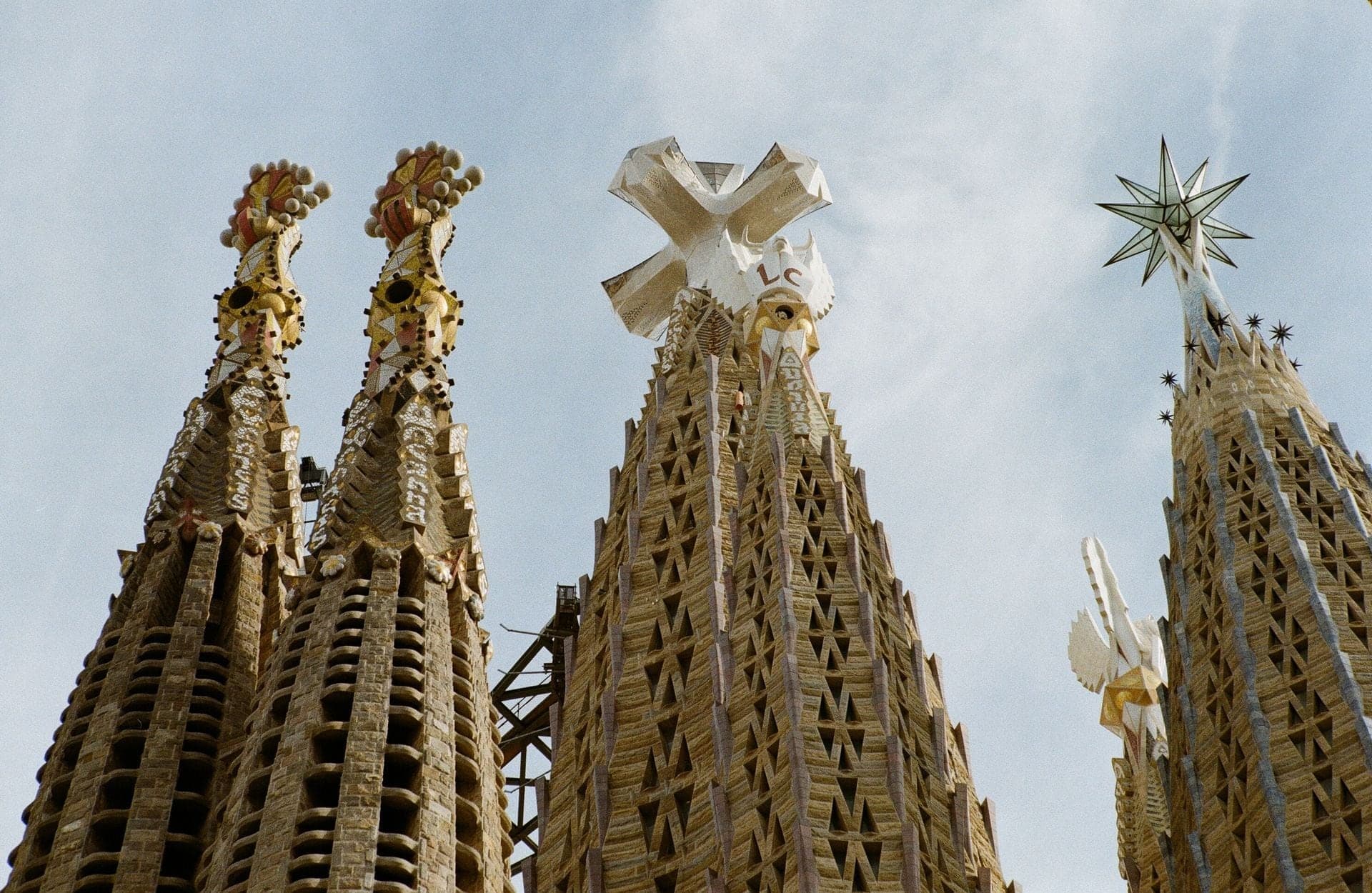
The towers are a sentence you can learn to read. Gaudí designed eighteen. Twelve are for the apostles, four over each of the church's three great fronts, and these four are the first of them. Higher up, four towers for the Evangelists, each a hundred thirty-five meters tall, carry their symbols on top: a human figure, an eagle, a lion and an ox. One tower, for Mary, is crowned with a star. And in the middle, highest of all, is the tower of Jesus Christ, with its cross.
By twenty twenty-six fourteen of the eighteen stood, and the walk shows them to you one side at a time. The four still to come belong to the main front, on the far side, and they are planned at a hundred twenty meters.
One of the four towers in front of you, the tower of Saint Barnabas, was finished in November nineteen twenty-five. It is the only tower Gaudí lived to see complete.
You may see scaffolding or netting on one of them: in twenty twenty-six the Nativity front was being restored, a tower at a time. You will probably see the big crane too, lowered in July twenty twenty-six to stay on and build those last four towers.
Follow the route down the ten steps at the end of the pond and along the shore path. For a step-free way, go round the other side of the pond. Next, the Nativity front close up.
2. Nativity Façade: Gaudí's Model
Walk on along the pedestrian street in front of the church and stop short of the queues, facing the three great doorways of the Nativity façade.
The inside of the basilica is ticketed, and it is worth it. Tickets are for a timed slot, best booked online well ahead, and the details are on this stop's card.
This is the busiest pavement of the walk. Keep your bag closed and in front of you: pickpockets work crowds like this one.
Now the façade. Gaudí knew he would never finish the whole church, so he chose to build one front completely, as a model for the people who would carry on after him. This is it, the Nativity, begun in eighteen ninety-one.
It has three doorways. Read them from left to right: Hope, for Joseph; Charity, for Jesus, the central and largest; and Faith, for Mary. Over the central doorway rises a carved cypress, the tree of life, with white doves perched on its branches and the symbols of the Trinity at its tip.
Look up at the bell towers. On this front and on the Passion front they are built of sandstone from Montjuïc, the hill on the far side of the city.
From nineteen twenty-five Gaudí lived here, on the building site. On the seventh of June nineteen twenty-six he was hit by a tram on the Gran Via, in the city center. Nobody recognized him, and he was taken to the old Hospital de la Santa Creu, the Holy Cross. He died three days later and is buried under this church. These towers were finished by nineteen thirty, four years after his death.
Keep that hospital in mind. It moved, and this walk ends at its new home.
Follow the route along the pedestrian street and across Carrer de Mallorca at the lights. Next, the front of the church that has not been built yet.
3. Glory Façade: The Front Door Still to Come
Walk on along Carrer de Mallorca and stop on this pavement, by the opening of a narrow side street. Then turn to face the church across the road.
This is the main front, and the one still to come: the Glory façade, facing the sea. What you see from here changes with the works.
Gaudí left a model of it, and the plan is enormous. Four towers for the apostles Andrew, Peter, Paul and James: the last four of the eighteen. Their street halves begin about thirty meters up, on eight columns along the edge of the site, one for each of the beatitudes. Behind them, a great porch with sixteen lanterns rising to eighty meters, and seven bronze doors by Subirachs; the central one carries the Lord's Prayer in Catalan.
Now the street under your feet. Carrer de Provença, beyond the church, is about four meters higher than this street. To climb that gap Gaudí designed a broad stairway up to this front, and the church's plan carries Mallorca on a raised bridge, with the traffic underneath.
That is where it stops being simple. A city plan of nineteen seventy-six drew a wide avenue toward this façade, across the two blocks behind you, where people live. In June twenty twenty-six the city council and the residents opened formal talks. In September twenty twenty-six the church's managers said the stairway cannot be built now, because there is a building in front of it, and they proposed rehousing people on land the church owns nearby. By October twenty twenty-six nothing had been agreed, not even who would pay.
So the main door of the tallest church in the world is a planning question as much as a building one. People live here: keep your voice down.
Follow the route along this pavement and back across Mallorca at the lights on the next corner. Next, a small school with a remarkable roof.
4. Sagrada Família Schools: A Roof of Straight Lines
Once you are across, walk on along the pavement on the church side and stop near the corner. Behind the site fence, close beside you, is a low brick building with a roof that rises and falls in waves. If the fence and the hoardings let you see it, that roof is one of the cleverest things on the site.
This is the Sagrada Família Schools. It was built in nineteen-oh-nine as a temporary school for the young children of the men working on the church, on ground everyone knew the church would one day need. Three classrooms and brick walls.
Look at the roof line. As Gaudí designed it, it was a thin vault of flat clay tiles, two or three layers laid together, the Catalan way, and its shape was made of straight lines. Imagine a straight beam along the middle of the roof, and straight boards running from it down to the top of the wall. The wall waves in and out, so the boards twist as they go, and together they make a rippling surface: a curved roof built entirely from straight lines. The walls wave too.
Hold on to that idea. Gaudí used the same kind of geometry, curved surfaces built from straight lines, in the pinnacles and vaults of the church itself.
The school has had a hard life. It burned on the twentieth of July nineteen thirty-six and its roof fell in. It was reroofed in nineteen forty, with changes, lost a corner in nineteen ninety-five to a pillar of the church, and in two thousand two it was taken apart and rebuilt here, on this corner. It stands inside the ticketed grounds, so from the street this is the view you get.
Follow the route across Carrer de Sardenya at the lights. Next, the Passion façade.
5. Passion Façade: Built to Inspire Fear
Walk on along the pavement beside the park and stop where its sandy path begins. Turn to face the church across the street. This is the Passion façade, the west side, and it is the opposite of the Nativity. The birth faces the sunrise; the death faces the sunset. Where the…
Full narration for this stop unlocks with the tour.
6. Apse: Where the Church Began
Walk on along Carrer de Provença and stop on this pavement. Turn to face the church across the open, traffic-free street. This rounded end of the church is the apse, and it is where the Sagrada Família started. Ten meters below it is the crypt, the first part built, begun in…
Full narration for this stop unlocks with the tour.
7. Avinguda de Gaudí: The Tower of Jesus Christ
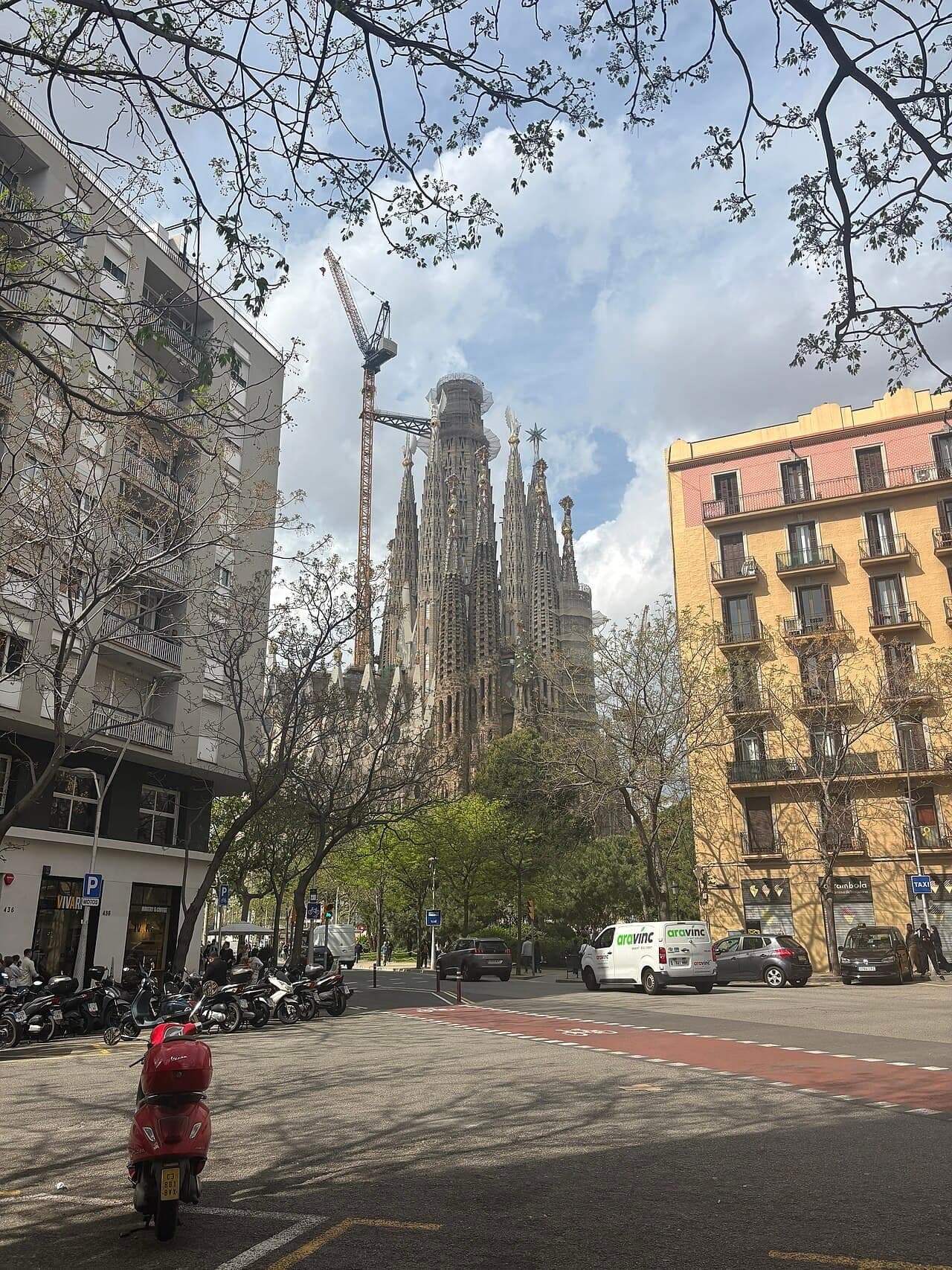
Walk on up the avenue and stop in the middle of the promenade. Now turn round and look back down the avenue at the church. The avenue's trees frame the middle of the building. In leaf they hide the outer towers and leave the central ones. The highest is the tower of Jesus…
Full narration for this stop unlocks with the tour.
8. Avinguda de Gaudí: A Street Given to People
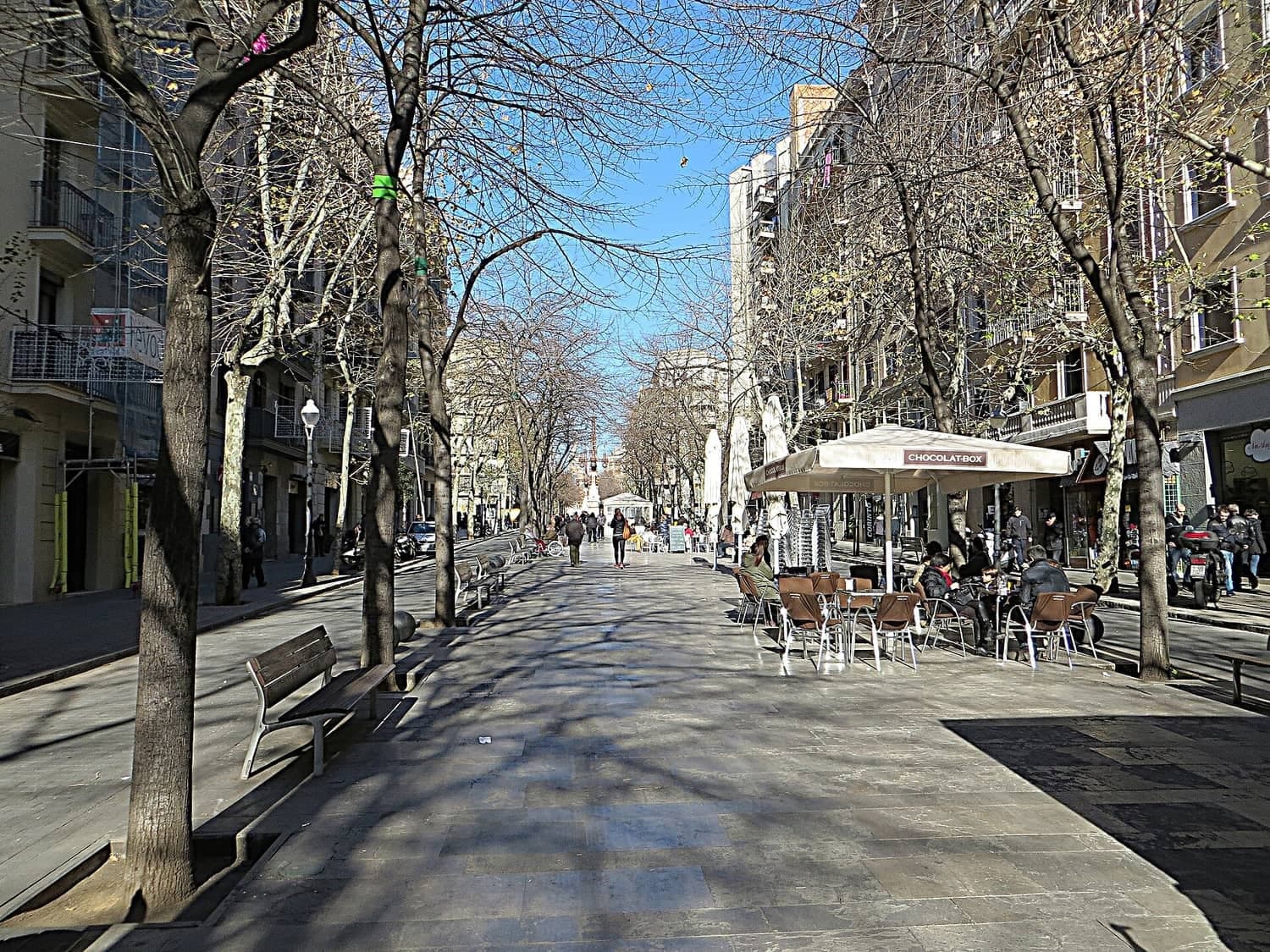
Walk on up the promenade, past the crossings, and stop under the trees. This is the middle of the Avinguda de Gaudí, Gaudí Avenue, and here the street itself is the thing to look at. The basilica is behind you and the hospital ahead, a few hundred meters each way. Look at how…
Full narration for this stop unlocks with the tour.
9. Avinguda de Gaudí: Fenosa's Bronze
Walk on past the last crossings and stop on the avenue. The bronze you have just passed, back at the corner, is worth a look over your shoulder. It is by the Catalan sculptor Apel·les Fenosa, and it is called Good Weather Chasing the Storm. Now look ahead, to the top of the…
Full narration for this stop unlocks with the tour.
10. Hospital de Sant Pau: A Town of Pavilions
Walk on toward the end of the avenue and stop short of the fountain, looking across the street at the hospital's front. The Sant Pau site is ticketed, and the details are on this stop's card. Its gardens and pavilions are worth the visit. From here, the front is free. The…
Full narration for this stop unlocks with the tour.
11. Sant Pau's Pavilions: A Hospital Until 2009
Walk on along this pavement and stop opposite the hospital's buildings, across the busy one-way street. From here you look at the pavilions over the street front of the site. Each one was built for its own medical specialty, and natural light, good ventilation and decorated…
Full narration for this stop unlocks with the tour.
- Sagrada Família, in Barcelona, Catalonia, Spain. — Canaan, CC BY-SA 4.0 · source
- Natibitatearen fatxada, eta dorreak, erdian Jesukristorena — Luistxo, CC BY-SA 4.0 · source
- Basílica de la Sagrada Família (Barcelona), façana c. Mallorca — Enric, CC BY-SA 4.0 · source
- Von der Kreuzung mit der Avenida Diagonal und dem Paseo de San Juan durch die Calle de Mallorca, inzwischen hat die Kirche eine Höhe erreich — Falk2, CC BY-SA 4.0 · source
- Sagrada Familia: Schulgebäude — Balou46, CC BY-SA 3.0 · source
- School building at the Sagrada Família. — Yair Haklai, CC BY-SA 3.0 · source
- Sagrada Família (Barcelona), façana de la Passió, des del c. Sicília - pl. Sagrada Família — Enric, CC BY-SA 4.0 · source
- Basílica de la Sagrada Família (Barcelona), façana nord, absis, c. Provença — Enric, CC BY-SA 4.0 · source
- Basílica de la Sagrada Família (Barcelona), angle nord-est, des de l'av. Gaudí — Enric, CC BY-SA 4.0 · source
- This is a photo of public art indexed in the cataloge Art Públic of Barcelona (Spain) under the code number — Enfo, CC BY-SA 3.0 ES · source
- Av. de Gaudi — Mister No, CC BY 3.0 · source
- El Bon Temps perseguint la Tempesta — Pere López Brosa, CC BY-SA 4.0 · source
- El Bon Temps perseguint la Tempesta — Pere López Brosa, CC BY-SA 4.0 · source
- Main facade of Hospital de la Santa Creu i Sant Pau — Suicasmo, CC BY-SA 4.0 · source
- This image was uploaded as part of Wiki Loves Monuments 2014. — Enfo, CC BY-SA 3.0 · source
- Exterior del Pavelló de Sant Jordi (Hospital de la Santa Creu i Sant Pau) — Jordiferrer, CC BY-SA 4.0 · source
- Hospital de la Santa Creu i Sant Pau — Kent Wang from Barcelona, Spain, CC BY-SA 2.0 · source
Images may be cropped or resized. Other photos via Unsplash and Pexels.