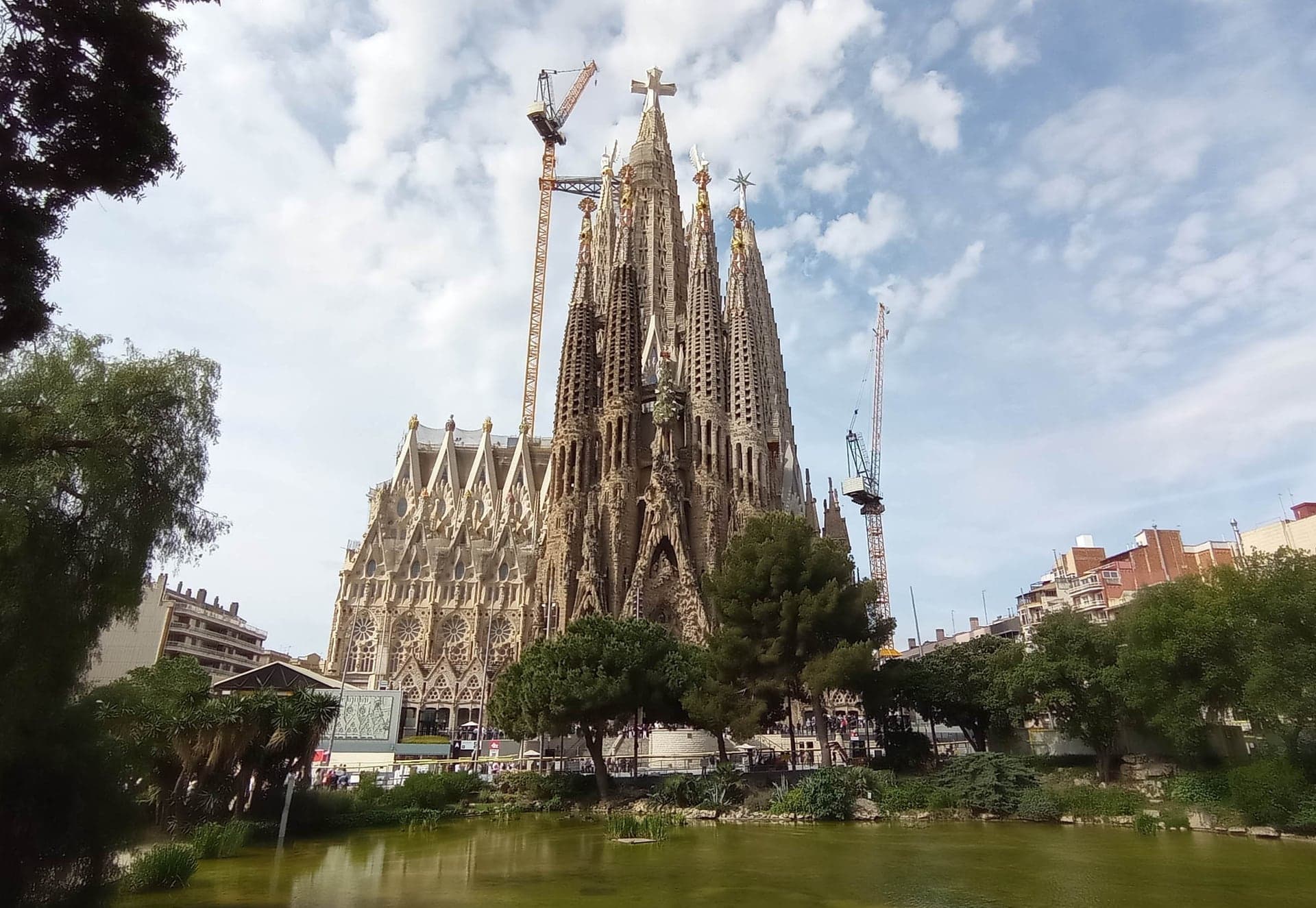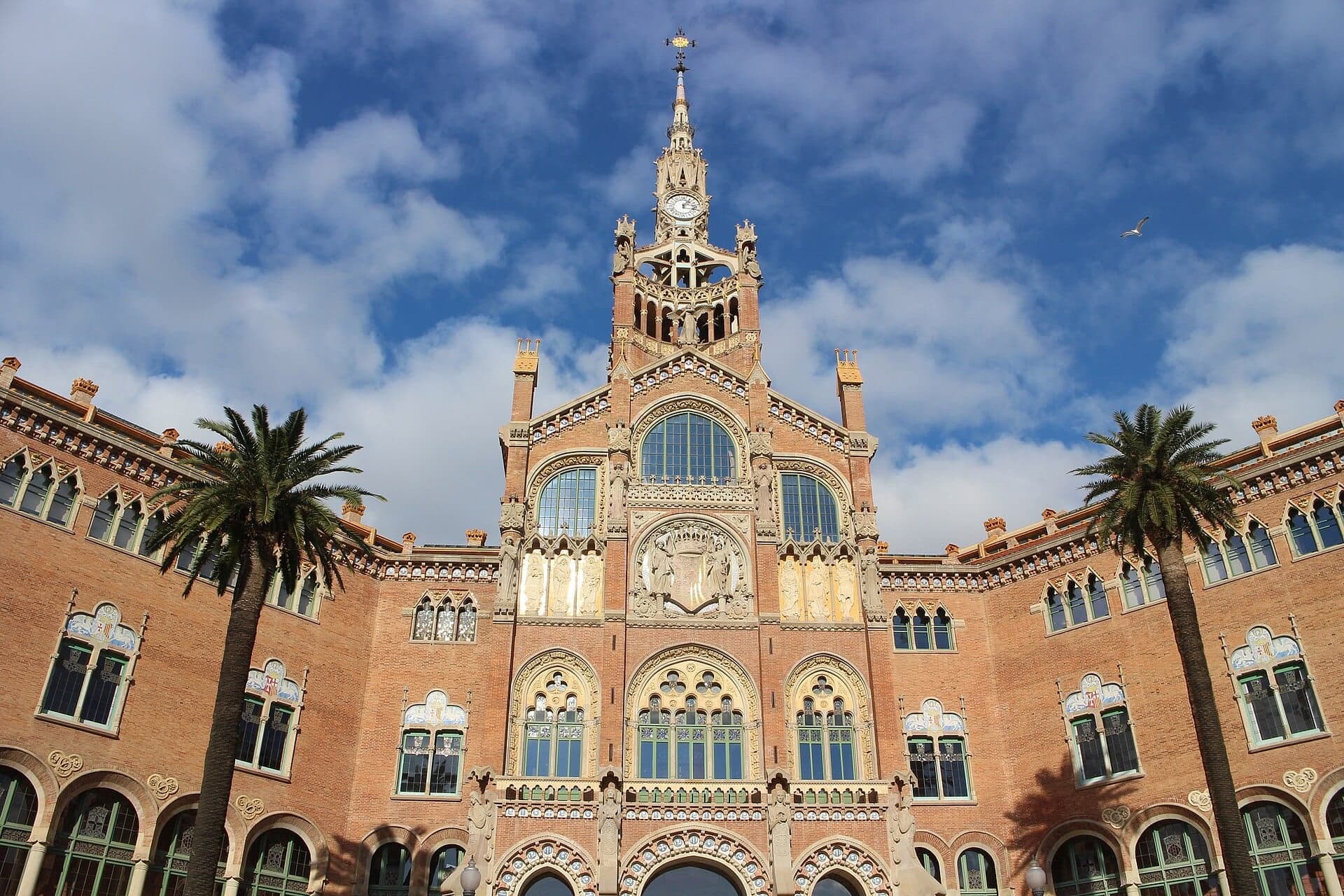
Most hospitals are built to be forgotten the moment you leave them. The Hospital de Sant Pau was built to be looked at. Lluís Domènech i Montaner designed it as a garden city of pavilions, turned off Barcelona's grid onto the shape of a cross, and decorated it as richly as any mansion, on the model, in the hospital's own words, of natural light, good ventilation and the decoration of the interiors. On the Sagrada Família and Sant Pau tour it arrives at the far end of the Avinguda de Gaudí as the counterweight to the basilica: one building reaching for heaven, the other built around the human body.
An old hospital and a banker's will
Its full name is the Hospital de la Santa Creu i Sant Pau, and the first half of that name is old. The Hospital de la Santa Creu was founded in 1401 from six small hospitals, and King Martin the Humane attended the laying of its foundation stone on 13 February 1401, which makes 2026 its 625th anniversary. The second half came with a will. Pau Gil i Serra, a Catalan banker living in Paris, died in 1896 and left his fortune to build a new hospital in Barcelona under the patronage of Saint Paul. It went up on Santa Creu land out in the fields between Gràcia, Horta, the Guinardó and Sant Martí de Provençals, and the job went to Domènech i Montaner, the architect of Casa Lleó Morera and the Palau de la Música Catalana.
Pavilions in a garden
Hear a stop from this walk
Sant Pau's Pavilions: A Hospital Until 2009
The plan is as radical as the ornament. Instead of one large block, Domènech designed separate pavilions surrounded by gardens and connected by a network of underground tunnels, each pavilion given to a different medical speciality. Construction of the first ten buildings began in 1902. Domènech designed a complex of 48 buildings; 27 were built, and only 16 of those followed his original Modernista design. He died in 1923, his son Pere Domènech i Roura finished the work, and King Alfonso XIII inaugurated the hospital on 16 January 1930.
The buildings earn the word "art" the moment you look closely: brick, ceramic and mosaic, the whole vocabulary of Catalan Modernisme applied not to a mansion or a concert hall but to a place where people came to be ill and, with luck, to get better. The hospital worked here for almost eighty years. In autumn 2009 healthcare moved to a modern building on the northern side of the site, and the old pavilions became the Recinte Modernista de Sant Pau, open to visitors. The complex was declared a Historic-Artistic Monument in 1978 and a UNESCO World Heritage Site in 1997, listed together with Domènech's Palau de la Música Catalana.
The cross that turns off the grid
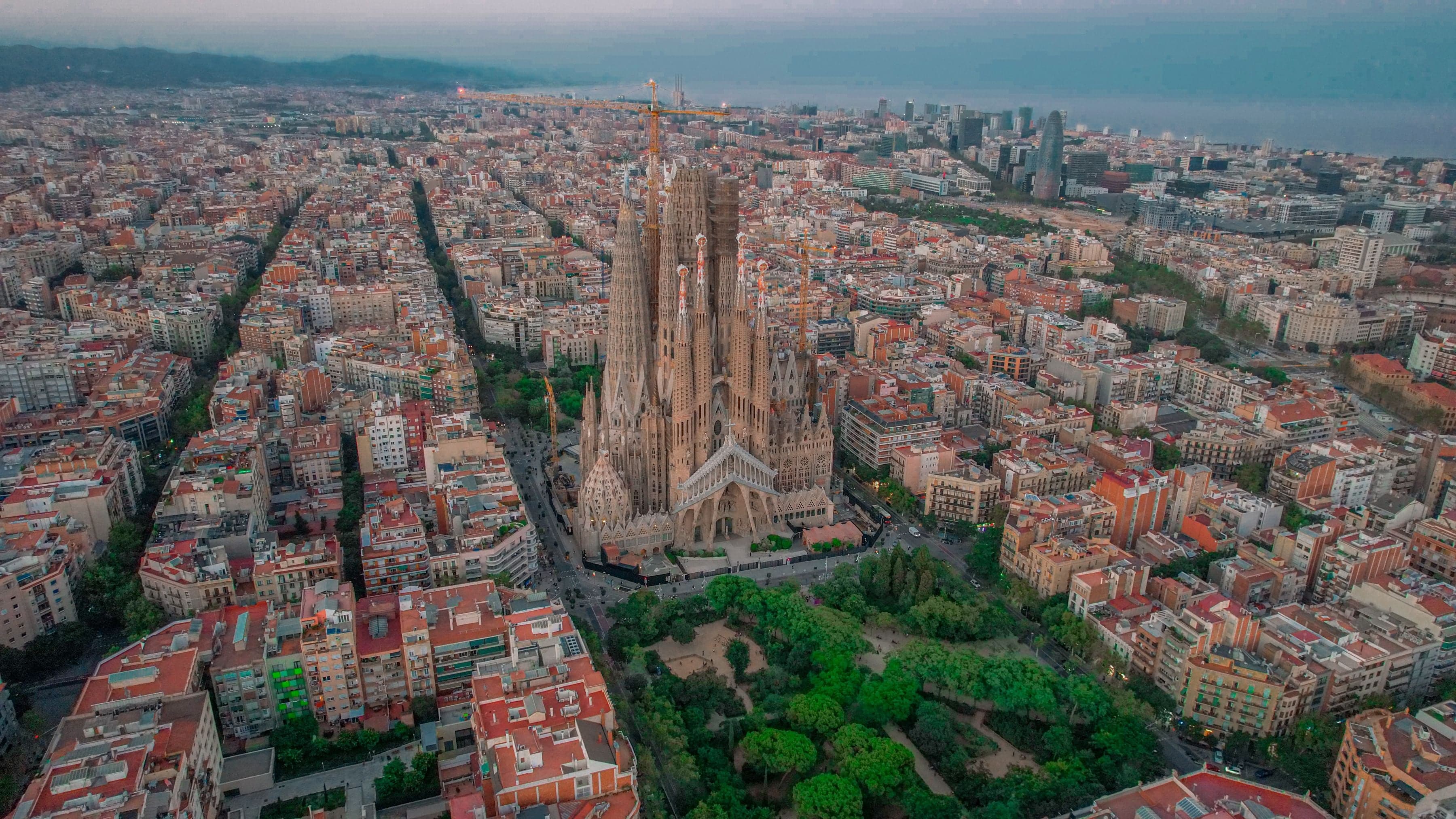
The most striking thing about Sant Pau is how it sits in the city. The hospital's own history says it followed "an urban layout different from that of the Eixample": a square plan organised round two diagonal axes, one north-south and one east-west, which together form a cross, the emblem of the old Hospital de la Santa Creu. Everywhere else in this part of Barcelona, Cerdà's grid sets the angles. Here a hospital turned its whole plan to draw its founder's sign on the ground. Why the grid matters is in the guide to Cerdà's Eixample.
You will often read that the hospital was aimed down the Avinguda de Gaudí so that it and the Sagrada Família frame each other. We found no source for that; the official reason for the diagonals is the cross. What is true is that the pedestrian avenue, lined with lamps by the city architect Pere Falqués, now links the two in about seven hundred metres, and the walk follows it. In autumn 2026 the two institutions even ran a free joint exhibition along it, "The Sagrada Família and the Hospital de Sant Pau. A Living Memory", until 15 November.
That shared avenue is why this piece and its companion belong together. The other side of the story lives in the stone book Gaudí left unfinished, and both buildings speak the same invented language of Modernisme. You can plan the walk from the Barcelona city page, the best walking tours of Barcelona, or the architecture walking tours of Barcelona.
Visiting
The tour stops on the public pavements outside. The precinct itself is ticketed: open daily from 9:30 to 18:30 from April to October and to 17:00 from November to March, with last entry half an hour before closing; a self-guided ticket is 18 euros before 2 pm and 17 euros after, and it is free on 23 April, Museum Night and 24 September (prices checked 12 October 2026).
Come to Sant Pau expecting a hospital and you will be disarmed. Come expecting art and you will see what Domènech was arguing: that the place where a body mends deserves to be as carefully made as any cathedral. The pavilions served the sick from 1930 to 2009, and the mosaics you see today watched real recoveries happen underneath them.
Sources
- Recinte Modernista de Sant Pau: history pages and visitor information (santpaubarcelona.org, checked 12 October 2026)
- Junta Constructora de la Sagrada Família, news of 7 July 2026, on the joint exhibition with Sant Pau
- Roamer audio-tour fact dossier, "Sagrada Família and Sant Pau" (12 October 2026)
Ready to experience it?
Sagrada Família and Sant Pau: Four Façades and an Avenue
60 min · 1.5 km · easy
More from Barcelona
Explore more at your own pace.
Best History Walking Tours in Barcelona (2026)
Cerdà's Eixample: The Grid Madrid Imposed and the Buildings That Broke Its Rules
El Born vs the Gothic Quarter: How to Tell Barcelona's Two Old Towns Apart
The Gothic Quarter in Three Layers: Roman, Royal and Rebuilt
Casa Batlló's Hidden Rib-Cage: Sixty Catenary Arches Under the Dragon