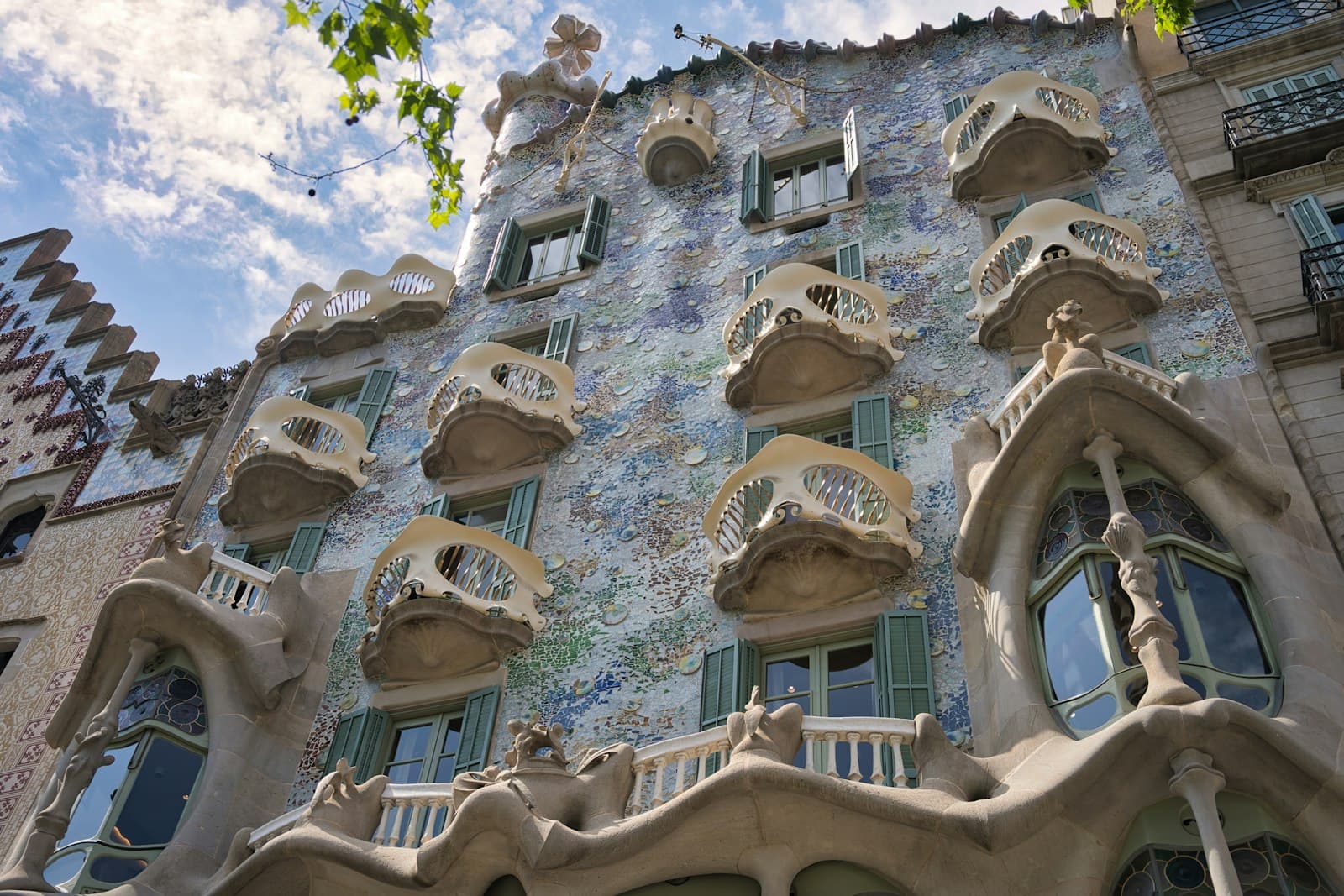
Everyone photographs Casa Batlló from the street. Almost no one sees the part that holds it up. The scaly roof and the mask balconies are the costume; above the top floor, out of sight, Gaudí set a row of sixty catenary arches, which the house itself says evoke the ribs of an animal. The Casa Batlló and La Pedrera walk shows you the front from across the Passeig de Gràcia; this piece is about what the front hides.
What the street sees
Casa Batlló stands at Passeig de Gràcia 43, on the block people call the Block of Discord: in Spanish, manzana means both a city block and an apple, and the apple of discord started a quarrel. Next door is Puig i Cadafalch's Casa Amatller, and on the corner Domènech i Montaner's Casa Lleó Morera, the only one of the three to win the city's prize for artistic buildings, in 1906.
Look up and you get the postcard. The house describes a front of stone, glass and ceramics: slender stone columns with bone-like shapes on the lower floors, balcony railings shaped like masks, a large gallery on the main floor, a roof of large scales that looks like the back of an animal, and a small tower topped by a four-armed cross. The balconies are cast iron, each made in a single piece and fixed with two anchor points. People read the whole front as Saint George and the dragon, roof as dragon, cross as sword; the house calls that a popular interpretation and notes that Gaudí never explained his work and directed the façade from outside, without precise plans. The Modernisme alphabet has a fuller reading of the materials.
The building itself is older than its skin. It was built in 1877 by Emili Sala Cortés, one of Gaudí's own architecture teachers. The textile industrialist Josep Batlló i Casanovas bought it in 1903 and first wanted it pulled down; demolition was ruled out, and Gaudí remade it from 1904 to 1906. It is a UNESCO World Heritage Site.
What the street cannot see
Hear a stop from this walk
Jardinets de Gràcia: The Top of the Passeig
Now stop looking at the façade and think about the top of the house. In the attic, the house says, Gaudí built sixty catenary arches in a row, a space that evokes the ribs of an animal.
A catenary arch is worth understanding precisely. A catenary is the curve a chain or rope takes when it hangs freely under its own weight. In that hanging state the chain is in pure tension, with no bending anywhere along its length. Flip that exact curve upside down and you get an arch that carries load in pure compression, again with no bending. Masonry is strong in compression and weak in bending, so a catenary arch is a shape that lets a masonry structure do only what masonry is good at.
Line sixty of those arches up and you have a spine of arches under the roof, entirely out of sight. The dragon on the outside is the theatre. The arches are the argument.
Why the hiding is the meaning
This inversion, structure hidden and decorative skin displayed, is the reason Casa Batlló belongs on an engineer's reading of Modernisme as well as an aesthete's. The skin tells a story; the arches do a job. Both layers are deliberate, and neither is lying about the other.
Carry the word catenary with you up the Passeig. A few blocks on, at La Pedrera, Gaudí went further: the owners describe an attic of 270 brick arches that Gaudí called "balanced" or catenary arches, under a stone front that is not structural at all but hangs on a frame of pillars like a curtain. Once you know the shape a chain makes, you start seeing it in buildings no tour narrates.
What to do here
If you go inside, the attic is the payoff of everything above it. The house sells timed tickets online from 29 euros, with the first entry at 9:00 and the last at 19:45, and children up to 12 go free (prices checked 12 October 2026). If you stay on the street, still make the mental move: look at the dragon, then imagine the sixty arches behind it. That double vision is what the walk is training.
Keep exploring Barcelona
Read the full route logic in the guide to how Barcelona wrote a new architectural language, or compare it against the Roman stone of the Temple of Augustus columns.
Ready to experience it?
Casa Batlló and La Pedrera: The Grid and Its Showpieces
75 min · 2 km · easy
More from Barcelona
Explore more at your own pace.
Best History Walking Tours in Barcelona (2026)
Cerdà's Eixample: The Grid Madrid Imposed and the Buildings That Broke Its Rules
El Born vs the Gothic Quarter: How to Tell Barcelona's Two Old Towns Apart
The Gothic Quarter in Three Layers: Roman, Royal and Rebuilt
Hospital de Sant Pau: A Hospital Built as Art