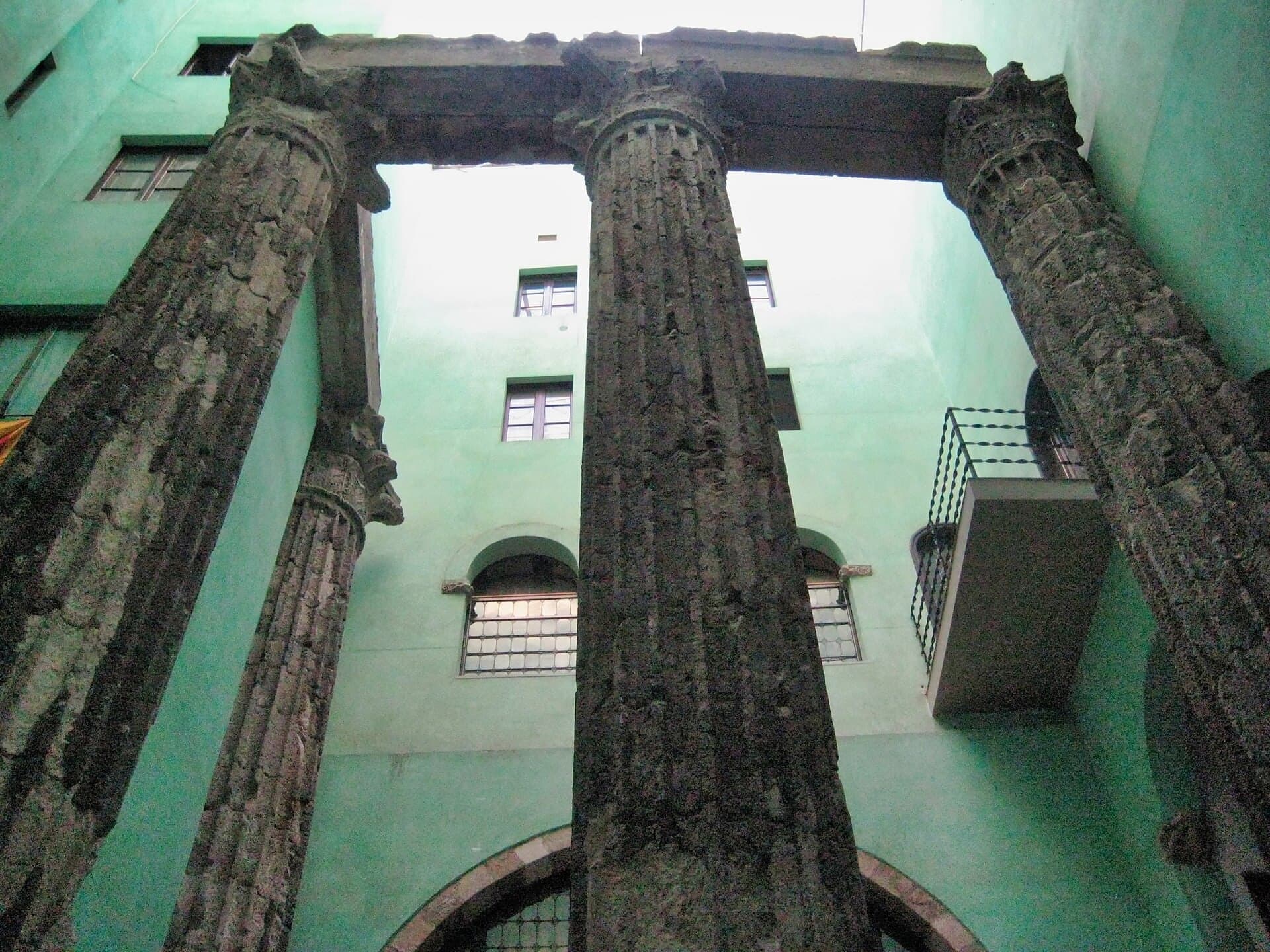
There is a doorway on Carrer del Paradís, a narrow lane a minute from Plaça de Sant Jaume, that thousands of people walk past every day. Number 10. Look through it in opening hours and you see four Corinthian columns from a Roman temple of the first century before the Common Era, dedicated to the cult of the emperor. Entry is free. The Gothic Quarter tour stops at this door because the temple is the top of the Roman town, and because its own story shows how the quarter's three layers, Roman, medieval and twentieth century, sit on top of each other.
What you are standing under
The Museu d'Història de Barcelona (MUHBA), which runs the site, describes a temple consecrated to the worship of the Roman Empire, built in the first century before the Common Era. It stood on a podium reached by stairs, at the highest point of a low rise the Middle Ages called Mons Taber, and it sat on the axis of the forum: an arcaded square ringed by the town's main public buildings, including the basilica and the curia, where the local senate met. The MUHBA's own research series calls it a hexastyle building of the Corinthian order, six columns across the front, built when the colony was founded.
What survives is four columns with fluted shafts and Corinthian capitals, part of the architrave above them and part of the podium. Nobody needs a height or a column count to feel the scale: stand at the door and look up.
Also on show is a stone pedestal honouring a Roman magistrate, the aedile Quintus Calpurnius Flavus. It was found in the foundations of the church of Santa Maria del Pi, reused as building stone, which is a neat way to see what happened to most of Roman Barcino: it went into the walls of the city that came after it.
How the columns came back
Hear a stop from this walk
Plaça Reial: Gaudí's Lampposts
For centuries the temple was absorbed into medieval buildings and divided between them. The columns you see were not stumbled on by builders. Their recovery was a project: the Centre Excursionista de Catalunya, the hiking and heritage club whose building this is, promoted it, and the architect Lluís Domènech i Montaner carried it out in the early twentieth century. In the middle of the century the architect Adolf Florensa continued the restoration and added a fourth column that had stood for some time in Plaça del Rei.
So even the oldest thing on the walk was arranged by the twentieth century. The stone is Roman. The way you see it, cleared, lit and completed with a column brought from two streets away, is modern.
The city that grew around them
Augustus founded the colony here around 10 BC and gave it a long name, Colonia Iulia Augusta Faventia Paterna Barcino. Its walls closed in about ten hectares. The temple stood on its high point while the rest of the city's history happened around it. The Gothic cathedral was begun on 1 May 1298, a few streets away. Santa Maria del Pi was consecrated in 1453. The cathedral's present front went up between 1887 and 1913. The bridge over Carrer del Bisbe was built in 1928. On the morning of 30 January 1938, Italian aircraft allied to Franco bombed the city, and the bombs that fell on Sant Felip Neri killed some twenty children sheltering in the church's basement.
Why this stop anchors the tour
The walk's argument is that the Gothic Quarter is three cities stacked in one: a Roman town whose gate, wall, temple and crossroads still show; a royal and medieval city built inside and on top of it; and a remake between 1927 and 1970 that restored, moved or rebuilt about forty buildings. The full case is in the Gothic Quarter companion. The temple is where the first layer is easiest to read, and its restoration is a reminder that the third layer touched even this.
What to do here
Step in. It is free and usually quiet, and there are no staff on site, so look rather than touch. The MUHBA lists it as open on Monday mornings from 10:00 to 14:00, Tuesday to Saturday from 10:00 to 19:00 and Sunday from 10:00 to 20:00, with last entry half an hour before closing, and closed on 1 January, 1 May, 24 June and 25 December. Then, back on the street, carry the question the tour keeps asking: when was the thing in front of me actually built?
Keep exploring Barcelona
Read the full argument in the Gothic Quarter companion, or see all the routes in the guide to the best self-guided walking tours in Barcelona.
Ready to experience it?
Gothic Quarter: Roman, Royal and Rebuilt
75 min · 1.8 km · easy
More from Barcelona
Explore more at your own pace.
Best History Walking Tours in Barcelona (2026)
Cerdà's Eixample: The Grid Madrid Imposed and the Buildings That Broke Its Rules
El Born vs the Gothic Quarter: How to Tell Barcelona's Two Old Towns Apart
Casa Batlló's Hidden Rib-Cage: Sixty Catenary Arches Under the Dragon
Hospital de Sant Pau: A Hospital Built as Art