Historical Park: The Burned Capital
110 min · 5 km · moderate
Ayutthaya was one of the richest cities on earth for four centuries, and then a Burmese army razed it in seventeen sixty-seven so completely that the Siamese abandoned the site and carried its own bricks downriver to build Bangkok. That single fire is the key to the whole place. What remains is not a preserved capital but its negative space: a royal core of burned temples, a belt of vanished foreign quarters along the southern rivers, and a skyline of towers that outlived the kingdom that raised them. The three Roamer walks read that lost cosmopolitan port through two questions that turn out to be the same question. What was destroyed here, and what did the world leave behind?
The city sat on an island ringed by three rivers in central Thailand, its temples gilded, its court receiving ambassadors from as far as Versailles. Understanding it means holding a paradox the ruins keep repeating: the more total the destruction, the more powerful the ruin became. A city burned to melt the gold off its statues is now a place people cross the world to stand quietly inside. You can read the full set of routes on the Ayutthaya walking tours hub, but the through-line is best paced in three passes: the royal island, the foreign shore, and the shapes on the sky.
The royal core, read through what burned
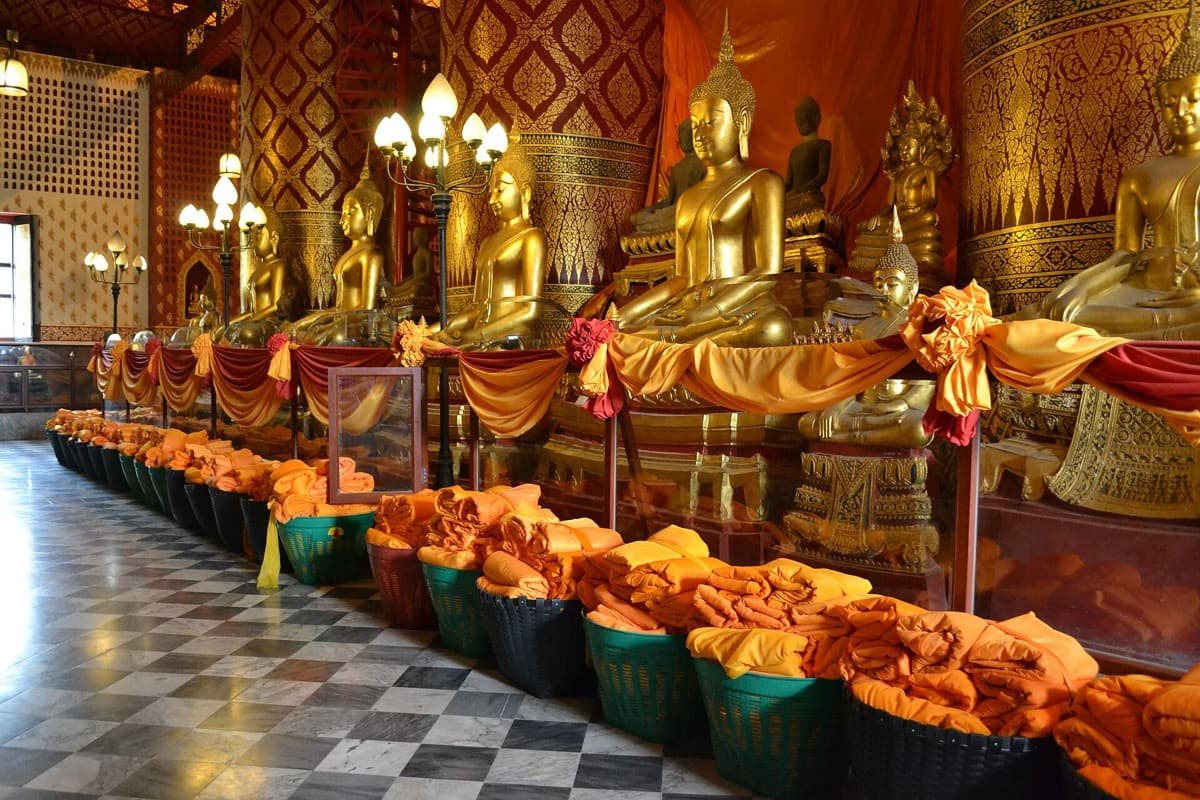
Start with the crown. The Burned Capital moves through six ruins on the island and reads the sack of seventeen sixty-seven as arithmetic rather than only cruelty. At Wat Phra Si Sanphet, the king's private chapel and later the model for Bangkok's Wat Phra Kaew, a standing Buddha called Phra Si Sanphet once rose about sixteen metres over a bronze core, sheathed in roughly three hundred forty-three kilograms of gold. The Burmese set the building on fire specifically to melt that gold and carry it off as bullion. The three bell-shaped chedis nearby, tombs holding the ashes of kings, survived. The gold god did not.
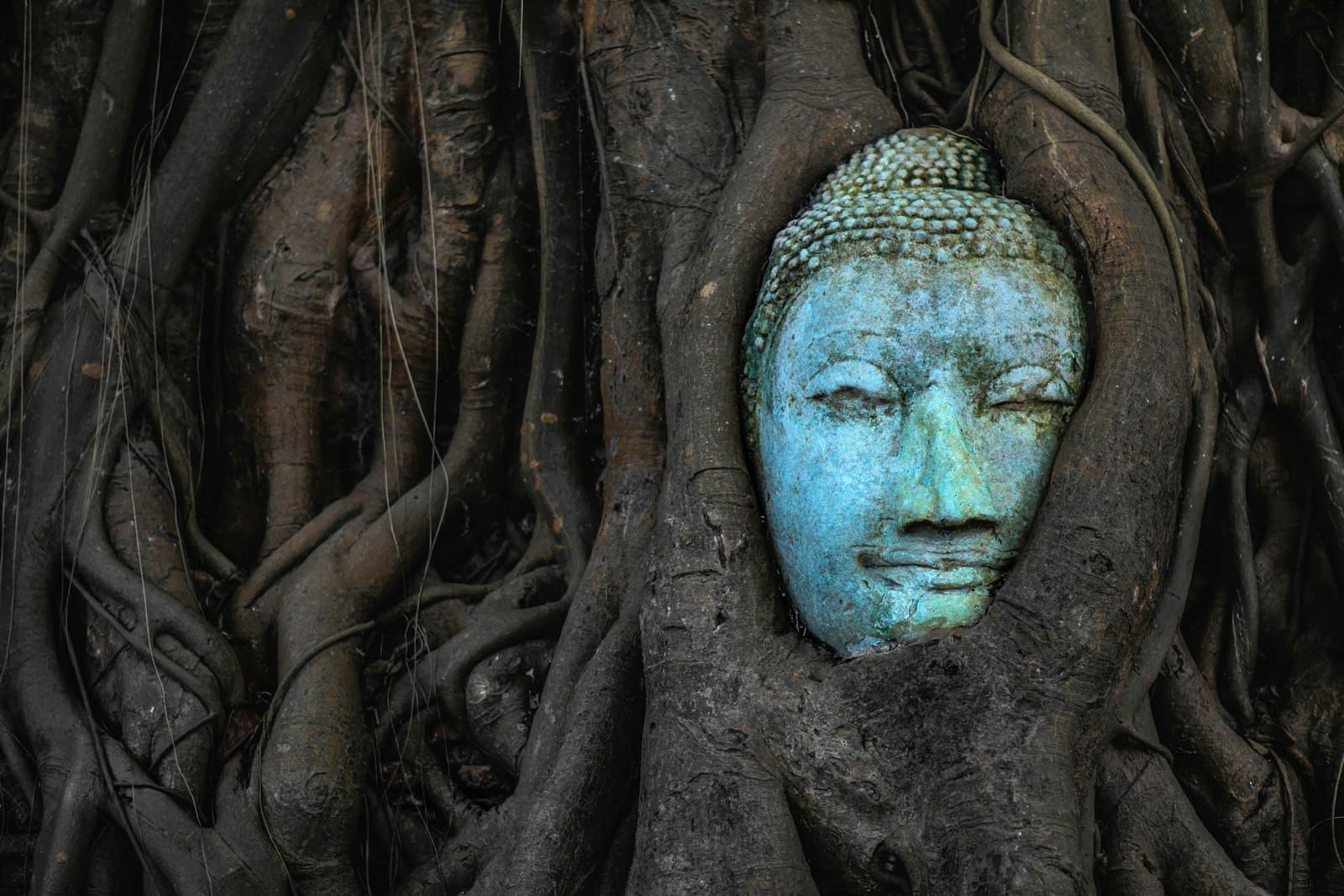
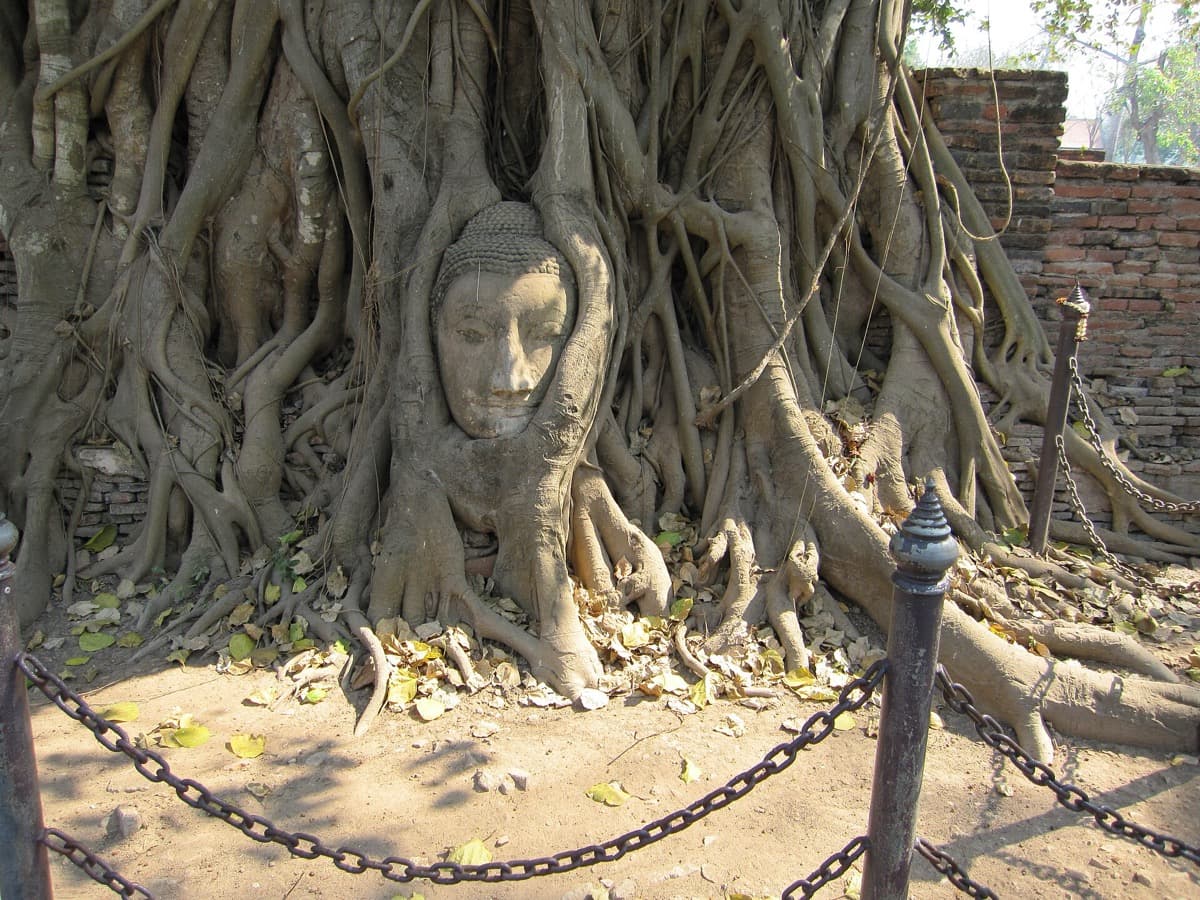
The same logic of loss and residue runs through the island. At Wat Ratchaburana, founded in fourteen twenty-four by King Borommarachathirat the Second over the ashes of two brothers who killed each other in single combat on war elephants, an underground crypt was discovered in nineteen fifty-six, looted by thieves in nineteen fifty-seven, and then properly excavated to yield more than two thousand objects, over one hundred thousand votive tablets, and more than one hundred kilograms of gold. At Wat Mahathat, once the religious and political center of the kingdom, a sandstone Buddha head sits calm in the roots of a bodhi tree, believed struck from its statue by the invaders, with no documented account of how it reached the roots. The emptiest stop is the loudest: at the Wang Luang, the royal palace, only brick foundations remain, because King Rama the First had those very bricks ferried down the Chao Phraya by barge to build Bangkok's Grand Palace, begun on the sixth of May seventeen eighty-two, using the vanished palace as its layout prototype. You are looking at the negative space of Bangkok.
Not everything melted. Phra Mongkhon Bophit, one of the largest bronze Buddhas in Thailand at about twelve and a half metres tall, lost its head and right arm when the city fell in April seventeen sixty-seven, then sat under open sky for roughly two hundred years before repair. In a strange coda, the Prime Minister of Burma, whose army had razed the city, donated toward restoring the hall during a nineteen fifty-six visit.
The foreign shore, read through who was welcomed and watched
Hear a stop from this walk
Ancient Royal Palace (Wang Luang): The Foundations That Became Bangkok
The wealth had a source, and it lived downriver. The World Port traces the vanished trading neighbourhoods where the Portuguese, Dutch, Japanese, Chinese, and French each held a settlement, a church, or a lodge. The thread here is sharper than tolerance. The port welcomed almost everyone and profited from everyone, yet it kept each community close enough to use and close enough to watch, and when a favoured foreigner rose too near the throne, the welcome could turn.
You can see the pattern in a single life. At Baan Yipun, the Japanese village of roughly a thousand to fifteen hundred residents, Yamada Nagamasa rose from the low Siamese court rank of Khun to the senior rank of Okya, commanded a Japanese guard corps, and won the favour of King Songtham. After he opposed King Prasat Thong's accession he was sent south to govern Ligor and was assassinated in sixteen thirty, and the village was burned around the same time. The economics were just as concrete a few steps away. At Baan Hollanda, the Dutch East India Company held a monopoly on Siamese deerskins and hides and shipped them north to Japan at a profit; their lodge stood until the sack of seventeen sixty-seven, and the modern information centre on the site opened in two thousand thirteen.
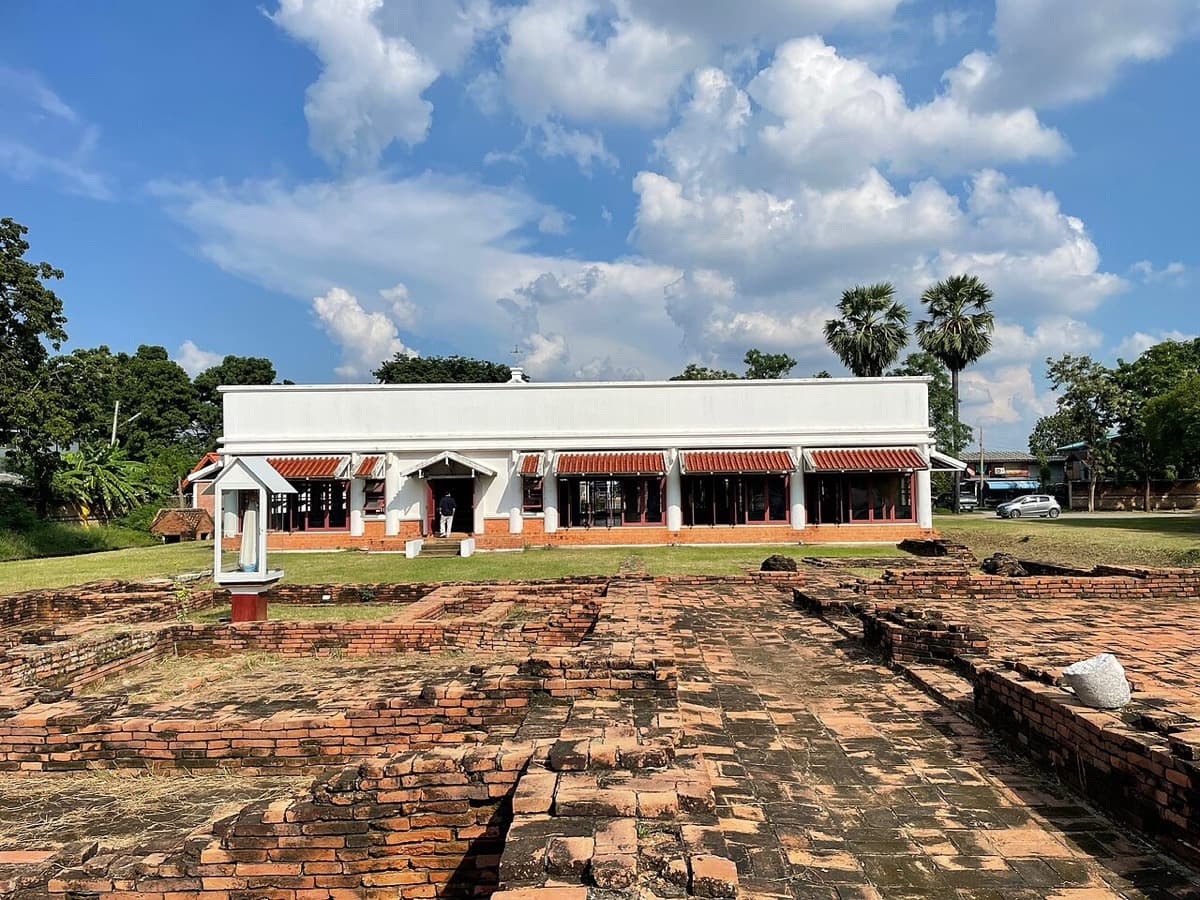
The port also kept its dead. At the Portuguese settlement, the earliest Western quarter, the Fine Arts Department began excavating on the second of March, nineteen eighty-four, and uncovered more than two hundred and fifty skeletal remains of European and Asian men, women, and children, buried with crosses, rosary beads, coins, tobacco pipes, and even spectacle lenses. Every one of these quarters is now grass, foundations, and bones, with one exception. St Joseph's Church, first founded in sixteen sixty-six on land given by King Narai, still says mass by the river as a working parish, more than three centuries on. It is the only foreign institution on the walk that survives as a living thing rather than a memory.
The skyline, read as a language
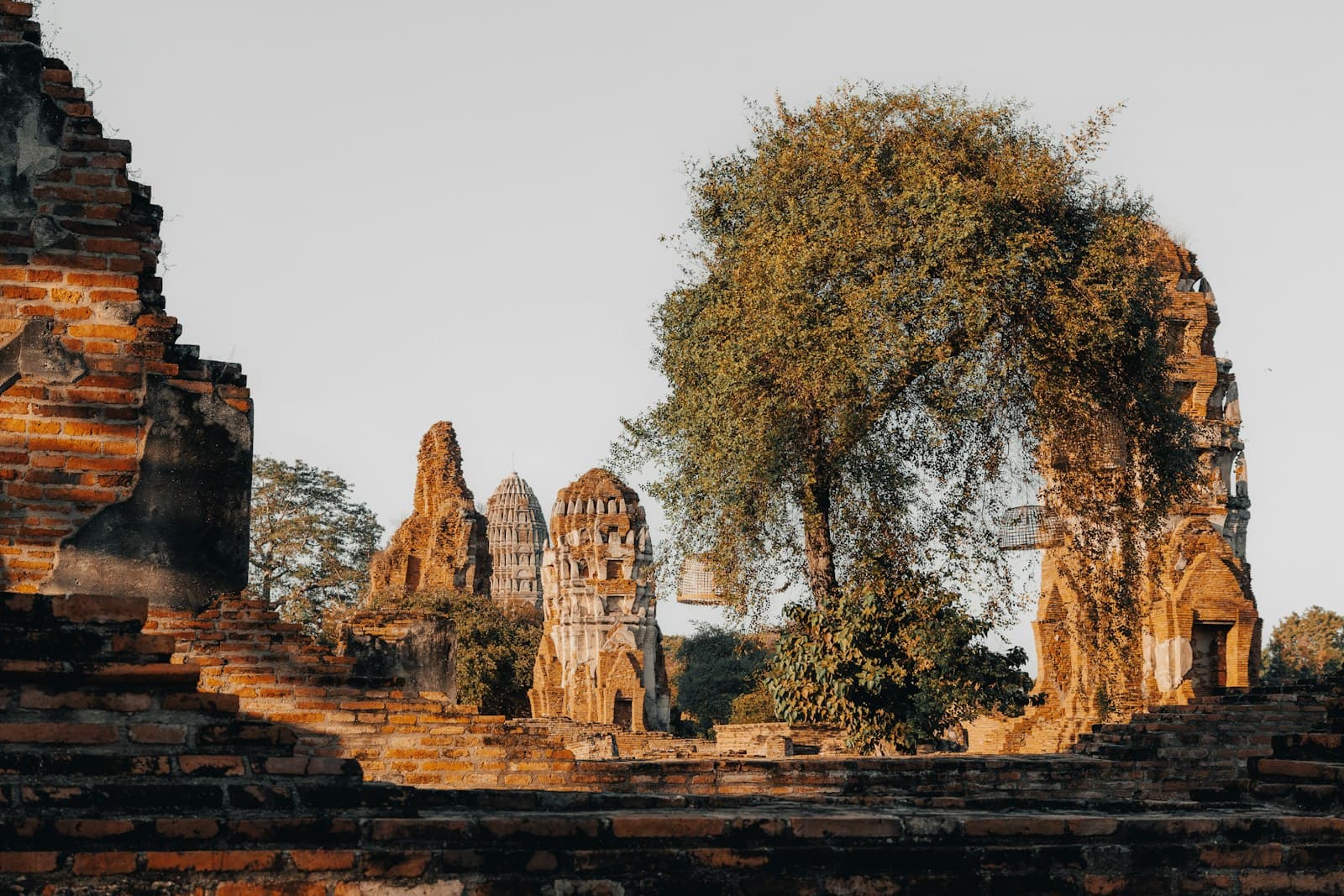
The third pass looks up. The Architecture of Kings treats the royal skyline as writing, built from two forms the kingdom held at once. The prang is a tall tapering tower borrowed from Khmer building; the chedi is a bell rising from a rounded base, an idea that traveled from Sri Lanka. Learning to read them is the point of the walk, so it begins at Wat Na Phra Men, the one temple inside the city the Burmese did not burn, spared because they used it as a military headquarters. With one intact roofline in your eye, the ruins that follow become legible as fragments you can complete.
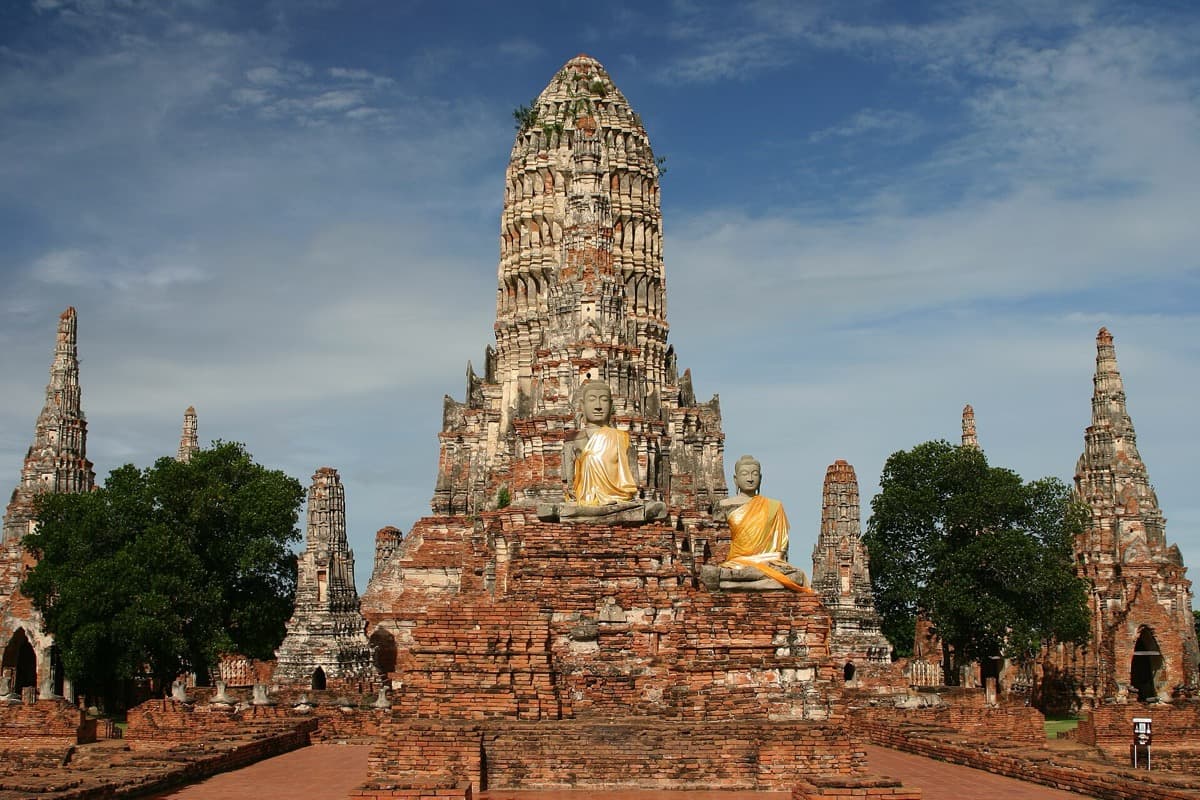
The grammar assembles at Wat Chaiwatthanaram, built in sixteen thirty by King Prasat Thong as the first temple of his reign, laid out as a diagram of the Buddhist universe. Its central prang, about thirty-five metres tall, stands for Mount Meru at the center of the world; four smaller prangs around it stand for the continents in the world-ocean; the rectangular gallery is the wall of iron mountains at the edge of everything. At golden hour, read from the temple's own west-bank river frontage, the whole plan resolves into one silhouette against the Chao Phraya, doubled in the water. It is the most photographed angle in the city, though the temple sits just outside the UNESCO World Heritage boundary despite being the face of Ayutthaya.
Read together, the three walks tell one story. A capital grew rich by keeping the world close, spent that wealth building a sacred skyline, and was burned so thoroughly that its ruins became more powerful than the city ever was. The gold left. The people scattered. The river stayed, the shapes stayed, and the ruins, in the end, complete themselves.
Sources
- Ayutthaya Historical Study group and reference site, ayutthaya-history.com, on temple attributions, dating disputes, and the foreign settlements
- Thailand Fine Arts Department records on the Wat Ratchaburana crypt excavation and the Portuguese settlement excavation of 1984
- Baan Hollanda information centre history of Dutch and Thai relations and the VOC deerskin trade
- UNESCO World Heritage Centre listing for the Historic City of Ayutthaya
- Royal chronicles of Ayutthaya as summarized in the Roamer tour research on the founding kings and the fall of 1767
Frequently asked questions
- Why was Ayutthaya destroyed?
- A Burmese army sacked and burned Ayutthaya in 1767, razing it so completely that the Siamese abandoned the site and founded a new capital downriver at Bangkok. In several cases the fires were deliberate: at Wat Phra Si Sanphet the Burmese burned the building specifically to melt the gold off a roughly sixteen-metre standing Buddha and carry it away as bullion.
- Was Ayutthaya really a cosmopolitan trading city?
- Yes. For a few centuries it was one of the busy sea gates of the early modern world, with separate riverside quarters held by the Portuguese, Dutch, Japanese, Chinese, and French. The Dutch East India Company even held a monopoly on Siamese deerskins and hides, shipping them north to sell at a profit in Japan.
- What happened to Ayutthaya's bricks after the city fell?
- King Rama the First had bricks removed from the ruined city, though not from its temples, and ferried down the Chao Phraya River by barge to build Bangkok and its Grand Palace, whose construction began on the sixth of May 1782. Bangkok's palace also copied the layout of the vanished Ayutthaya royal palace as its prototype.
- What is the difference between a prang and a chedi in Ayutthaya?
- The prang is a tall tapering corn-cob tower borrowed from Khmer temple building, while the chedi is a bell rising from a rounded base, a form that traveled from Sri Lanka. Ayutthaya's royal builders used both, letting each carry royal meaning across the skyline.
- Is Wat Chaiwatthanaram a UNESCO World Heritage Site?
- No, not technically. Although Wat Chaiwatthanaram sits within the Ayutthaya Historical Park and is often photographed as the face of the city, it lies just outside the boundary of the UNESCO-inscribed Historic City of Ayutthaya, so it is not itself an inscribed site.
Ready to experience it?
Historical Park: The Burned Capital
110 min · 5 km · moderate
More from Ayutthaya
Explore more at your own pace.
Ayutthaya Travel Guide: Days, Transport, Season, Safety, and Costs
Reading Ayutthaya's Royal Skyline at Wat Chaiwatthanaram
The Excavated Dead of Ayutthaya's Portuguese Settlement
Wat Lokayasutharam: Reading Ayutthaya's Reclining Buddha
Wat Mahathat, Ayutthaya: The Buddha Head in the Tree Roots