Stand at the southeastern corner of Ayutthaya, where the Chao Phraya and Pa Sak rivers come together, and you are standing at the reason the whole city grew rich. Wat Phanan Choeng sits on the east bank at exactly this confluence, and inside its hall a colossal gilded Buddha has watched over sailors and traders for centuries. The temple record places its founding around the year thirteen twenty-four, roughly twenty-seven years before Ayutthaya was officially established in thirteen fifty-one. The crossroads of the two rivers, in other words, was already sacred before the capital existed. If you want to understand how one Siamese port kept the entire early modern world close enough to trade with, you begin here, at the water, with the Buddha the river brought in.
A confluence before a capital
Rivers made Ayutthaya. The city sat on an island where three rivers met, a natural moat and a natural harbour in one, and ocean-going ships could reach it from the Gulf of Siam. That geography is why the Portuguese, the Dutch, the Japanese, the Chinese, and the French all came, and why each ended up in its own settlement strung out downriver from the palace. Wat Phanan Choeng marks the point where the sea route bent into the city. A ship coming upriver from the gulf reached this confluence first, and here it was that people who had just survived a sea crossing stepped ashore and gave thanks.
The temple predates all of the European trading lodges. Tradition connects its early years to a settlement of Chinese refugees, part of the movement of people from the Song dynasty world into Southeast Asia, and the site functioned from the start as a river shrine for arrivals from the sea. Before the Dutch built their deerskin monopoly, before Japanese samurai settled across the water, before Portuguese soldiers were buried under a Dominican church, there was this: a place where the water carried people in, and where they prayed before it carried them out again.
Luang Pho To, the Buddha that fills the hall
Hear a stop from this walk
Baan Hollanda: The Dutch Lodge and the Deerskin Monopoly
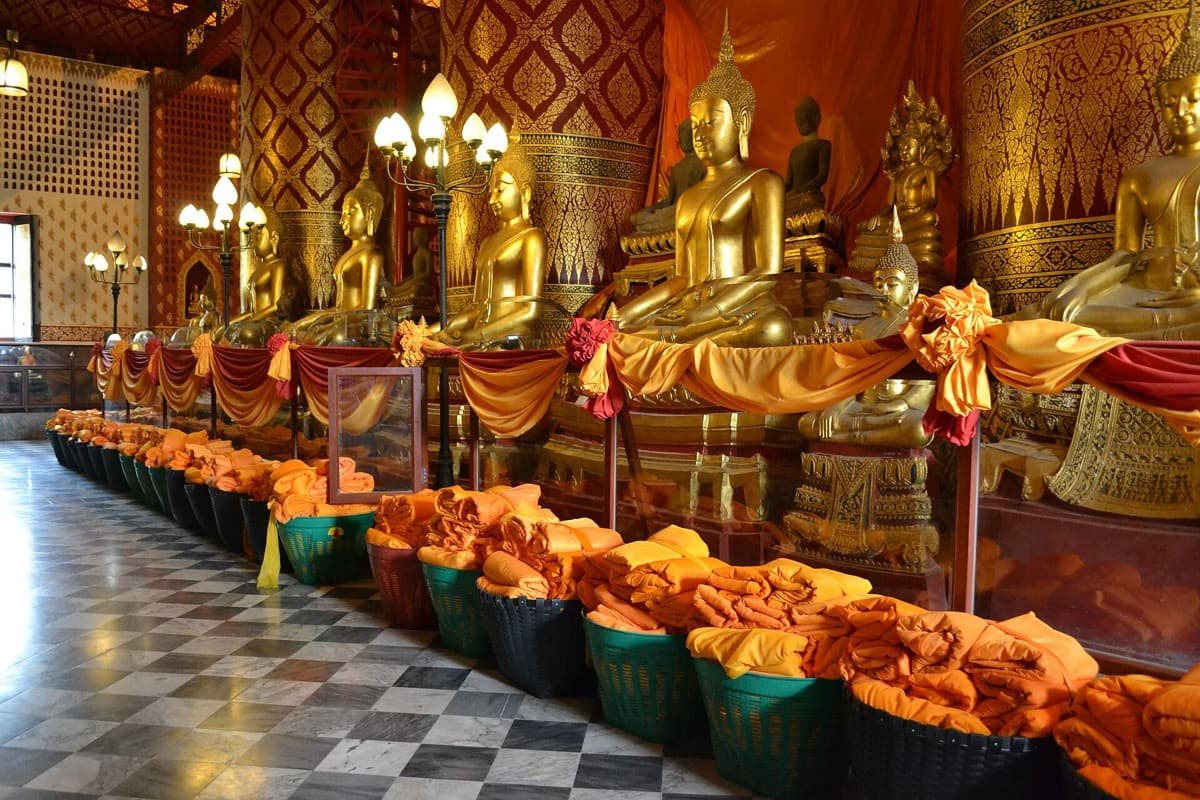
Step inside and the scale does the talking. The main image, Luang Pho To, is a seated Buddha in the Subduing Mara posture that stands roughly nineteen metres high and about fourteen metres across the lap. It is among the largest and most revered Buddha images in Thailand, and the effect in the enclosed hall is deliberate. You are meant to feel small under it. Gilded, serene, and enormous, it presses down on the room in a way that photographs never capture. The formal name is Phra Buddha Trai Rattana Nayok, given by King Mongkut after a restoration in the nineteenth century, though almost no one uses it. To Thai worshippers the image is simply Luang Pho To, a familiar and affectionate name for a figure of overwhelming size.
The temple's own name carries a small clue to what you are looking at. Phanan Choeng derives from Khmer roots meaning, roughly, to sit with legs interlaced, a reference to the cross-legged posture of the great seated image. The name and the statue are one idea. The whole temple is built around the body of the Buddha inside it.
Sam Po Kong and the sailors' devotion
Here is the layer that ties this temple to a world port rather than to any single nation. Thai-Chinese devotees have long called this same image Sam Po Kong, and they revere it as a guardian of sailors and mariners. The monastery became a pilgrimage site for the local Chinese community, and on any busy day you will still see visitors offering robes and incense, folding Theravada Buddhist practice together with the older gestures of ancestral veneration. One Buddha, two names, two devotional traditions, meeting in a single hall by the river.
There is a famous story attached to that name. Tradition holds that in the year fourteen oh seven the Ming admiral Zheng He, commander of China's great treasure fleet, visited Wat Phanan Choeng on his second voyage and made offerings here. It is worth being honest about this one. The popular link between Sam Po Kong and Zheng He is a devotional legend, not documented history, and you should hold it lightly. But the legend still tells the truth about the place. Long before the European companies arrived, this was a Chinese river shrine where people arriving by sea gave thanks for safe passage and prayed for the next crossing. The Zheng He story is how devotion remembers that older reality, even if the admiral himself never climbed these steps.
The one thing to understand standing here
If you take a single idea away from this stop, let it be this. Everything downriver, the Dutch lodge, the Japanese village, the Portuguese graves, the French church, was about foreigners the port let in on its own terms, welcomed for profit and watched with care. Wat Phanan Choeng is the counterweight. It is not a foreign quarter. It is the host. The river and the temple were here before the trading nations came, and they remained after the Burmese sack of seventeen sixty-seven brought the port down. Where the foreign settlements are now grass and foundations and excavated bone, this temple is still full of incense and gold and people at prayer.
That is what makes it the right place to begin a walk through the vanished foreign quarters. Stand at the water's edge and watch the two rivers merge. The current you are looking at is older than every neighbourhood on the walk ahead, older than the capital, older than the trade. Everyone who ever came to Ayutthaya to buy hides or sell gunpowder or flee a war passed this confluence first. The Buddha in the hall behind you was already here to receive them.
Walk it yourself
Wat Phanan Choeng is a working temple, so dress modestly, cover your shoulders and knees, and slip off your shoes before entering the hall. Entry is twenty baht. Come early, ideally by eight or nine, before the riverside heat builds, and take a moment at the water before you move on.
This is the first stop on Roamer's self-guided audio tour of Ayutthaya's foreign quarters, a downriver walk of about seven kilometres that traces the lost trading neighbourhoods from this river temple to a French church still saying mass by the water. You set the pace and skip what you like. To see how it fits the wider city, browse our Ayutthaya walking tours or start from the Ayutthaya city page, then let the audio meet you at the confluence.
Sources
- Wat Phanan Choeng, Wikipedia. Confluence location, founding around 1324, Luang Pho To dimensions (19.2 metres high, 14.2 metres across the lap), Subduing Mara posture, the formal name given by King Mongkut, the Khmer etymology, Sam Po Kong devotion and the mariner guardianship, the Zheng He tradition, and the 20 baht entry.
- Wat Phanan Choeng, History of Ayutthaya (ayutthaya-history.com). Temple history, the 1324 founding predating the capital, and the settlement of Song dynasty Chinese refugees tied to the site.
- Roamer tour transcript, "The World Port: Ayutthaya's Foreign Quarters." Fact-audited narration for the anchor stop, including the confluence framing, the roughly seven-kilometre route, and the legend-versus-history handling of Zheng He.
- Yamada Nagamasa and Baan Hollanda entries, Wikipedia. Context for the surrounding foreign settlements referenced in the walk.
Ready to experience it?
Foreign Quarters: The World Port
135 min · 7 km · hard
More from Ayutthaya
Explore more at your own pace.
Ayutthaya Travel Guide: Days, Transport, Season, Safety, and Costs
The Burned Capital: How Ayutthaya's Ruins Read the World That Made Them
Reading Ayutthaya's Royal Skyline at Wat Chaiwatthanaram
The Excavated Dead of Ayutthaya's Portuguese Settlement
Wat Lokayasutharam: Reading Ayutthaya's Reclining Buddha