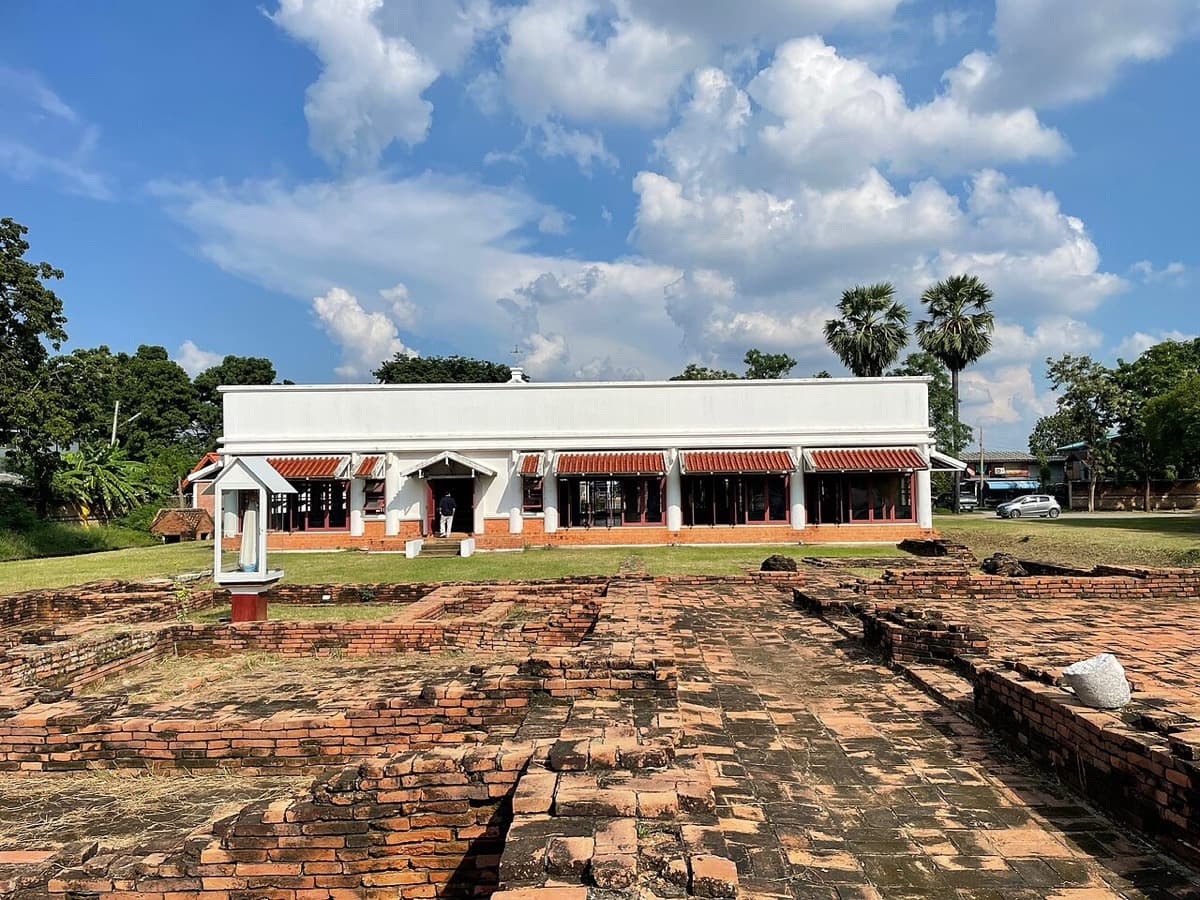
On the south bank of Ayutthaya, in an open field with little shade, excavators reached down into the ground and found the buried people of the Portuguese Settlement. More than two hundred and fifty skeletal remains came up out of the earth here: European and Asian, men, women, and children, some still laid out exactly as they had been placed. Around the bones lay crosses, crucifixes, rosary beads, coins, tobacco pipes, glass, spectacle lenses, and porcelain. No other stop on this walk gives you the world port so directly. The Dutch left a lodge and the Japanese left a memory, but here the port kept its people, and the ground held onto them for four hundred years.
That is the argument of the whole tour, and this is the place that proves it. Ayutthaya, the old Siamese capital, spent centuries as one of the busy sea gates of the early modern world. It kept the world in separate neighbourhoods, each just downriver from the palace: the Portuguese, the Dutch, the Japanese, the Chinese, the French, and others, each with a settlement, a church, or a trading lodge. The port welcomed almost everyone and profited from everyone. It also drew each community close enough to use and close enough to watch, and when a favoured foreigner rose too near the throne, the welcome could turn. The Portuguese quarter is where you can stand over the human cost of that bargain.
The first Western quarter
The Portuguese were the first Western nation in contact with Ayutthaya, from the reign of King Ramathibodi the Second, who ruled from the late fourteen hundreds into the early fifteen hundreds. The settlement grew after fifteen thirty-eight, when King Chairacha, fearing Burmese expansion, engaged a company of about one hundred and twenty Portuguese soldiers. Those soldiers and the community that formed around them settled on this stretch of the south bank. It became the oldest of the Western neighbourhoods, and the pattern it set repeated for two centuries: a foreign group brought in for what it could offer, given room to live, and kept at a measured distance from the sacred center of Siamese power.
The village held three Catholic churches. The ruins you can walk today belonged to a Dominican church, sometimes called San Petro. The dating is honestly uncertain. Secondary sources place the first Dominican church here around fifteen forty, while the scholar Michel Jacq-Hergoualc'h dates the surviving structure to the last quarter of the sixteenth century. Hold the buildings' age loosely. What is not loose is what came out of the ground. On March the second, nineteen eighty-four, the Fine Arts Department began excavating, and the site turned from a grassy field into an archive of ordinary lives. The grave goods tell you these were not passing sailors. Spectacle lenses and tobacco pipes belong to people who read, who smoked in the evenings, who lived their whole lives downriver in a foreign quarter and never went home.
How the anchor connects to the rest of the walk
Hear a stop from this walk
Baan Hollanda: The Dutch Lodge and the Deerskin Monopoly
Walk the full route and the Portuguese dead stop making sense in isolation. The tour is a downriver transect that begins upstream at Wat Phanan Choeng, where the Chao Phraya and Pa Sak rivers meet. That temple, whose record dates its founding to about thirteen twenty-four, predates the capital itself, and its colossal seated Buddha, Luang Pho To, roughly nineteen metres high, has been revered by Thai-Chinese sailors as Sam Po Kong, a guardian of mariners. Before any European arrived, the river was already carrying people in from the sea and receiving their thanks. That is the ground everything else is built on.
From there the walk moves down the east bank to Baan Hollanda, the site of the Dutch East India Company's lodge. The Dutch formalised trade with Siam in sixteen oh four, won permission for a post under King Ekathotsarot in sixteen oh eight, and saw a new VOC factory rise in sixteen thirty-four under King Prasat Thong. They became the principal Western trader in Siam on the strength of a monopoly over deerskins and hides, which they shipped north to sell at a profit in Japan. A quiet riverbank turned out to be a hinge in a trade that ran from the forests of Siam to the markets of Japan.
Then comes the Japanese village, Baan Yipun, and the tour's darkest thread. A community of perhaps one thousand to fifteen hundred Japanese lived here: traders, Christian refugees, and ronin, masterless samurai who had fought on the losing sides at Sekigahara in sixteen hundred and at the siege of Osaka. One of them, Yamada Nagamasa, born around fifteen ninety, rose from the low Siamese rank of Khun to the senior rank of Okya, commanded a Japanese guard corps, and won the favour of King Songtham. When he opposed King Prasat Thong's rise, he was sent south to govern Ligor and assassinated there in sixteen thirty. The village burned around that time. The port had raised a foreign soldier to the edge of power, then let the welcome turn.
Now cross the water, as the tour does, and the Portuguese Settlement lands with full weight. You have seen the profit at the Dutch lodge and the ambition at the Japanese village. Here you see the bodies. This is the moment the walk's thesis stops being an idea and becomes a field of graves.
What survives the port
The tour does not end in the ground. It closes on two survivors. Wat Phutthaisawan, a Siamese temple founded in thirteen fifty-three by King Uthong, also known as Ramathibodi the First, stands with its tall white Khmer style prang representing Mount Meru, the cosmic mountain. It survived the Burmese fall of seventeen sixty-seven and has been in continuous use since the fourteenth century. And St Joseph's Church, founded in sixteen sixty-six on land given by King Narai and built by the French bishop Pierre Lambert de la Motte, is the one foreign institution here still alive. The bright yellow building you see is a nineteenth century rebuild by the architect Joachim Grassi, with its first mass in eighteen ninety-one, and it still says mass by the river.
The contrast is the point. The foreign quarters were guests: welcomed, used, watched, and eventually gone. The river and the temple were the hosts, and they remained. Standing over the excavated dead at the Portuguese Settlement, you hold both truths at once. This is where the whole downriver argument is buried, waiting for you to walk back up the bank and hear how it began. If you want to see the full route and the other Ayutthaya walks, browse the Ayutthaya walking tours or start from the Ayutthaya city page.
Sources
- History of Ayutthaya, "Portuguese Settlement excavation" (ayutthaya-history.com). Details on the fifteen thirty-eight settlement, the Dominican church, and the nineteen eighty-four excavation.
- Museum Thailand, Portuguese Settlement Ayutthaya page. Site background, grave finds, and visiting information.
- Baan Hollanda official site, "Our Story" (baanhollanda.org). VOC lodge history and the deerskin trade.
- Wikipedia, "Yamada Nagamasa" and "Japanese Village (Ayutthaya)." Biography and the Japanese enclave's history.
- Wikipedia, "St Joseph's Church, Ayutthaya" and "Pierre Lambert de la Motte." Founding, rebuild, and the Paris Foreign Missions Society.
Ready to experience it?
Foreign Quarters: The World Port
135 min · 7 km · hard
More from Ayutthaya
Explore more at your own pace.
Ayutthaya Travel Guide: Days, Transport, Season, Safety, and Costs
The Burned Capital: How Ayutthaya's Ruins Read the World That Made Them
Reading Ayutthaya's Royal Skyline at Wat Chaiwatthanaram
Wat Lokayasutharam: Reading Ayutthaya's Reclining Buddha
Wat Mahathat, Ayutthaya: The Buddha Head in the Tree Roots