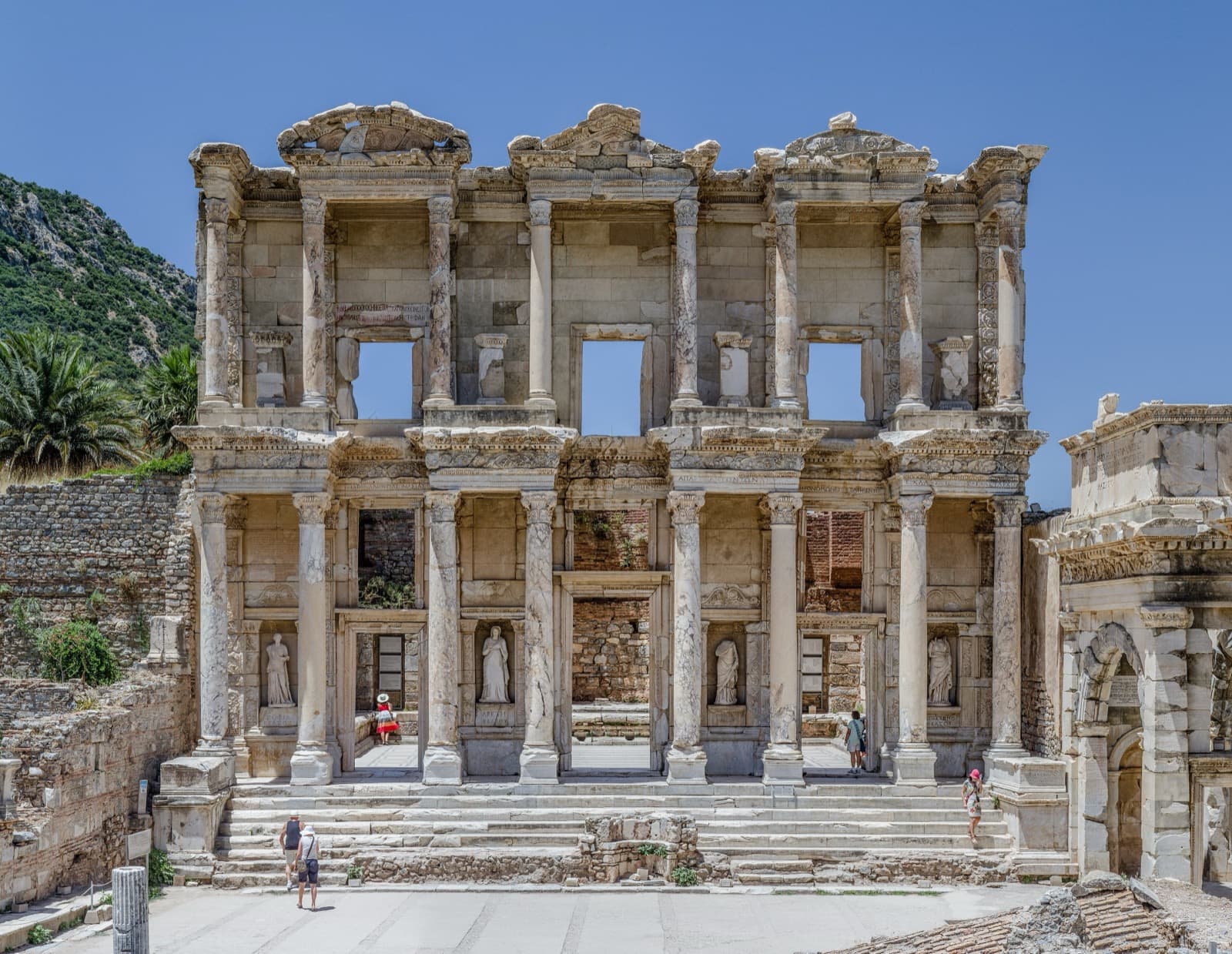
Walk Ephesus downhill from the Upper Gate along Curetes Street to the Library of Celsus, the market, the Great Theater and the harbor street that now ends in fields.
Start · Upper Gate and State Agora: A City Moved by Flood
DirectionsStops
- 1
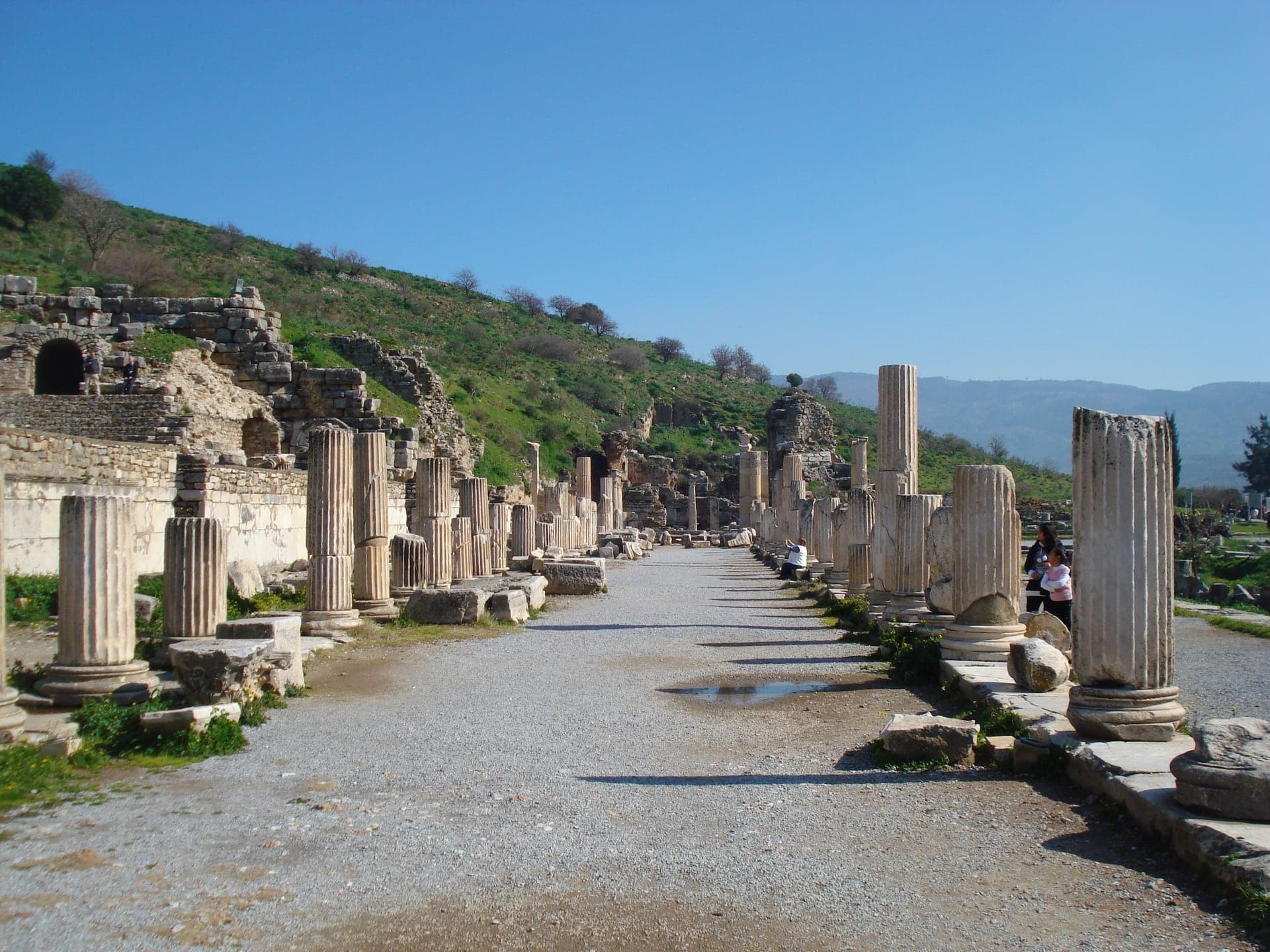
Upper Gate and State Agora: A City Moved by Flood
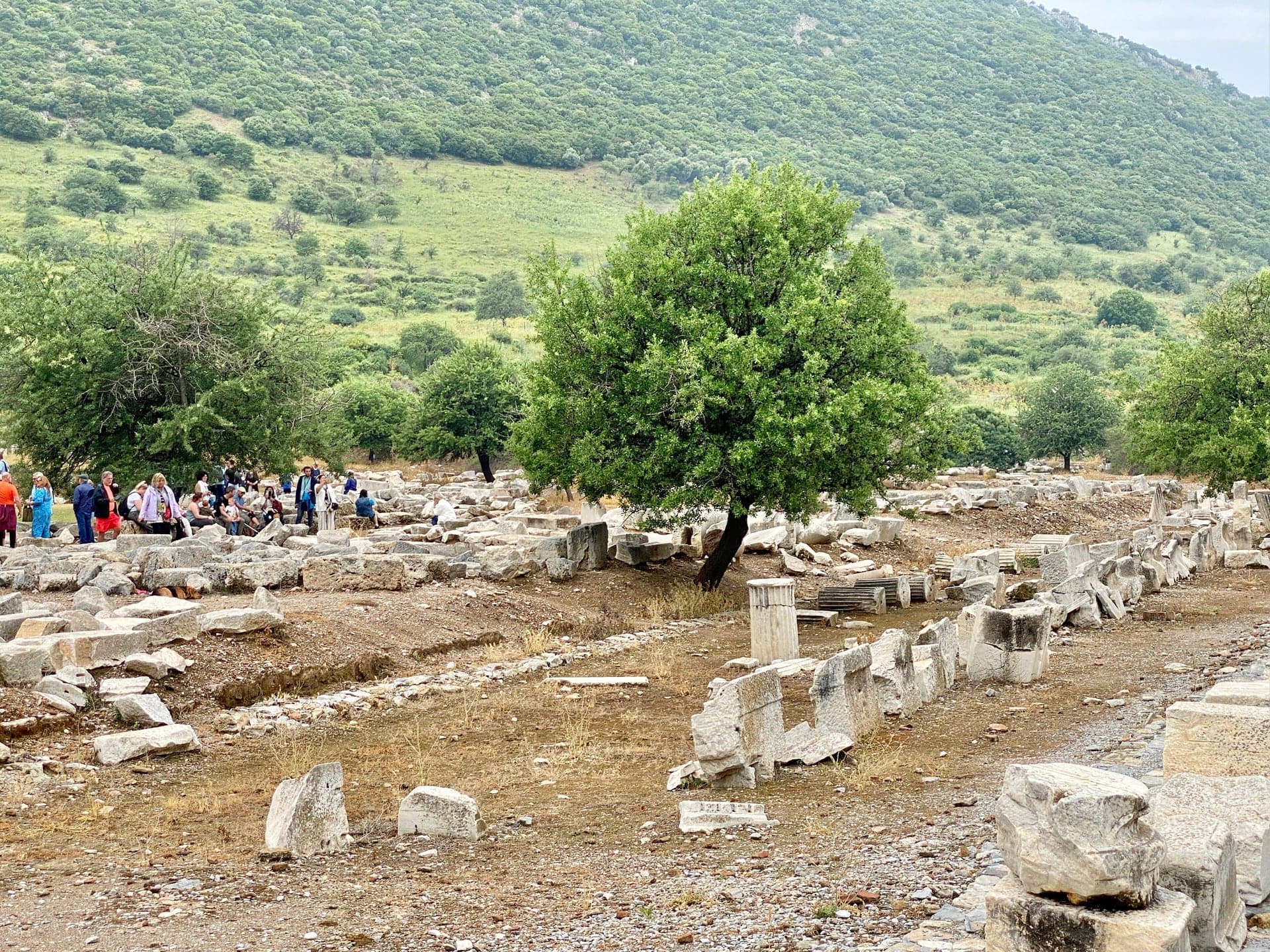
The government square by the upper gate. A king once flooded the people out of their old homes to move them here.
- 2
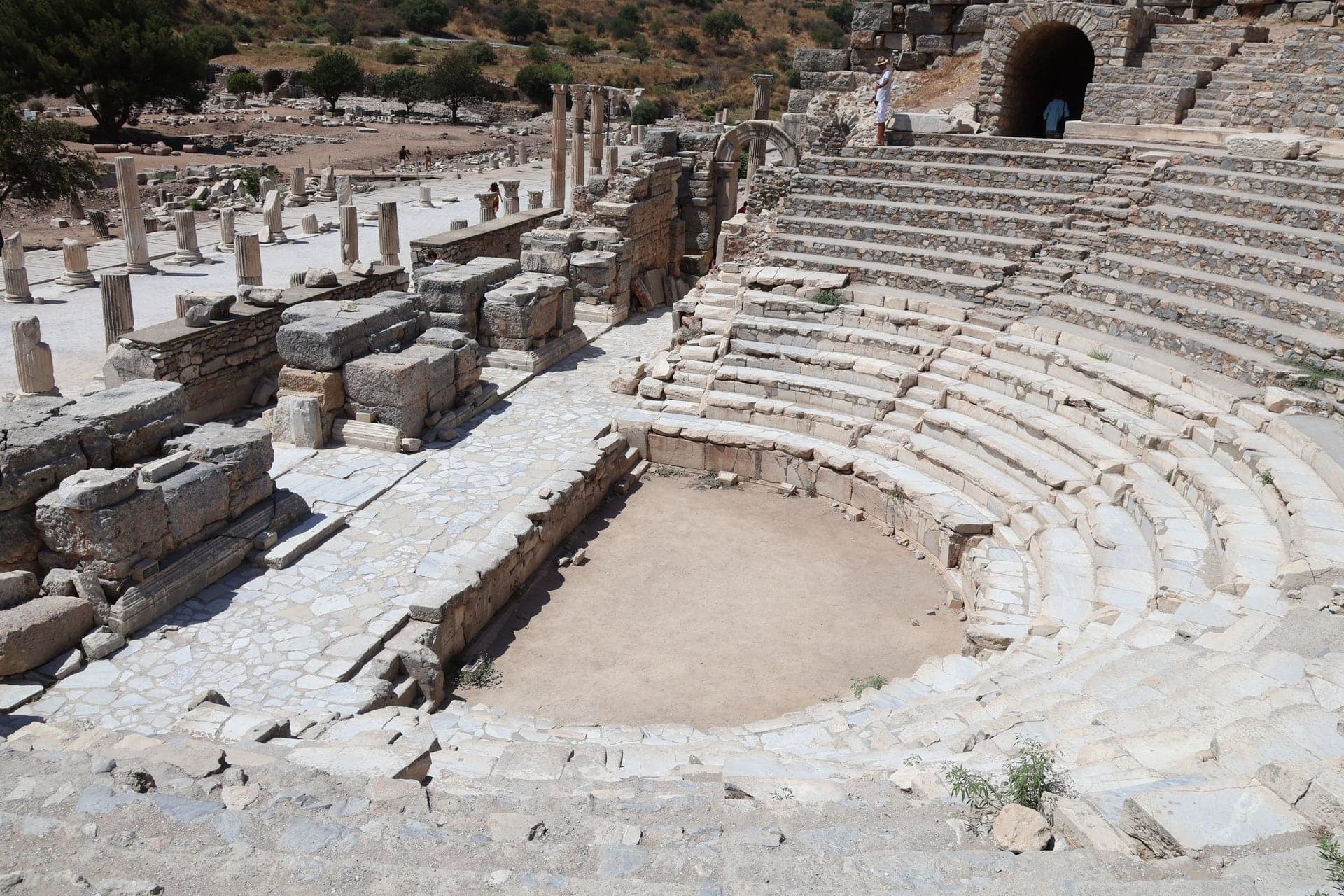
Odeon and Prytaneion: Council House and Town Hall
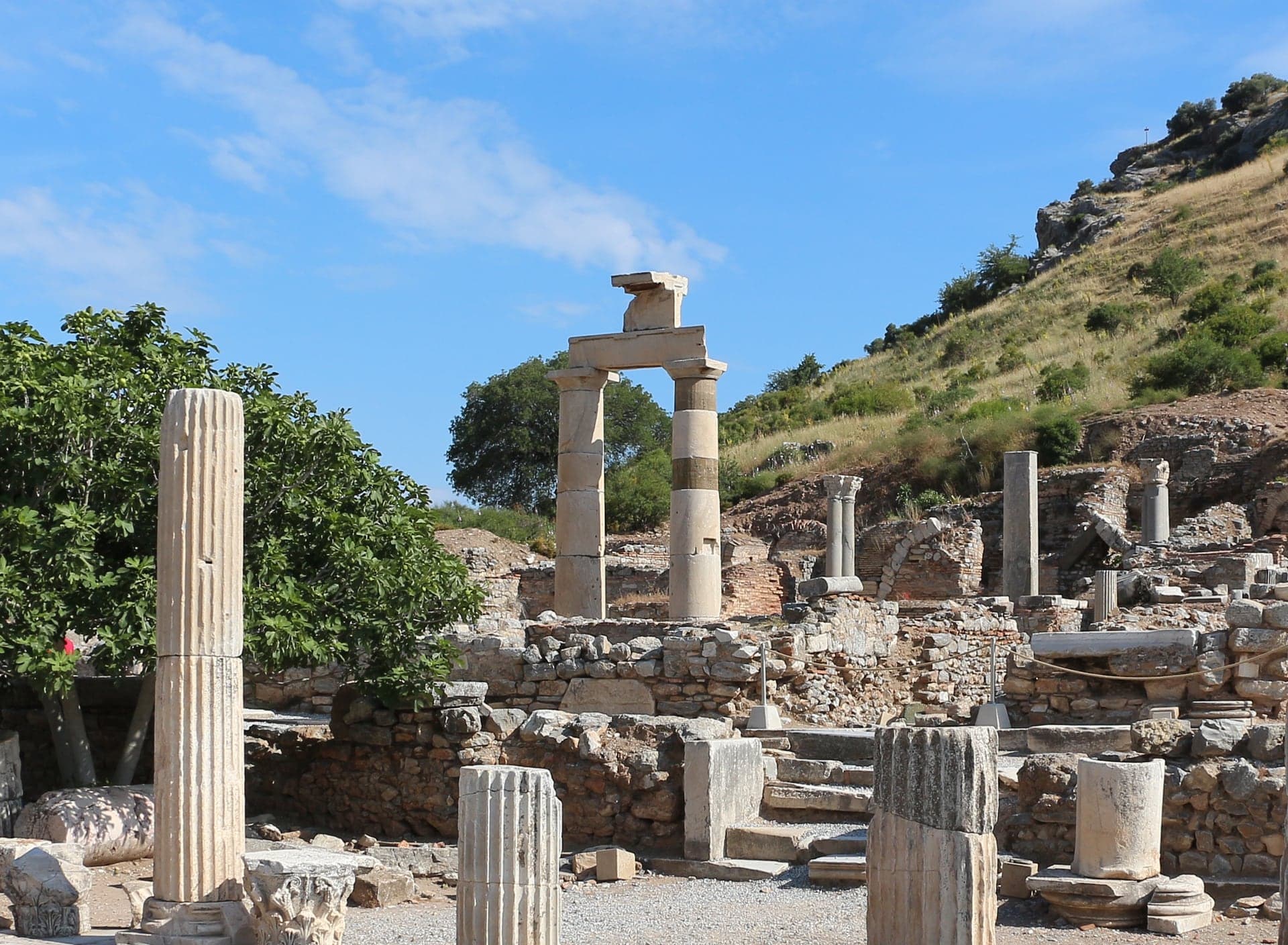
The council met in this small roofed theater. Beside it, the inscribed columns of the town hall gave the main street below its modern name.
- 3
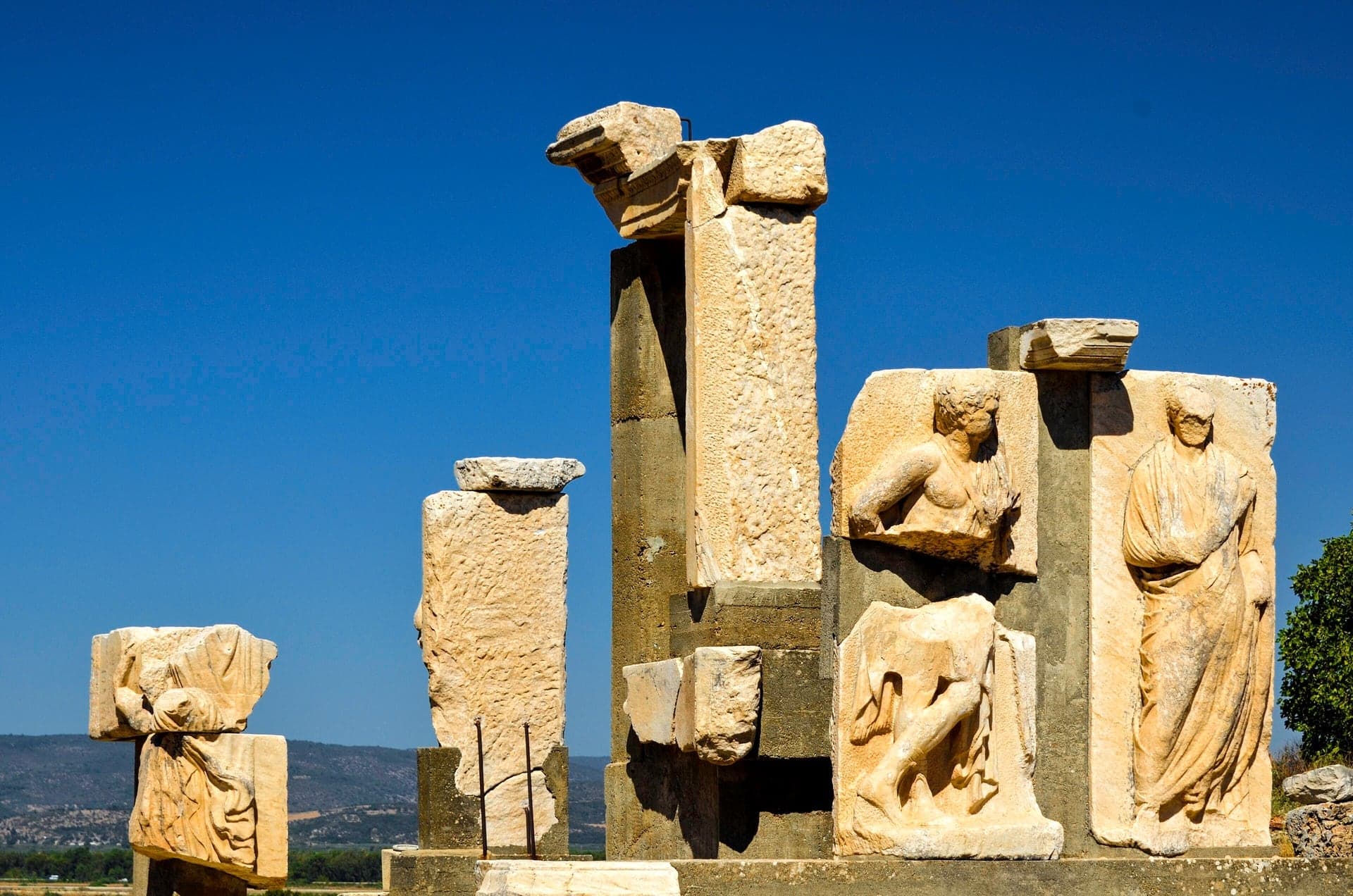
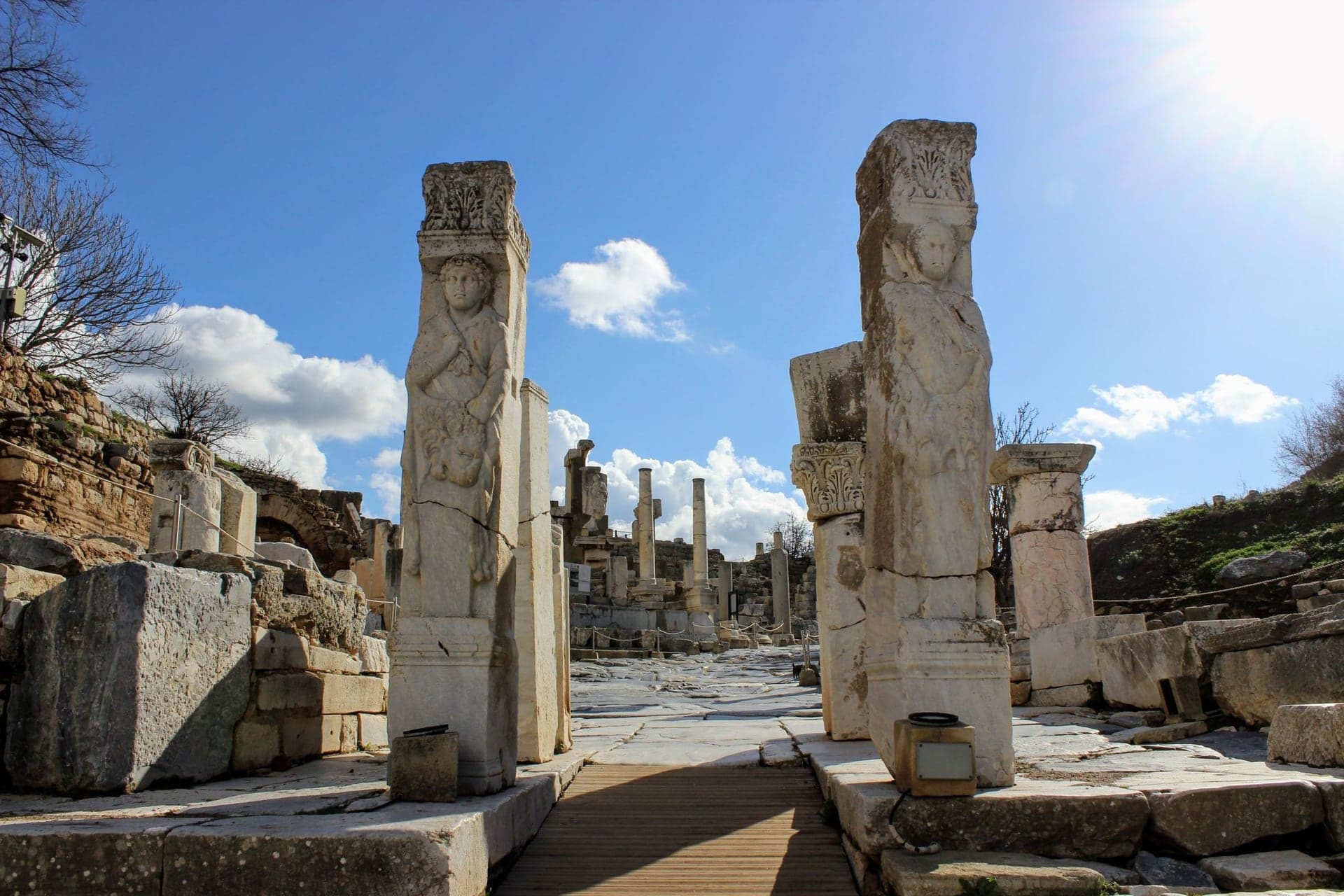
Gate of Hercules: Old Carvings in a Newer Gate
Old carvings reused in a later gate. Beside them stands a monument rebuilt in raw concrete on purpose.
- 4
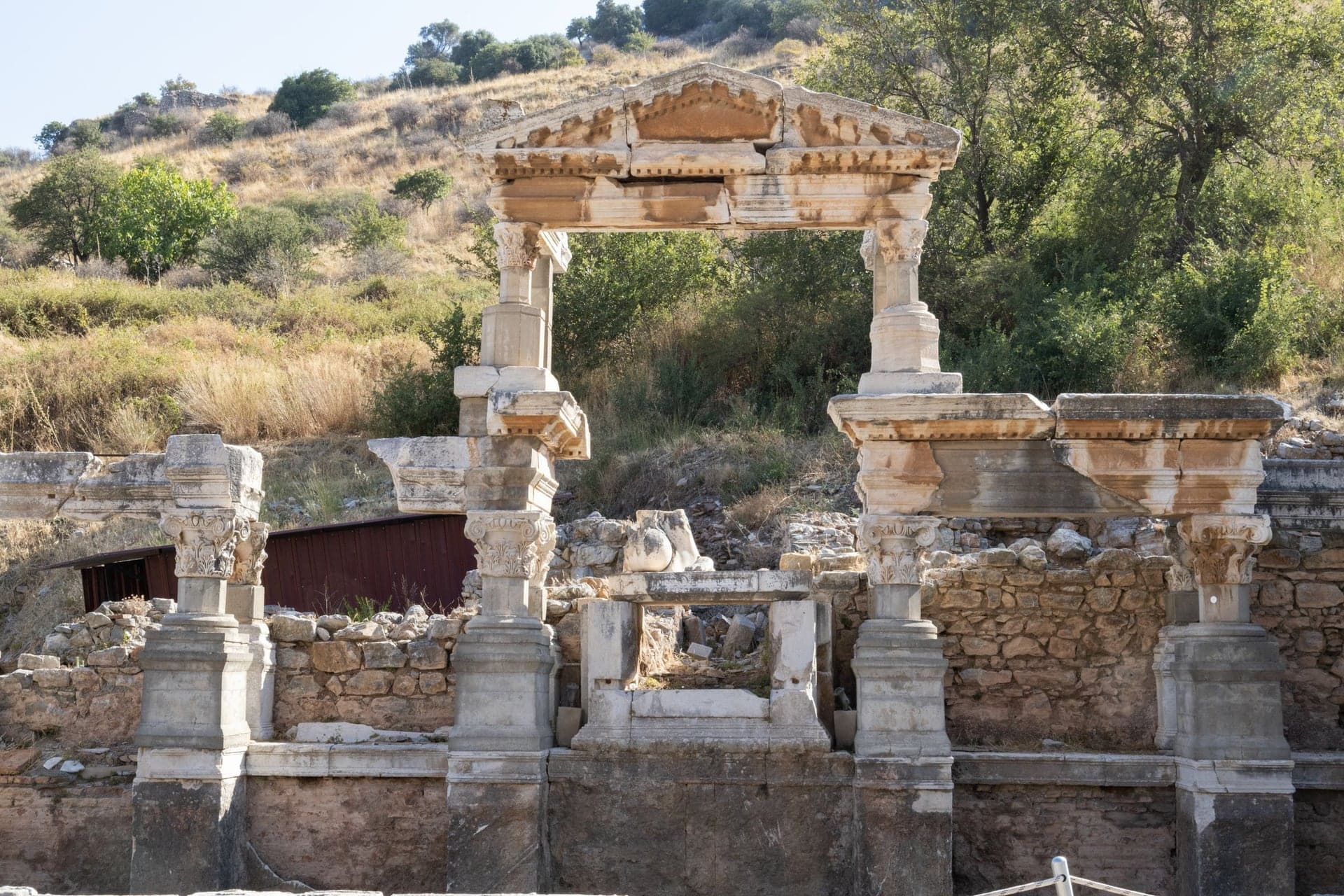
Curetes Street: An Emperor Reduced to a Foot
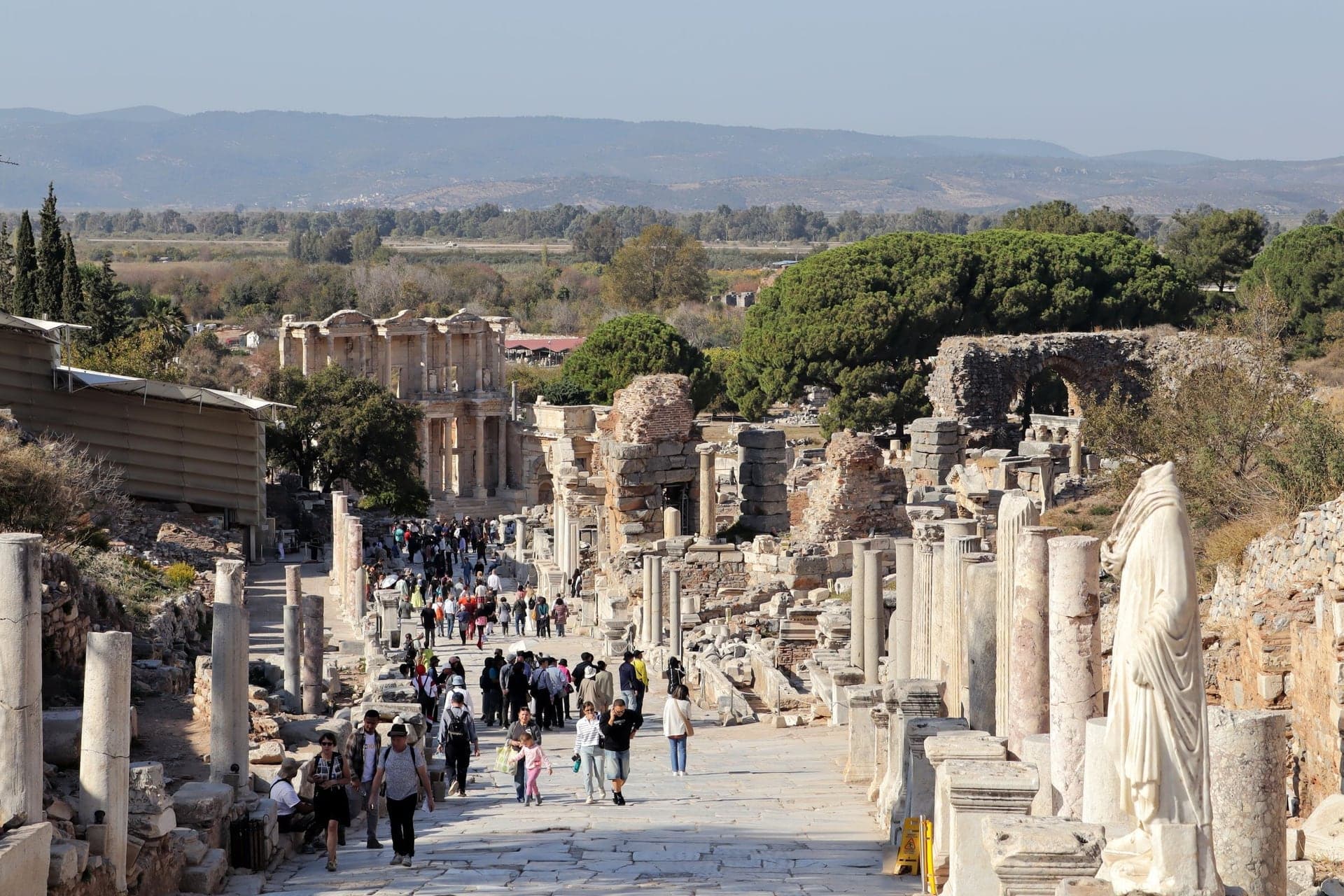
A marble main street named by archaeologists. An emperor's fountain stands re-erected at a smaller size.
- 5
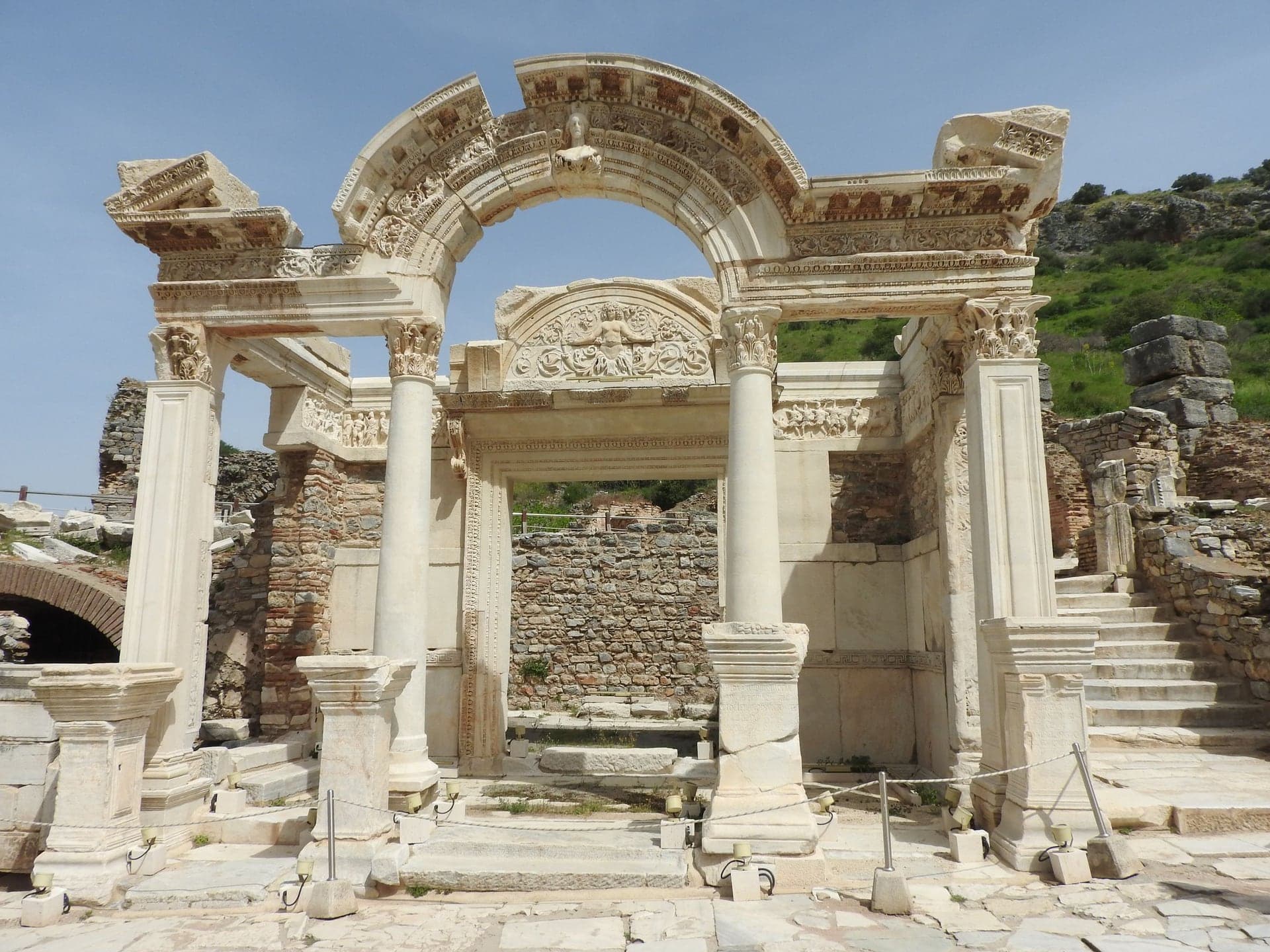
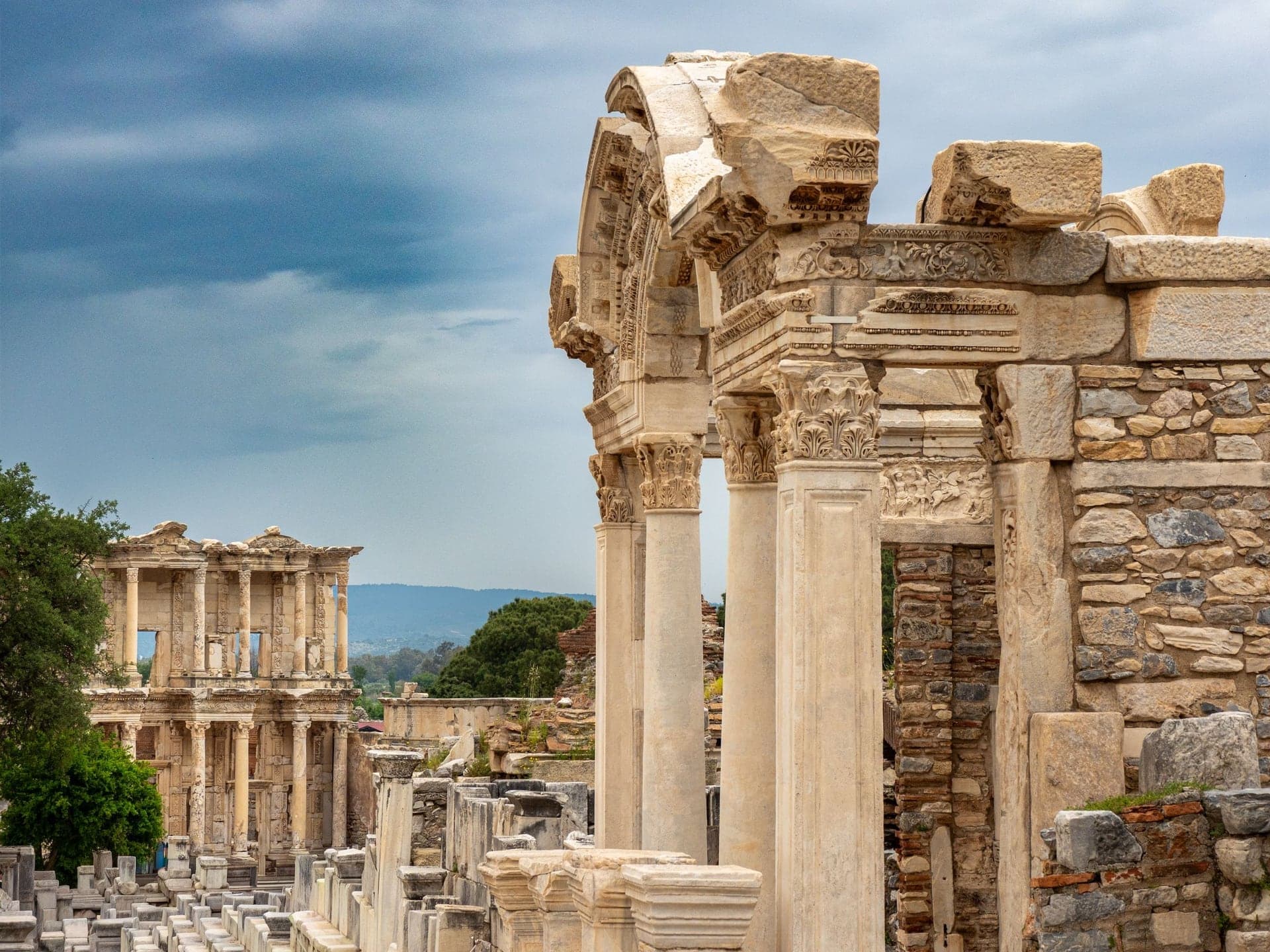
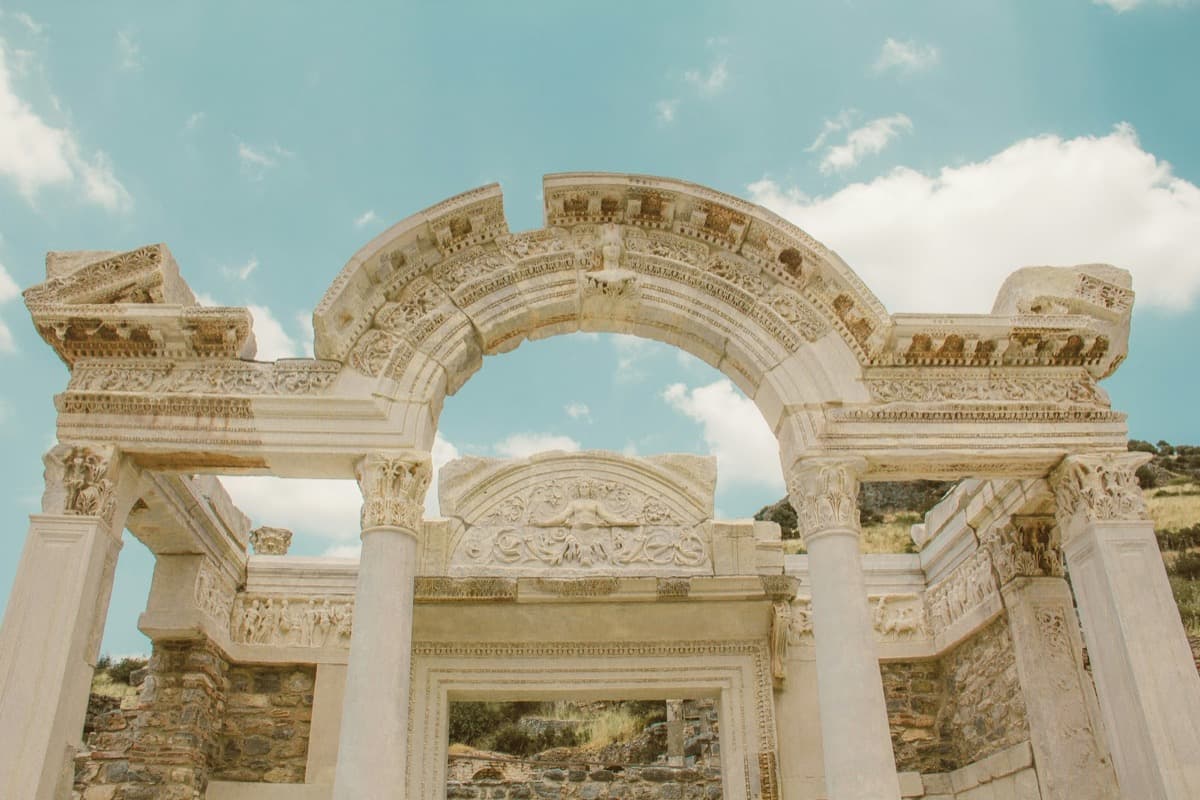
Temple of Hadrian: One Family's Gift
One family paid for this small temple porch. A goddess of fortune is carved on its arch, and the panels inside are copies.
- 6
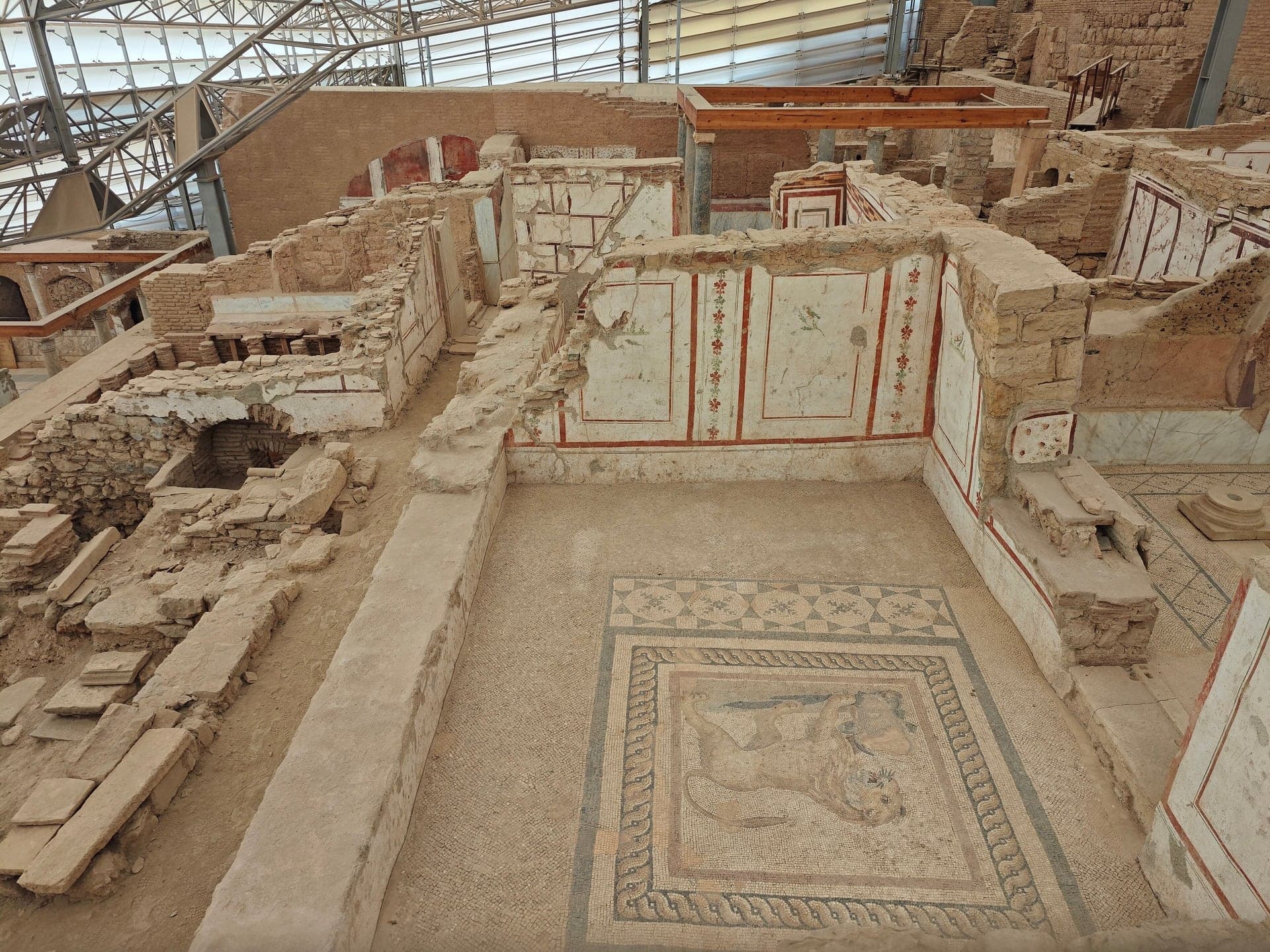
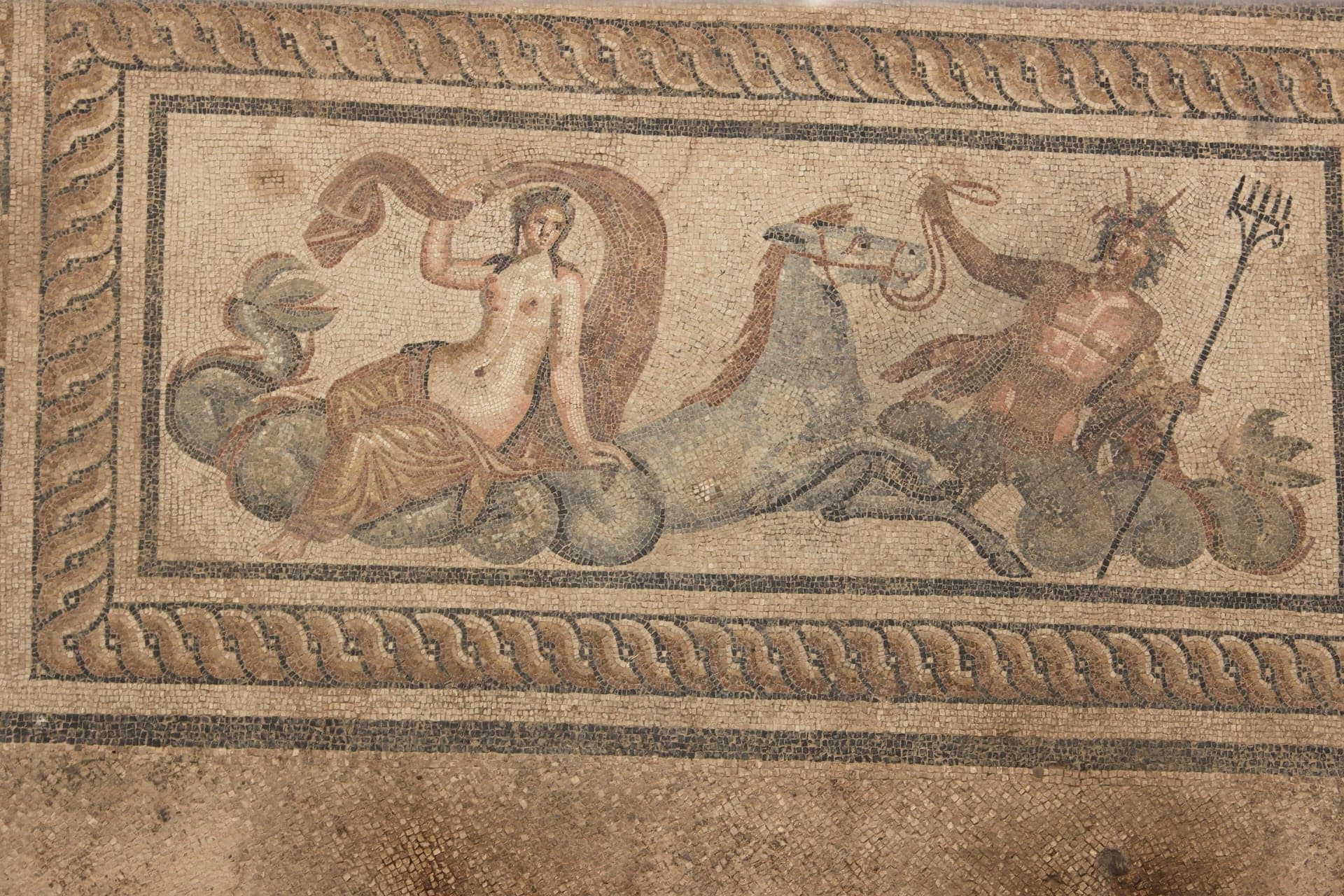
Terrace Houses: Seven Roman Homes Under One Roof
Seven Roman houses under one modern roof. Painted walls and mosaics were left where they were found; a separate ticket worth buying.
- 7
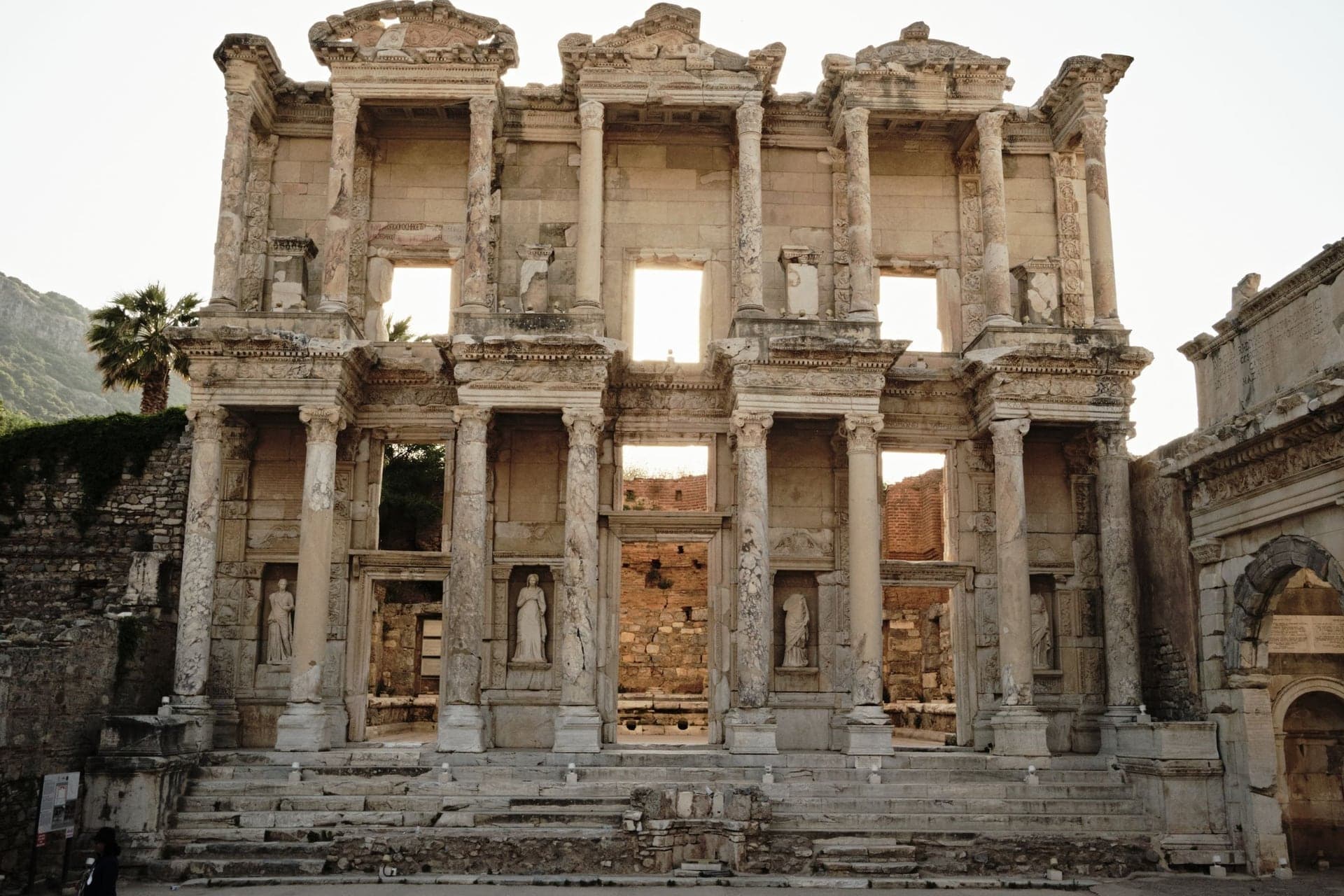
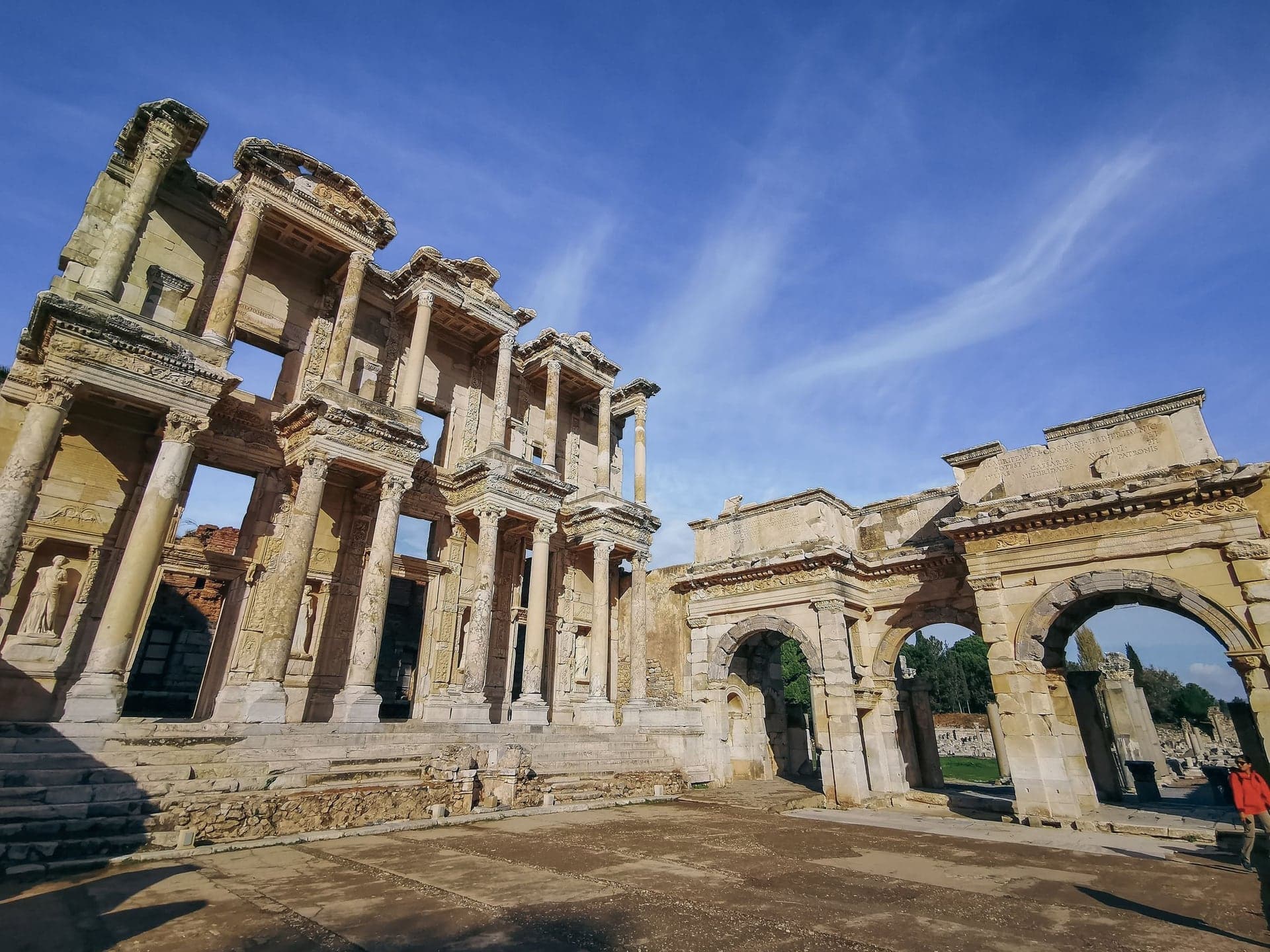
Library of Celsus: A Son's Monument, Stood Back Up
A son built this library front over his father's tomb. It was put back up from its own blocks in the 1970s.
- 8
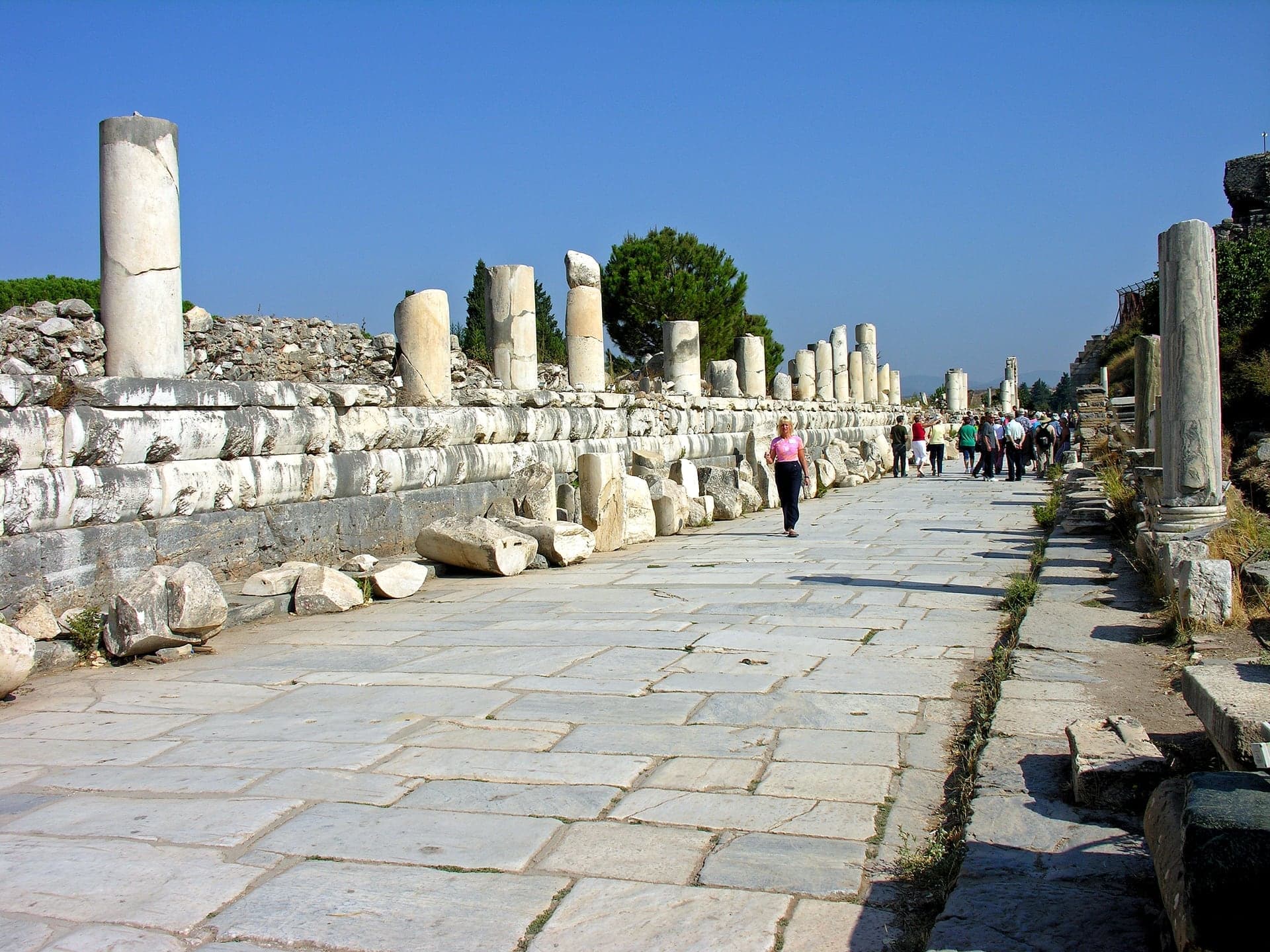
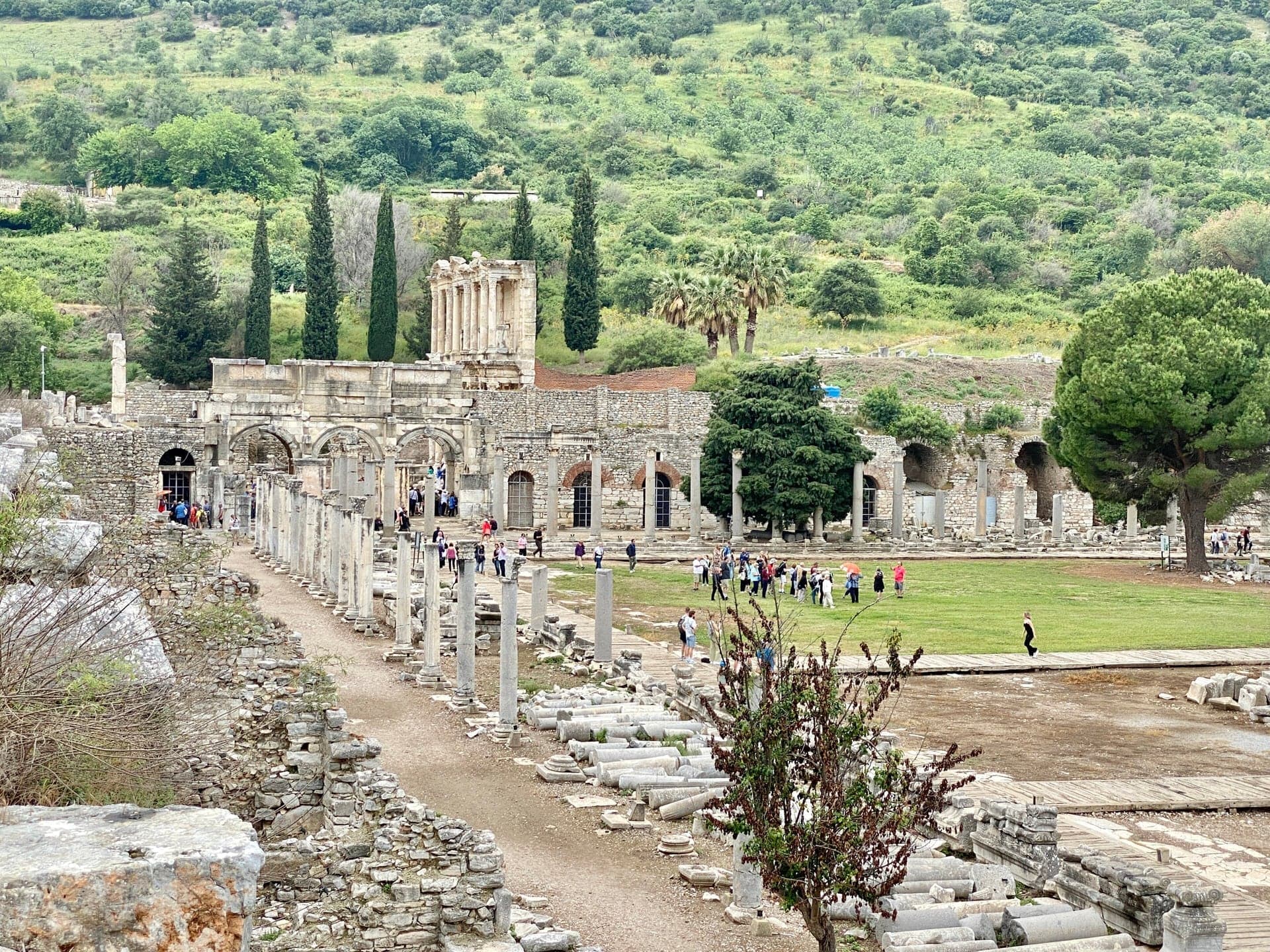
Commercial Agora: The Market Fed by the Sea
Shops lined this great market square. Its goods came up from the harbor, and the theater rises beyond.
- 9
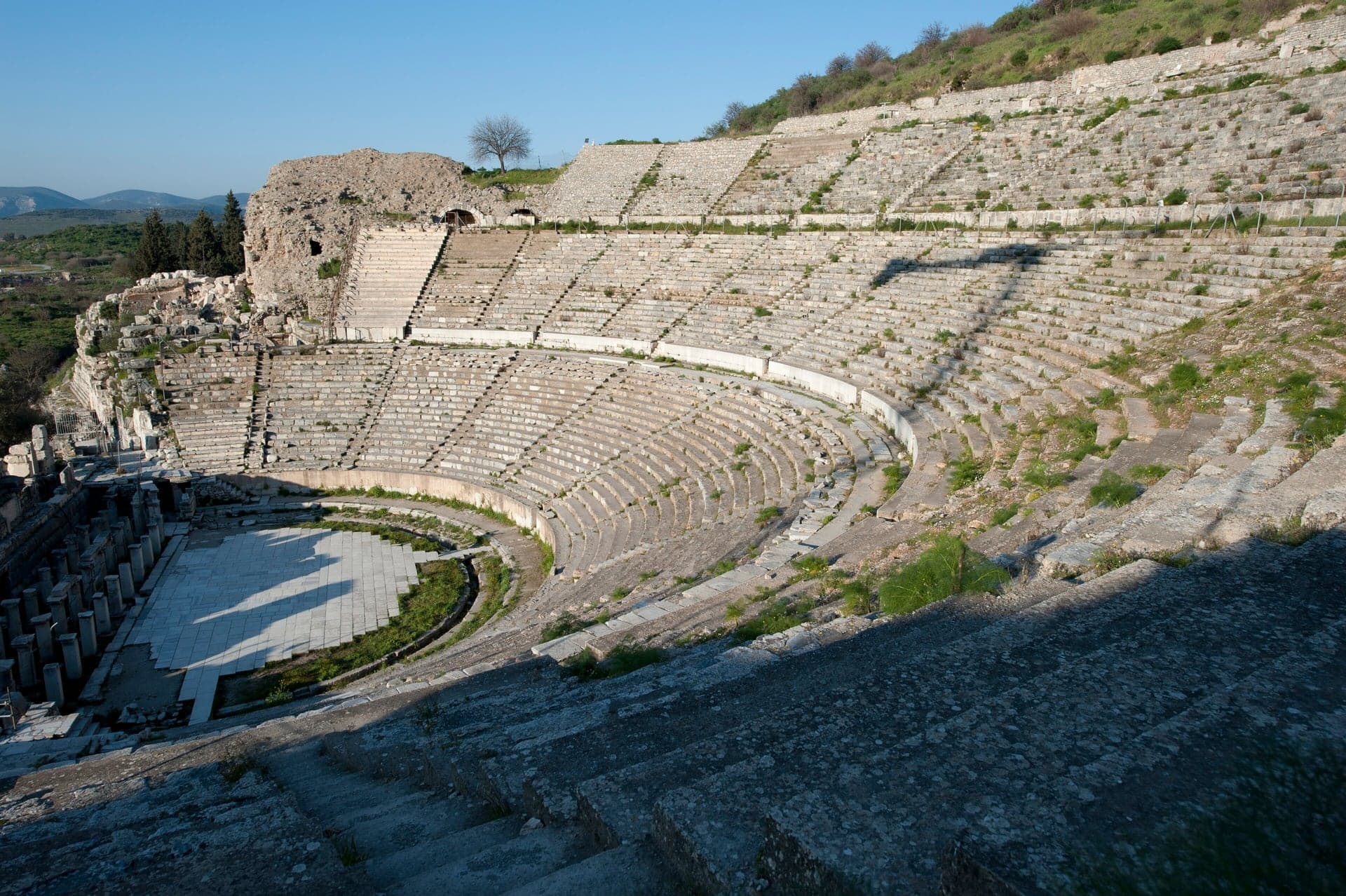
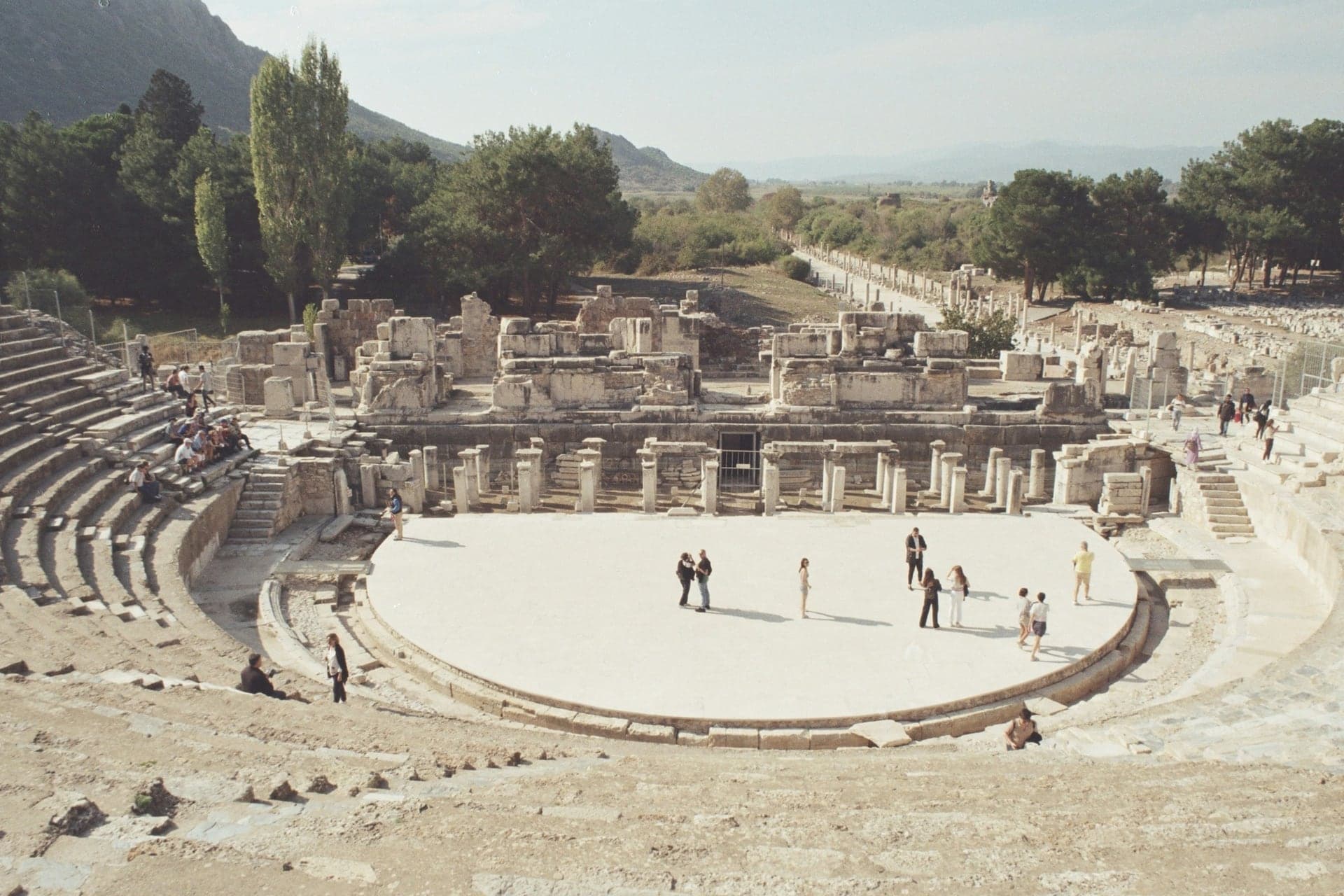
Great Theater: Great Is Artemis of the Ephesians
A theater for about twenty thousand people. The Book of Acts places a silversmiths' riot here.
- 10
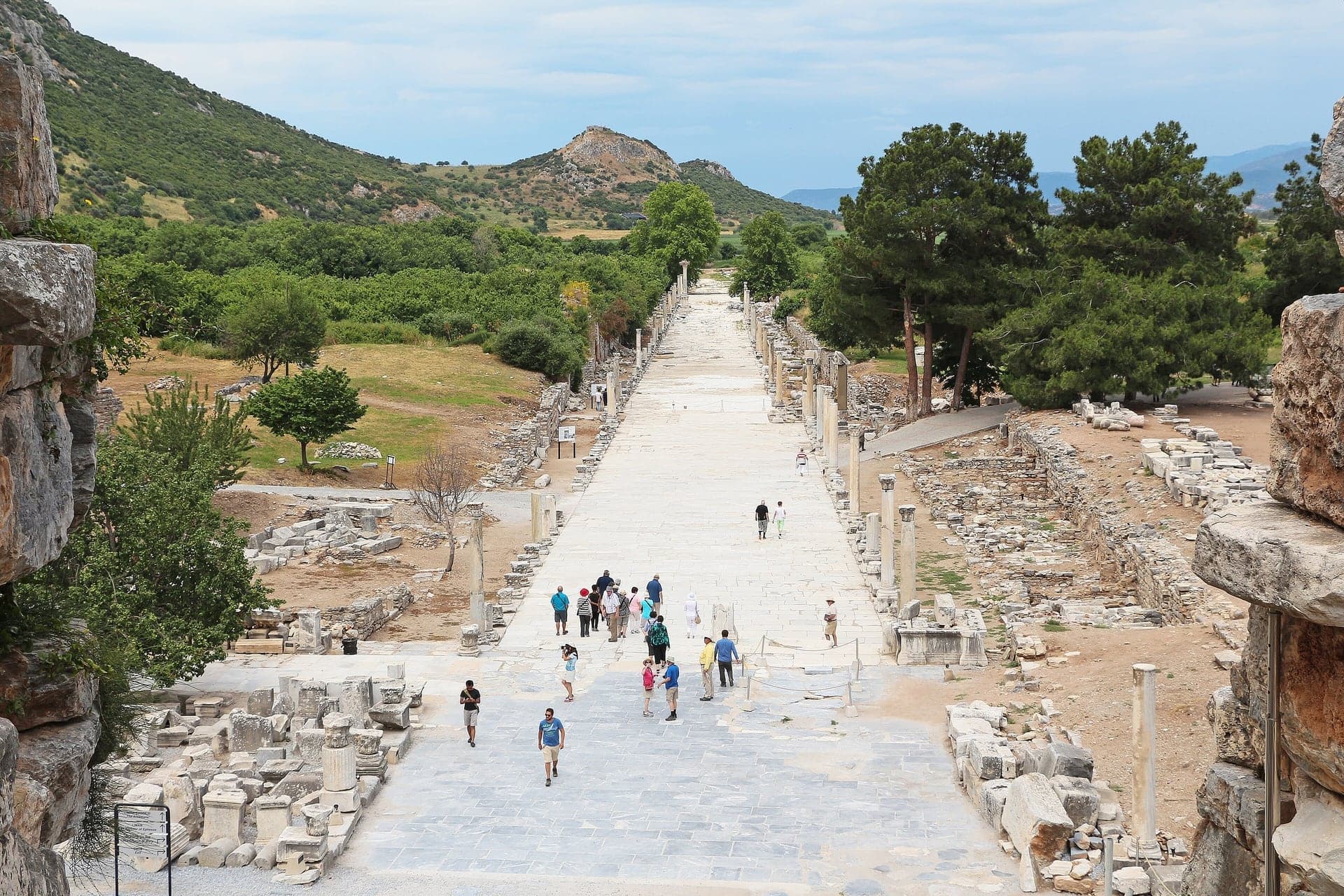
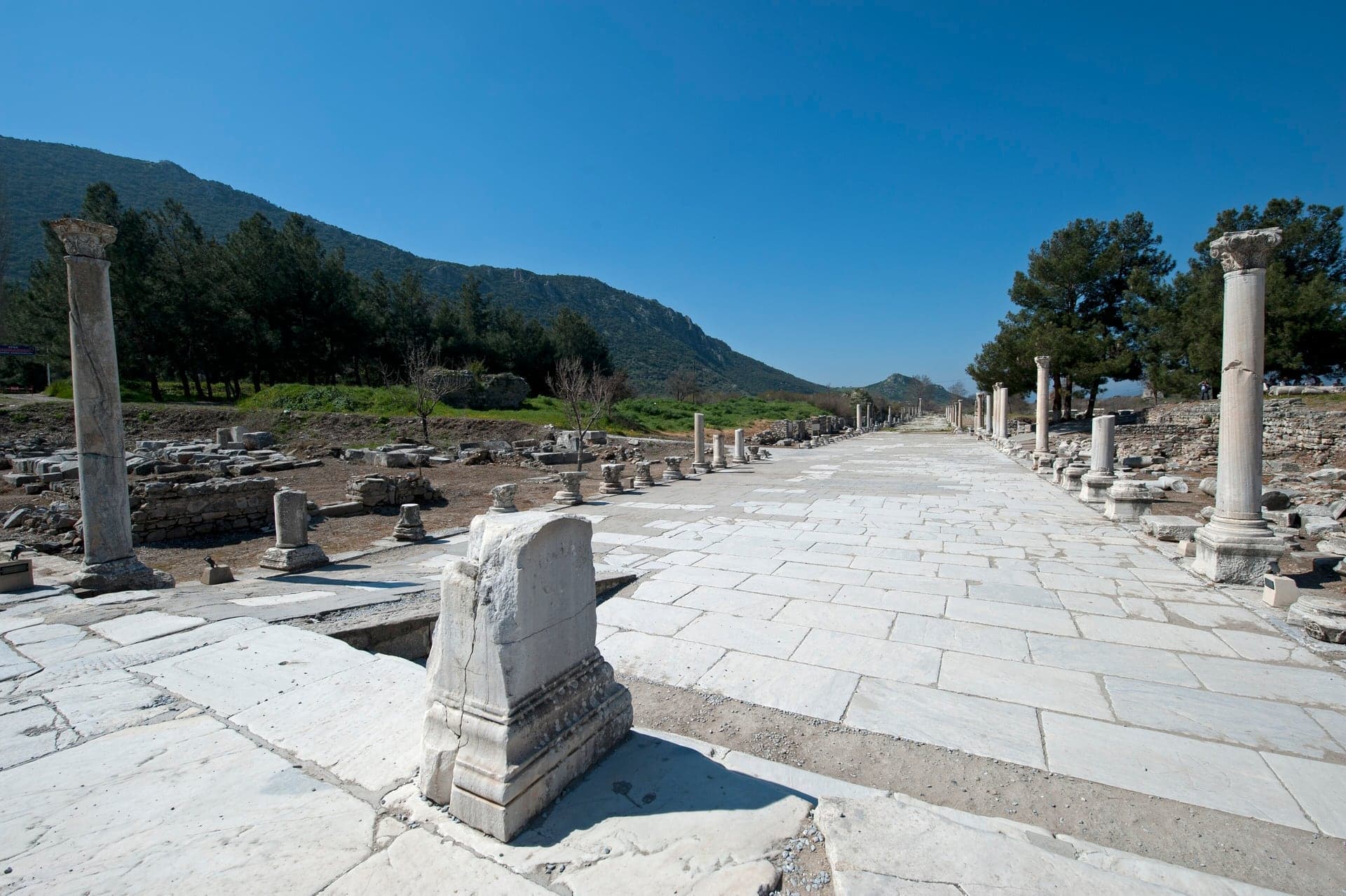
Arcadian Way: The Street to a Vanished Sea
The harbor street now runs toward fields. Silt pushed the coast miles away.
- 11
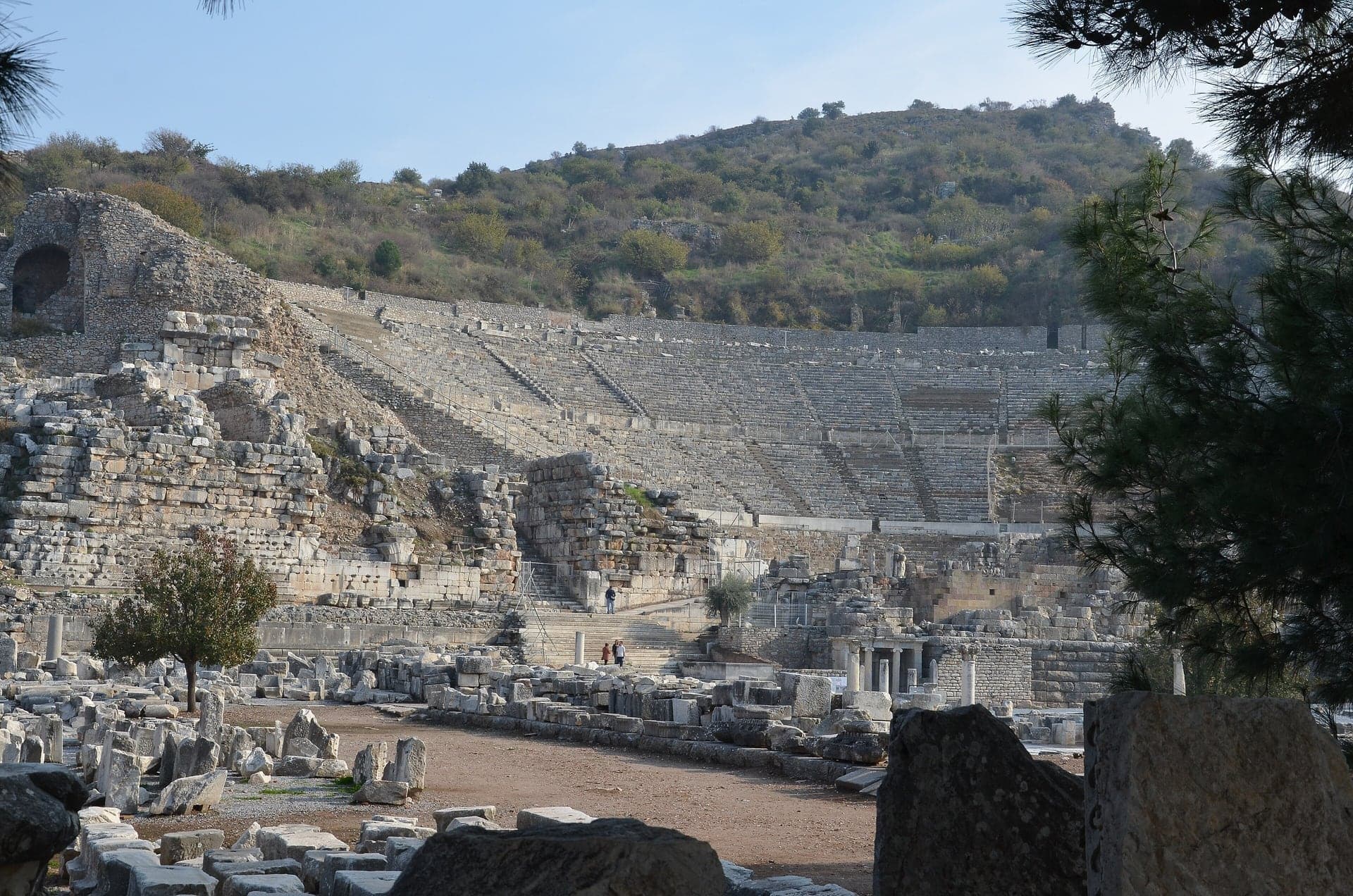
Theater Gymnasium and the Lower Gate: The Long Afterlife
A Roman gymnasium by the lower gate. The story closes with the city's long afterlife, from church councils to the excavators.
Details
Best Time to Visit
Come at opening time, 8:00, before the heat builds; the site is exposed and there is little shade until the tree-lined path at the very end. The Library of Celsus faces east, so its front is lit in the morning. In summer, the evening openings (see stop 1's card) are cooler. Checked 5 October 2026.
Pro Tips
- •This walk runs downhill from the upper entrance to the lower entrance. If you arrive at the lower entrance, take a taxi up to the upper entrance first, then walk down and leave by the lower one.
- •Play the introduction before the ticket check or in your first minute inside: the first stop starts about thirty meters past security.
- •If you plan to see the Terrace Houses, buy that separate ticket (€15, checked 5 October 2026) at their own entrance on Curetes Street; it is worth the time.
- •Many originals from this walk are in the Ephesus Museum in Selçuk: the frieze panels from the Temple of Hadrian, the two statues of Artemis found in the town hall, the statues from the Fountain of Trajan, the Resting Warrior from the Pollio fountain, and the statues of Augustus and Livia. It is open every day 08:30 to 17:30, ticket office until 17:00 (checked 5 October 2026).
- •The four statues on the Library of Celsus are copies; the originals are in the Ephesos Museum in the Neue Burg, Vienna.
- •The Cave of the Seven Sleepers is a little over a kilometer from the lower entrance. It is not on this walk; check locally whether it is open before you go.
- •Your site ticket also covers the Ephesus Experience Museum (checked 5 October 2026).
Safety & Precautions
- •The site is exposed, with almost no shade, and the marble paving of Curetes Street is worn, uneven and slippery. Wear flat shoes with grip, a hat and sunscreen, and carry water.
- •Stay on the paths and walkways. Never climb on the ruins or step past ropes; many areas are closed to visitors.
- •Visitor reports from February to June 2026 say the Great Theater's seating and Marble Street (from the library to the theater) have been closed for restoration since April 2025, with visitors routed through the Commercial Agora (checked 5 October 2026). This walk is written to work from the theater square either way.
- •The Library of Celsus is under conservation planned to run to the end of 2027, so part of its front may be behind scaffolding.
- •Most of the Arcadian Way beyond its open end near the theater is roped off; the walk looks down it rather than walking it.
- •The route has no steps, but Curetes Street is steep and rough-paved, which is hard going for wheelchairs and strollers.
- •Opening hours change with the season; check the official page for winter hours before you go.
Travel advisory: Exercise Increased Caution (Level 2).
Gallery
Related Reading
Go deeper on what you'll see, hear, and walk through.
Overview
Best Self-Guided Walking Tours in Selcuk (Ephesus) (2026)
3 min
Overview
One Day in Selcuk and Ephesus: A Walkable Morning-to-Evening Itinerary
7 min
Overview
Selcuk and Ephesus Travel Guide: Days, Transport, Costs, Safety
7 min
Thematic
Best History Walking Tours in Selcuk (Ephesus) (2026)
2 min
Thematic
Selcuk: The Afterlife of Ephesus
8 min
Companion
Curetes Street: How to Read the Whole Marble City of Ephesus
7 min
Deep dive
The Library of Celsus: A Tomb Dressed as a Library
7 min
Read
What to Eat in Selcuk (Ephesus)
6 min
Read the walk
The full story of Ephesus: The City That Rebuilt Itself, in words. Prefer to listen? Play it narrated, from home or on location.
Introduction
Ephesus lies in the hills near the Aegean coast of Turkey, just outside the town of Selçuk. Under Rome it was the capital of the province of Asia, a port city of marble streets, fountains and temples. It was also knocked down again and again by earthquakes and war, and each time its people built it back up from whatever lay to hand: old columns, old carvings, old inscriptions, set into new walls. Keep an eye out for pieces that do not quite match.
Three people turn up along the way. Celsus, a Roman senator, and his son Aquila, who built a library over his father's grave. Varius, a wealthy citizen who paid for a small temple with his wife and daughter. And Demetrius, a silversmith who, the Book of Acts says, filled the theater with an angry crowd.
There are eleven stops over about three quarters of a mile, a little over a kilometer, and the walk takes about an hour and a half at an easy pace. It starts just inside the upper entrance, after the ticket check, and runs downhill all the way to the lower entrance, so there is no climbing back. The whole site is ticketed. The Terrace Houses, about halfway down, are a separate ticket, and well worth it.
1. Upper Gate and State Agora: A City Moved by Flood
Welcome to Ephesus. One thing first: your site ticket covers everything on this walk except the Terrace Houses, and the details are on this stop's card.
Walk on along the boardwalk and stop where the ground opens out beside you into a wide, flat square of grass and scattered stone. This was the State Agora, the government end of the city. Ephesus had two great squares: this one, up the hill, for the council, the officials and public ceremony, and a market square down at the bottom, fed by the harbor. You are going to walk from one to the other, downhill all the way.
Along the side of the square nearest the path ran a long covered hall, two stories high, built in the year eleven AD and paid for by a local benefactor. Statues of the emperor Augustus and his wife Livia stood in it. They are now in the Ephesus Museum in Selçuk. Behind that hall stood the council house and the town hall, which come next.
Why is the city up here at all? Around two hundred and ninety BC, the king Lysimachus built a wall around this site. The geographer Strabo says the people did not want to move into it, so the king waited for a downpour, blocked the drains and flooded them out of their old homes. He named the new city after his wife, Strabo adds, but the old name won.
So Ephesus had moved before, and this is the move that stuck. Look at the stone around you as you go: blocks reused, columns patched, walls built and built again. That habit starts here.
Follow the route along the edge of the square. Next, a small roofed theater where the city council met.
2. Odeon and Prytaneion: Council House and Town Hall
Walk on along the path until curved rows of stone seats rise right beside it, and stop there.
This is the Odeon, a small roofed theater that served as the city's council house and as a concert hall. The seats climb the foot of the hill in a half circle, and a roof once covered the whole thing. Around one hundred and fifty AD a wealthy couple paid for a new stage building, and an inscription records the gift. It held an estimated fourteen hundred people.
Just ahead, beyond the Odeon, stood the Prytaneion, the town hall, seat of the city's executive. Inscriptions suggest it also kept the city's sacred hearth, the fire of the goddess Hestia. Look for the two plain columns standing there, smooth, without the vertical grooves that many columns here carry. They are covered in lines of carved lettering. Much of it is lists of priests called the Curetes. They were a real priestly college, and the geographer Strabo says they held feasts and performed secret sacrifices at one of the city's festivals.
Those columns have been on a journey. Late in the fourth century, builders took parts of the town hall and reused them, in a bath house and along the main street below. Archaeologists found the pieces there and carried them back up here in the late nineteen fifties. Keep the Curetes in mind when you reach that street.
The town hall gave up something else. In nineteen fifty-six the excavators found two marble statues of Artemis of Ephesus here, the goddess the whole city honored. Both are now in the Ephesus Museum in Selçuk.
Follow the route on down the hill. Next, a winged Victory, the hero Hercules, and a monument rebuilt to look deliberately modern.
3. Gate of Hercules: Old Carvings in a Newer Gate
Walk on down the paved slope and stop above the point where the street begins to drop, beside a jumble of carved marble blocks set in rough gray concrete.
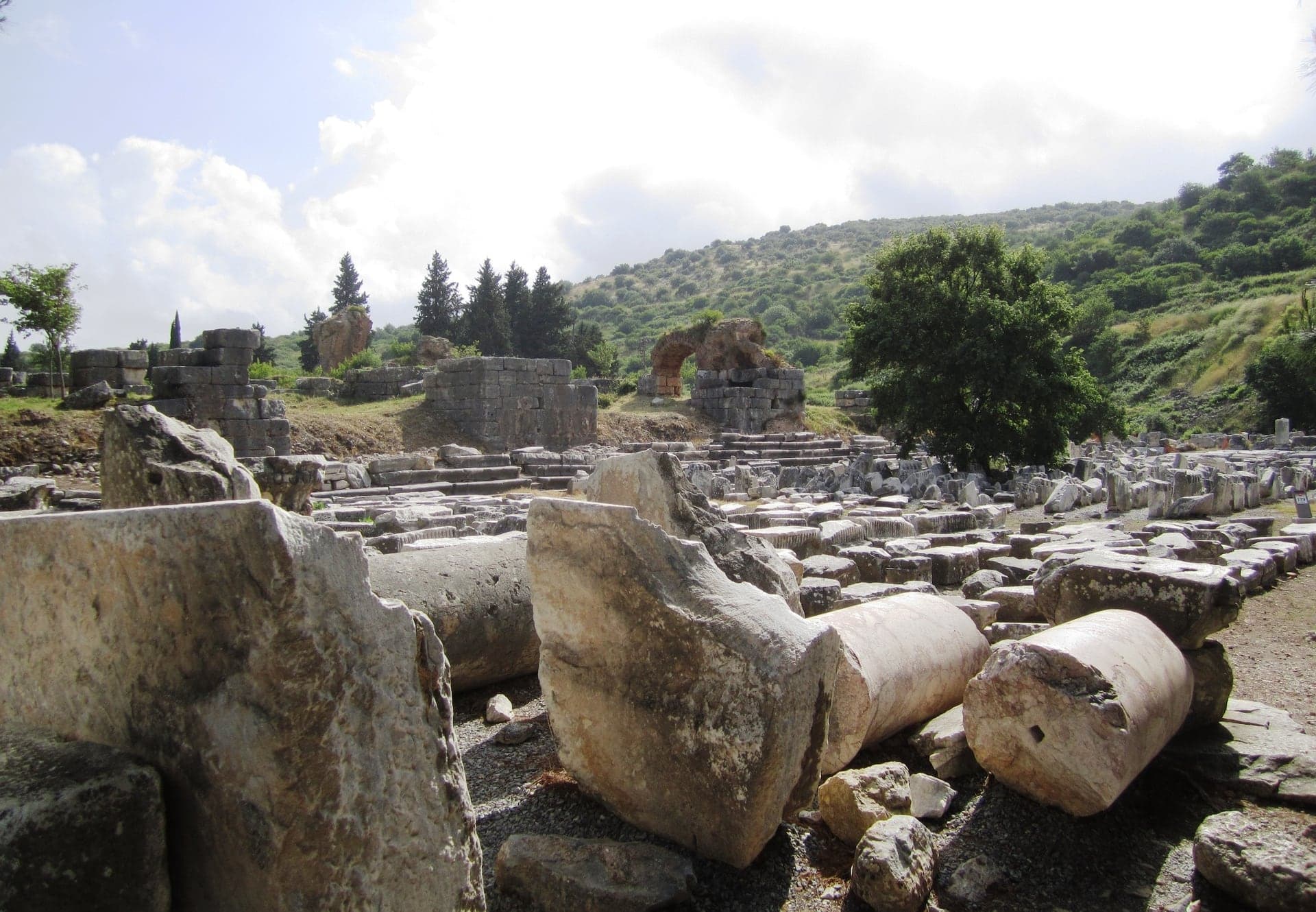
That jumble is on purpose. It is the Memmius Monument, put up a few decades before Christ for Gaius Memmius, a grandson of the Roman dictator Sulla. When it was rebuilt in modern times, nobody tried to fake an ancient building. The original carved pieces were set in raw concrete in plain geometric shapes, not in their old positions, and the new parts make no attempt to look old. Remember that gray concrete. A great deal of what you will see today was put back up in the twentieth century, and few pieces admit it so openly.
Just ahead, look for a carved panel of a winged woman holding out a wreath. She is Nike, the goddess of Victory, carved in the first or second century AD. Long afterward she was reused on the arch of a gate. That gate stood a little further down, where you can see two pillars carved with Hercules wearing his lion skin, the same figure twice, in mirror image. Those reliefs are older work too, reused in late antiquity in a gate that narrowed the street so that wagons could not get through.
Across the path from the concrete, the broad open square takes its modern name from the emperor Domitian, whose temple stood on its far side, a temple for the emperors' cult built for the whole province. Much later, in about six hundred and fifteen, a sudden fire swept through shops on that square during an attack. Excavators found arrowheads, around six hundred pilgrim flasks, and the coins still lying in the tills.
Follow the route down the street, between the pillars of Hercules. Next, the main street and an emperor's fountain.
4. Curetes Street: An Emperor Reduced to a Foot
Walk on down the marble street and stop opposite a tall two-story frame of columns at the street's edge, with a big stone base in front of it. Stay here while this plays.
You are on Curetes Street, the main axis of the city, cutting at an angle down the saddle between two hills. The name is modern. Archaeologists gave it, because column drums reused along the street were carved with lists of the Curetes, the same priests named on the columns up by the town hall. In ancient times the street was most likely called the Embolos.
Look down at the paving: big marble slabs, worn and uneven. A drain runs beneath them, carrying water down the hill. Colonnades once lined the street, with statues on inscribed bases, and many of those bases are still standing.
The excavators say the buildings along this street were damaged again and again and refurbished each time. Between the fifth and sixth centuries, damaged buildings on the lower part of the street were turned into grand public fountains.
The frame in front of you is the Fountain of Trajan, built early in the second century and dedicated to Artemis and to the emperor Trajan. A colossal statue of Trajan stood above the water outlet, one foot resting on a globe. Find the base: what is left of him here is that foot and the ball beneath it. Other statues from the fountain are in the Ephesus Museum in Selçuk. The fountain was dug out in nineteen fifty-eight and partly put back up in nineteen sixty-two, and the frame you see is smaller than the original.
Follow the route on down the street. Next, a small temple paid for by one family.
5. Temple of Hadrian: One Family's Gift
Walk on and stop in front of a small temple porch with an arch rising into its pointed roof. Stay here for this one. This is the Temple of Hadrian. Its inscription says a citizen named Varius built it from the foundations, statue and all, at his own expense, together with his…
Full narration for this stop unlocks with the tour.
6. Terrace Houses: Seven Roman Homes Under One Roof
Walk on and stop opposite the entrance to the Terrace Houses, under the big modern roof that climbs the slope across the street from the temple. This is a separate ticket from the site ticket, and it is worth it. The details are on this stop's card. Stay here while this…
Full narration for this stop unlocks with the tour.
7. Library of Celsus: A Son's Monument, Stood Back Up
Walk on to the foot of the street, where the two-story marble front of the Library of Celsus fills the view, and stop in the open square before its steps. Celsus was a Roman senator who served as consul and later as governor of the province of Asia. After his death, his son…
Full narration for this stop unlocks with the tour.
8. Commercial Agora: The Market Fed by the Sea
Walk on through the gateway and along the wooden walkway, and stop out in the market square. The gateway you just came through was the market's entrance from the library square, so you arrived the way shoppers did. This was the Commercial Agora, the city's market, a square…
Full narration for this stop unlocks with the tour.
9. Great Theater: Great Is Artemis of the Ephesians
Walk on out of the market and stop in the open square in front of the theater's stage building. Look up at the seats. They climb the hillside in a huge half bowl, nearly five hundred feet across. The Austrian excavators date the start of building to the second century BC. It…
Full narration for this stop unlocks with the tour.
10. Arcadian Way: The Street to a Vanished Sea
Walk on to the head of the long, straight street that runs away from the theater, and stop where you can look straight down it. This is the Arcadian Way, the city's harbor street, about a third of a mile long and nearly forty feet wide, lined with colonnades and shops. Its…
Full narration for this stop unlocks with the tour.
11. Theater Gymnasium and the Lower Gate: The Long Afterlife
Walk on along the tree-lined path and stop beside the open ground of the Theater Gymnasium. This was a gymnasium of the second century AD. Its open exercise court faced the harbor street, and its bath wing still lies mostly unexcavated beneath the ground. Ephesus did not end…
Full narration for this stop unlocks with the tour.