Ephesus: The City That Rebuilt Itself
90 min · 1.2 km · moderate
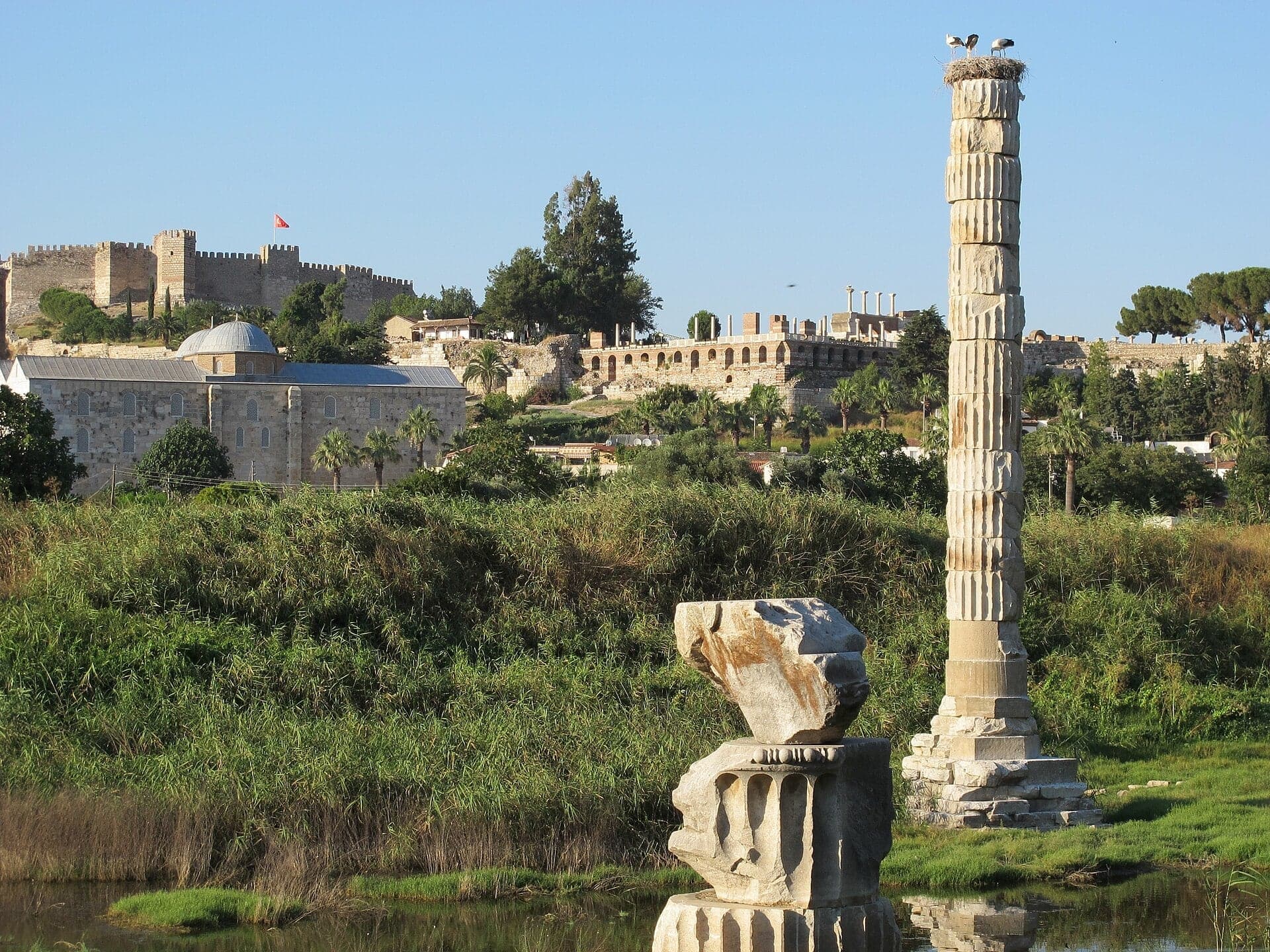
Selcuk inherited the afterlife of Ephesus, and to walk it is to trace how a great classical city drained away and climbed a hill to survive. Down on the plain lies the marble metropolis of Ephesus, once one of the largest cities of the Roman east, with a council house, terraced mansions, a monumental library, and a theatre for about twenty thousand. Above the town rises Ayasuluk hill, crowned by a fortress and the basilica of Saint John. In a marshy field between them stands a single re-erected column, all that is left of the Temple of Artemis, one of the seven wonders of the ancient world. The through-line that unites both of our Selcuk (Ephesus) walking tours is displacement: the water left, the city moved uphill, and the town you actually walk today was built in part from the older places' own stones.
The city that was built to face the sea
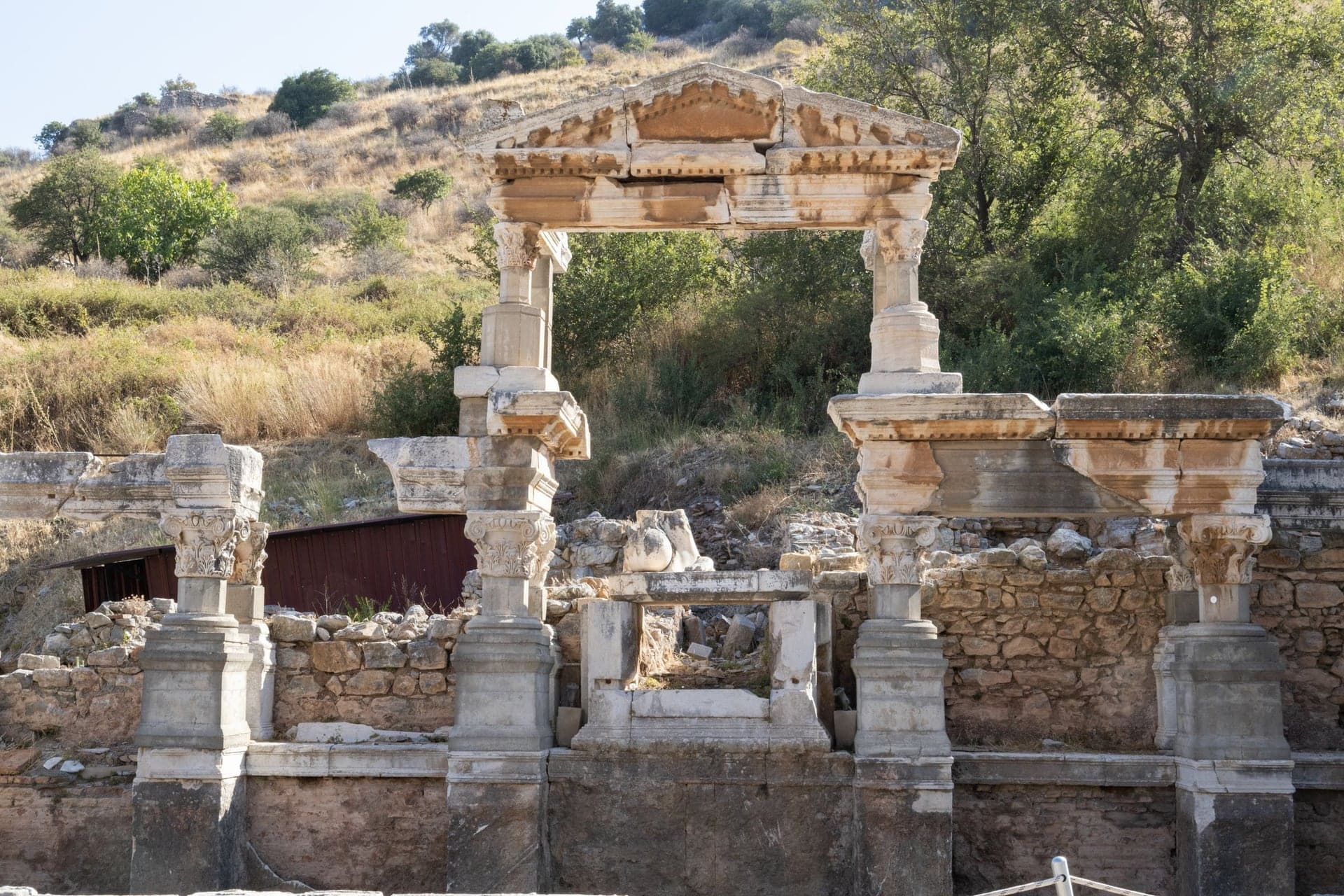
Ephesus was engineered as a downhill machine. On Ephesus: The City That Rebuilt Itself you begin at the top, in the State Agora, where the council met in the roofed Odeon (also called the Bouleuterion) and the Prytaneion kept the city's sacred hearth. From that civic brain the marble streets run down. Curetes Street, a name archaeologists gave it, slopes down over worn and rutted marble, lined once with shops, fountains, and monuments. It descends past the small carved porch of the Temple of Hadrian, paid for by a citizen named Varius with his wife and daughter and dedicated jointly to Artemis, to the emperor, and to the people of the city.
Halfway down, a modern roof shelters the Terrace Houses, the homes of the rich. The block you can visit, Terrace House 2, holds seven elite homes on terraces up the slope, built in the early first century A D and lived in until an earthquake in the later third century. Its floor mosaics and wall paintings were left where they were found, along with marble panelling, fountains, and underfloor heating that warmed the rooms from below. It is the private counterpart to the public grandeur outside.
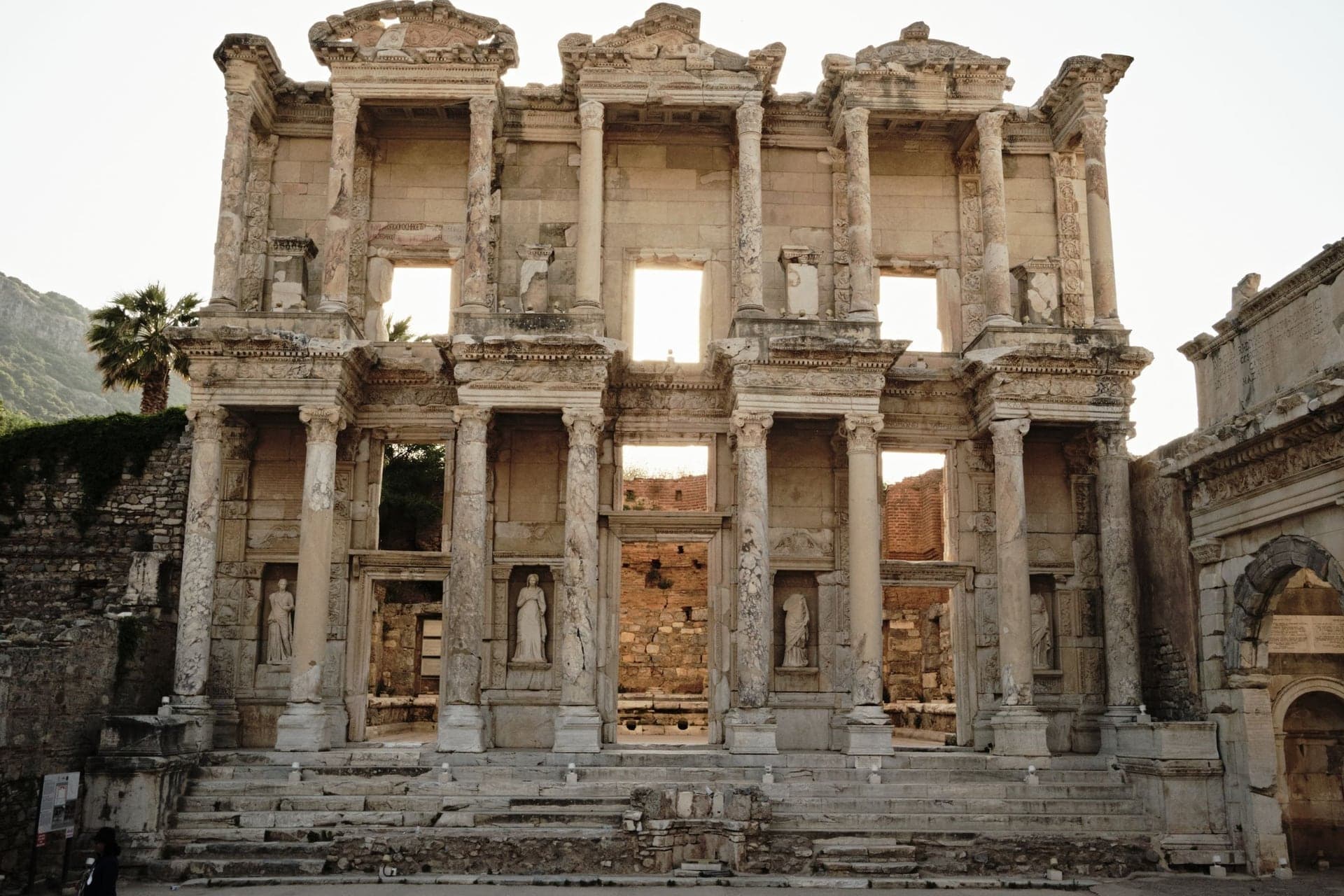
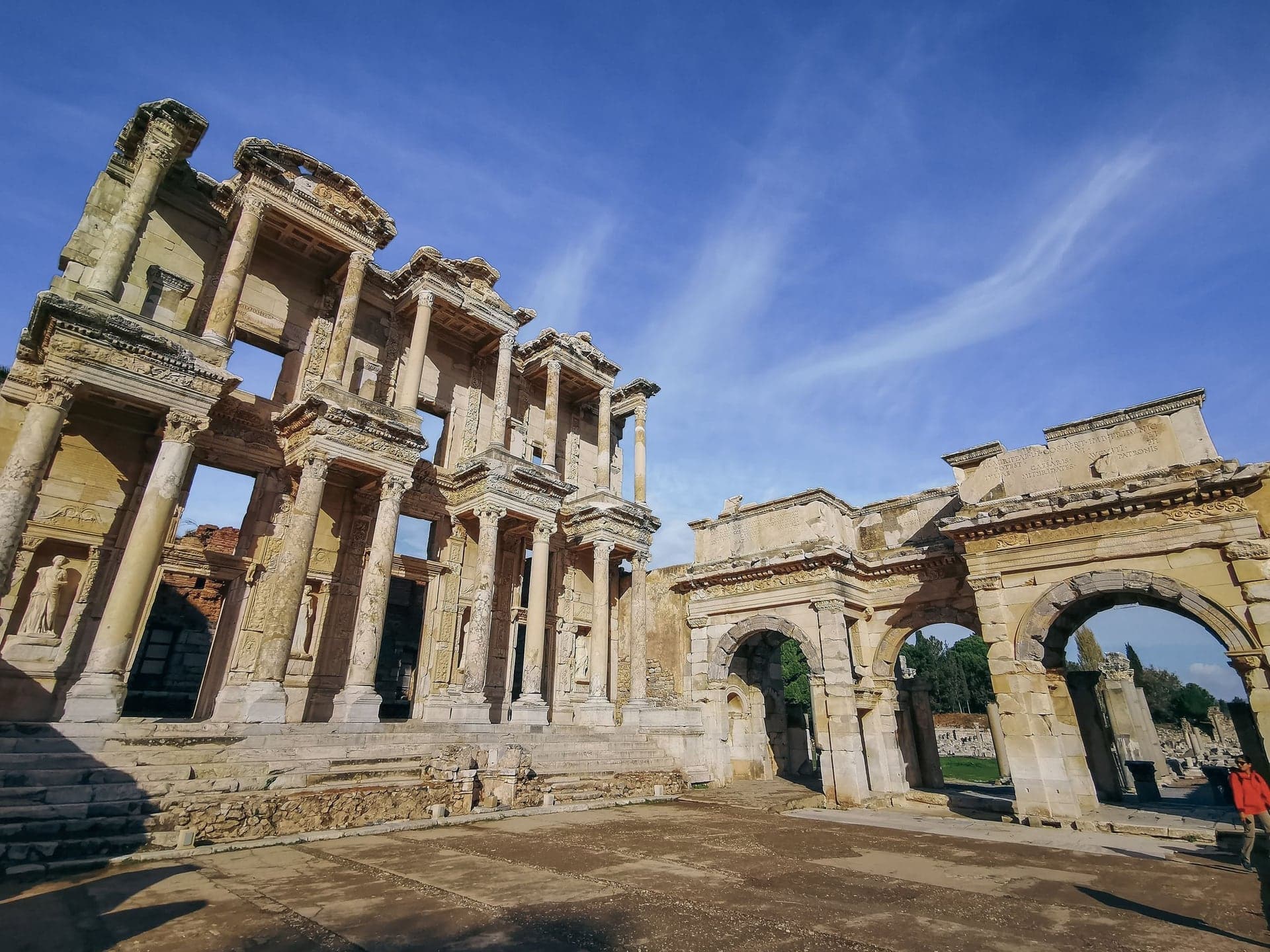
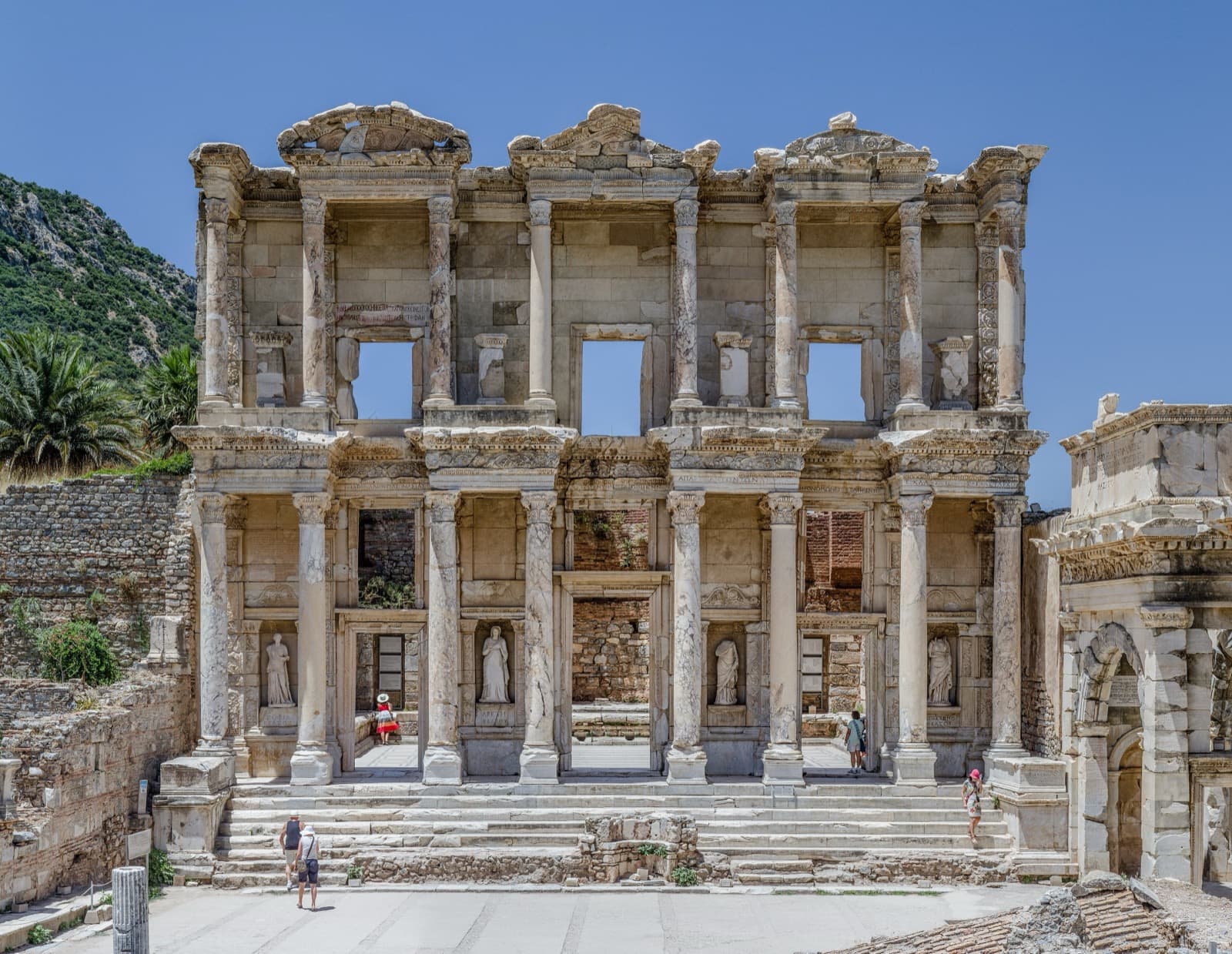
At the foot of the street stands the image everyone carries away: the two-storey marble facade of the Library of Celsus. It is richer than it looks, because this library is also a tomb. His son Aquila raised it in the early second century A D for his father, the senator Tiberius Julius Celsus Polemaeanus, who lies buried in a chamber beneath the building. Its four facade statues, copies of the originals in Vienna, stand for wisdom, excellence, and knowledge, all three labelled with Celsus's name, and for inspiration, labelled for a later donor named Philippus. The facade you see was reassembled from collapsed fragments by anastylosis between nineteen seventy and nineteen seventy-eight, by the Austrian architect Friedmund Hueber with Volker Michael Strocka.
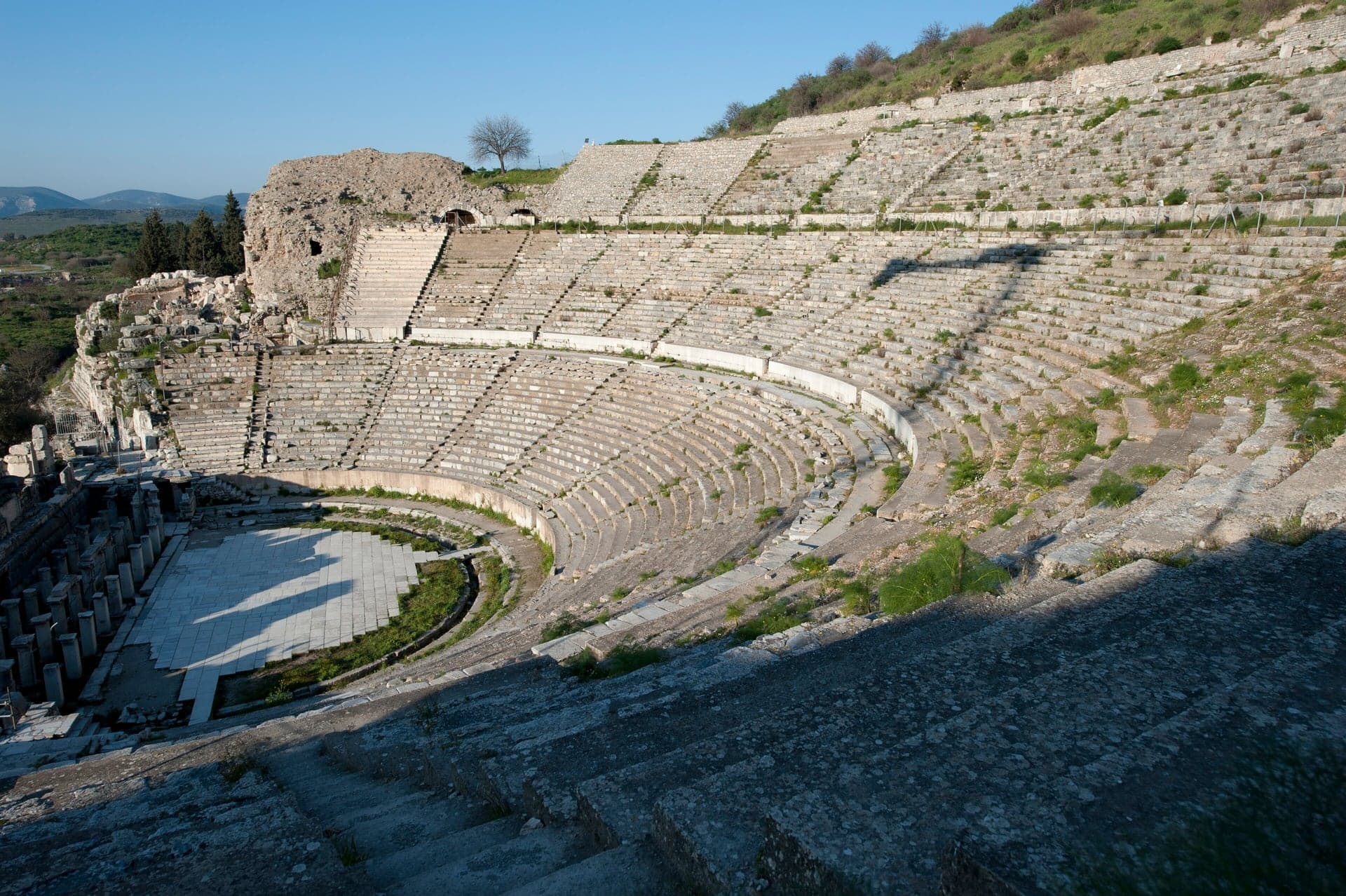
Beside the library opens the Commercial Agora, the square market, entered through the triple Gate of Mazeus and Mithridates, dedicated in four to three B C to the emperor Augustus. The gate was funded by two freed slaves of the emperor's family, who dedicated it to their patrons. Above it, cut into the slope of Mount Pion, is the Great Theatre, seating about twenty thousand, one of the largest in Asia Minor. The Book of Acts sets here the riot of the silversmiths led by Demetrius against the Apostle Paul, the crowd shouting "Great is Artemis of the Ephesians," while Paul's friends kept him out of the theatre. It is the moment the old religion and a new faith collided in public.
The harbour that silted, the road that points at nothing
Hear a stop from this walk
Theater Gymnasium and the Lower Gate: The Long Afterlife
The whole descent ends at the Arcadian Way, a colonnaded avenue more than five hundred metres long that once ran arrow-straight from the theatre to the harbour. Rebuilt around four hundred A D under the emperor Arcadius, it had fifty oil lamps along its colonnades, according to a sixth-century inscription. And now that lamp-lit road points at empty ground. The Kucuk Menderes river, the ancient Cayster, carried silt into the bay year after year until the coast lay five or six kilometres away and marsh took its place. Silt cut the city off from its sea. The great port was left stranded inland, and only a smaller harbour further west kept working.
That vanished harbour is where the second walk picks up the story.
When the greatest monuments are absences
Temple of Artemis and Ayasuluk Hill: Where Ephesus Went is a walk about relocation, nine stops through the town from the Ephesus Museum to the field of the Temple of Artemis. It starts with the goddess: in the museum you meet the Great Artemis, nearly three metres tall under a crown shaped like a temple in three tiers, and the Beautiful Artemis, both found in nineteen fifty-six in the town hall of Ephesus, with four rows of rounded forms on the chest whose meaning scholars still debate.
Then the town shows where her temple went. The tall arches through the centre of Selcuk are a Byzantine aqueduct bridge, built between five hundred and forty-nine and five hundred and sixty-five A D by an engineer named Lazaros to carry water to the church on the hill, and its lower piers are made of blocks taken from the Temple of Artemis. Storks nest on them from mid-March to the end of August. The Isa Bey Mosque, dated by its inscription to thirteen seventy-five and built for Isa Bey of the Aydinid emirate by an architect named Ali of Damascus, is the theme made physical: its plan recalls the Great Mosque of Damascus, and most of the marble on its west facade came from the ruined temple. Above it the walls of the Ayasuluk Fortress crown the hill. In the seventh century, with the harbour of Ephesus unusable and disease spreading, the people settled on this hill. Ephesus did not vanish so much as move, uphill, to this hill.
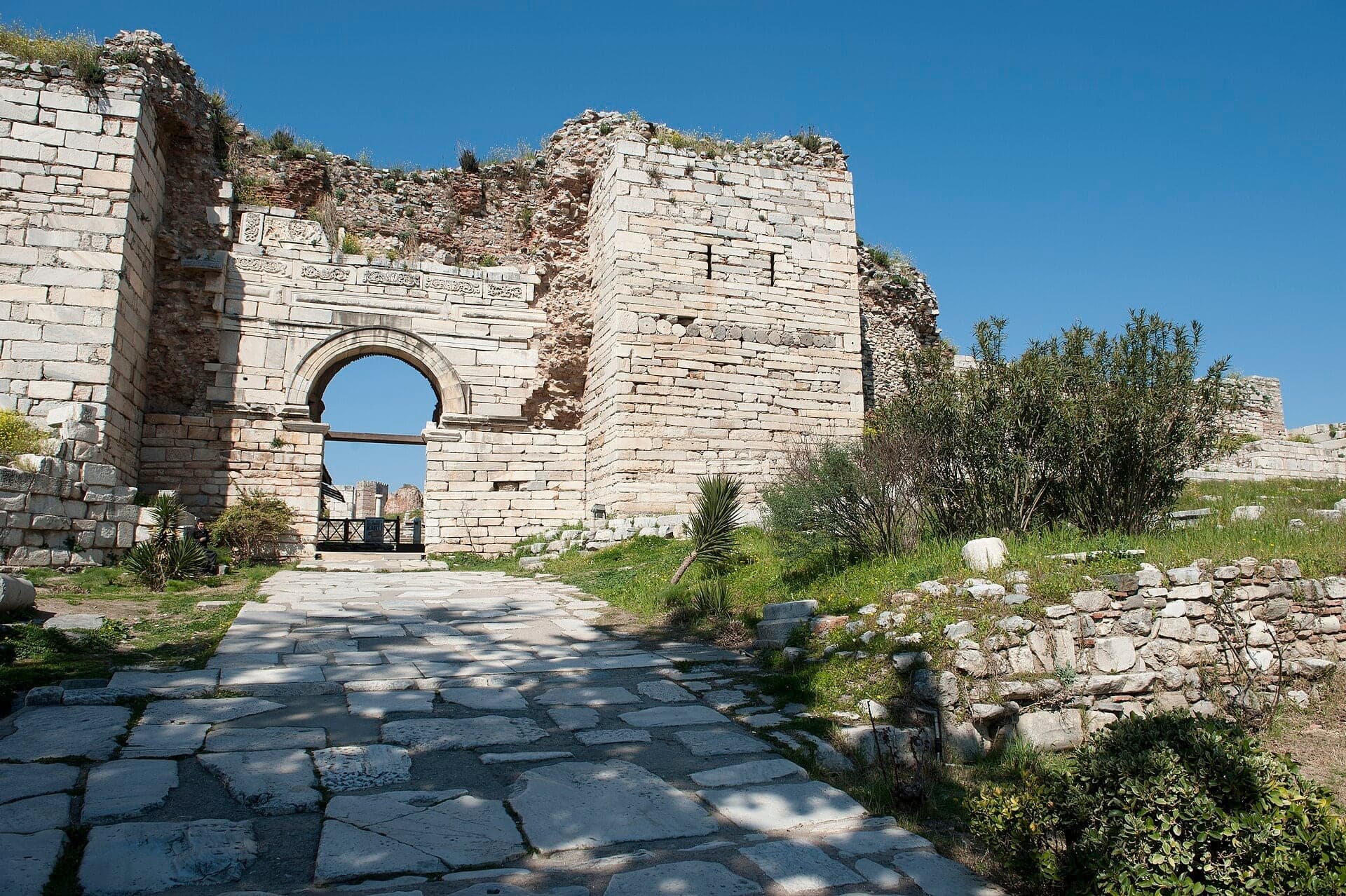
On the slope spread the wide foundations of the Basilica of Saint John, a domed cruciform church commissioned by the emperor Justinian, usually dated about five hundred and forty-eight to five hundred and sixty-five A D. The historian Procopius says Justinian made it so large and beautiful that it closely resembled his Church of the Holy Apostles in Constantinople. By church tradition Saint John the Evangelist was buried on this spot, and the grave still marks the crossing of the plan. The monograms of Justinian and the empress Theodora survive on some of its capitals. The walk reaches it at the Gate of Persecution, whose reused Roman sarcophagus reliefs of the Trojan War were later taken for a Christian martyrdom. After the Turkish conquest the church became a mosque, then a ruin, now partly re-raised.
The town that never emptied
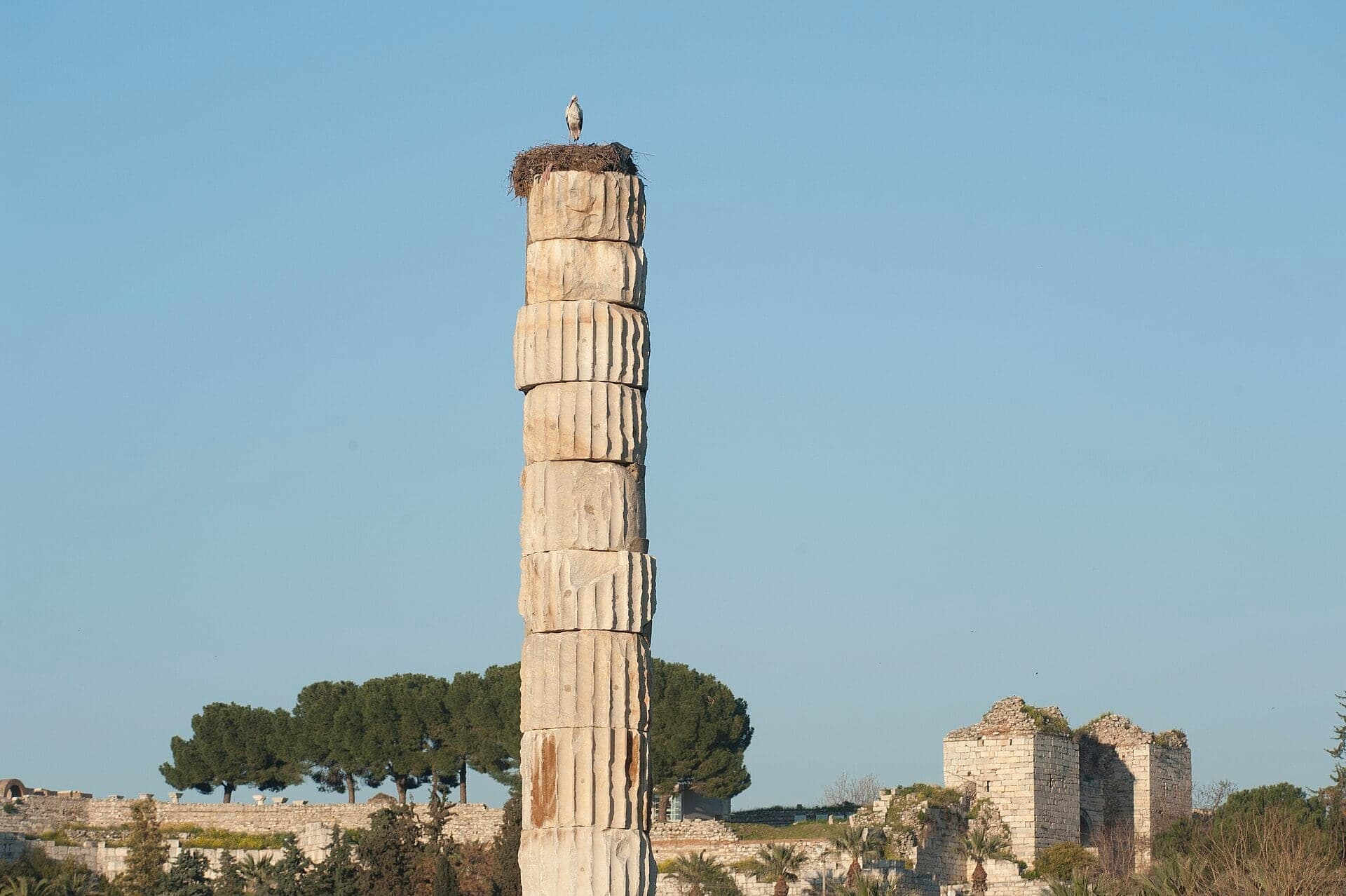
The walk resolves in the field where it all started. Past the Isa Bey Mosque and the bath the town calls Isa Bey's, the last stop is the flat, damp ground where the Temple of Artemis once rose, an Ionic marble temple far larger than the Parthenon in Athens. Today a single column, put back together in modern times from pieces of several columns, stands over foundations below the water table. The site was lost for centuries until John Turtle Wood found it on the last day of eighteen sixty-nine, after six years of searching the mud. Strabo names Herostratus as the man who burned the earlier temple in three hundred and fifty-six B C, and Valerius Maximus says he did it so that his name would be known to the whole world, which is why reckless fame at any cost is still called herostratic.
Here is the whole story in one view: Byzantine arches built of the temple's own stones, storks nesting on them in summer, and a Turkish town living its ordinary life underneath. The wonder vanished. The great city moved and fell silent. But the settlement never entirely stopped. It simply shifted ground and kept going.
Sources
- Roamer tour transcript, Ephesus: The City That Rebuilt Itself, rebuilt and fact-checked October 2026: the State Agora, Curetes Street, Library of Celsus, Great Theatre, and the Arcadian Way.
- Roamer tour transcript, Temple of Artemis and Ayasuluk Hill: Where Ephesus Went, rebuilt and fact-checked October 2026: the Ephesus Museum, the aqueduct, the Basilica of Saint John, the Isa Bey Mosque, and the Temple of Artemis.
- Austrian Archaeological Institute, Forschungen in Ephesos 2/1 (the theatre) and G. Wiplinger, BABESCH Byvanck Lecture 2019 (the Byzantine aqueduct of Selcuk).
- Kunsthistorisches Museum Vienna, collection records for the Library of Celsus statues.
- Ephesus UNESCO World Heritage Site listing, inscribed twenty fifteen (site scope covering the Artemision, Ayasuluk hill, and the ancient city).
- Ephesus Archaeological Museum, Selcuk (collection of the Great and Beautiful Artemis statues and finds from the Artemision and Basilica of Saint John).
Frequently asked questions
- Why did the ancient city of Ephesus decline?
- The harbour that Ephesus was built to serve silted up. The Kucuk Menderes river, the ancient Cayster, carried silt into the bay until the coast lay five or six kilometres away and marsh replaced the water. The stranded port lost its trade, and in the seventh century, with the harbour unusable and disease spreading, the population moved inland to Ayasuluk hill.
- What remains of the Temple of Artemis at Selcuk?
- Very little. The temple was an Ionic marble structure larger than the Parthenon in Athens and counted among the seven wonders of the ancient world, but today only foundations under the water table survive. A single column, stacked from miscellaneous fragments and re-erected in modern times, stands in an often marshy field. The site was lost for centuries and rediscovered only in 1869.
- Is the Library of Celsus really a tomb?
- Yes. The Library of Celsus was built in the early second century A D by his son Aquila for his father, the Roman senator Tiberius Julius Celsus Polemaeanus, who lies buried in a chamber beneath the building. It functioned as both a library and a mausoleum. The facade you see today was reassembled from collapsed fragments by anastylosis between 1970 and 1978.
- What is on Ayasuluk hill in Selcuk?
- Ayasuluk hill holds the medieval and later heart of the town that succeeded Ephesus. Its fortress walls crown the hill, and on the slope stand the foundations of the Basilica of Saint John, a domed cruciform church commissioned by the emperor Justinian and built between roughly 548 and 565 A D over the traditional tomb of Saint John the Evangelist. The Isa Bey Mosque, dated by its inscription to 1375 and built for Isa Bey of the Aydinid emirate, sits on the western slope.
- How are Ephesus and modern Selcuk connected?
- Selcuk is the living successor to ancient Ephesus on the plain and to medieval Ayasuluk on the hill, both of which emptied out. Buildings like the Isa Bey Mosque reused columns from Ephesus, and most of the marble on its west facade came from the ruined Temple of Artemis. A Byzantine aqueduct, built in the sixth century by an engineer named Lazaros partly from the temple's stones, still threads the town centre, with storks nesting on its piers from mid-March to the end of August.
Ready to experience it?
Ephesus: The City That Rebuilt Itself
90 min · 1.2 km · moderate
More from Selcuk
Explore more at your own pace.
One Day in Selcuk and Ephesus: A Walkable Morning-to-Evening Itinerary
Selcuk and Ephesus Travel Guide: Days, Transport, Costs, Safety
Curetes Street: How to Read the Whole Marble City of Ephesus
The Temple of Artemis and How Selcuk Reads Its Own Absences
The Basilica of Saint John: Justinian's Church Built Over a Tomb