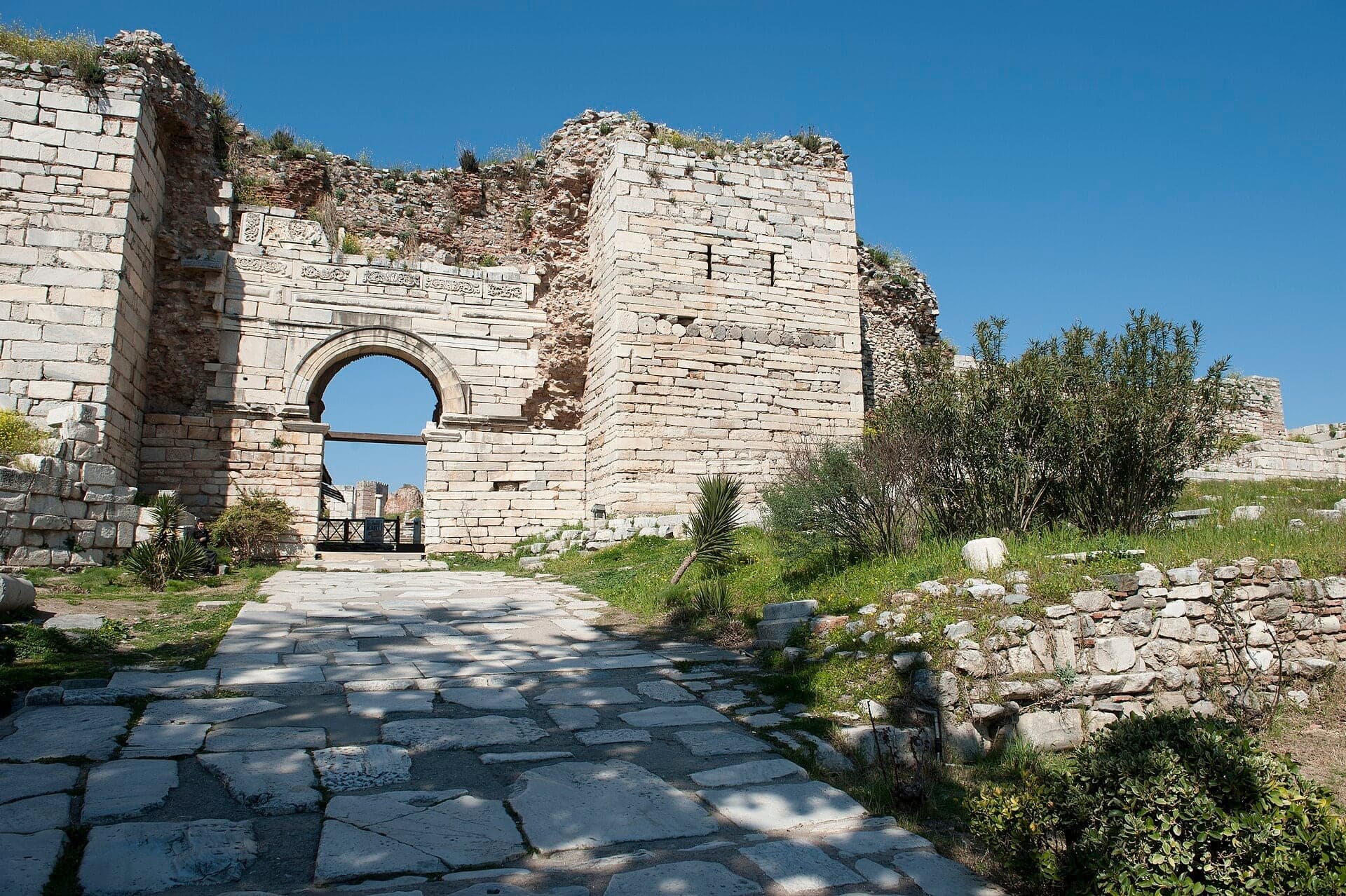
Emperor Justinian commissioned the Basilica of Saint John on the slope of Ayasuluk hill to enclose a tomb, and that decision explains everything about the ruin you stand in front of today. The wide foundations, the re-raised arches and columns, the crypt at the center of the plan: all of it exists because Christian tradition placed the grave of John the Apostle on this exact spot, and a sixth-century emperor decided that grave deserved a church which, in the words of the historian Procopius, closely resembled his own Church of the Holy Apostles in the capital. The single thing to understand here is that the building was never really about architecture. It was a reliquary the size of a cathedral, raised over a body, on a hill an entire city eventually climbed to reach.
A church built to cover a grave
Start with the tomb, because the church starts with it too. By church tradition, John the Evangelist spent the last years of his life preaching at Ephesus and was buried on this slope. That connection is tradition, not documented fact, and the tour's narration is careful to say so. What is documented is what the tradition produced. A small, old church already stood over the supposed grave when Justinian, as Procopius records, tore it down and ordered something far grander. Construction is usually dated from about 548 to 565. The new basilica was laid out as a cruciform plan under six domes, with the tomb at the crossing of the arms. Walk the outline slowly and the logic reveals itself. The whole vast floor plan radiates outward from one point on the ground, the spot where a body was believed to lie.
That is an unusual way to design a monumental building. Most great churches organize themselves around an altar and a congregation. This one organizes itself around a grave. The scale followed the sanctity: Justinian's structure measured roughly 130 meters long by 40 meters wide, dwarfing the small church it replaced. Procopius says it closely resembled the Church of the Holy Apostles in Constantinople, itself a burial church for emperors. So the reference point was deliberate. This was a mausoleum-basilica in the imperial mode, exported from the capital to a provincial hill in Asia Minor because a saint was thought to rest here.
Reading the stones that survive
Hear a stop from this walk
Temple of Artemis: The Wonder That Became a Town
Because so little of the elevation stands, the ground plan does the talking. The reconstructed arches and columns you see were raised again in modern times to suggest the enormous covered space that once existed here, a nave and transepts and choir crowned by domes carried on solid piers. You are not looking at the original roofline. You are looking at a partial rebuild that gestures at the original volume. Keep that distinction in mind, because it is easy to mistake the reconstruction for the sixth-century church itself.
Look closely at some of the capitals and you can find a detail that dates the building precisely. Carved into a few of the lower capitals are the monograms of the empress Theodora, Justinian's consort, and of the emperor himself. Theodora died in 548, the very year construction began, which is why her monogram matters: it fixes the church firmly to the earliest phase of the reign's building program and to the imperial couple who ordered it. A carved cipher in stone is a small thing to search for on a big ruin, but it is a signature, and it survives.
The church did not stay a church. After the Turkish conquest of the region, under the Beylik of Aydin in the early fourteenth century, the basilica was converted into a mosque. Then war, earthquake, and time took the rest. The building you visit is therefore a layered object: a sixth-century imperial basilica, a medieval mosque, and a twentieth-century partial reconstruction, all occupying the same footprint. That layering is the real subject of the walking tour it anchors, which follows how the town of Selcuk outlived its own famous ruins by moving uphill.
Why this hill, and why it mattered
The basilica did not sit in isolation. It shared this hill with the Ayasuluk Fortress just above it, and today a single combined ticket covers both, which is why the two are best visited together. That pairing is not an accident of ticketing. As ancient Ephesus down on the plain lost its harbour to silt and its people to disease, the population moved in the seventh century to this high ground. The church over the tomb of John became one of the anchors of the new settlement. Pilgrims came for the grave; the fortress guarded the community that grew up around it. For centuries this was the beating center of the medieval town, the reason the place had a name and a reason to exist after the great classical city on the plain fell silent.
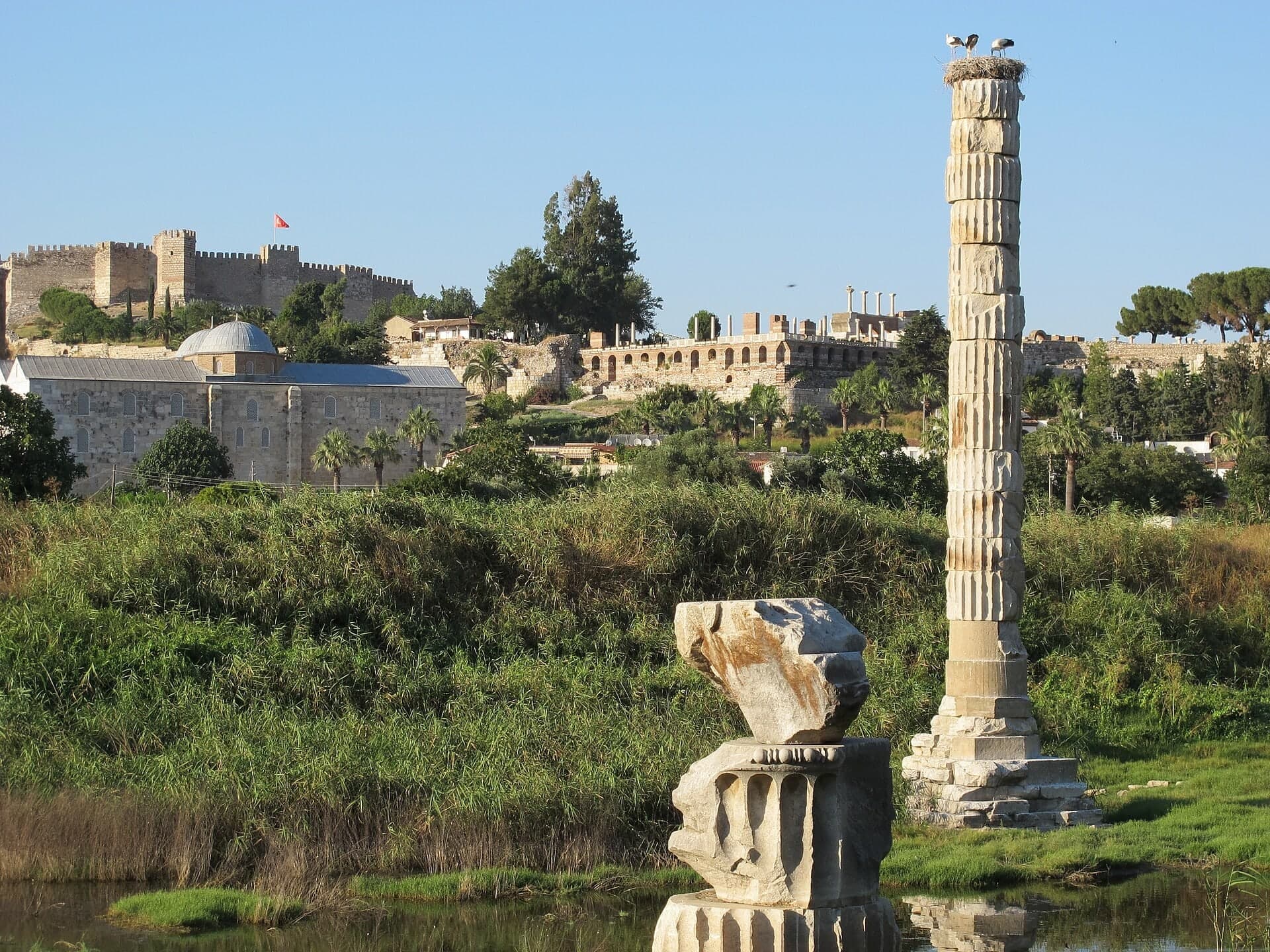
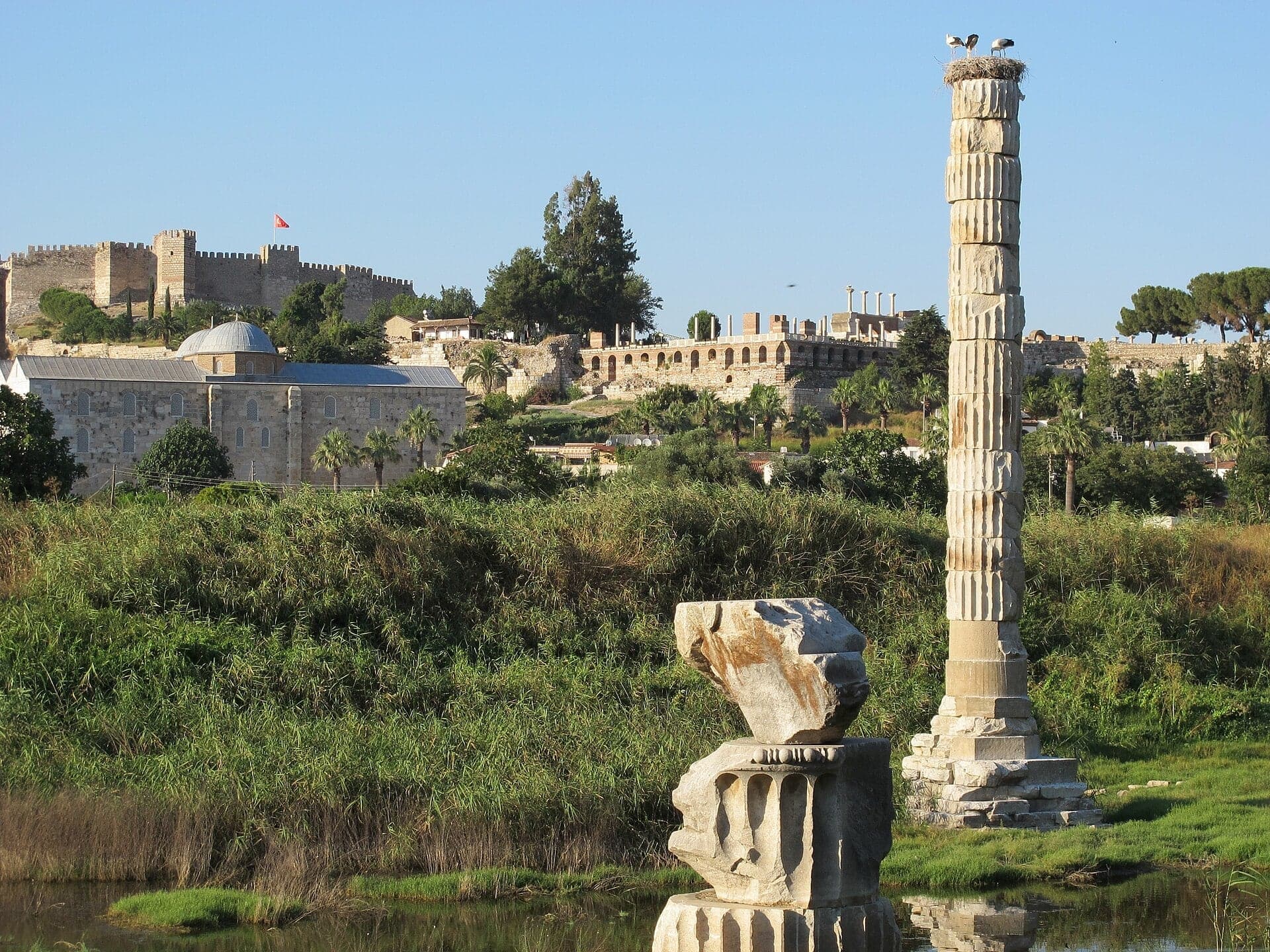
That is the one idea to carry away from standing in front of these foundations. The Temple of Artemis, a wonder of the ancient world, left a single column in a wet field a short walk from here. The Basilica of Saint John left a full ground plan and a crypt because it was built to protect something specific and stationary: a tomb that could not be moved. The wonder vanished into marsh. The church endured, in outline at least, because it had a body to keep in place.
Stand at the crossing, look down toward where the plain runs flat to the vanished harbour, and you can read the whole relocation in one sweep. A city moved uphill to survive, and it clustered around a grave and a fortress. The rest of the tour walks you through that story stop by stop, from the museum where you meet the goddess of the vanished wonder face to face, to the empty temple field where her stones came from.
If you want the full arc, the surrounding stops set this church in context: the temple that disappeared, the Byzantine aqueduct built partly from its stones to bring water to this church, the Isa Bey Mosque with temple marble in its west facade, and the fortress overhead. Browse the Selcuk (Ephesus) walking tours to plan the route, or start from the Selcuk (Ephesus) city page. The Gate of Persecution and the Basilica of Saint John are the sixth stop on the self-guided Temple of Artemis and Ayasuluk Hill: Where Ephesus Went walk, and it is the moment the tour's theme of loss and survival stops being an idea and becomes a floor plan under your feet.
Sources
- Procopius, Buildings 5.1.4-6: the earlier church to the Apostle John and Justinian's replacement.
- Basilica of St. John (Ayasuluk - St. Jean site), official page on muze.gov.tr: the tomb at the centre, the six domes, and the shared ticket with the fortress.
- The Byzantine Legacy, "Basilica of St. John in Ephesus": Byzantine architectural history and the church's role in the pilgrimage landscape of Ephesus.
- G. Wiplinger, "De aquaeductu urbis Ephesi", BABESCH Byvanck Lecture 2019, and the Ayasuluk Archaeological Site page on muze.gov.tr: the aqueduct to the church and the relocation of Ephesus to Ayasuluk hill.
- Turkish Archaeological News, "Basilica of Saint John and Ayasuluk Fortress": the shared hilltop site and combined visiting context.
Ready to experience it?
Temple of Artemis and Ayasuluk Hill: Where Ephesus Went
90 min · 2.8 km · easy
More from Selcuk
Explore more at your own pace.
One Day in Selcuk and Ephesus: A Walkable Morning-to-Evening Itinerary
Selcuk and Ephesus Travel Guide: Days, Transport, Costs, Safety
Selcuk: The Afterlife of Ephesus
Curetes Street: How to Read the Whole Marble City of Ephesus
The Temple of Artemis and How Selcuk Reads Its Own Absences