Curetes Street is the marble spine of Ephesus, and once you feel it descend under your feet, the logic of a whole classical metropolis clicks into place. This grand colonnaded street runs downhill from the Gate of Hercules, a late antique gate at its head, to the great library at the foot, and it was engineered to move people, water, and goods in one direction: down, toward trade, toward the theatre, toward a harbour. Reading that slope is the fastest way to understand what Ephesus was, how it governed itself, how it made its money, and why a great port city slowly lost its sea. Stand on the worn slabs and you are standing on the argument of the entire tour.
The slope carries the whole story
Ephesus, near Selcuk in Turkey, does not hand you fragments the way most ruins do. It hands you a city you can walk from end to end, and the fact that carries everything is the gradient. The site slopes, so you walk it almost entirely downhill, and every marble street was built to run that way on purpose. Enter at the top, at the upper entrance, and you begin in the civic brain of the metropolis: the State Agora, the Upper Agora, the city's administrative quarter. Around it stand the buildings that ran the city. The small roofed Odeon, also called the Bouleuterion, seated an estimated fourteen hundred people and served as both the meeting hall of the council, the boule, and a covered concert hall. It was remodelled into its present form around one hundred and fifty A D by a wealthy Ephesian, Publius Vedius Antoninus, and his wife Flavia Papiane, though parts of it may be older. Nearby stood the Prytaneion, the town hall, which kept the city's sacred hearth, a fire that stood for the life of the city.
From that civic centre, the marble drops away. Curetes Street is the artery that connects the political upper city to the commercial lower city, the ceremony of government flowing down toward the noise of the market. It runs at an angle across the city, colonnaded on both sides, lined behind the columns with shops, fountains, statue bases, monuments, and porticoes floored with mosaic, with a drain under the paving. The marble slabs underfoot are worn smooth and rutted. The name is modern. Archaeologists took it from column drums carried down from the town hall and reused along the street, inscribed with lists of the Curetes, a real priestly college that, according to Strabo, held feasts and performed mystic sacrifices at the festival of Ortygia. In antiquity the street was probably called the Embolos.
What the street displays as you descend
Hear a stop from this walk
Theater Gymnasium and the Lower Gate: The Long Afterlife
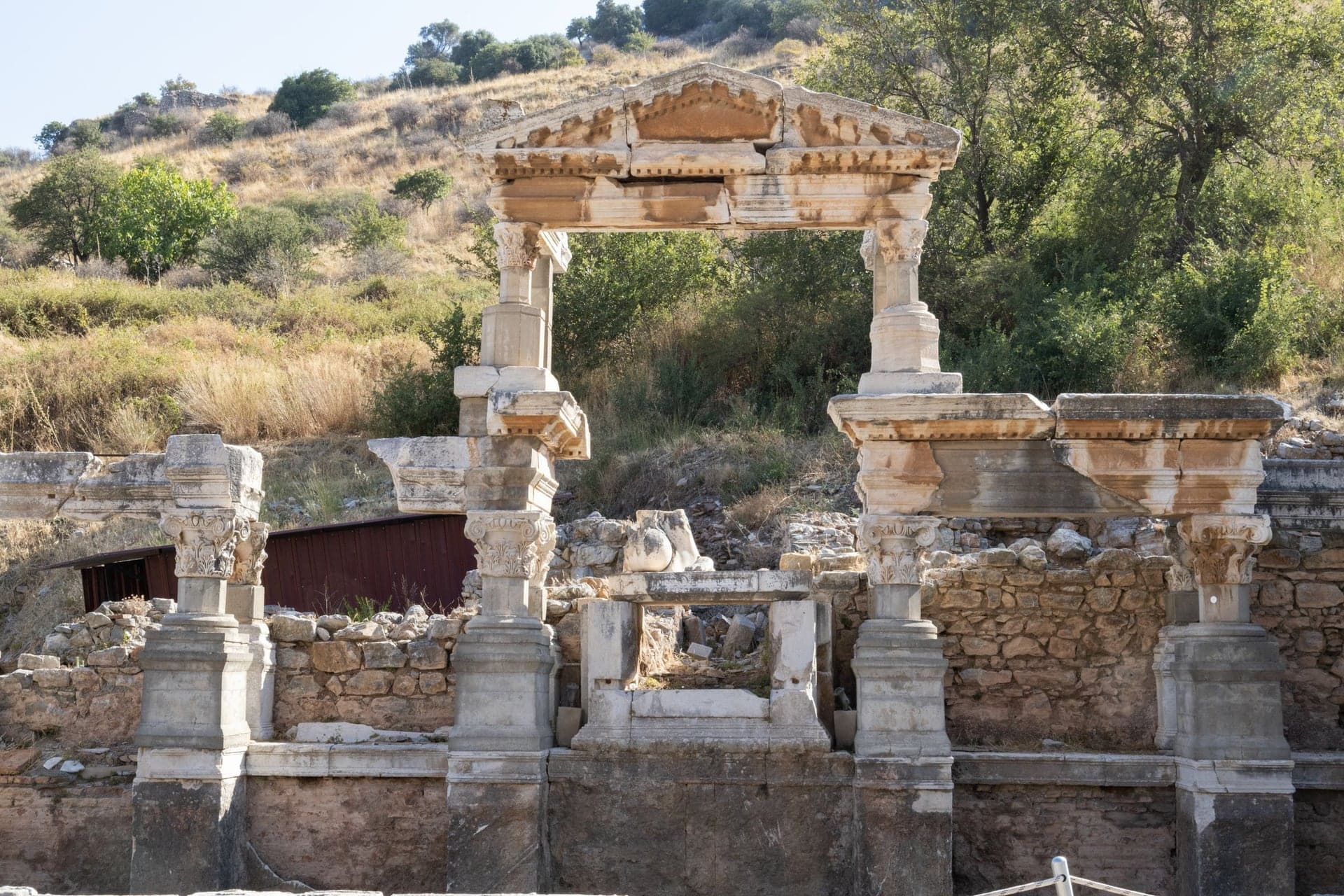
Walk Curetes Street slowly and it becomes a catalogue of how a Roman city advertised itself. On the north side stands the small, exquisite porch of the Temple of Hadrian. Its building inscription says it was paid for by Publius Quintilius Valens Varius, with his wife and his daughter Varilla, and scholars date it either early in Hadrian's reign or to the 130s. It was dedicated to three at once: to the goddess Artemis, to the emperor Hadrian, and to the people of Ephesus. Four supports frame the porch, and a curved Syrian-type arch rises into the pediment carrying a bust of Tyche, the goddess of the city's fortune. The carved frieze panels inside the porch are casts, and they are not from Hadrian's time: they were added in a late fourth-century restoration, and the originals are kept in the Ephesus Museum in Selcuk. Read it and you understand that one private family could bind goddess, ruler, and neighbours into a single monument on the main street.
Look up the slope opposite the temple and a modern roof shelters the Terrace Houses, the Yamac Evler, where you step out of the public marble and into private life. The block you can visit, Terrace House 2, holds seven elite homes on terraces up the slope, built in the early first century A D and lived in until an earthquake in the later third century. The Austrian excavators call it one of the best preserved ancient houses in the eastern Mediterranean, with mosaics and wall paintings left where they were found, marble panelling, open courtyards, fountains, and underfloor heating that warmed the rooms from below. The Terrace Houses need a separate ticket, an extra fifteen euros in twenty twenty-six, and they are the domestic counterpart to everything grand and public outside.
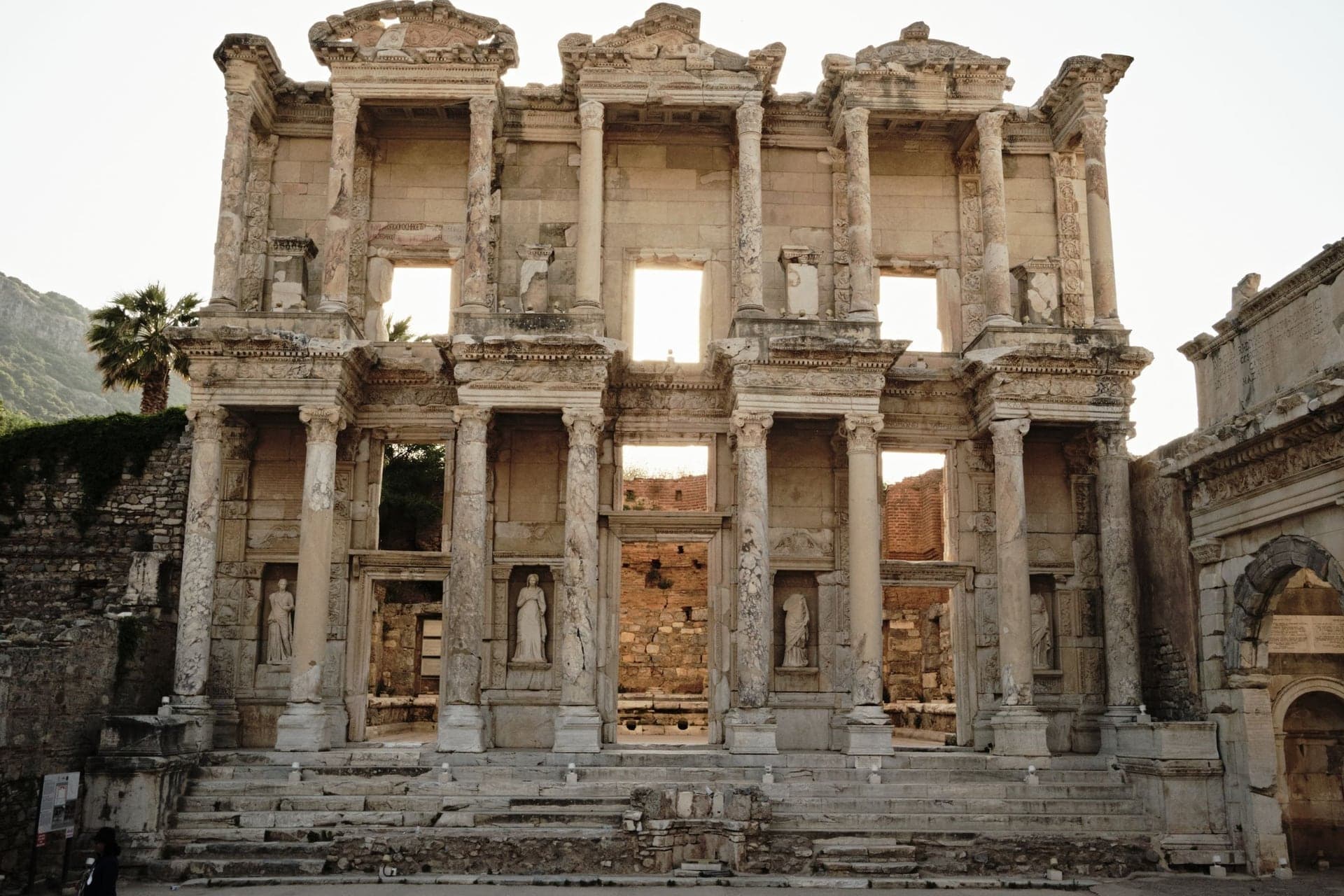
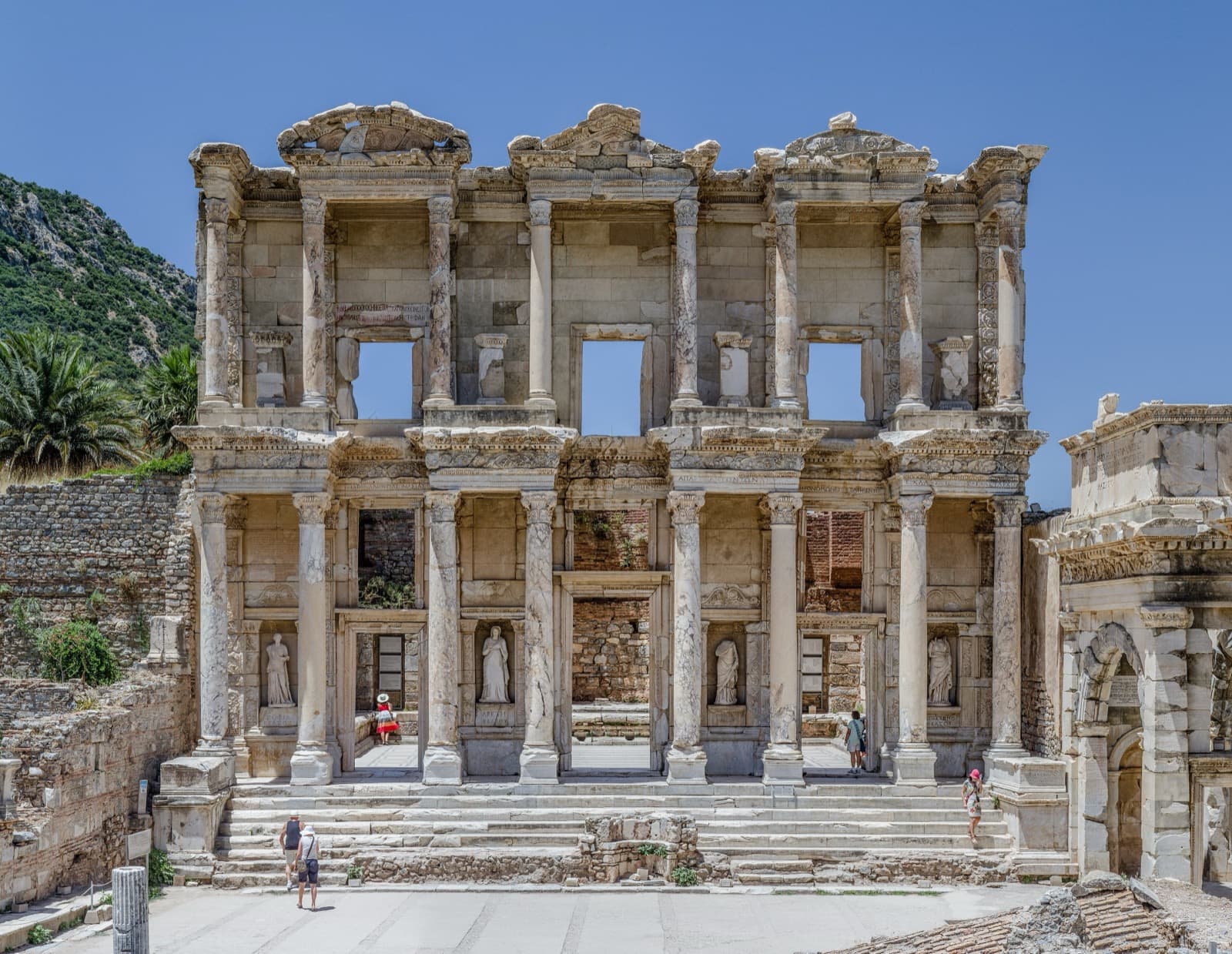
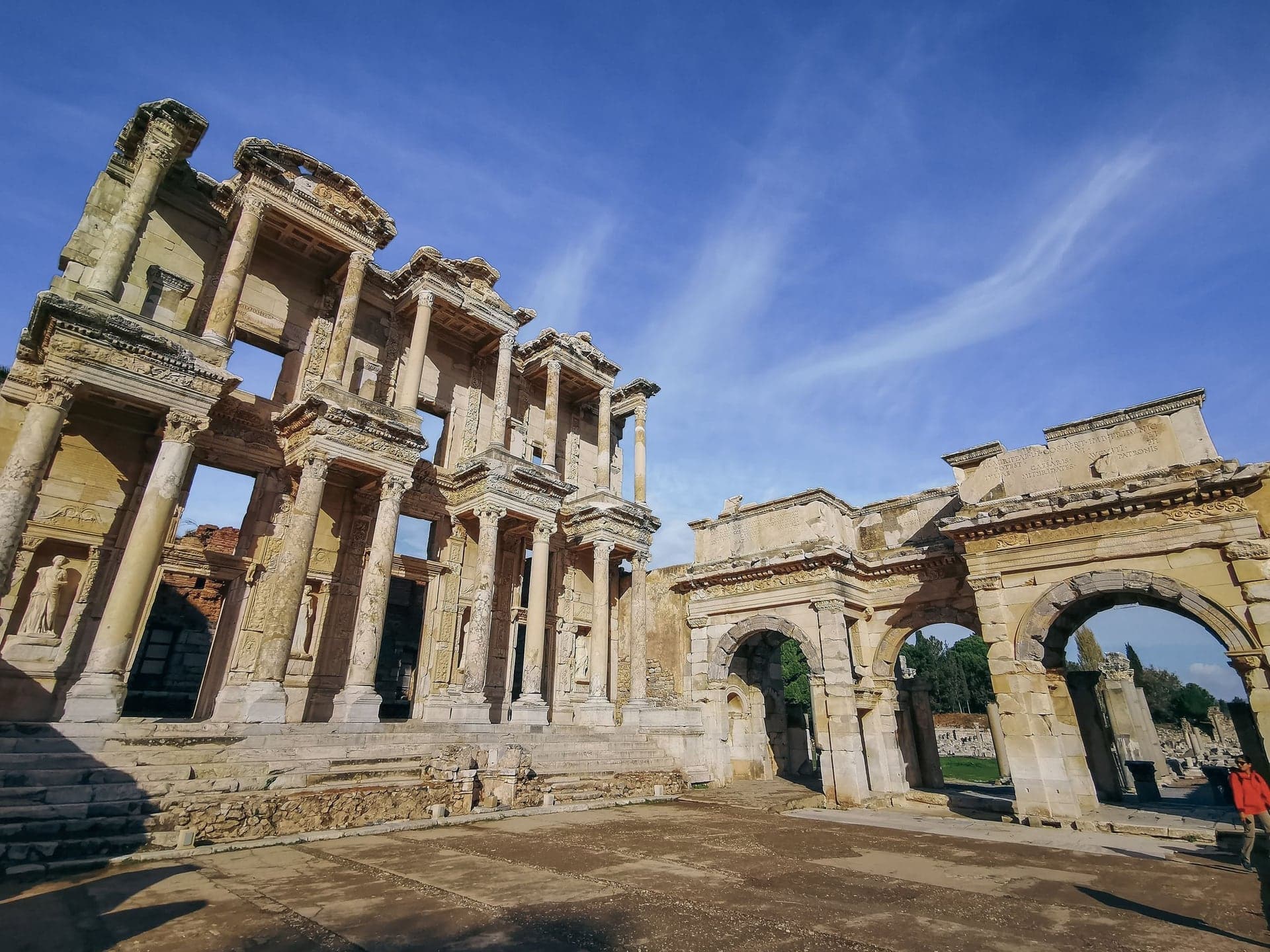
At the foot of the street waits the image everyone carries away: the two-storey marble facade of the Library of Celsus. It is richer than it looks, because this library is also a tomb. His son Aquila built it in the early second century A D for his father, the senator Tiberius Julius Celsus Polemaeanus, who lies in a sarcophagus in a chamber beneath the building. It once held thousands of scrolls. Three of its four facade statues, wisdom, excellence, and knowledge, carry Celsus's name; the fourth, inspiration, is labelled for a later donor named Philippus. The statues on site are copies, the originals in the Ephesos Museum in Vienna, and the collapsed facade was re-erected by anastylosis between nineteen seventy and nineteen seventy-eight, by the Austrian architect Friedmund Hueber with Volker Michael Strocka. It is original marble with new material added, pieced back together in the modern age.
Where the marble points
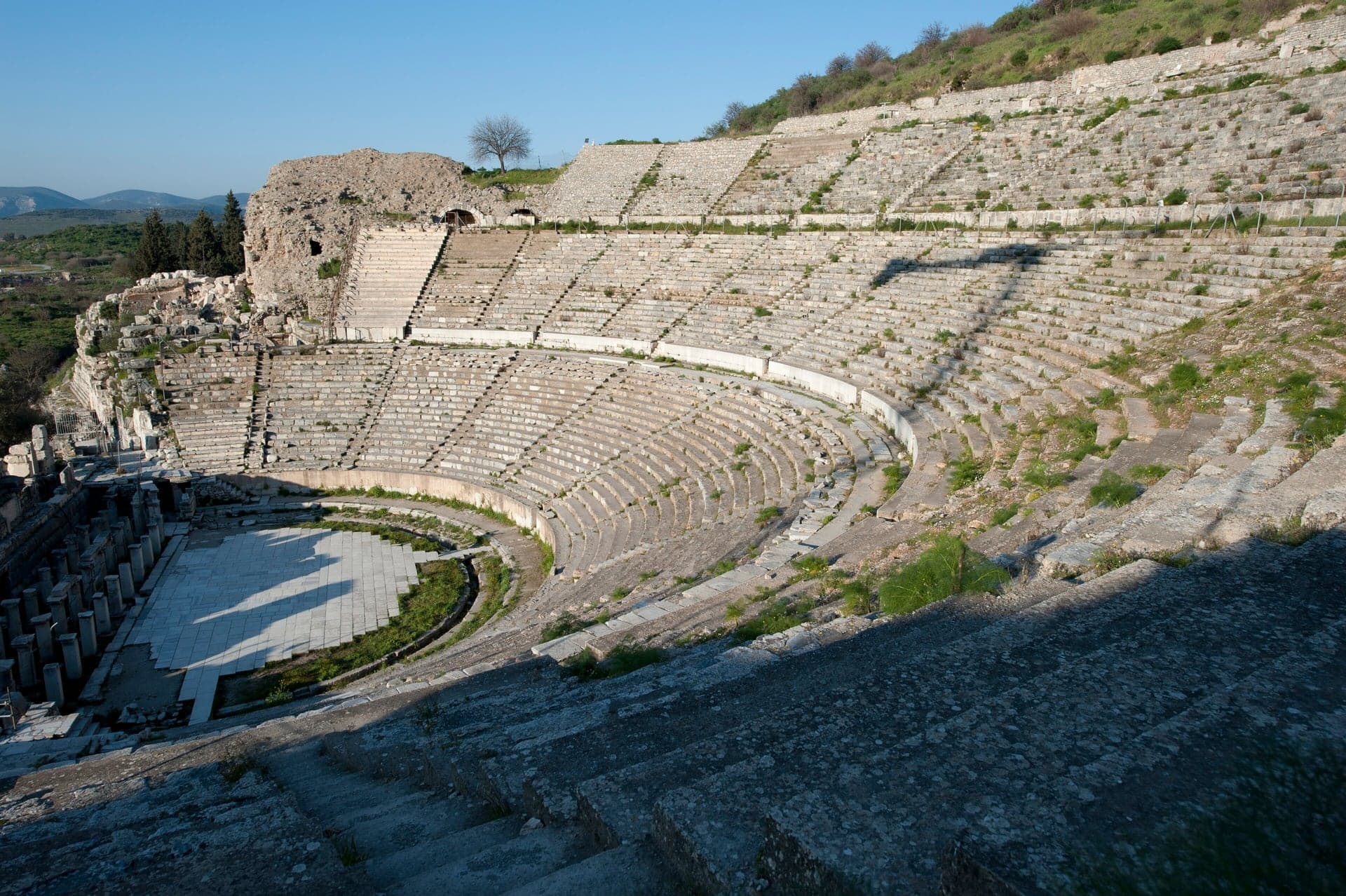
Curetes Street delivers you to the market and the scale of the city. Beside the library opens the Commercial Agora, the Tetragonos Agora, about one hundred and ten metres on a side, colonnaded on all four sides with shops. Its triple Gate of Mazeus and Mithridates, dedicated in four to three B C to the emperor Augustus and his family, was funded by two freed slaves of the emperor's family, who dedicated it to their patrons. Beyond it, cut into the slope of Mount Pion, the Great Theatre held about twenty thousand spectators, one of the largest in Asia Minor, and the Book of Acts sets here the two-hour riot stirred up by the silversmith Demetrius against the Apostle Paul, though Paul's friends kept him out of the theatre.
From the theatre the Arcadian Way strikes west toward the sea: about half a kilometre long, and a sixth-century inscription records fifty oil lamps along its colonnades. It points now at empty ground. The Kucuk Menderes river silted the bay until the coast lay five or six kilometres away, and the great port was left stranded inland. Silt cut the city off from its sea. That is the story Curetes Street sets in motion, and to feel it, you have to walk the slope yourself. The self-guided Ephesus: The City That Rebuilt Itself tour walks it in eleven stops from the upper gate to the lower gate. Compare it with the other Selcuk (Ephesus) walking tours, then start from the top gate in Selcuk (Ephesus) and let the marble carry you down.
Sources
- Austrian Archaeological Institute, Forschungen in Ephesos 2/1 (the theatre, about twenty thousand seats) and Waldner, Forschungen in Ephesos 11/4 (Curetes Street and its ancient name, Embolos), via the Austrian Academy of Sciences Press.
- Strabo, Geography 14.1.20-24: the Curetes and the silting harbour; Stock et al., "In search of the harbours", Quaternary International 312 (2013).
- Building inscription of the Temple of Hadrian (IEph 429) and Quatember, "Der sogenannte Hadrianstempel an der Kuretenstrasse": the Varius family and the dating question.
- Ephesus Terrace Houses, official page on muze.gov.tr, and ISAW (NYU), Ladstaetter on Terrace House 2: date, size, and the end of occupation.
- Kunsthistorisches Museum Vienna, collection records for the four Library of Celsus statues, including Ennoia Philippou.
- Gate of Mazaeus and Mithridates, Livius: the Augustan dedication of four to three B C and its inscription to the two freedmen's patrons.
Ready to experience it?
Ephesus: The City That Rebuilt Itself
90 min · 1.2 km · moderate
More from Selcuk
Explore more at your own pace.
One Day in Selcuk and Ephesus: A Walkable Morning-to-Evening Itinerary
Selcuk and Ephesus Travel Guide: Days, Transport, Costs, Safety
Selcuk: The Afterlife of Ephesus
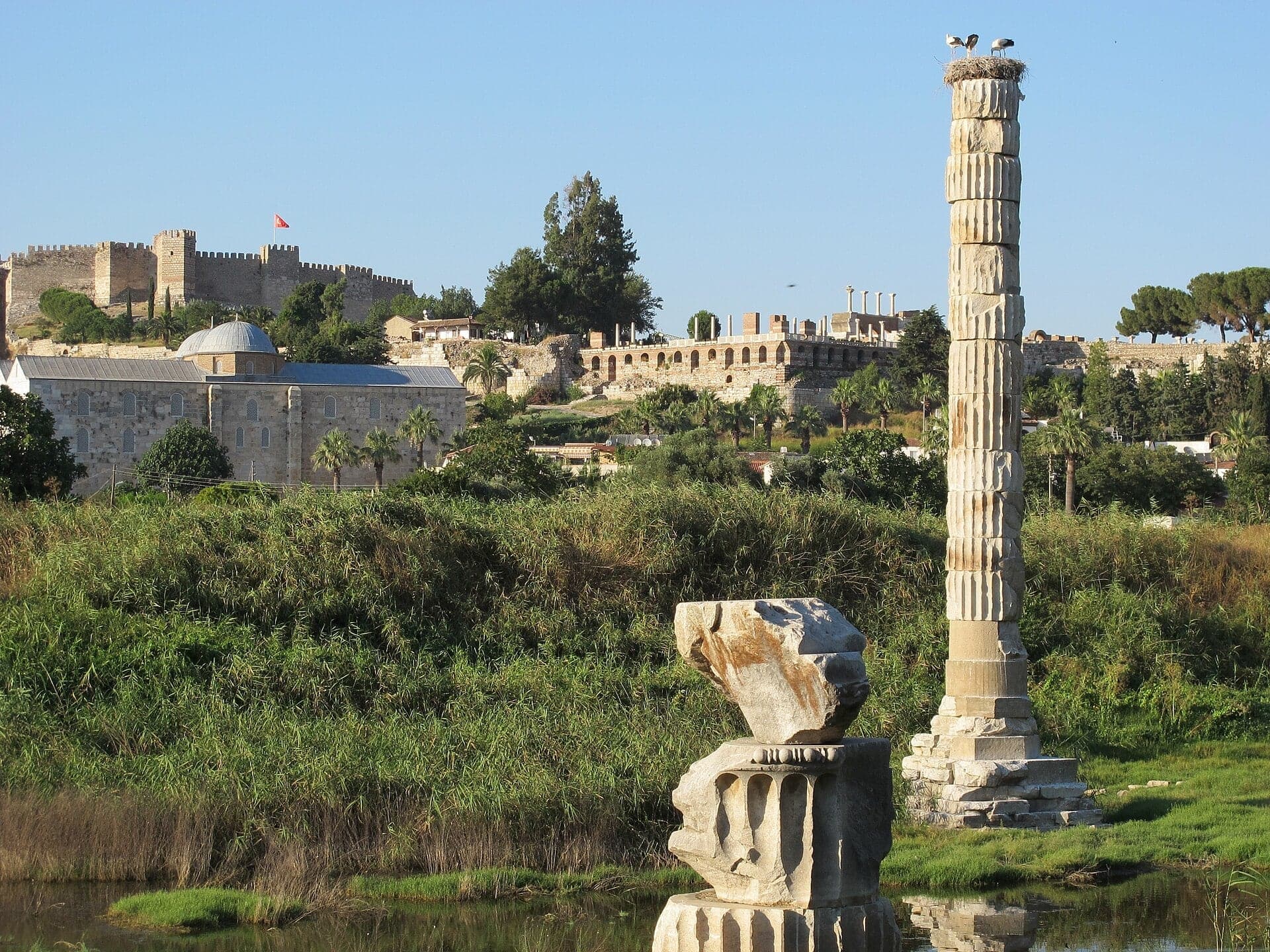
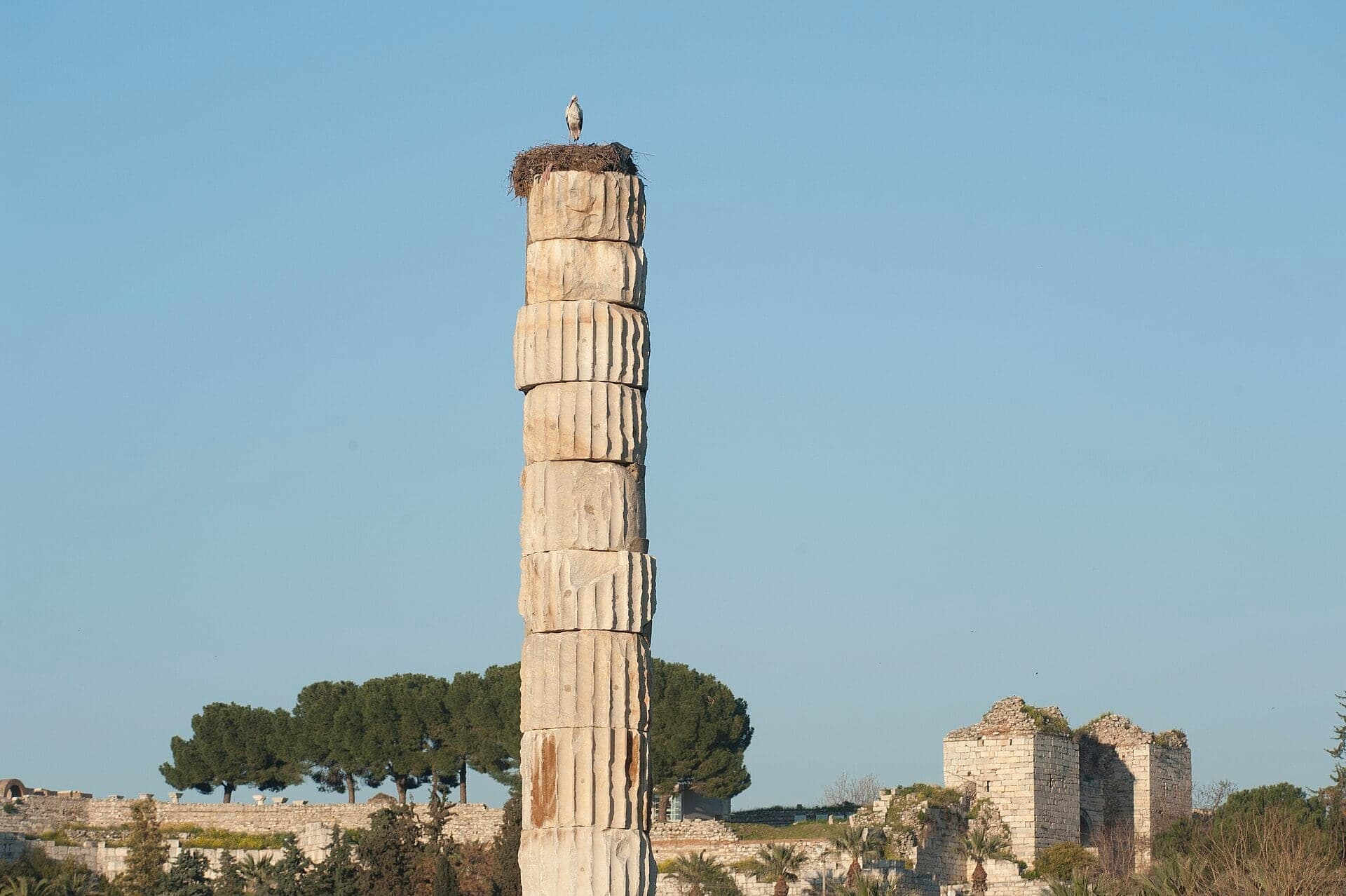
The Temple of Artemis and How Selcuk Reads Its Own Absences
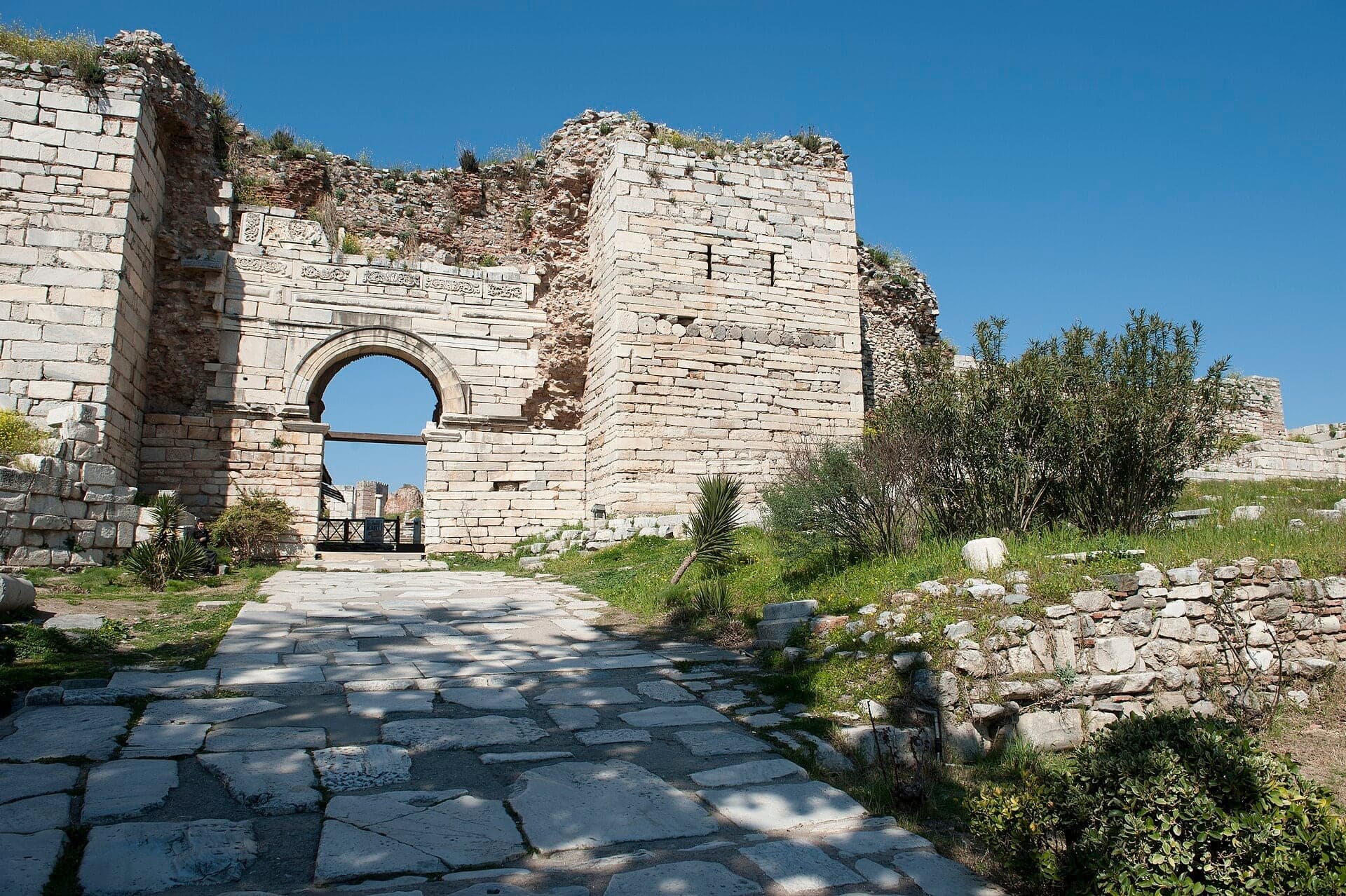
The Basilica of Saint John: Justinian's Church Built Over a Tomb