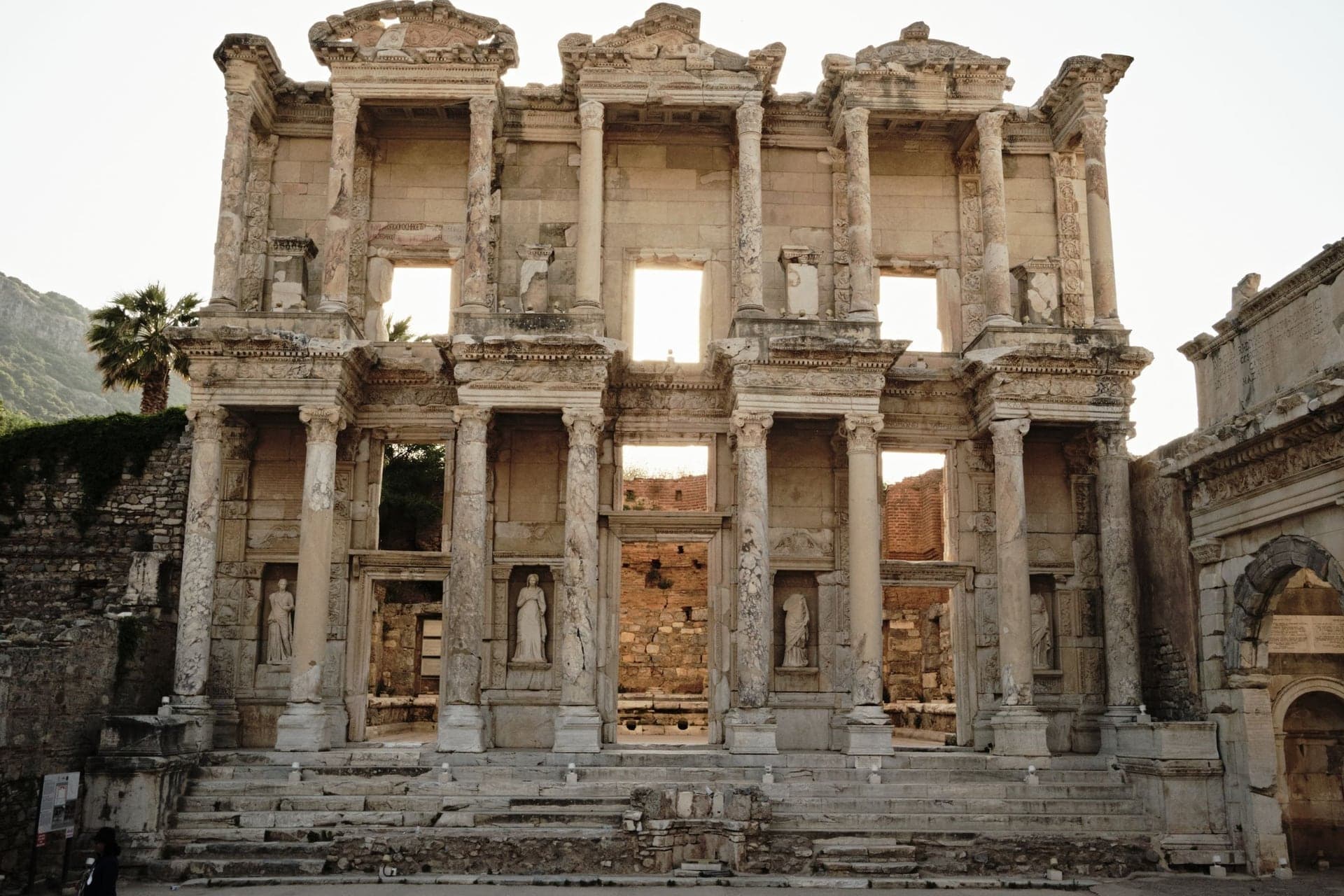
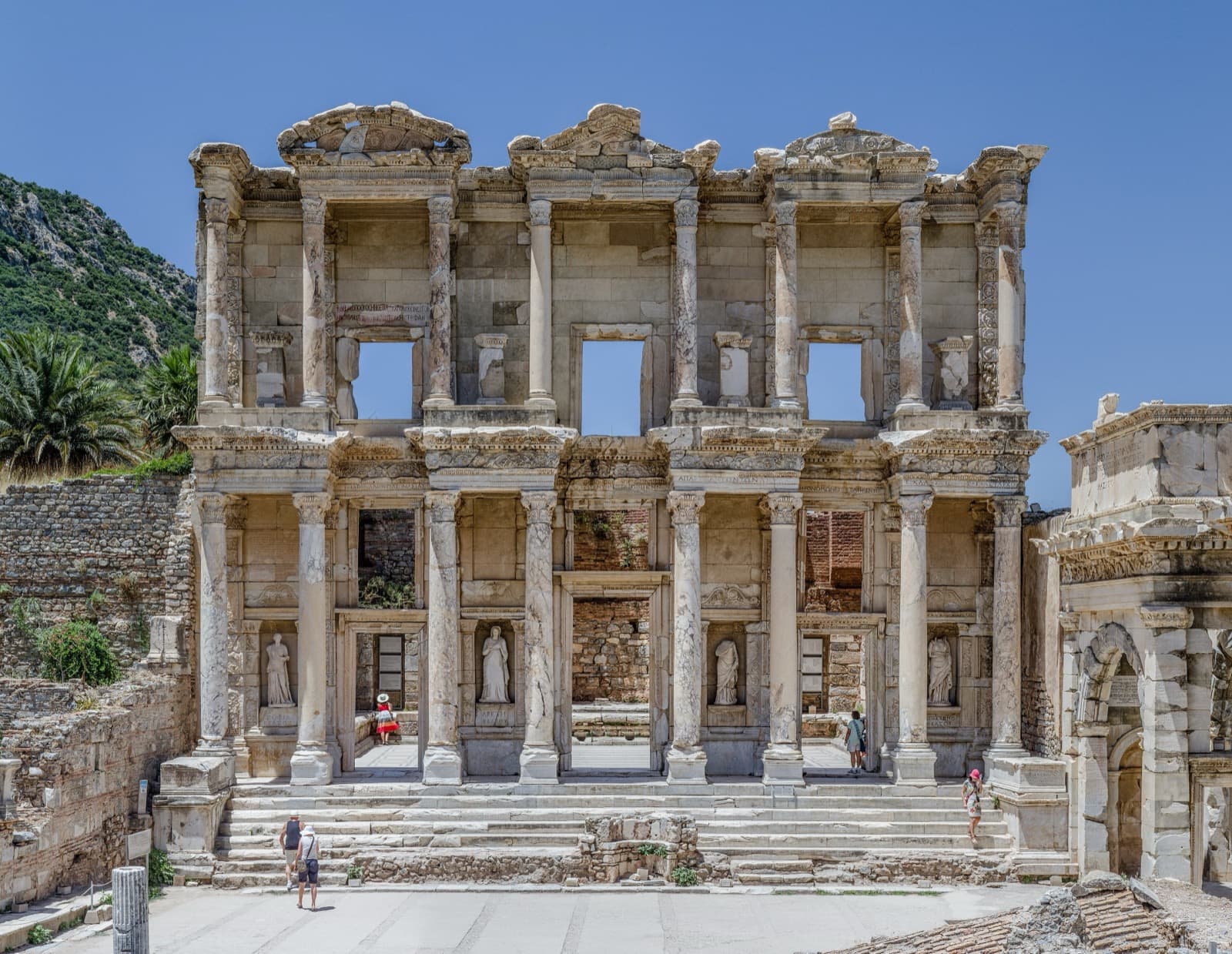
The Library of Celsus at Ephesus is at once a library and a tomb. A son built it to hold thousands of scrolls above the buried body of his father, and the two-storey marble facade that visitors photograph today was reassembled from collapsed fragments in the twentieth century. Stand at the foot of Curetes Street and you are not simply looking at the most famous ruin in Turkey. You are reading a monument in which learning, mourning, and civic pride were deliberately fused into a single wall of stone.
A senator buried under his own reading room
The library was raised in the early second century A D by a man named Aquila, and it was a monument to his father, the Roman senator Tiberius Julius Celsus Polemaeanus. Celsus was no minor figure. He had reached the consulship in 92 A D, the highest ordinary office in Rome, and he later served as proconsul, the governor, of the province of Asia, the very region whose greatest city was Ephesus. When he died, his son did something that would have struck a Roman as extraordinary and moving at once. He buried his father inside the building.
Celsus lies in a decorated sarcophagus in a chamber beneath the building. Roman law generally kept the dead outside the walls of a city, so to inter a man at the heart of the urban centre, under a public monument, was a mark of exceptional honour granted to an exceptional citizen. The building therefore carries a double meaning that is easy to miss when you are only admiring the columns. Every reader who once climbed the steps to consult a scroll was standing above a grave. Learning was raised, quite literally, over a father's memory.
That fusion was the point. This was a library standing on a tomb, and a son telling the world that his father's mind and reputation deserved a structure that looked like a temple.
Reading the facade
Hear a stop from this walk
Theater Gymnasium and the Lower Gate: The Long Afterlife
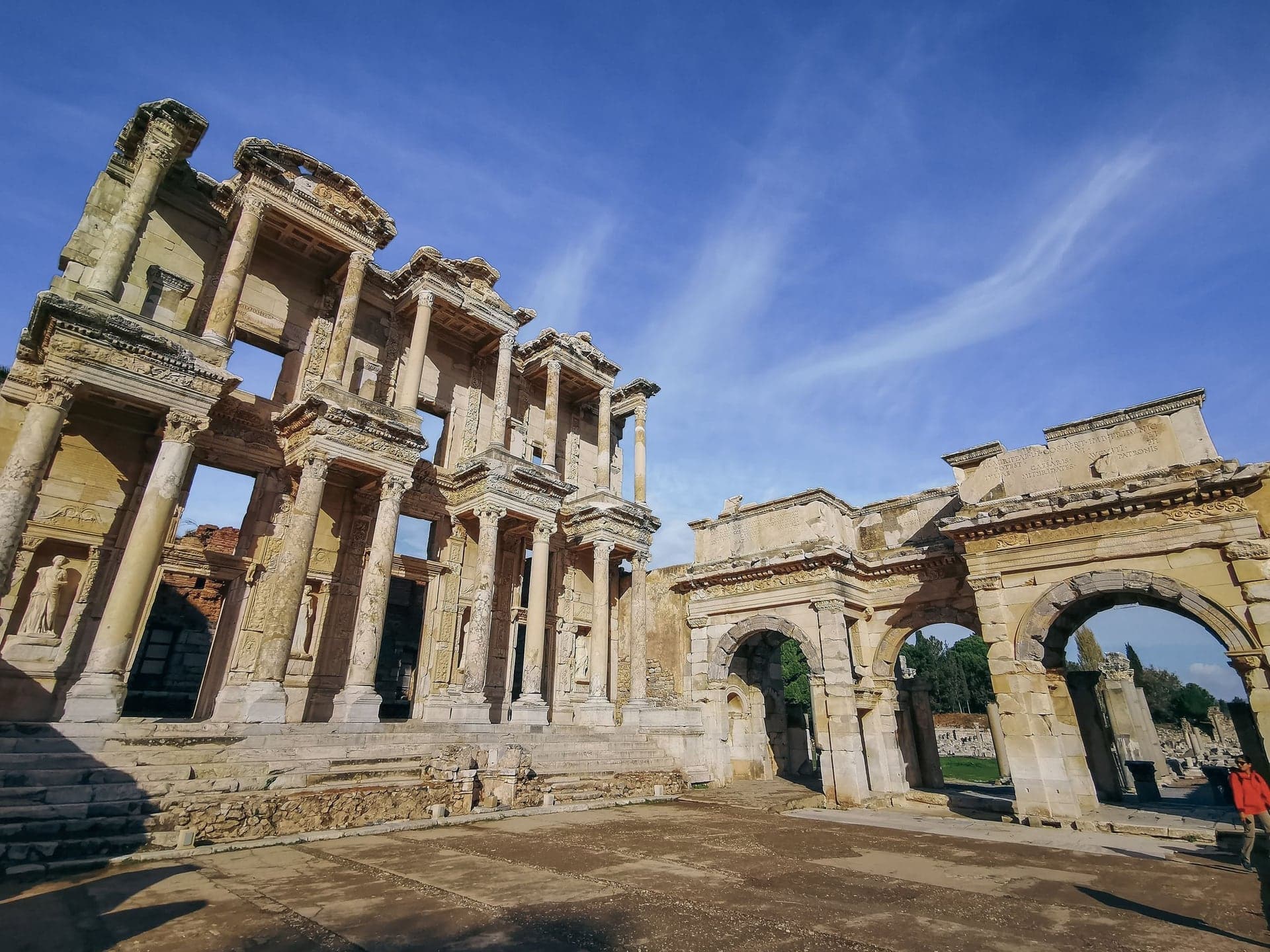
The front of the building was designed to be read like a page. Look at the four statues set into the niches between the columns. They are not portraits. They personify qualities a cultivated Roman was meant to admire, and three carry Celsus's own name: Sophia, his wisdom; Arete, his excellence; and Episteme, his knowledge. The fourth, Ennoia, inspiration, is labelled for someone else, a Philippus who looked after donations for a later restoration of the facade, and her inscription was painted rather than carved. All four are marble figures that replaced earlier bronzes. Together they announce what the building housed and what it honoured. A man of learning, framed by learning's virtues.
Be honest with yourself about what you are seeing, because Ephesus rewards that honesty. The statues in the niches are copies. The originals stand today in the Ephesos Museum in Vienna, taken there after the Austrian excavations among finds the Ottoman sultan gave to the Austrian emperor. This is common across Ephesus, where much of the most delicate carving has been moved to museums for protection, and casts or reconstructions hold the visible positions. Knowing this does not spoil the facade. It sharpens what you are looking at, which is a careful modern presentation of an ancient design rather than an untouched survival.
Inside was a public library of several thousand scrolls, in the words of the Austrian Academy of Sciences, a serious collection by the standards of the ancient world. Guides often add that the reading room had double walls to keep damp away from the papyrus. The story is widely repeated, but we could not confirm it from the excavators' own publications, so treat it as a guide's tale rather than a fact. The scrolls themselves are the quiet reason the building deserves the name library rather than mere monument.
The facade you see was rebuilt from rubble
Here is the fact that changes how you look at the whole thing. The marble front standing before you is a resurrection. For centuries the facade lay collapsed, a heap of shattered columns and cornice pieces on the ground. What you see is the result of a painstaking reconstruction carried out between 1970 and 1978 by the Austrian Archaeological Institute, led by the architect Friedmund Hueber with the archaeologist Volker Michael Strocka, using fragments that the earlier Austrian excavators had recovered at the site in 1903 and 1904.
The technique has a name: anastylosis. It means rebuilding a ruined monument from its own original pieces, fitting the surviving fragments back into their proven positions and adding new material only where it is needed to hold the old stone together. It is the opposite of guesswork or fantasy restoration. Every genuine block goes back where the evidence says it belongs. So the columns you photograph are, for the most part, the actual ancient marble of the library, with new material added where it was missing, stood upright again after centuries on the ground.
That is why the Library of Celsus can feel more vivid than ruins that were never touched. It gives you the height and the proportion, the sense of a facade rising two storeys against the sky, in a way that a scatter of fallen stones never could. You are looking at real antiquity, reassembled by modern hands with modern discipline.
The one thing to understand standing here
If you take away a single idea from this spot, let it be this: the Library of Celsus is not a library that happens to be beautiful. It is a private act of love and ambition made permanent in public marble. A son took his father, a consul and governor, and instead of a simple tomb outside the walls he built a temple to the man's intellect at the foot of the city's grandest street, put his father's body under the reading room, and crowned the front with the virtues of the educated mind. Wisdom, excellence, knowledge, and inspiration stand guard over a senator's grave.
Everything else about the building, the scroll collection, the reassembled columns, follows from that intention. It was meant to be read as a claim about what a life of learning and service was worth, and it still reads that way today.
The library sits at the foot of Curetes Street, where the ceremonial upper city meets the commercial market and the theatre below. To walk the marble down to it the way an ancient Ephesian would have, from the council house at the top of the site to the road that once ran to the vanished harbour, follow the self-guided Ephesus: The City That Rebuilt Itself tour on the Roamer app, eleven stops from the upper gate to the lower gate at your own pace, or compare the Selcuk (Ephesus) walking tours. The library is under conservation planned to run to the end of 2027, so part of its front may be behind scaffolding. For the wider context of the town beside the ruins and the museum where the original Artemis statues are kept, start from Selcuk (Ephesus).
Sources
- Austrian Academy of Sciences: the library as Aquila's memorial over his father's tomb, its several thousand scrolls, and the 1970 to 1978 reconstruction.
- Ephesus: The City That Rebuilt Itself, self-guided tour (Roamer), rebuilt and fact-checked October 2026: the stop text for the Library of Celsus.
- Kunsthistorisches Museum Vienna (Ephesos Museum), collection records for Sophia, Arete and Episteme Kelsou and Ennoia Philippou: home of the original facade statues.
- Austrian Archaeological Institute Ephesus excavation records: documentation of the recovered facade fragments used in the 1970s anastylosis.
Ready to experience it?
Ephesus: The City That Rebuilt Itself
90 min · 1.2 km · moderate
More from Selcuk
Explore more at your own pace.
One Day in Selcuk and Ephesus: A Walkable Morning-to-Evening Itinerary
Selcuk and Ephesus Travel Guide: Days, Transport, Costs, Safety
Selcuk: The Afterlife of Ephesus
Curetes Street: How to Read the Whole Marble City of Ephesus
The Temple of Artemis and How Selcuk Reads Its Own Absences