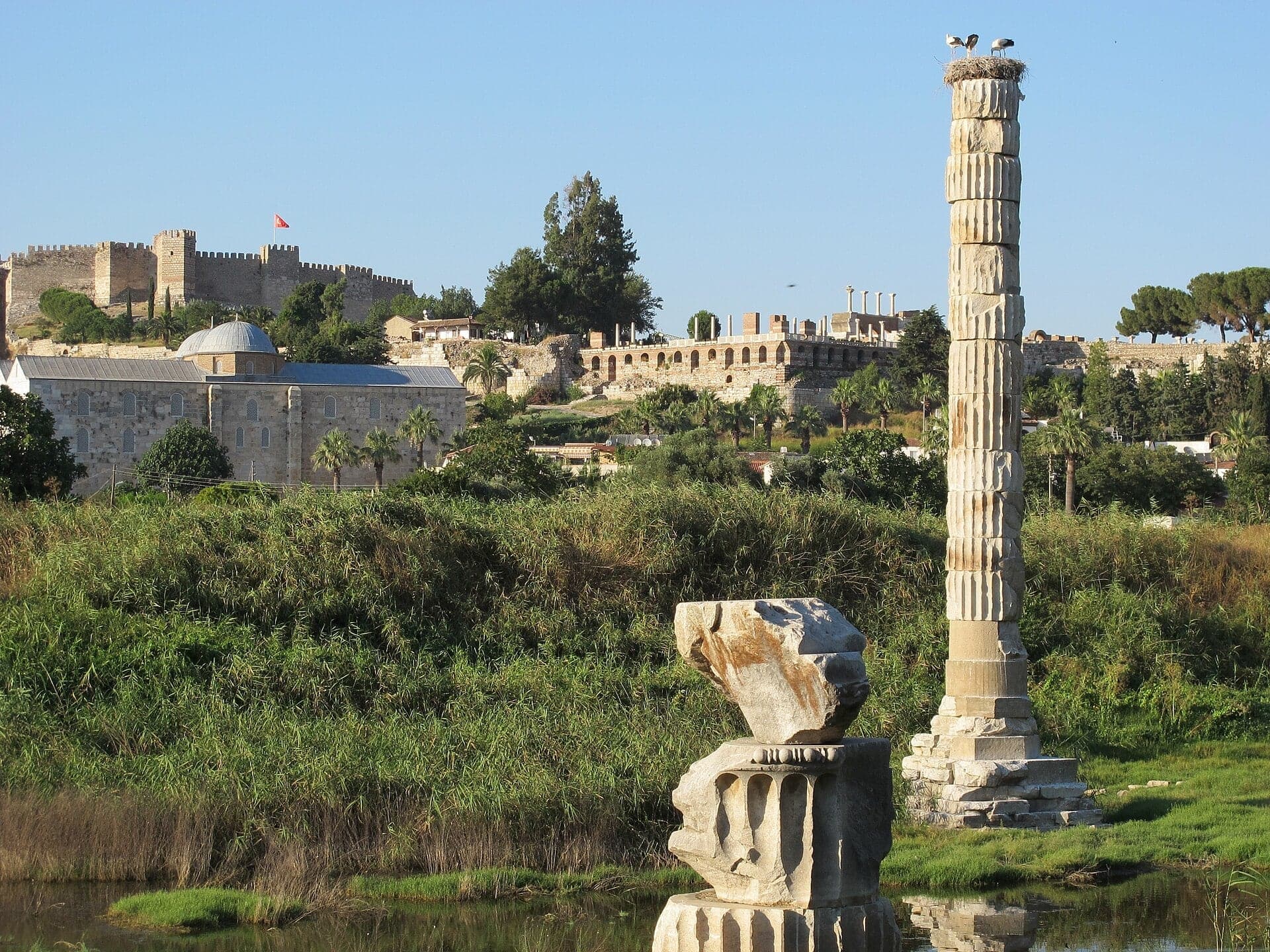
Stand at the edge of a flat, damp field on the outskirts of Selcuk and you are looking at one of the seven wonders of the ancient world. There is almost nothing to see: reeds, standing water, and a single column stacked from mismatched fragments and re-erected in modern times so that visitors would have something to face. That absence is the whole point. The Temple of Artemis, the vanished wonder, is the way into a town that has spent two thousand years surviving the disappearance of its own famous places, and reading that empty field correctly changes how you see everything that leads to it.
The temple itself was not modest. The archaic temple of the sixth century B C was, by Pliny's account, a hundred and twenty years in the building, and Herodotus says King Croesus of Lydia gave most of its columns. That temple burned in 356 B C. Strabo names the arsonist as Herostratus, Valerius Maximus says he did it so that his name would be known to the whole world, and Plutarch passes on an old joke that the goddess missed the fire because she was busy bringing Alexander the Great into the world that same day. The Ephesians rebuilt, and it is this later temple, an Ionic marble giant far larger than the Parthenon in Athens, with columns about eighteen metres tall, that was counted among the seven wonders. The Goths wrecked it in the 260s A D, and afterwards it was looted for its stone and buried under about six metres of river mud. The site vanished so completely that John Turtle Wood, digging for the British Museum, found it only on the last day of 1869, after six years of searching.
Why the empty field explains the town
Hold the contrast for a moment. The fame is immense. The remains are one column in a wet field. This is the paradox the entire route turns on, and the walk saves the field for last, because the missing temple is easier to find in the town than in the field. It starts in the Ephesus Museum, where you meet the goddess first: two marble statues of Artemis of Ephesus found in 1956 in the town hall of ancient Ephesus. The Great Artemis stands nearly three metres tall under a crown shaped like a temple in three tiers; the Beautiful Artemis is smaller. The museum describes four rows of rounded forms on her chest, linked to fruitfulness and fertility, and scholars still argue over what they represent.
Then her stones start to turn up. The tall arches that stride through the town centre are not a Roman aqueduct. They are a Byzantine siphon bridge, built between 549 and 565 A D by an engineer named Lazaros in the time of Justinian, to carry spring water from the hills above Sirince to the church on the hill, and the Austrian excavators have shown that its lower piers are built of blocks taken from the Temple of Artemis. Even the pipe along the top was made of drilled Roman column drums. Higher up, the Isa Bey Mosque, dated by its doorway inscription to 1375, was built for Isa Bey, ruler of the Aydinid emirate that held this coast before the Ottomans, by an architect named Ali of Damascus, and its plan recalls the Great Mosque of Damascus. According to the district governorship, most of the marble on its west facade was brought from the Temple of Artemis, then in ruins. The city that vanished did not simply disappear. It changed hands, and its stones went back to work.
Above the mosque, the walls of the Ayasuluk Fortress crown the hill, with some fifteen towers. Down on the plain, where the land runs flat toward what was once the sea, stood Ephesus. In the seventh century A D, with its harbour unusable and disease spreading, the people gave up the port and settled on this hill. The Greek name of the saint's church district, Hagios Theologos, the Holy Theologian, became the Turkish Ayasuluk. Ephesus is not truly gone. It moved uphill, and the town grew up around it.
A church, a gate, and a town that moved
Hear a stop from this walk
Temple of Artemis: The Wonder That Became a Town
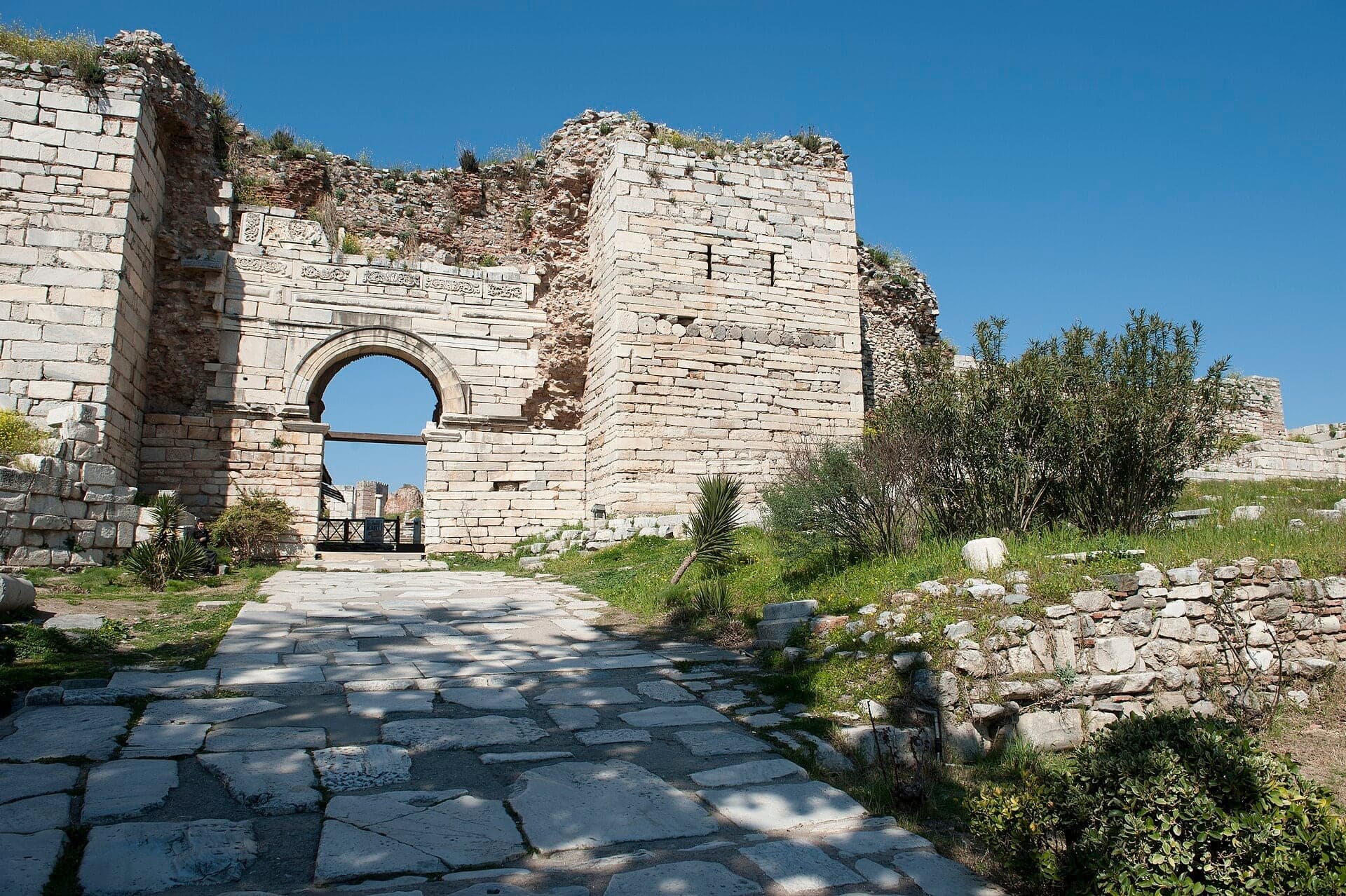
On the same slope spread the wide foundations of the Basilica of Saint John, a great domed cruciform church commissioned by the emperor Justinian, usually dated about 548 to 565 A D. By church tradition, Saint John the Evangelist spent his last years preaching at Ephesus and was buried on this spot, and the grave still marks the crossing of the plan. That connection is tradition, not plain fact, and the tour is careful to say so. What is solid is the building's later life: the monograms of Justinian and the empress Theodora are carved on some of its capitals, and after the Turkish conquest of the fourteenth century the church became a mosque before falling to ruin. The walk reaches it at the Gate of Persecution, where Roman sarcophagus reliefs of the Trojan War were set over the arch in the eighth century and later read as a Christian story; travellers took the scene for a martyrdom, which is how the gate got its name.
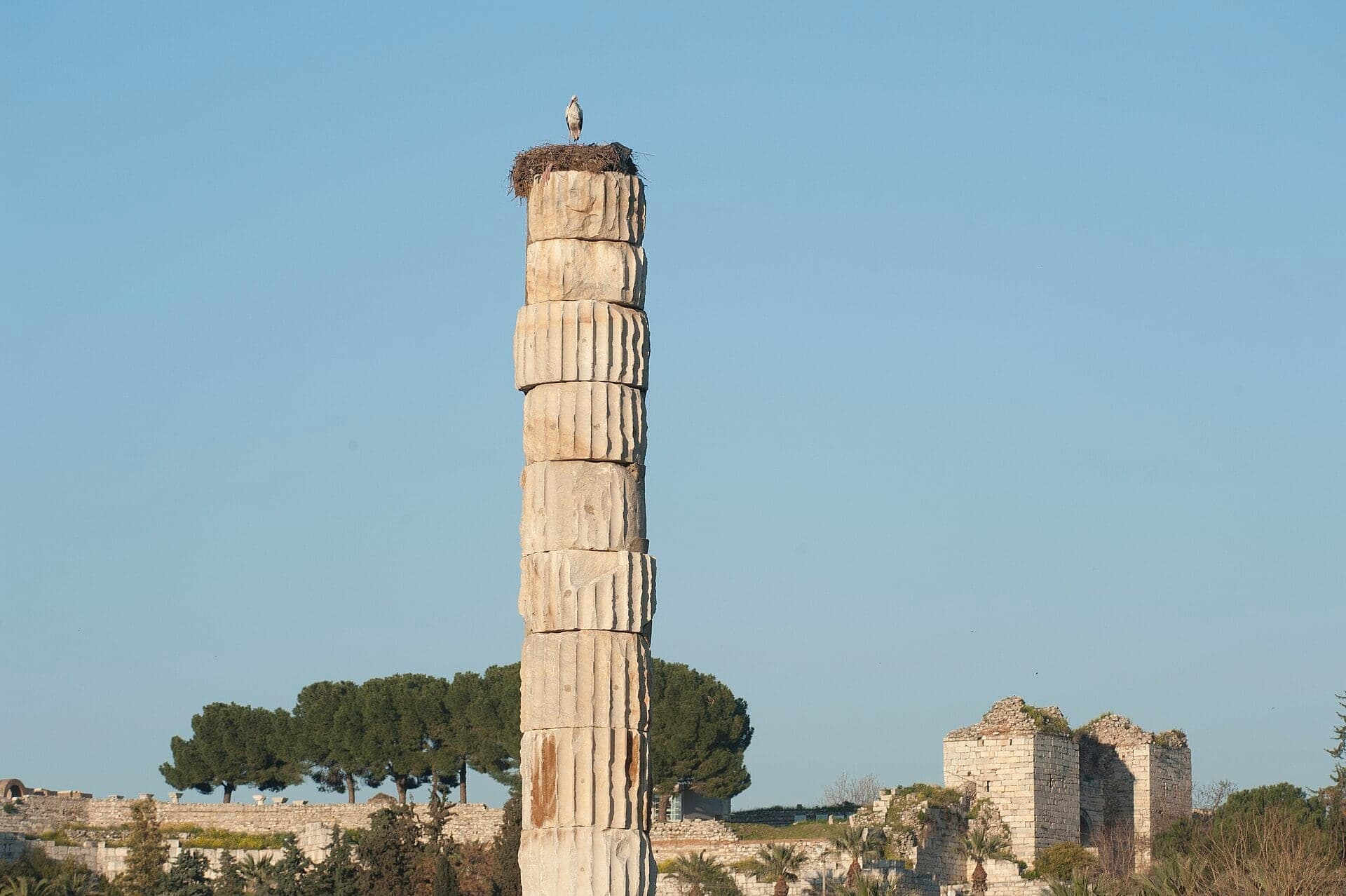
In spring and summer storks build great untidy nests on top of the aqueduct piers; they arrive in mid-March and most have left by the end of August. Selcuk is the living successor to both Ephesus on the plain and medieval Ayasuluk on the hill. Both emptied out. This town did not. The modern name has only been used since 1914, honouring the Seljuk Turks. And the walk ends where the stones came from: the field of the Temple of Artemis, where Croesus's Ephesus once stood around the temple, and where the goddess you met in the museum had her house.
Walk it in order
The sequence matters here more than in most cities, because each stop reframes the last. The self-guided Temple of Artemis and Ayasuluk Hill: Where Ephesus Went tour has nine stops over just under three kilometres, about an hour and a half, with a few steps but no climb. The museum and the basilica are ticketed; the ministry lists no ticket for the temple field, so check at the site before you count on going in. You can compare the route with the other Selcuk options among the Selcuk (Ephesus) walking tours, or start from the Selcuk (Ephesus) city page. Begin, as the tour does, at the Ephesus Museum. Meet the goddess, follow her stones through a town that kept changing faith, and let the empty field do its work at the end.
Sources
- Pliny, Natural History 36.21; Herodotus 1.92; Strabo, Geography 14.1.21-22; Valerius Maximus 8.14; Plutarch, Life of Alexander 3: the temple's building, Croesus's columns, Herostratus and the fire.
- "The Temple of Artemis at Ephesus", ISPRS Annals X-M-1-2023: the Late Classical temple, its columns, its destruction and burial in river mud.
- M. Weissl, "Grundzuege der Bau- und Schichtenfolge im Artemision von Ephesos" (Austrian Archaeological Institute): the temple's phases and John Turtle Wood's 1869 discovery.
- G. Wiplinger, "De aquaeductu urbis Ephesi", BABESCH Byvanck Lecture 2019: the Byzantine aqueduct bridge, its engineer Lazaros and its piers of temple stone.
- Selcuk District Governorship, "Isabey Camii", and Museum With No Frontiers, "Isa Bey Mosque": the 1375 inscription, Ali of Damascus and the temple marble in the west facade.
- Procopius, Buildings 5.1, and Turkish Archaeological News, "Basilica of Saint John and Ayasuluk Fortress": Justinian's church, its monograms and its later life.
- Ephesus Museum, Selcuk, official page on muze.gov.tr: the Artemis statues and the museum's halls.
Ready to experience it?
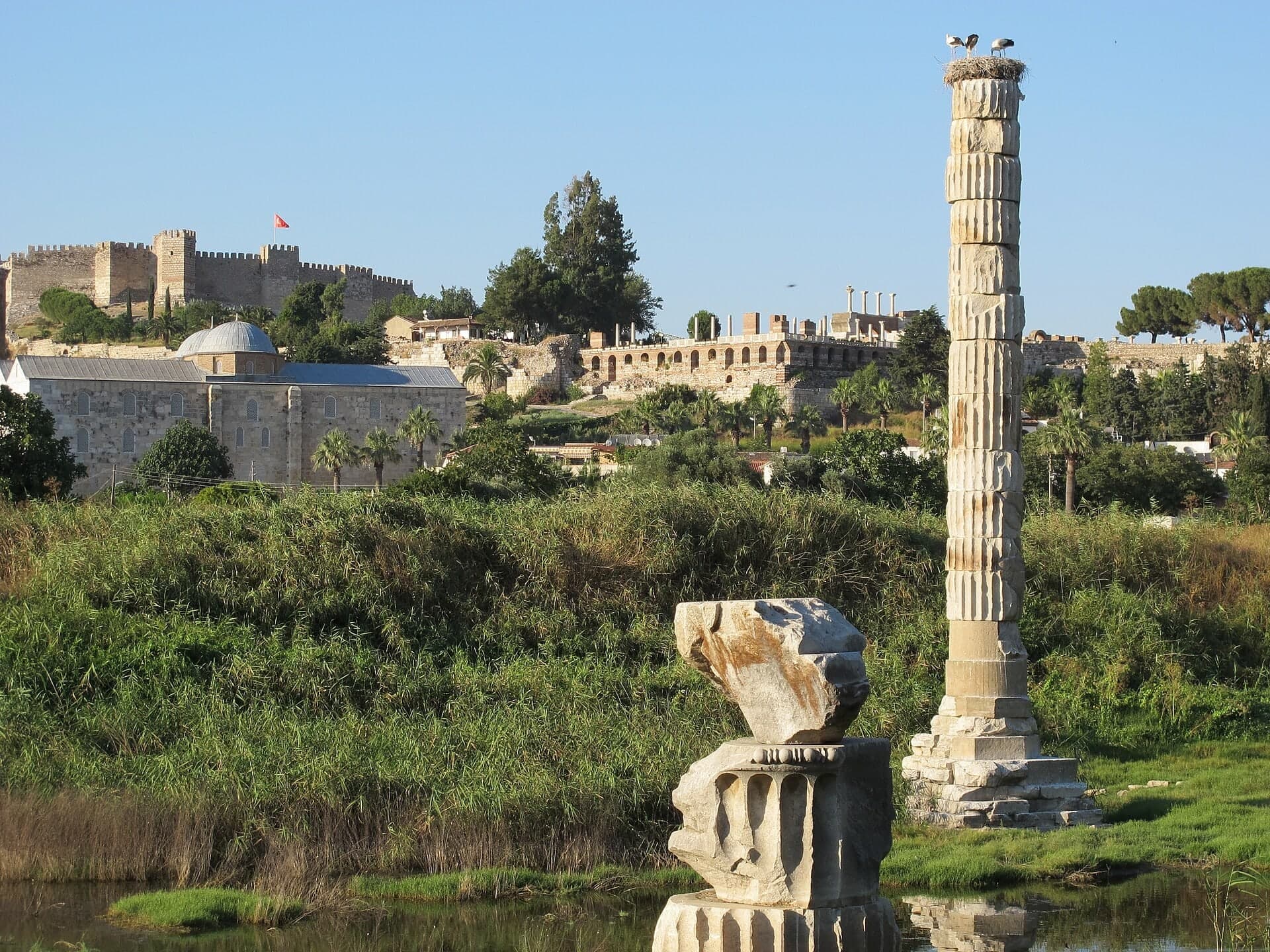
Temple of Artemis and Ayasuluk Hill: Where Ephesus Went
90 min · 2.8 km · easy
More from Selcuk
Explore more at your own pace.
One Day in Selcuk and Ephesus: A Walkable Morning-to-Evening Itinerary
Selcuk and Ephesus Travel Guide: Days, Transport, Costs, Safety
Selcuk: The Afterlife of Ephesus
Curetes Street: How to Read the Whole Marble City of Ephesus
The Basilica of Saint John: Justinian's Church Built Over a Tomb