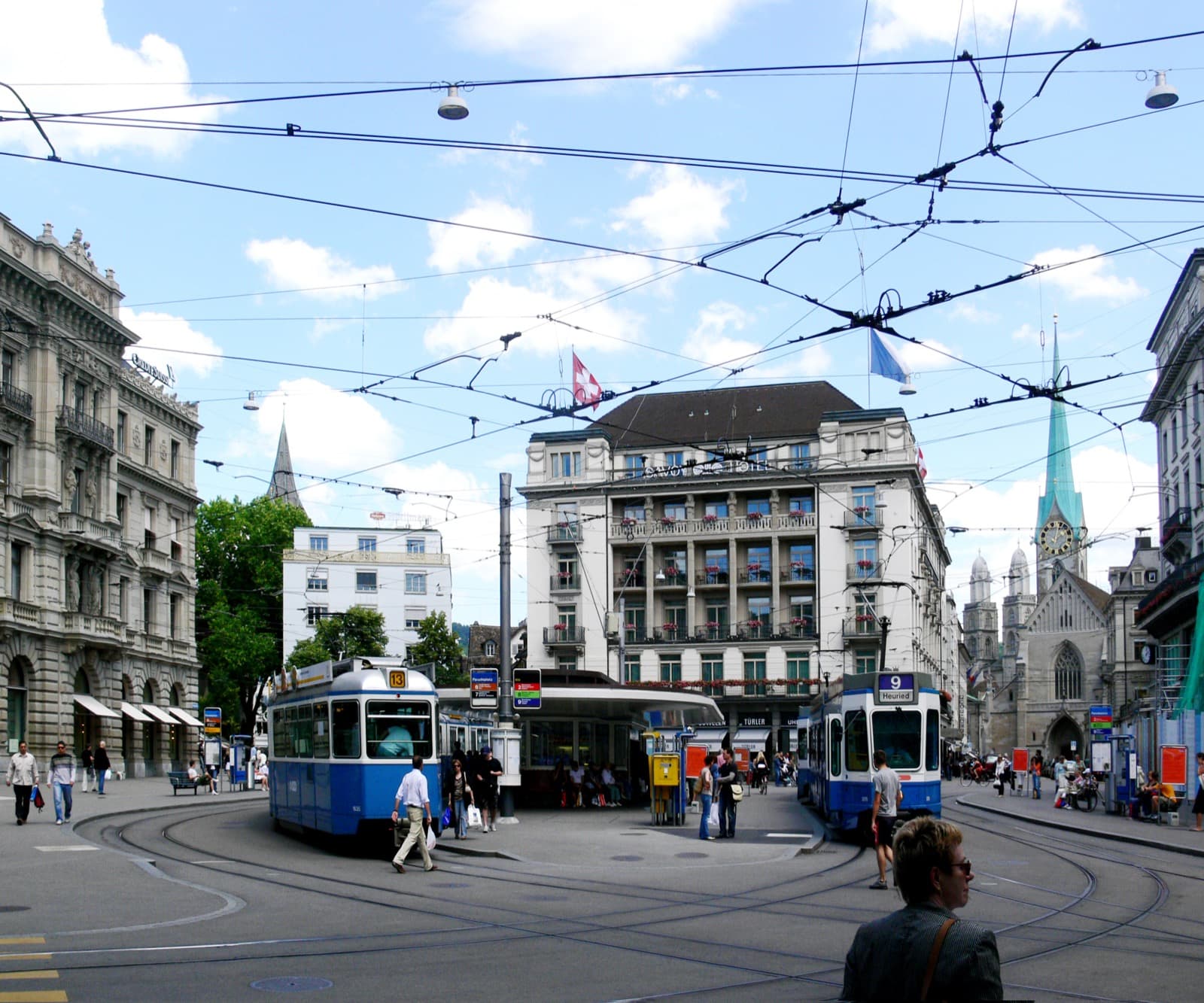
Paradeplatz is a quiet square about halfway down Zurich's Bahnhofstrasse that carries more weight than any other patch of pavement in Switzerland: it is the traditional heart of the country's banking, it sits on the ground of a former pig market, and beneath its legend of buried gold lies a documented reckoning over Holocaust-era bank accounts. Stand on it and you are standing where a merchant republic learned to turn earth into money, and where, in the nineteen nineties, that money had to answer for its wartime past. Read this one square carefully and you have read most of modern Zurich.
From pig market to banking address
Begin with the name, because Paradeplatz did not always sound so grand. For centuries this open ground was a livestock market, known in Swiss German as the Saeumaert, a pig market held on the edge of the walled town. In eighteen nineteen it was renamed Neumarkt, the new market. Only in eighteen sixty-five did it take the name it carries now, Paradeplatz, and that change of name is the whole story in miniature.
What happened in between was Bahnhofstrasse. When Zurich pulled down its medieval fortifications, the city laid out its grand avenue from eighteen sixty-four along the line of the filled-in moat, running straight from the new railway station down to the lake. The moment that broad, tree-lined street reached this old market ground, the ground became valuable. A square where farmers once sold pigs turned into a grand address, and the address attracted the banks. The renaming to Paradeplatz in eighteen sixty-five was the city recognizing what it had made. One of the great Swiss banks, Schweizerische Kreditanstalt, the institution that later became Credit Suisse, had already been founded here in eighteen fifty-six by Alfred Escher to finance the country's railways, and it fixed its headquarters on this square. Within a single generation the livestock market had become the banking heart of the nation.
That compression is worth holding onto as you stand there. The pavement is calm, almost anticlimactic for a place with this reputation. There is no soaring skyline, no monumental gesture. The power of Paradeplatz is deliberately understated, which is itself very Swiss. The headquarters of the country's largest banks gather around a square that could pass, at a glance, for an ordinary tram junction. If you want to understand Zurich walking tours as a whole, this restraint is the lesson: the money here does not shout.
The legend of the gold, and the ground truth beneath it
Hear a stop from this walk
The Quaibruecke: The View to the Alps
By long tradition, great vaults of gold are said to lie beneath this pavement. It is the kind of story a rich city tells about itself, and it is worth naming clearly for what it is: legend, not documented fact. No public record confirms a hoard under Paradeplatz. But the story persists because it captures something true about how the world pictures Swiss banking, discreet, subterranean, unimaginably deep. The city half-enjoys the myth, and so should you, as long as you file it under folklore rather than history.
There is, however, a documented weight beneath this square, and it deserves plain words rather than romance. In the nineteen nineties the question of dormant bank accounts from the Holocaust era became a serious public reckoning. The accounts of Jewish depositors who died in the Nazi genocide had, in many cases, gone unreturned to their heirs, and the matter was entangled with Switzerland's restrictive wartime refugee policy, which turned away many Jewish people fleeing Nazi persecution. In nineteen ninety-six an independent commission led by the former United States Federal Reserve chairman Paul Volcker was established to investigate. In August nineteen ninety-eight the country's two largest banks agreed to a settlement of one and a quarter billion dollars.
State this soberly, as the reckoning itself demanded, neither as accusation nor as apology. It is simply part of the honest history of the ground you are standing on. The gleam above the pavement, the watch shops and the marble bank fronts, and the harder ground truth beneath the shine are not two different stories. They are the same square, and Paradeplatz holds both at once. A place that trades on discretion was, in the end, asked to account for what discretion had concealed.
Why this square explains the city
Paradeplatz is the pivot of the walk that runs down Bahnhofstrasse, and there is a reason it falls at the middle rather than the end. The avenue begins at Zurich Main Station, opened in eighteen seventy-one, the largest railway station in Switzerland. It ends at the lake, where the city engineer Arnold Buerkli reclaimed the shoreline in the eighteen eighties using rubble carted from the very fortifications Zurich had demolished. Between the station and the water, the street climbs, in reputation if not in altitude, toward its brightest point. That point is Paradeplatz. A widely cited study in twenty eleven ranked Bahnhofstrasse among the most expensive retail streets in the world, and the banks gather thickest right here.
So the square is where the two Zuriches meet most tightly. One is the older, heavier city: the guild republic that governed from ornate halls like the nearby Zunfthaus zur Meisen until the French Revolution swept the old order away in seventeen ninety-eight, the reformer Huldrych Zwingli's town of the fifteen twenties, the drained moat under the avenue. The other is the postcard city of money, watches and the lake. Paradeplatz is the hinge between them. It was built by turning defences into commerce, a market for animals into a market for capital, and it was later forced to reconcile its comfortable present with an uncomfortable past.
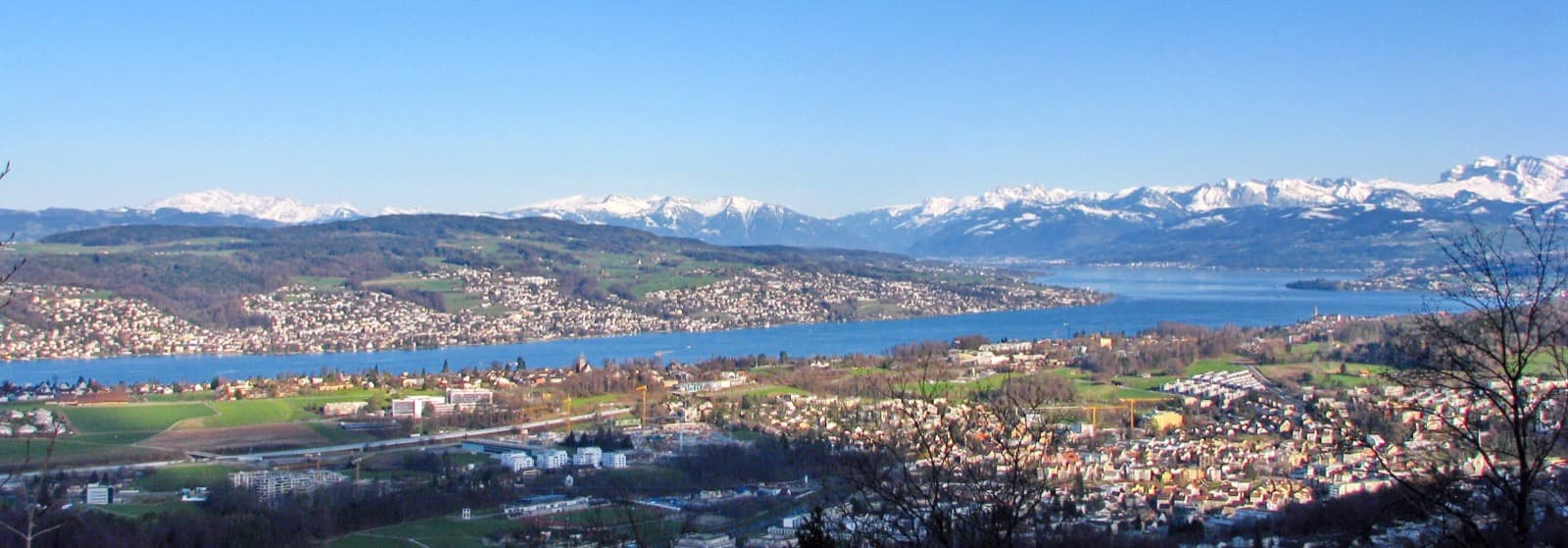
Stand here for a few minutes before you move on. Watch the trams converge and part, notice how little the square announces itself, and remember that under this quiet is a pig market, a legend of gold, and a settlement signed in nineteen ninety-eight. Then keep walking down toward the water, because the same street that made this square rich ends, only a few hundred metres on, at the open lake and the distant Alps. Paradeplatz is the middle of the argument. The lake is where it resolves.
The full walk carries you the whole length of it, from the station to the shore, at your own pace, with no group and no schedule. You can browse the tour and start it from the Zurich city page, and if you want the wider picture first, the guide to Zurich walking tours sets Paradeplatz in the context of the reformation old town and the reborn industrial west. However you begin, begin here, on the quietest important square in Switzerland.
Sources
- Roamer tour transcript, "Bahnhofstrasse: The Street of Gold and the Lake" (fact-audited, audit score 96): primary source for the square's naming history, the pig-market origin, and the Volcker reckoning.
- Paradeplatz (Wikipedia): confirms the Saeumaert livestock-market origin and the 1819 Neumarkt / 1865 Paradeplatz renamings.
- Credit Suisse (Wikipedia): confirms Schweizerische Kreditanstalt was founded by Alfred Escher on Paradeplatz in 1856.
- Volcker Commission (Wikipedia): the independent committee established in 1996 under Paul Volcker to investigate dormant Holocaust-era accounts, and the 1998 settlement of $1.25 billion by the two largest Swiss banks.
- Bahnhofstrasse (Wikipedia): the eighteen sixty-four laying of the avenue on the filled moat and its 2011 ranking among the world's most expensive retail streets.
Ready to experience it?
Bahnhofstrasse: The Street of Gold and the Lake
90 min · 3 km · easy
More from Zurich
Explore more at your own pace.
One Day in Zurich: A Walkable Itinerary from Old Town to the Lake
Zurich: The City That Reformed Itself
Bahnhofstrasse: The Moat Beneath Zurich's Street of Gold
The Grossmünster and the City That Emptied Its Own Churches
Fraumünster: The Abbey of Ruling Women That the Reformation Emptied and Chagall Refilled