The Grossmünster is where Huldrych Zwingli launched the Swiss Reformation in fifteen nineteen, and reading Zurich's old town through this twin-towered minster reveals a city that emptied its own churches out of conviction and then enforced that conviction with real cruelty. Modern Zurich reads as banks, trams and watch shops. The older and stranger story sits in the churches by the river, and the Grossmünster is the room where it began.
The sermon that started it
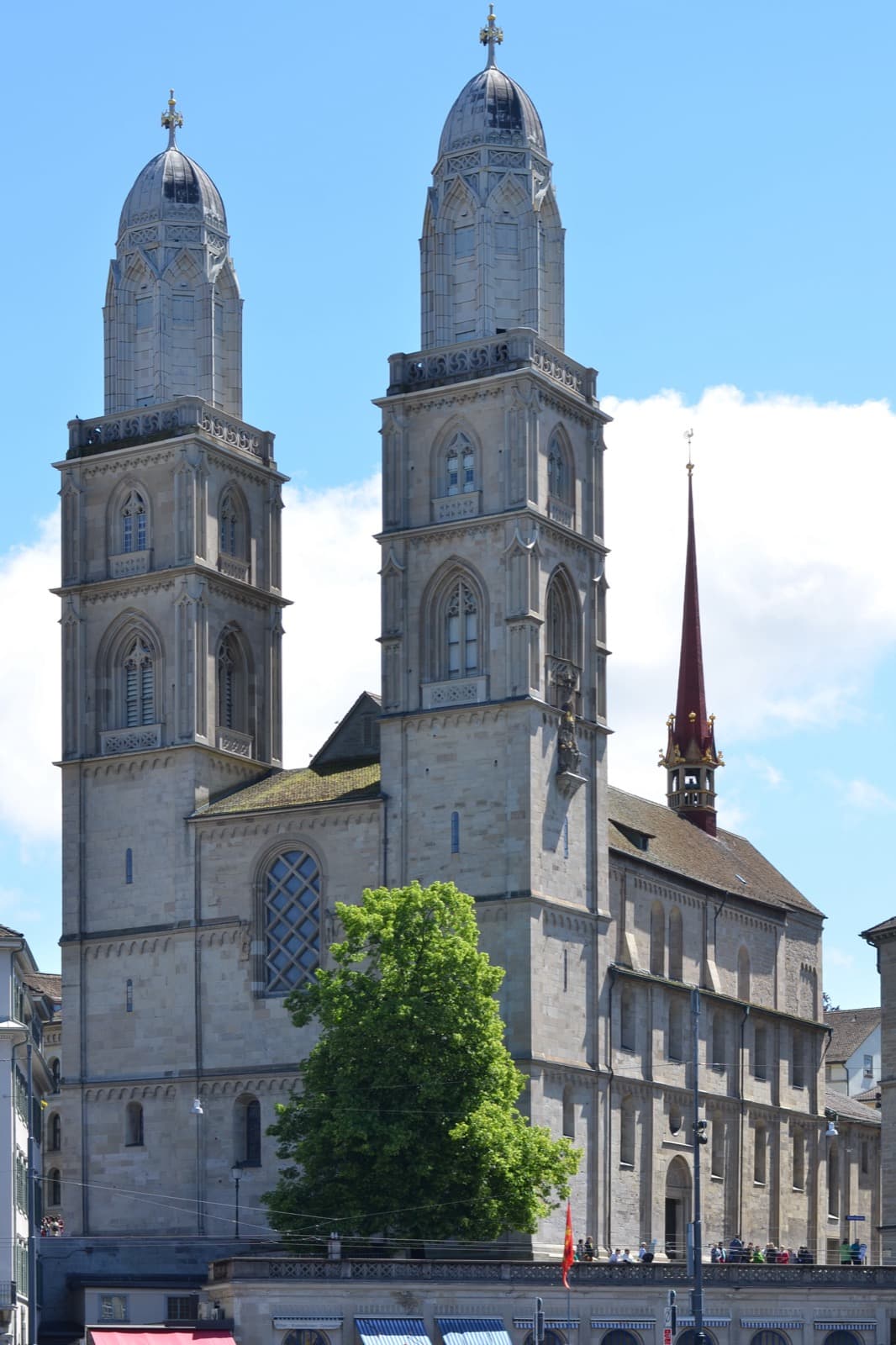
Stand in front of the Romanesque church on the east bank of the Limmat and the towers announce themselves first: two blunt stone shafts capped with the neo-Gothic tops that were added by seventeen eighty-seven after a fire in seventeen sixty-three. The towers themselves went up between fourteen eighty-seven and fourteen ninety-two. The body of the building is older, begun around eleven hundred and inaugurated around twelve twenty. Tradition holds that Charlemagne founded a church on this spot after his horse knelt at the tombs of the city's patron saints Felix, Regula and Exuperantius, and archaeology confirms a Roman burial ground was here.
None of that is why the minster matters far beyond Zurich. On the first of January, fifteen nineteen, a preacher named Huldrych Zwingli, arrived in the city only days before, gave his first sermon here. His argument was that faith should rest on scripture alone, and Zurich followed him. Within five years the church acted on the logic. In fifteen twenty-four the organ and the religious statues were removed and the interior was stripped bare. That plainness is not neglect. It is the argument made physical, and it is the single thread that ties the whole walk together.
Zwingli did not die peacefully. He was killed at the Battle of Kappel on the eleventh of October, fifteen thirty-one, fighting in a war of religion. The man who told Zurich to trust scripture over spectacle ended on a battlefield, and the movement he lit reached far past the city walls. This is the pre-purchase promise of the full tour: it names the reformers plainly and treats the Reformation's cruelties with sobriety rather than spectacle. If you want the wider map of routes, the Zurich walking tours hub gathers them, and the Zurich city page sets the scene.
What the bareness cost
Hear a stop from this walk
Rathaus: The Council House Standing on the River
The empty interior has a companion fact you should carry with you, and the tour puts it on the bridge you cross to reach the minster. In the fifteen twenties this stretch of the green Limmat became a place of execution. Radical reformers known as Anabaptists rejected the baptism of infants and insisted on baptising believing adults. The Zurich council, the same council that followed Zwingli, made adult re-baptism punishable by drowning. Under that edict, Felix Manz, the first Swiss Anabaptist martyr, was drowned in this water on the fifth of January, fifteen twenty-seven.
That is the honest weight of the Grossmünster's story. The reforming city that emptied the churches also killed people for their beliefs in the current running beside them. Conviction and cruelty share the same years and the same water. A walk that skips this is selling you a postcard. The full route lets you stand on the Münsterbrücke, the stone bridge built between eighteen thirty-six and eighteen thirty-eight, and hold both truths at once before you climb the far bank.
The abbey the reformers dissolved
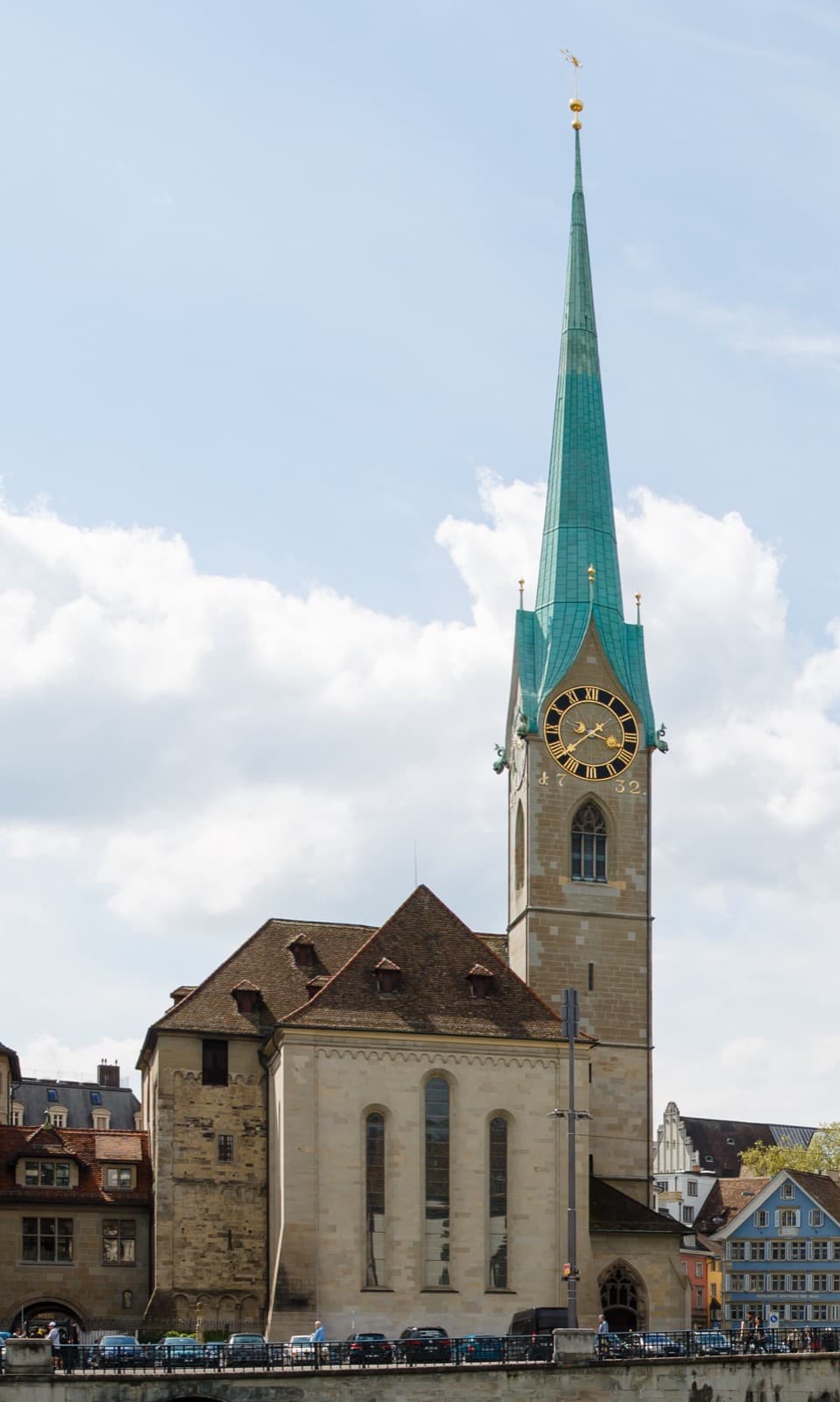
Cross back in your mind to the west bank and the story deepens. The Fraumünster, the Church of Our Lady, was founded in eight fifty-three by Louis the German for his daughter Hildegard, as a convent for women of aristocratic families. These were not cloistered figures without worldly reach. In ten forty-five King Henry the Third granted the abbess the right to hold markets, to collect tolls, and to mint coin, so the money changing hands in early Zurich carried her authority. For centuries an abbess here was, in effect, a ruler of the town.
The Reformation ended that. The abbey was dissolved on the thirtieth of November, fifteen twenty-four, and the church was stripped of its images like the Grossmünster across the river. Then the story folds back on itself. People now come to the Fraumünster for colour, because its choir holds five tall stained-glass windows made by Marc Chagall and installed in nineteen seventy, glowing in deep blue and red. A church emptied of art five centuries ago is visited above all for its glass. Reading the two minsters as a facing pair, one an abbess's power dissolved, one a reformer's austerity begun, is the whole architecture of the walk.
The layers around the minster
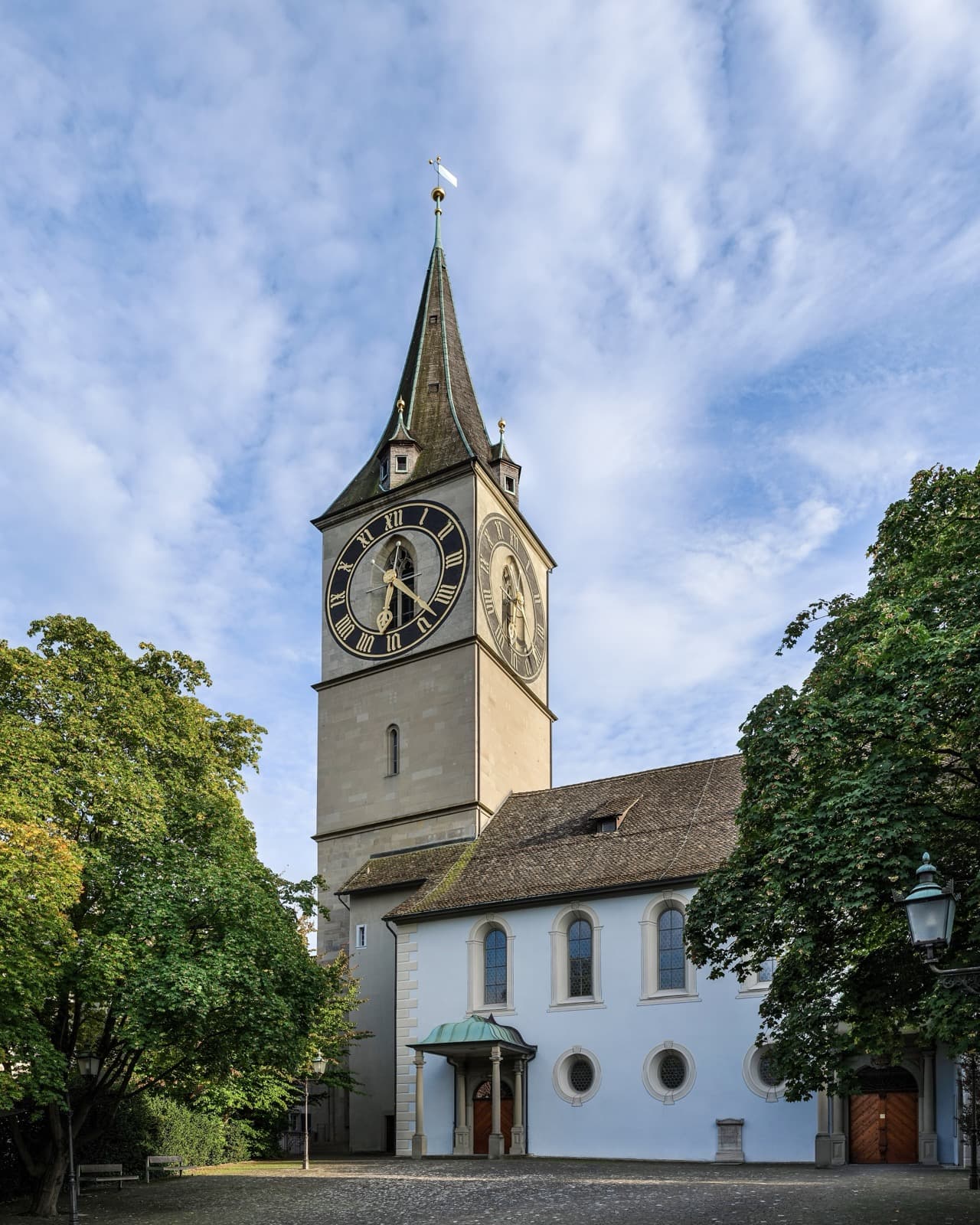
The route earns its keep with the quieter stops too. It begins on Lindenhof, the tree-shaded hill where the Romans built the customs post they called Turicum around fifteen BC, giving the city its name. Just below stands Sankt Peter, the oldest parish church in Zurich, its medieval tower carrying a clock face of eight point six four metres, the largest church clock face in Europe. Its present nave, consecrated in seventeen oh six, is described as the first church built under Protestant rule in the city, so even the timekeeping sits on the far side of the Reformation.
Behind the Grossmünster the tour eases into the Niederdorf, the car-free lower-town quarter the locals call the Dörfli, the little village, a tangle of cobbled lanes to wander without a fixed order. The walk closes at the Rathaus, the Town Hall built between sixteen ninety-four and sixteen ninety-eight with its foundation anchored in the Limmat itself. This was the seat of government of the Republic of Zurich until seventeen ninety-eight, the same council that followed Zwingli, stripped the churches, and ordered the drownings. Ending here draws the arc shut: authority stood on this water for centuries, and it was over this water that the republic decided to remake itself.
Why walk it alone
The old-town heritage largely runs on packaged group circuits and lake cruises. This route hands you a quiet map instead. The whole loop is about two and a half kilometres across seven stops and needs roughly eighty-five minutes at an unhurried pace, longer if you linger, which is the point. You set the clock, pausing where the story catches you, standing as long as you like in the bare choir or on the bridge. Nobody threads the lanes ahead of you. When you reach the Grossmünster and stand with its plain interior and two towers, you will understand what began in that room, and why the emptiness is the message.
Sources
- Grossmünster, Wikipedia. Foundation tradition, tower dates, and Zwingli's fifteen nineteen sermon.
- Fraumünster, Wikipedia. Abbey founding, abbatial minting rights, dissolution, and the Chagall windows.
- Felix Manz, Wikipedia. The fifteen twenty-seven drowning and the Anabaptist persecutions in Zurich.
- St. Peter, Zurich, zuerich.com. The oldest parish church and Europe's largest church clock face.
- Zurich Town Hall, Wikipedia. Construction dates and the seat of the Republic of Zurich.
Ready to experience it?
Old Town: The City That Reformed Itself
85 min · 2.6 km · moderate
More from Zurich
Explore more at your own pace.
One Day in Zurich: A Walkable Itinerary from Old Town to the Lake
Zurich: The City That Reformed Itself
Bahnhofstrasse: The Moat Beneath Zurich's Street of Gold
Fraumünster: The Abbey of Ruling Women That the Reformation Emptied and Chagall Refilled
Im Viadukt: How Zurich Turned a Railway Wall Into a Market Street