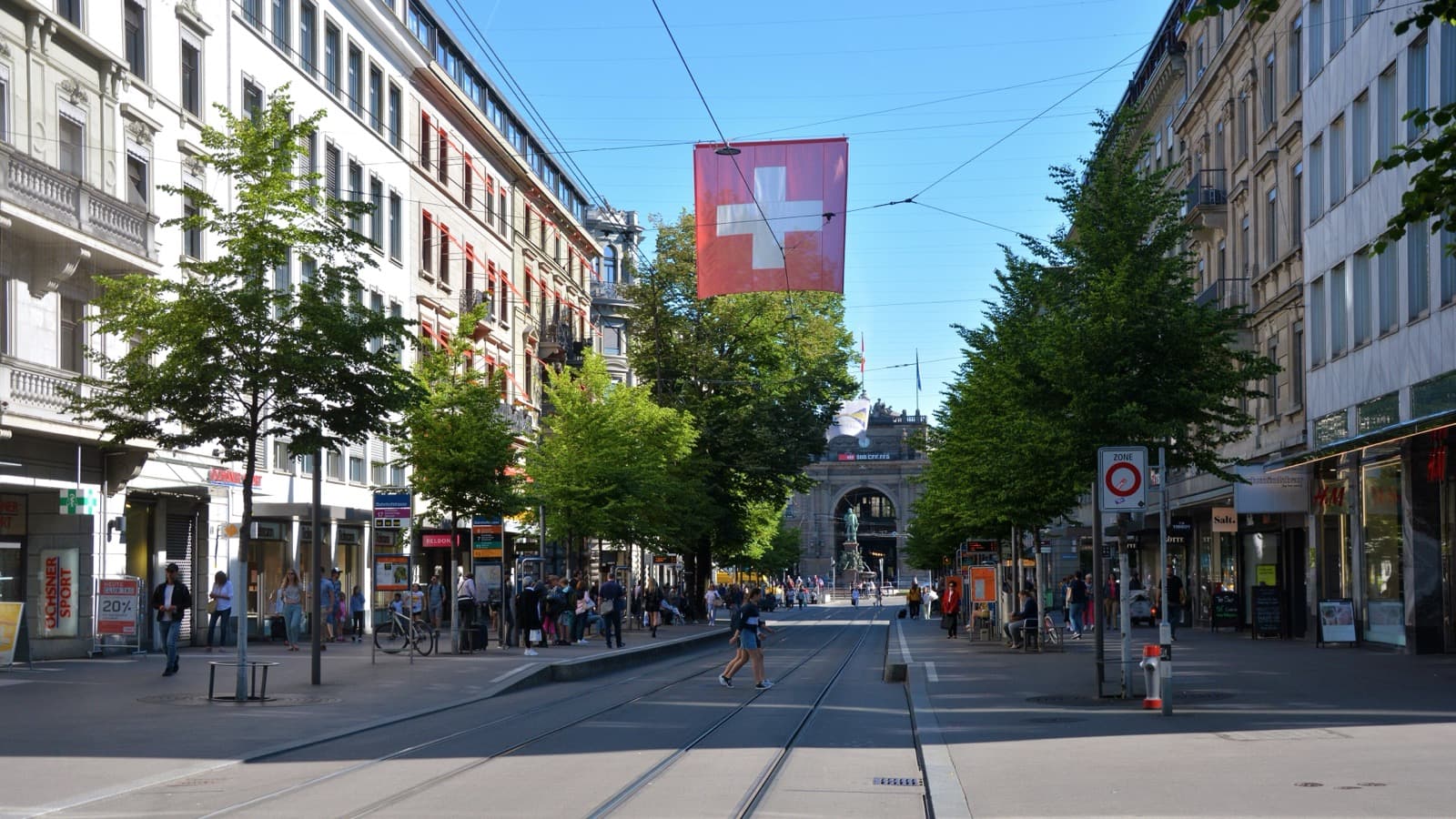
Bahnhofstrasse, the avenue most travelers know as Zurich's street of gold, sits on a filled-in medieval moat. The broad, tram-threaded promenade lined with watch shops and bank headquarters runs along the exact line of the city's old defensive ditch, drained and paved over in the eighteen sixties. Once you know that a defense became a display, the whole avenue reads differently, and so does the city it points toward. A walk down Bahnhofstrasse from the main station to Lake Zurich is really a walk through the moment Zurich stopped fearing a siege and started selling the frontage.
A street where a moat used to be
When Zurich pulled down its medieval fortifications, the city laid out Bahnhofstrasse from eighteen sixty-four directly along the line of the filled-in moat. That moat even had a homely local name, the Froeschengraben, the ditch of the frogs. So the grandest address in the country is quite literally the trace of the old walls, softened into a lime-lined boulevard. It runs about one and a half kilometres from the station down to the lake, largely given over to walkers with trams running through it.
The avenue became famous for one thing above all: money made visible. A widely cited study in twenty eleven ranked Bahnhofstrasse the most expensive retail street in Europe and among the most expensive in the world, and it is still often described that way. Watches, jewellery and the great luxury names fill these blocks. But the engineering underneath matters as much as the shine on top. This was a confident nineteenth-century decision to sweep away walls and replace them with commerce and light. A city that could no longer imagine being besieged filled its moat and rented out the edge.
That single fact, a moat turned into a market, is the argument of the entire route. If you want the full context and the other Zurich routes that pair with it, the Zurich walking tours hub gathers them, and the Zurich city page holds the practical details.
What the avenue points toward
Hear a stop from this walk
The Quaibruecke: The View to the Alps
Bahnhofstrasse does not stand alone; it is a spine, and each stop along it deepens the same idea. The walk begins at the head of the avenue, where Zurich Main Station, opened in eighteen seventy-one to the design of the architect Jakob Friedrich Wanner, turns its monumental front to face the new street. It is the largest railway station in Switzerland. Across the tracks, on the peninsula between the Limmat and the Sihl, the Swiss National Museum, opened in eighteen ninety-eight to a design by Gustav Gull, rises in deliberate castle-like historicism, a fortress built for memory rather than defense. The avenue opens between the practical machinery of the railway and the castle of national memory, and then runs straight toward the water.
About halfway down comes Paradeplatz, the traditional heart of Swiss banking and the headquarters square of the country's largest banks. The square took its present name in eighteen sixty-five, the year Bahnhofstrasse opened through to the station, and the great banks gathered here in the decades that followed, raising their headquarters around its edges. Before that it was something far earthier: for centuries this was a livestock market, the Saeumaert, a pig market on open ground, renamed Neumarkt in eighteen nineteen and Paradeplatz only in eighteen sixty-five, once Bahnhofstrasse had turned it into a grand address. The banking heart of Switzerland stands on an old market for pigs.
Paradeplatz carries a heavier history too, and it deserves plain words. In the nineteen nineties the question of dormant bank accounts from the Holocaust era, together with Switzerland's restrictive wartime refugee policy that turned away many Jewish people fleeing Nazi persecution, became a serious reckoning. An independent commission led by the former US Federal Reserve chairman Paul Volcker was set up in nineteen ninety-six to investigate, and in nineteen ninety-eight the two largest banks agreed to a settlement of one and a quarter billion dollars. The long-told story of gold vaults beneath the pavement is legend, the kind a rich city tells about itself. The settlement is documented fact. The square holds both.
The older republic, and the reclaimed shore
Step one block off the lower avenue toward the Fraumuenster and the story reaches back before the banks. The Zunfthaus zur Meisen, a guild house built in seventeen fifty-seven by the architect David Morf for the wine merchants' guild, curves in pale late-Baroque lines near Muensterhof. Behind that elegant front sits a form of government. From the guild constitution of thirteen thirty-six, drawn up under Rudolf Brun, the guild masters governed Zurich, and for more than four centuries these merchant and craft brotherhoods ran the city-republic. That regime ended abruptly in the spring of seventeen ninety-eight, when the armies of the French Revolution dissolved the old order. The guilds are not entirely gone, though; the city still celebrates them each spring at the Sechselaeuten festival.
The avenue ends at the water, and the water is engineered too. Buerkliplatz, at the foot of Bahnhofstrasse where the River Limmat leaves the lake, is named after the city engineer Arnold Buerkli. Between eighteen eighty-one and eighteen eighty-seven, Buerkli directed the building of the lakeside quays, reclaiming land from the water using rubble carted from the demolished city fortifications. The same stones that once walled Zurich in were tipped into the lake to make the promenade. The old defenses became the avenue behind you and the ground beneath your feet.
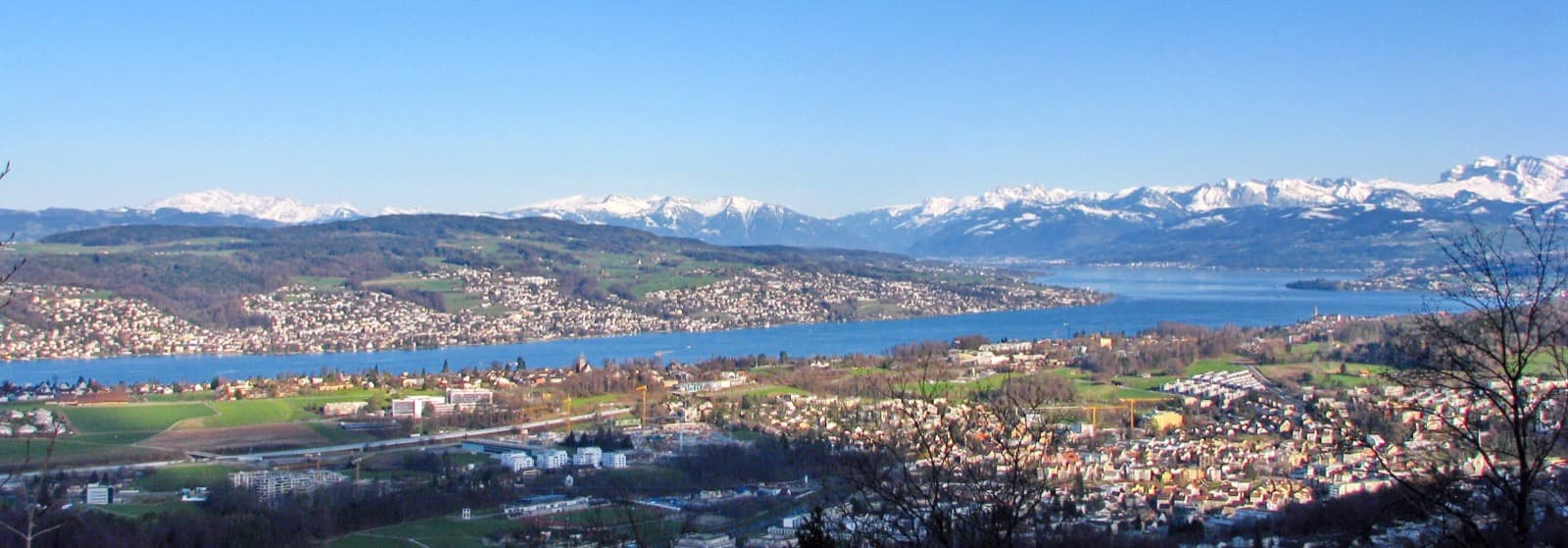
Cross to the eastern shore and the confident decade completes itself. The quays, the Quaianlagen, run about three kilometres of reclaimed shore; the chestnut trees along the Utoquai walk were planted in eighteen eighty-seven, as old as the quay. At the head stands the Opera House, opened in eighteen ninety-one to a design by the Viennese architects Fellner and Helmer, built on reclaimed ground and, in a small technical distinction, the first opera house in Europe lit by electricity. End on the Quaibruecke, the lake bridge built between eighteen eighty and eighteen eighty-four and opened on the first of January eighteen eighty-five, its longest span about one hundred and twenty metres. From the middle of it, river, lake, old town and the distant Alps all open at once.
Why walk it yourself
The whole logic of Bahnhofstrasse rewards an unhurried pace. This is a flat, largely pedestrian route of about three kilometres over seven stops, roughly ninety minutes to two hours if you linger. Walk it downhill from the station so the route ends on the open water, and pause on the bridge long enough to see the moat, the money and the mountains as one connected geography. The self-guided audio tour narrates each stop where you stand, with the dates and engineers named as you go, and lets you sit by the lake as long as you please. Zurich, entire, found at your own pace.
Sources
- Bahnhofstrasse (Wikipedia): history of the avenue laid on the filled-in Froeschengraben moat from eighteen sixty-four, and its ranking among Europe's and the world's most expensive retail streets.
- Paradeplatz and Volcker Commission (Wikipedia): the square's pig-market origins, its eighteen sixty-five renaming, and the nineteen ninety-eight dormant-accounts settlement.
- Zunfthaus zur Meisen and Rudolf Brun (Wikipedia, Britannica): the seventeen fifty-seven guild house and the thirteen thirty-six guild constitution that governed Zurich until seventeen ninety-eight.
- Quaianlagen and Zurich Opera House (Wikipedia): Arnold Buerkli's eighteen eighties quay reclamation and the eighteen ninety-one Opera House lit by electricity.
- Zurich Hauptbahnhof and Swiss National Museum (Wikipedia): the eighteen seventy-one station by Jakob Friedrich Wanner and the eighteen ninety-eight museum by Gustav Gull at the head of the avenue.
Ready to experience it?
Bahnhofstrasse: The Street of Gold and the Lake
90 min · 3 km · easy
More from Zurich
Explore more at your own pace.
One Day in Zurich: A Walkable Itinerary from Old Town to the Lake
Zurich: The City That Reformed Itself
The Grossmünster and the City That Emptied Its Own Churches
Fraumünster: The Abbey of Ruling Women That the Reformation Emptied and Chagall Refilled
Im Viadukt: How Zurich Turned a Railway Wall Into a Market Street