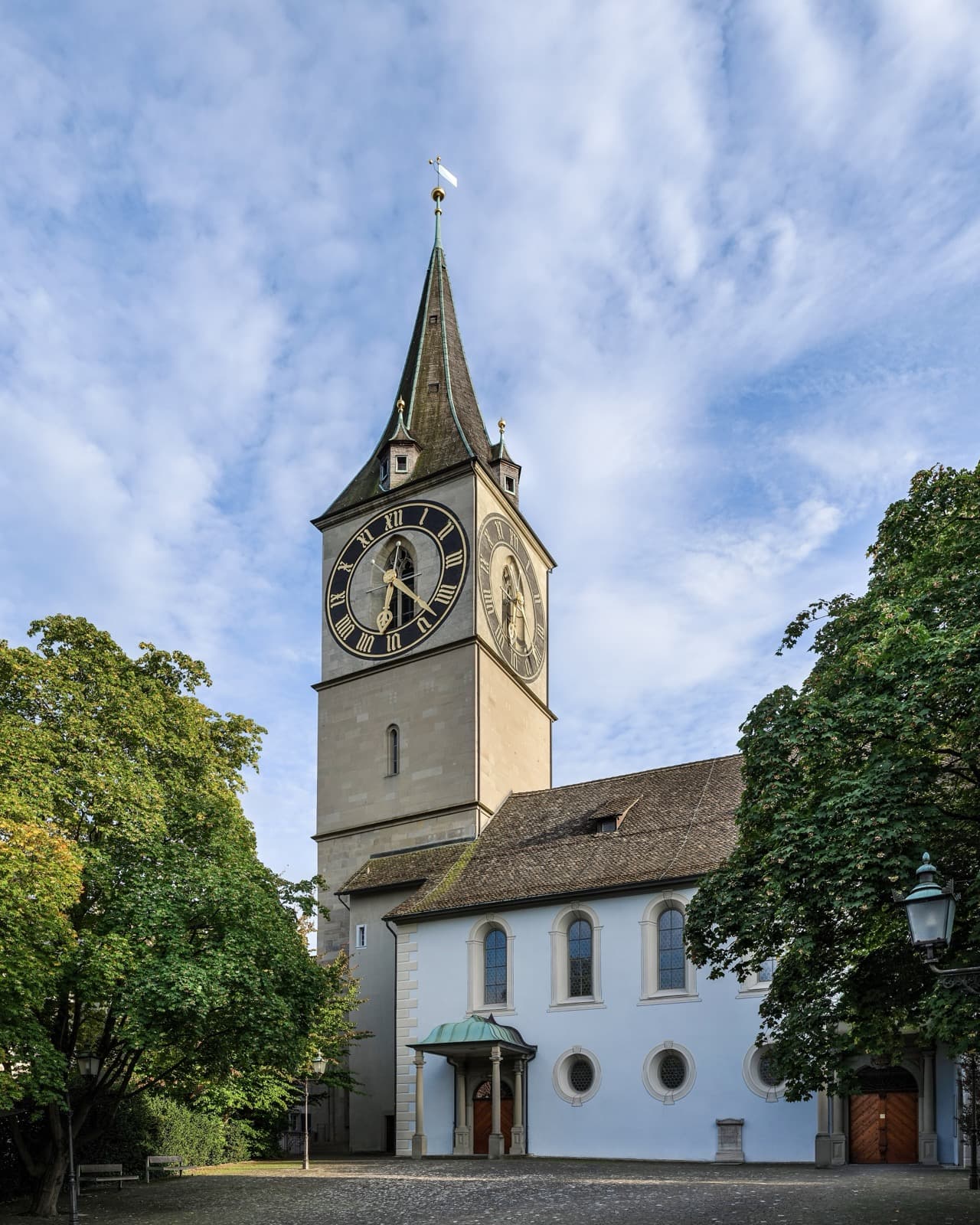
The Fraumünster is a former abbey whose abbesses once held the right to mint Zurich's coin, was emptied of its images during the Reformation of 1524, and is now visited above all for the five stained-glass windows Marc Chagall made for its choir in 1970. That is the whole strange arc of the building in one sentence: worldly power, then deliberate bareness, then color again. Standing in front of its slender green spire on the west bank of the Limmat, most visitors read a pretty river church. The more accurate reading is a thousand-year argument about who runs a city and what a church is allowed to show.
An abbey founded for a king's daughter
The name says minster, and "muenster" is the German word for it, but the Fraumünster began as a convent. Louis the German, a grandson of Charlemagne, founded it in 853 for his daughter Hildegard, as a house for women drawn from aristocratic families. That founding is the first thing to hold onto, because these were not cloistered women removed from the world. They ran an institution that reached into the daily business of the town below.
The power was formal and financial. In 1045 King Henry the Third granted the abbess the right to hold markets, to collect tolls, and to mint coin. Read that again: the money changing hands in early Zurich carried the authority of the woman who ran this church. In 1218 the emperor confirmed the abbey's imperial independence, which set the abbess outside the reach of local lords and directly under the crown. For centuries an abbess of the Fraumünster was, in practical terms, a ruler of the town. When you stand here, the useful correction to make is this: for much of the medieval period, one of the most powerful figures in Zurich was not a bishop or a burgomaster but the woman in charge of this abbey.
The reformer's city empties its own church
Hear a stop from this walk
Rathaus: The Council House Standing on the River
Then came the break that this whole quarter of the old town is built around. In the 1510s and 1520s a preacher named Huldrych Zwingli, working from the Grossmünster across the river, argued that faith should rest on scripture alone and that a church cluttered with images and relics had lost its way. Zurich, remarkably, agreed with him and acted on it.
The Fraumünster was dissolved on 30 November 1524, and the church was stripped of its images and turned to Protestant use, its walls left bare. What is easy to miss on the tourism plaques is who did the handing over. The last abbess, Katharina von Zimmern, born in 1478 and elected to the office in 1496, did not fight the change. She passed the abbey and its rights into the possession of the city rather than defend a thousand-year institution to the point of conflict, and she lived on as a private citizen until 1547. A house of ruling women closed its own doors and gave its authority to the council.
The bareness that resulted is the actual history of the interior, and it is worth insisting on. What you do not see, the removed statues and painted panels and gold, is the point. The Reformation here was not a slow fading of Catholic decoration. It was a decision, taken in a few years, to empty the room on purpose. The same movement and the same council that stripped this church also drowned Anabaptists in the Limmat a few steps away, so the austerity you feel inside is not gentle. It was conviction, and in those years it was also cruelty.
Chagall's return of color
The final turn is the one that fills the church today. In 1970 the choir received five tall stained-glass windows by Marc Chagall, the Russian-French modernist, who was in his early eighties when he completed them. Reported at roughly ten metres tall, they run in deep blues and reds and carry scenes drawn from scripture, each window built around a biblical theme. A large window by Augusto Giacometti, made in 1940, adds its own light nearby.
Sit with the irony, because it is the reason to come. A church that was deliberately emptied of art five centuries ago is now visited above all for its art. The Reformation removed the images; a twentieth-century artist put images back, and the city that once tore color out now queues to photograph it. Chagall did not undo the Reformation. He worked with it. His glass reads so strongly precisely because the walls around it are plain, the way a single lit candle reads brighter in a dark room than a bright one. The bareness the reformers created became the frame that makes his blue windows hit.
The one thing to understand standing here
If you take one idea away from the Fraumünster, let it be that this is a building about power changing hands. Founding abbesses held it and coined money with it. A reformed council took it and stripped the church to the stone. A modern painter gave the emptied choir back its color on the city's own terms. Three regimes of authority, one small church on a green river, and each one visible if you know where to look: the imperial founding in the very existence of a royal abbey, the Reformation in the plain walls, and the modern settlement in the glass.
The Fraumünster is the third stop on Roamer's self-guided Old Town: The City That Reformed Itself walk, which traces the Swiss Reformation from the founding hill of Lindenhof, past Sankt Peter and its giant clock, across the Limmat to the Grossmünster where Zwingli preached, and out into the lanes of the Niederdorf. Doing it on foot and alone lets you give the Chagall choir the quiet minutes it rewards, then move on when you are ready rather than when a group is. For the full set of routes through the old town and along the lake, see our guide to Zurich walking tours. Come on a bright day: the blues and reds only wake up in strong light, and the bare stone makes them hit harder.
Sources
- Fraumünster, Wikipedia. Founding in 853 by Louis the German, the abbesses' minting and market rights from 1045, the 1218 imperial independence, the dissolution of 30 November 1524, and the 1970 Chagall windows.
- Katharina von Zimmern, Wikipedia. The last abbess (1478 to 1547), elected in 1496, who handed the abbey to the city of Zurich in late 1524.
- "Marc Chagall's Church Windows at the Fraumünster," zuerich.com. Official city tourism page on the five choir windows and the artist's advanced age when he made them.
- "The Chagall Windows in Fraumünster Church," blog.lumaiere.com. Detail on the five window themes, their reported roughly ten-metre height, and Chagall's age of 83 at completion in 1970.
- Roamer tour transcript, "Old Town: The City That Reformed Itself" (fact-audited, 2026). Primary source for the walk's route and the church's Reformation history.
Ready to experience it?
Old Town: The City That Reformed Itself
85 min · 2.6 km · moderate
More from Zurich
Explore more at your own pace.
One Day in Zurich: A Walkable Itinerary from Old Town to the Lake
Zurich: The City That Reformed Itself
Bahnhofstrasse: The Moat Beneath Zurich's Street of Gold
The Grossmünster and the City That Emptied Its Own Churches
Im Viadukt: How Zurich Turned a Railway Wall Into a Market Street