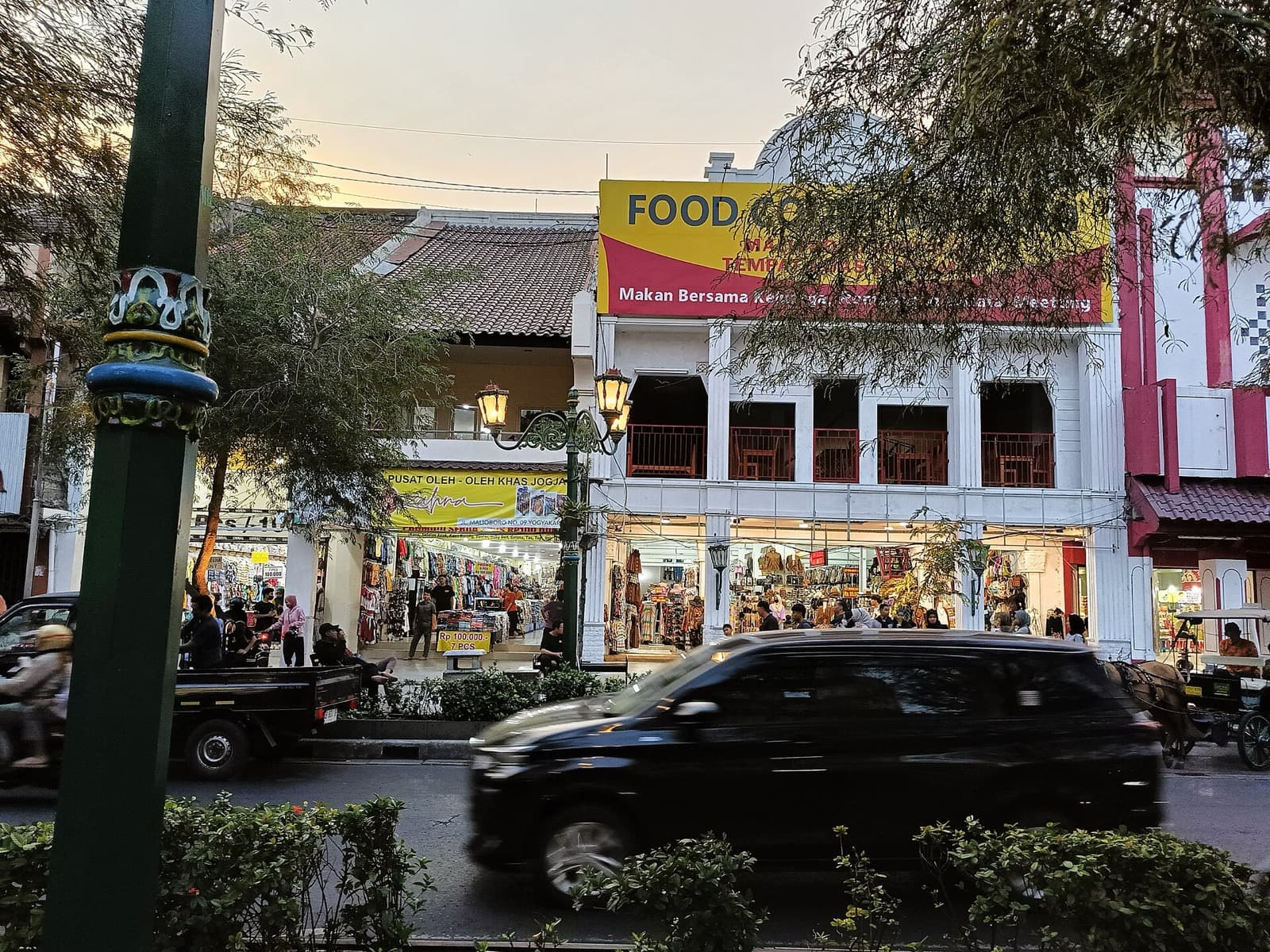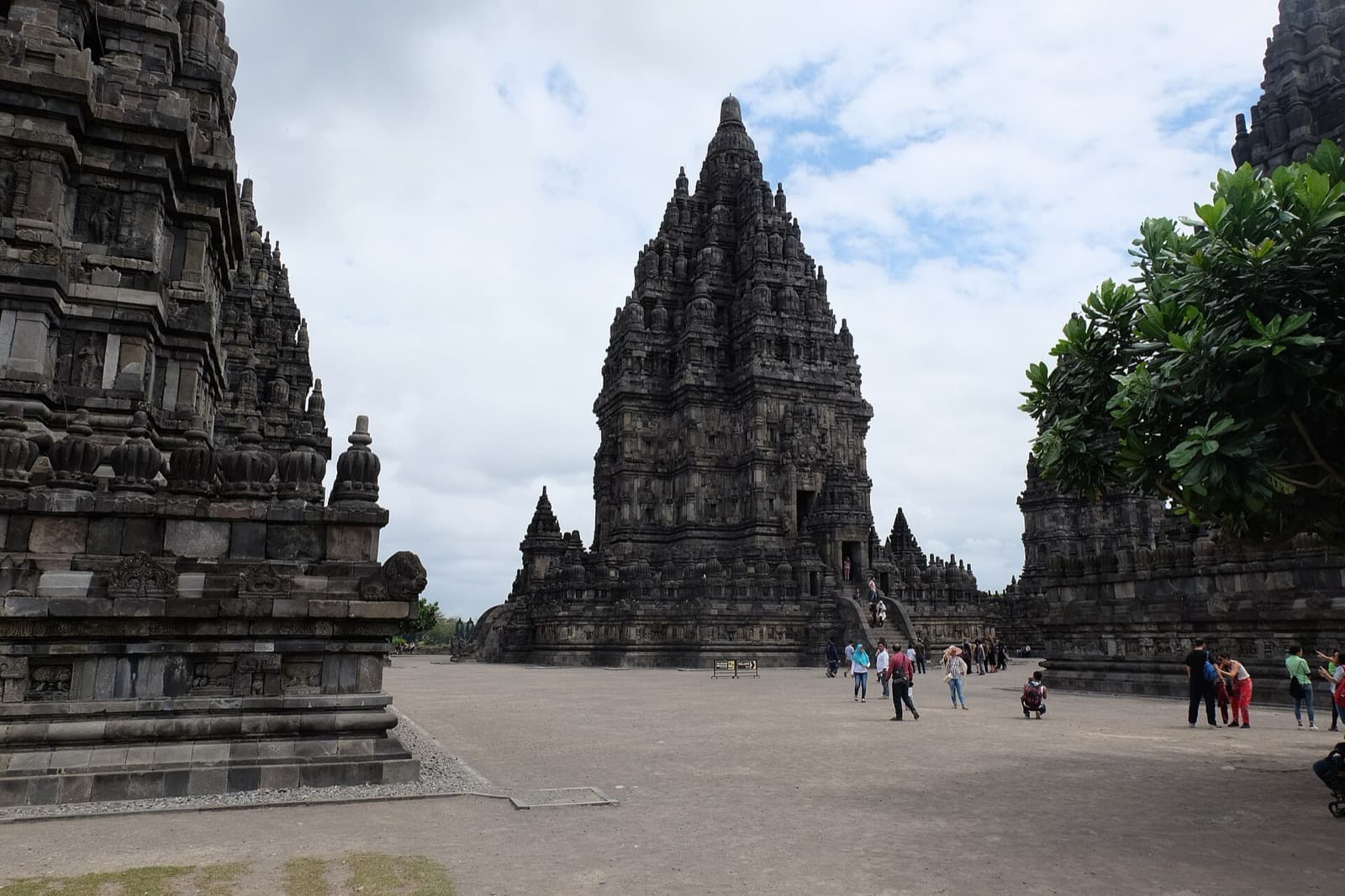
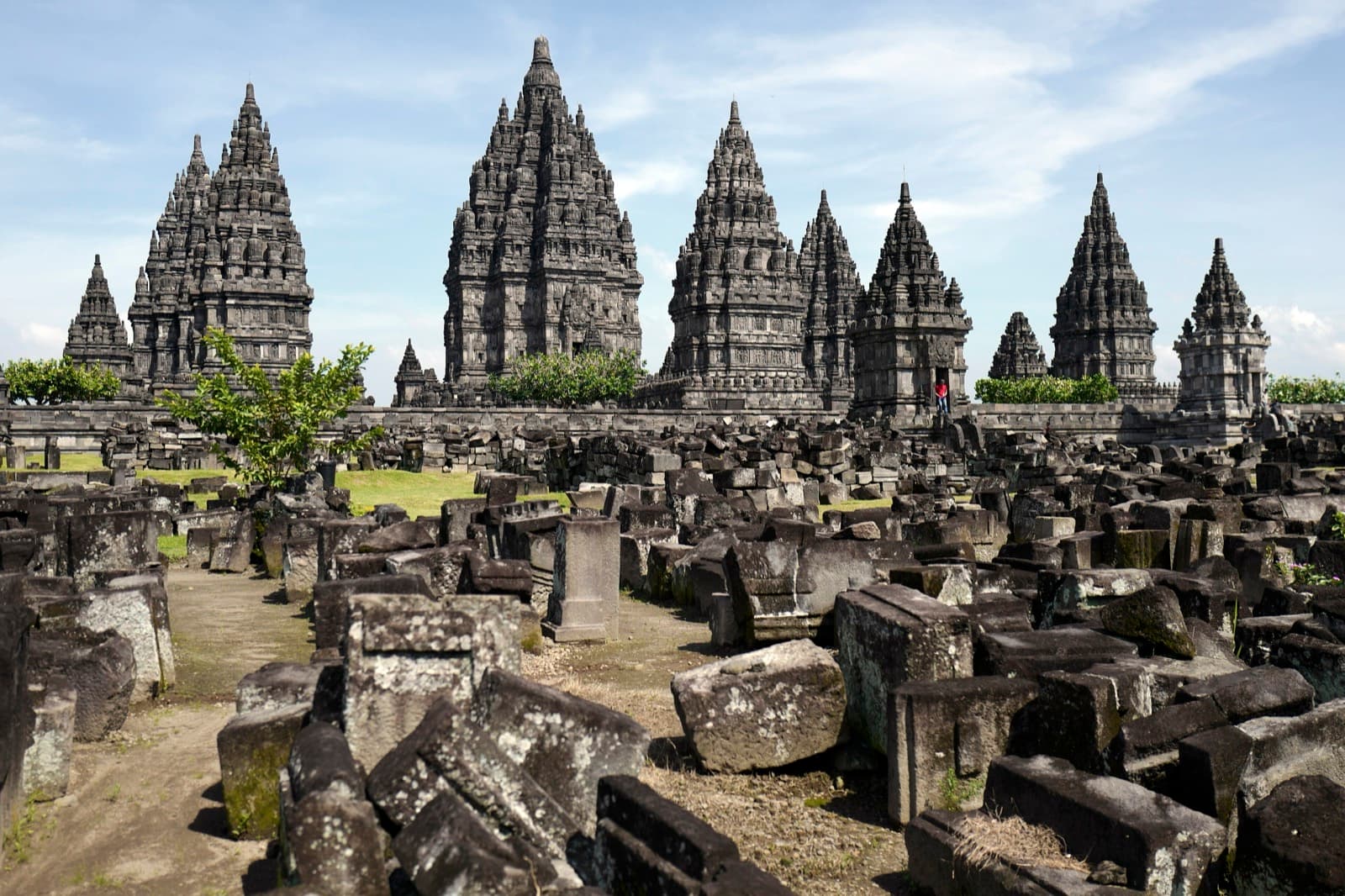
Candi Shiva, the 47-metre central tower at Prambanan, is not a lone monument you photograph and leave. It is the pivot of a ninth-century plan, and the compound around it, hundreds of shrines arranged in concentric rings, only reveals its logic when you walk it slowly and clockwise. Reach the tower and you are standing at the geometric and theological center of Indonesia's largest Hindu temple compound, about seventeen kilometres from Yogyakarta. Everything else on the plain, the flanking towers, the animal-mount shrines, the field of broken perwara, the Ramayana carved along the inner galleries, is organized in relation to this one structure. That is the argument of the whole tour, and Candi Shiva is where it becomes visible.
A tower built as the answer to a question
Prambanan went up around 850 AD under the Hindu Sanjaya line of the Mataram kingdom, likely begun by the king Rakai Pikatan. The Shivagrha inscription dates the inauguration to 856 AD and names the compound the House of Shiva. The timing matters. The great Buddhist monument of Borobudur stood only a short distance away and had been finished a few decades earlier. Prambanan reads as a deliberate Hindu answer on the same plain, and the answer was built vertically. The central Shiva temple measures 47 metres tall and 34 metres wide, the tallest and largest structure on the site.
The word candi simply means a temple. This one is engineered as a cosmic diagram. Its inner sanctum has four chambers facing the four cardinal directions, and the main chamber holds a statue of Shiva Mahadeva, the god to whom the entire compound is dedicated. The height is not decoration. It is a statement of hierarchy, a stone signal of which god the Mataram court held highest, resolved in the most direct architectural terms available: build his tower taller than any other.
The chamber where a princess turns to stone
Hear a stop from this walk
Candi Shiva: The Tallest Temple to a Broken Heart
Walk around to the north chamber and the architecture hands you a story. That chamber holds a statue of Durga Mahisasuramardini, the goddess Durga in the act of slaying a buffalo demon. It is genuine ninth-century sculpture, and a standard, powerful image in Hindu art. Local Javanese tradition, however, identifies this Durga figure with a cursed princess named Loro Jonggrang.
The legend, told plainly as legend and not as history, runs like this. A prince named Bandung Bondowoso wanted to marry the princess, and she set an impossible condition: build a thousand temples in a single night. He nearly managed it, commanding an army of demon workers. Near completion, the princess and her maids lit fires in the east and pounded rice to fake the dawn. The demon workers, believing daybreak had come, fled. Enraged at the trick, the prince cursed the princess to become the final, thousandth statue, the very Durga image standing in this chamber. That folk tale gives the whole compound its Javanese nickname and ties a broken engagement to a royal temple raised more than a thousand years ago. The tower is the tallest temple in the land, and inside it, by legend, a princess turned to stone.
Why the plan needs your feet
Here is what a scheduled group cannot give you at Candi Shiva, and why the tour is built around walking it yourself. The Ramayana epic is carved in bas-relief along the inner galleries, and it is not meant to be glanced at. It begins at the eastern entrance, where you turn left and move clockwise, the circumambulation Hindu ritual calls for, keeping the temple on your left. Panel by panel, the story of the prince Rama, his wife Sita, her abduction, and the war to win her back scrolls past at the pace of your own footsteps. The narrative does not even stop at one tower. It continues from the Shiva temple onto the neighbouring Brahma temple, so reading the epic means physically walking from one structure to the next.
This is the core of what autonomy means here. The reliefs were designed to reward a slow, unhurried reading in the order the sculptors intended, and a hurried tour is the one thing that defeats them. On your own clock you can pause at a single panel for as long as you like and follow the carving rather than a guide's watch.
The compound Candi Shiva organizes
Once you understand the central tower, the rest of the plan clicks into place. Candi Shiva sits at the middle of the Trimurti group, the three highest gods in Hinduism, which UNESCO records as the three great Hindu divinities the compound is dedicated to. To the south rises Candi Brahma, the creator; to the north Candi Vishnu, the preserver; with Shiva the transformer given the tallest tower between them. Prambanan is therefore not a temple to one god but a statement about the whole order of the cosmos, with Shiva at its center.
Facing those three towers across a narrow courtyard stand three smaller vahana shrines, each dedicated to the animal mount of the god opposite. In front of Shiva is the Nandi temple, still holding a large seated-bull statue looking back toward his master. Facing Vishnu is the shrine of Garuda, the eagle-like bird that lends its name to Indonesia's national symbol and airline; facing Brahma, the shrine of Hamsa the swan. Ringing all of it was a field of 224 perwara shrines in four concentric rows, part of the 240 structures the original compound held. Most now lie in ruins after the court moved east in the tenth century and after the 2006 Yogyakarta earthquake, but even as rubble they map the ambition of the plan.
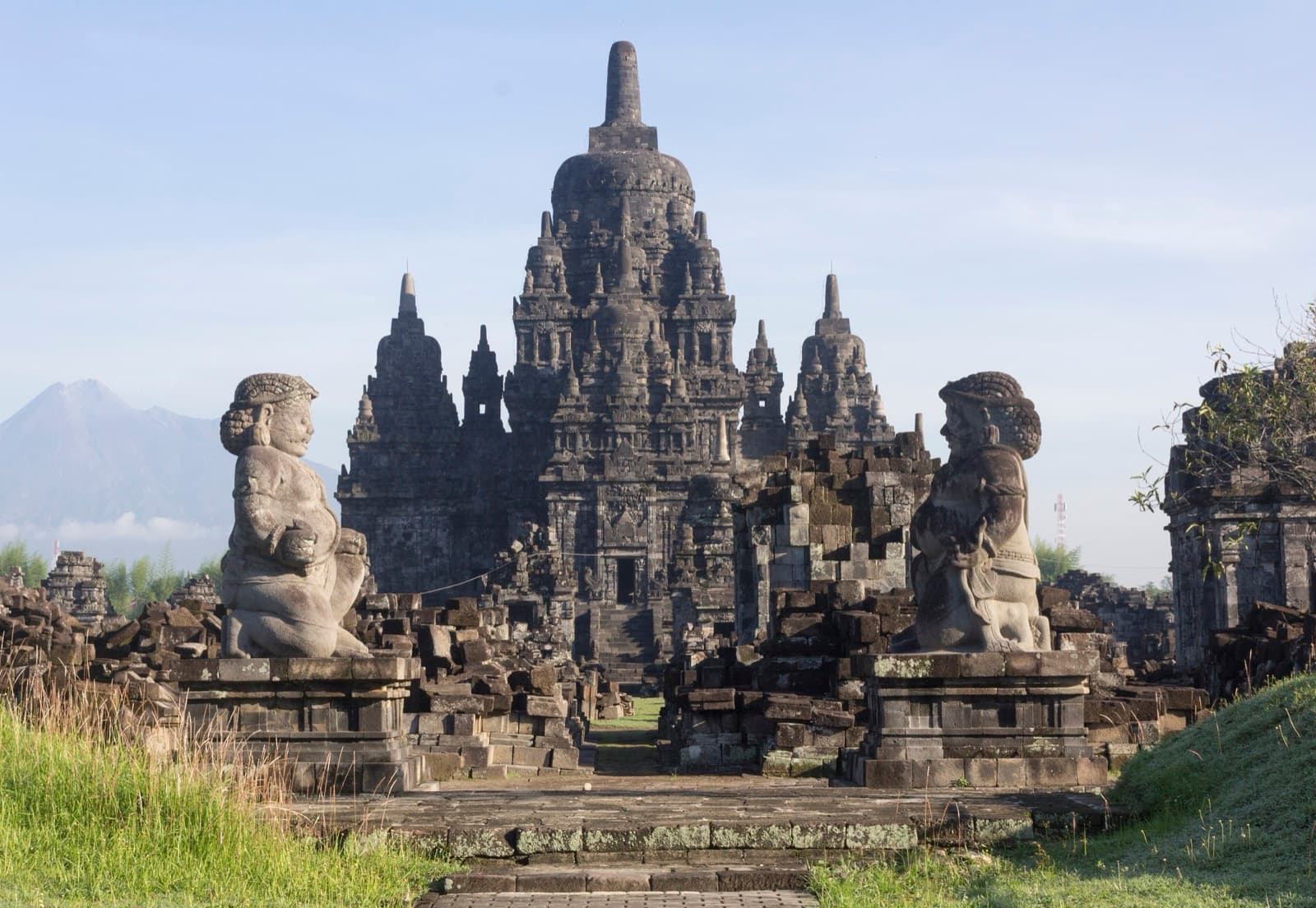
The walk closes about eight hundred metres north at Candi Sewu, a Mahayana Buddhist complex whose Manjusrigrha inscription dates it to 792 AD, older than Prambanan. Its Old Javanese name means a thousand temples, though it actually has 249 structures, and that name comes from the very Loro Jonggrang legend you met at Candi Shiva. A Buddhist ruin, named by a Hindu folk tale. The Prambanan Temple Compounds were inscribed as a UNESCO World Heritage Site in 1991.
Read the full route and the other stops in our guide to Yogyakarta walking tours, then take the walk the way its builders designed it: slowly, clockwise, and in the round.
Sources
- Prambanan Temple Compounds, UNESCO World Heritage Centre (list 642): inscription in 1991, dedication to the three great Hindu divinities, compound plan.
- Shivagrha inscription, Wikipedia: 856 AD inauguration under the Sanjaya line, the House of Shiva dedication.
- Prambanan, Wikipedia: the 47-metre central tower, 240 structures and 224 perwara, reconstruction history, and the Loro Jonggrang legend.
- Sewu and Manjusrigrha inscription, Wikipedia: the 792 AD dating and the 249 structures of Candi Sewu.
- Roamer tour transcript, "Prambanan: The Tallest Temple to a Broken Heart" (fact-audited en.json), for the walking sequence and per-stop detail.
Ready to experience it?
Prambanan: The Tallest Temple to a Broken Heart
90 min · 1.4 km · easy
More from Yogyakarta
Explore more at your own pace.
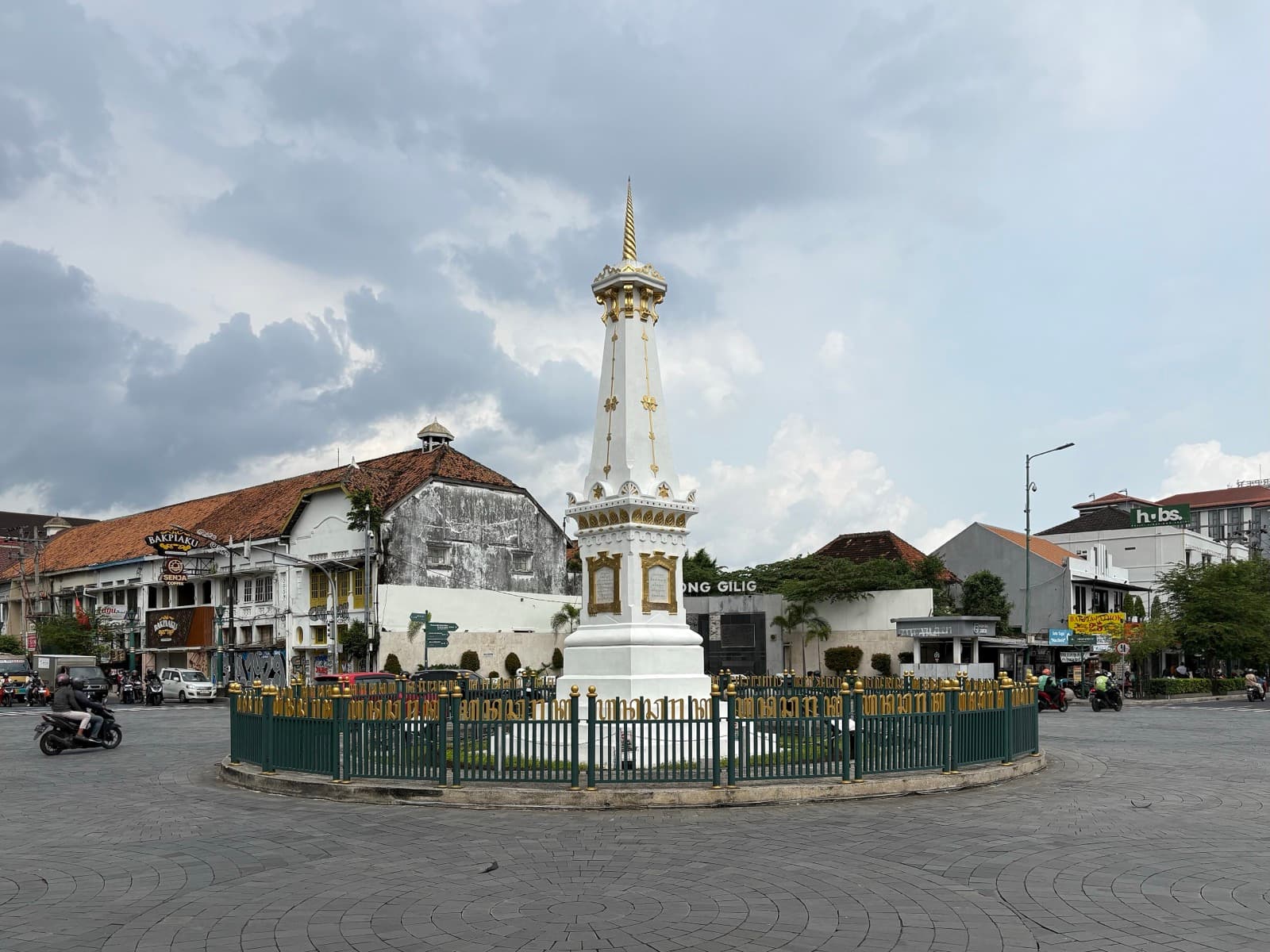
One Day in Yogyakarta: A Walkable Itinerary
The Kraton at the Center: How Yogyakarta Was Drawn as a Single Straight Line
The Rupadhatu Galleries: How to Read Borobudur's 2,670 Carved Panels
Candi Sewu: The Buddhist "Thousand Temples" That Number 249
The 72 Perforated Stupas of Borobudur: Why the Buddha Is Half-Hidden