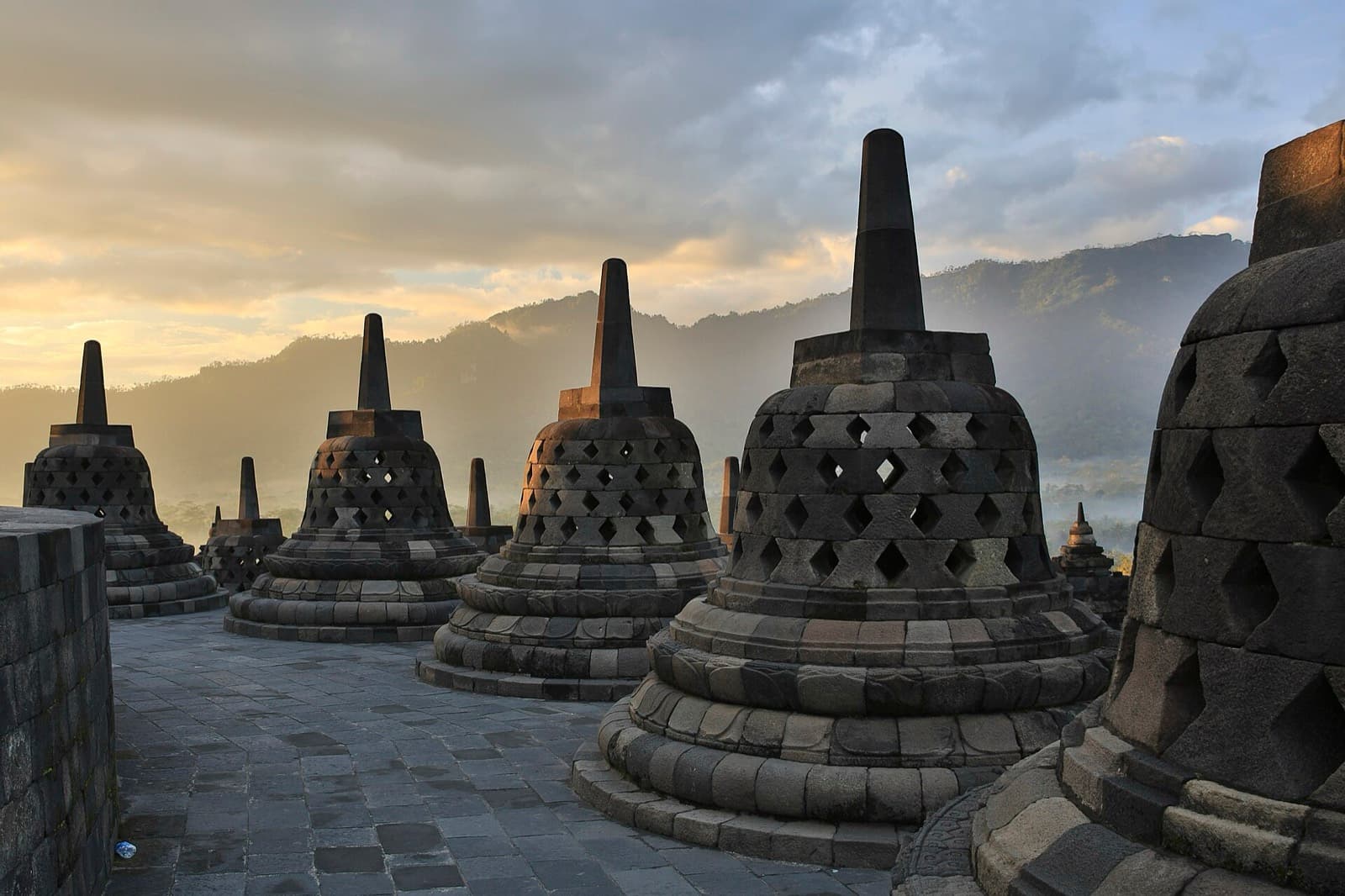
Near the top of Borobudur, seventy-two bell-shaped stone stupas ring the three circular terraces, and each one is perforated: its surface pierced with a lattice of small openings, a seated Buddha half-seen inside. This is the image the whole world knows Borobudur by, the crown of latticed bells that forms the silhouette in every postcard of the ninth-century Javanese monument. But the perforations are not ornament. They are a deliberate instruction about how to see, and standing in front of them is the one moment on the climb where the monument stops teaching with pictures and starts teaching with what it withholds.
What you are actually looking at
A stupa is a dome-shaped Buddhist monument. At most temples a stupa is solid, a sealed mound of masonry. Borobudur's seventy-two upper stupas are different. Each is openwork, its dome cut through with a grille of small holes, and UNESCO records that each one originally held a seated Buddha statue inside. The openings are shaped as diamonds on the lower two circular terraces and as squares on the highest one. Through them you can just make out the figure within: a Buddha half-seen, half-hidden, glimpsed rather than displayed.
Hold that word, glimpsed. Lower down the monument, on the square terraces, Borobudur puts its Buddhas plainly on view, seated in open niches along the balustrades, each with a clear hand gesture you can read at a glance. Those figures are shown to you. Counting every Buddha carved for the monument, the square-terrace niches and the seventy-two upper stupas together, Borobudur originally held five hundred and four Buddha statues in all. The wall figures below are shown. The seventy-two up here are the opposite. The stone does not hand you the figure. It lets you sense it, partly veiled, through a screen. The same subject, the seated Buddha, is presented in two completely different registers depending on where you stand on the climb, and that change is the point.
Why half-hidden, and not shown
Hear a stop from this walk
Kamadhatu: The Hidden World of Desire
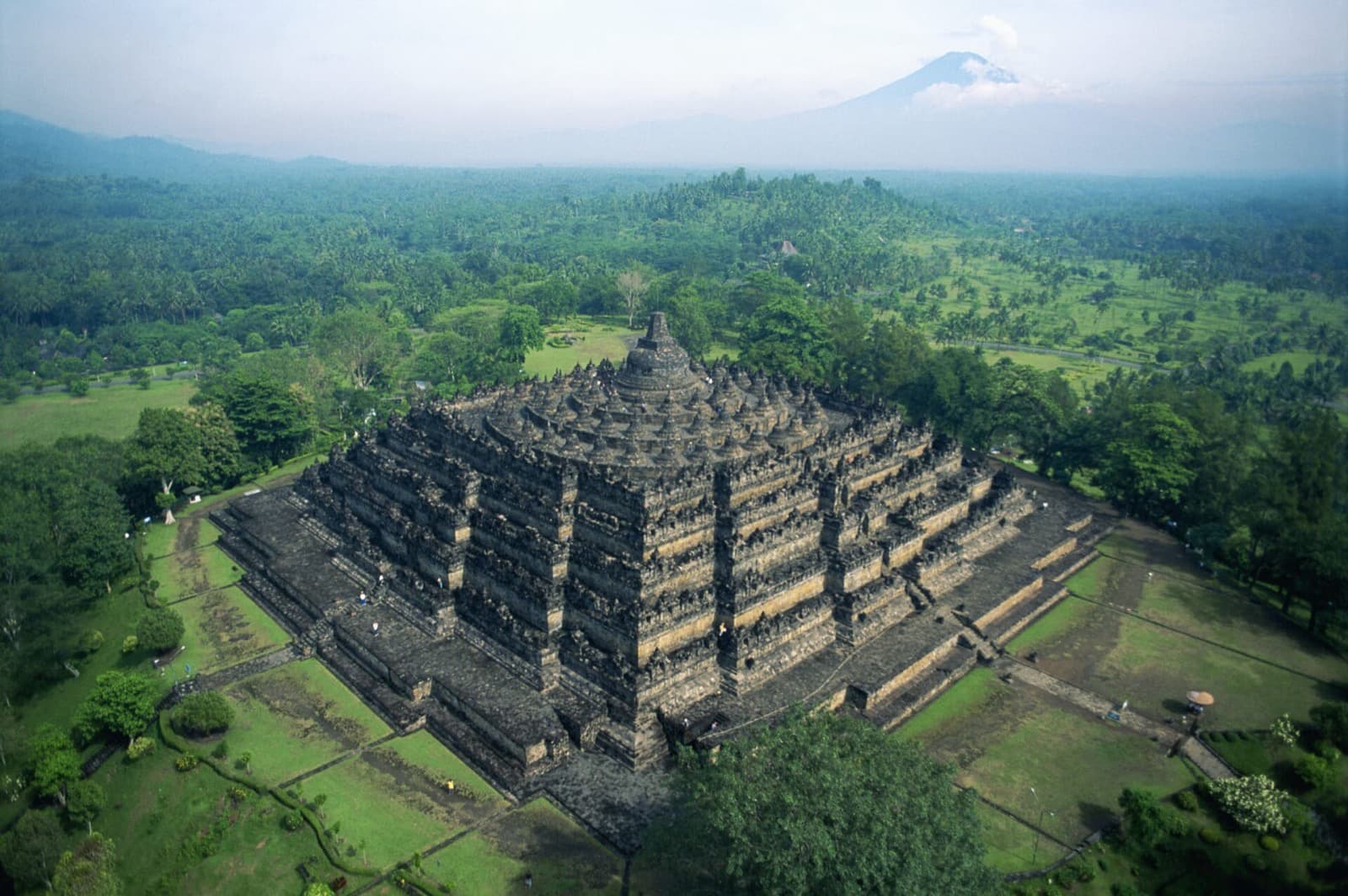
To understand the lattice you have to understand where it sits in the ascent. Borobudur is not a building you enter. It is a mountain of stone you climb, and its nine stacked platforms are arranged as a diagram of the Buddhist path: six square terraces below, three circular terraces above. The concealed foot, buried behind a stone casing, represents the world of desire. The square galleries above it are the world of form, carved with roughly two thousand six hundred and seventy relief panels that pilgrims read clockwise, panel by panel, like the pages of a life. Then the carving stops. The three circular terraces at the top belong to a zone called the formless realm, and their surfaces are deliberately left plain.
The seventy-two perforated stupas stand in exactly that formless zone. So the design problem was this: how do you place a Buddha in the realm that is supposed to be beyond image and beyond form? The answer is the lattice. Up here, near the summit, the Buddha is no longer set out openly for you to read. It is enclosed, screened, apprehended through pierced stone. The figure is present, but it will not resolve into a plain object. It comes and goes as you move, clearer from one angle, dissolving from another. That flicker between seen and unseen is the whole meditation folded into a single design choice. Something understood is not quite the same as something plainly shown, and the stone stages exactly that difference.
Standing in front of it: the one thing to grasp
If you take away a single idea from the perforated stupas, let it be this. The real experience is the looking itself, not the photograph. It is tempting to treat this crown of latticed bells only as a picture to capture, because it is the most photographed thing on the monument. But the design rewards a different kind of attention. Walk slowly between the stupas and watch how the Buddha inside each one behaves as your angle shifts. From straight on, through a diamond opening, you catch the curve of a shoulder or the line of a lowered hand. Move two steps and the figure retreats into shadow. The monument built that motion into stone on purpose. You are meant to move, and the seeing is meant to be partial.
There is a quiet emotional weight to it once you notice. Seventy-two of them ring you around, each a bell of stone with its half-glimpsed presence inside, and the effect near the top of the climb is not display but suggestion. After the crowded galleries below, where the Buddha was shown and repeated many times over, this restraint lands hard. The figure is there. You simply are not permitted to have all of it.
And this stupa terrace is not the end of the ascent. One level higher stands the great central dome, and it takes the same logic one final step: it is sealed and empty, holding no statue and no image at all. When the main dome was investigated in eighteen forty-two, no documented account of what lay inside survives, and the stupa remains empty and imageless to this day. So the monument moves from Buddhas shown openly, to Buddhas glimpsed through a lattice, to a summit that shows you nothing. The perforated stupas are the hinge in that progression, the moment the image begins to withdraw before it disappears entirely.
Walk it in order, at your own pace
The perforated stupas only make sense as the sixth stop in a climb, not as a standalone photo op. Their half-hidden Buddhas answer the fully visible ones on the terraces below, and they set up the empty dome above. Read in sequence, the lattice reads as a deliberate turn in a long argument carved into a hillside.
That sequence is exactly what a self-guided visit is built for. Group sessions on the upper terraces move on a clock, and a Buddha glimpsed through pierced stone does not survive being hurried. Walking Borobudur at your own pace lets you circle a single stupa, change your angle, and let the figure come and go the way the builders intended. The Roamer self-guided audio tour, Borobudur: The Mountain of Merit, walks you through all seven stops in order, from the western foot up to the empty summit, so the perforated stupas arrive with the full weight of everything below them. For more ways to explore the region on foot, see our guide to Yogyakarta walking tours.
Note that reaching the upper terraces where these stupas stand uses a timed ticket, a licensed guide, and provided woven Upanat sandals to protect the stone. If you cannot get a slot, the shape of the whole climb, including this latticed crown, is still visible from the base terraces, and the tour is written to work from there.
Sources
- Borobudur Temple Compounds, UNESCO World Heritage Centre (whc.unesco.org/en/list/592): Primary record of the seventy-two perforated stupas, the reliefs, and the ninth-century Sailendra construction; inscribed 1991.
- Borobudur, Wikipedia: Encyclopedic overview covering the openwork stupas, the enclosed Buddha statues, the 504 total Buddha figures, the plain circular terraces, and the empty central dome investigated in 1842.
- Roamer tour, "Borobudur: The Mountain of Merit": Fact-audited stop-by-stop narration of the seven-stop climb, including the perforated-stupa terrace, used as the structural basis for this article.
Ready to experience it?
Borobudur: The Mountain of Merit
90 min · 1.5 km · moderate
More from Yogyakarta
Explore more at your own pace.
One Day in Yogyakarta: A Walkable Itinerary
Candi Shiva: How Prambanan's Tallest Tower Organizes an Entire Temple City
The Kraton at the Center: How Yogyakarta Was Drawn as a Single Straight Line
The Rupadhatu Galleries: How to Read Borobudur's 2,670 Carved Panels
Candi Sewu: The Buddhist "Thousand Temples" That Number 249