Rattanakosin: The Royal Island
120 min · 5.5 km · moderate
If you have one meal in Bangkok, order a bowl of boat noodles, a plate of pad thai, and a papaya salad, then chase them with mango sticky rice when mangoes are in season. Bangkok food is a map of Thai history you can taste: rice-country stir-fries turned national policy, Chinese immigrant cooking that built Chinatown, and Lao and northeastern flavors carried in by rail. This guide walks through the specific dishes worth seeking, where each tradition comes from, and the handful of Thai phrases that turn a confused point-and-smile into ordering like a local. It ends where the eating is densest, on the Bangkok walking tours that thread the food streets of Yaowarat and the old riverside quarter.
The dishes that define Bangkok, and where they come from
Pad thai is the dish most travelers arrive wanting, and its story is stranger than the plate suggests. It was promoted as a national dish during the government of Plaek Phibunsongkhram, prime minister from 1938 to 1944 and again from 1948 to 1957. During World War Two a 1942 flood damaged rice paddies in the Chao Phraya delta, and the state pushed noodles over rice, sending out recipes and free carts to street vendors. Scholars debate how close that wartime dish was to what you eat now (the modern recipe is documented mostly from the 1960s onward), but the political origin is real. Order it fresh from a wok stall, squeeze the lime, and add chili and crushed peanut yourself.
Boat noodles (kuay teow reua) are the bowl locals reach for. The name comes from Bangkok's canal era, when vendors ladled noodles from small boats along the khlongs, keeping portions tiny so the broth would not spill in the rocking hull. Urban development drained many canals by the 1970s and the stalls moved onto land, but the small dark bowls stayed, along with the ritual of ordering several at once. The broth is deep, faintly bitter, and layered with pork or beef. Two or three bowls make a meal.
Som tam (green papaya salad) carries a Lao and northeastern lineage. The Thai historian Sujit Wongthes has traced its roots to Lao settlers in central Thailand in the late eighteenth and early nineteenth centuries, from where it spread into Isan along the northeastern railway around the turn of the twentieth century. It is pounded to order in a mortar: shredded green papaya, lime, fish sauce, chili, and palm sugar. Ask for it milder if you are new to Thai heat, because the standard build is fierce.
Mango sticky rice (khao niao mamuang) is the dessert to time. Shops serve it much of the year, but the peak is Thailand's hot season, roughly April and May, when Nam Dok Mai and Ok Rong mangoes are sweetest. Warm glutinous rice, salted coconut cream, a fanned half-mango: simple, and best from a vendor who is selling a lot of it.
Chinatown is where Bangkok eats hardest
Hear a stop from this walk
Museum Siam: Decoding Thainess
Yaowarat, Bangkok's Chinatown, is the district that best rewards an empty stomach. Its cooking reflects the Chinese immigrant community that settled the riverside and, over generations, financed the young capital. Khao man kai, the Thai take on Hainanese chicken rice, arrived with migrants from Hainan Island in southern China. The name translates roughly to chicken-fat rice: poached chicken over rice cooked in the fat and broth, served with a sharp ginger-chili sauce. Yaowarat is one of the neighborhoods most associated with it.
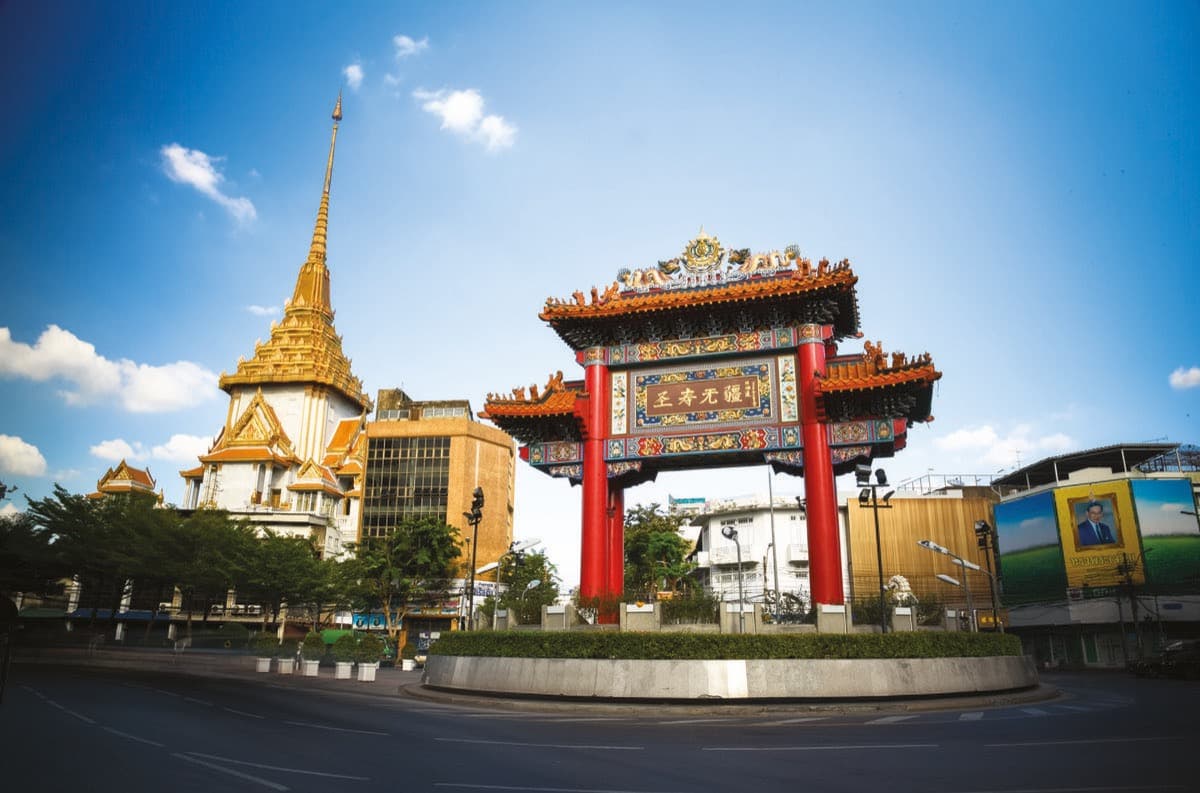
Yaowarat runs cool and quiet in the morning, when the market lanes off Charoen Krung stock up, and turns into a wall of neon and grills after dark. If you can only come once, come in the evening. The bangkok-chinatown-yaowarat walk on the app traces the same gold artery past Wat Traimit's five-and-a-half-tonne solid gold Buddha, through the market lanes of Talat Mai, and down Sampeng Lane, so the eating and the history sit on one route.
One date to know: during the annual Vegetarian Festival, also called the Nine Emperor Gods Festival, Yaowarat goes fully meatless for nine days. In 2025 it ran October 20 to 29. Yellow flags mark every vendor cooking to the festival's rules, from Odeon Circle down toward the Chaloem Buri intersection, and the streets fill with meat-free versions of the usual stalls. Early evening, around five, is the moment to walk it.
How to order like a local
You do not need much Thai, but a few phrases change everything. To order, point and say ao (dish), krap if you are male or ao (dish), ka if you are female (that is roughly "I'll take"). For rice dishes served for one person, raat khao means "over rice."
Spice is the thing most visitors get wrong. Mai phet means "not spicy," but even that can tingle at a Thai stall. Phet nit noi, "a little spicy," usually lands better and is the phrase most travelers actually want. Phet mak is "very spicy," which you can save for later in the trip. Useful add-ons: khai dao is a fried egg on top, and piset means an extra-large portion.
The most reliable rule is not linguistic. Eat where the locals line up. A stall crowded with Thai office workers at lunch is cooking fresh batches fast, which is both the tastiest and the safest bet.
Eating safely without eating timidly
Bangkok street food is generally safe if you follow a few habits, and treating it as dangerous means missing the best meals in the city. Choose busy stalls where turnover is high and food is cooked to order in front of you. Prefer dishes served hot off the wok or grill. Be more cautious with raw items and with ice or tap water: stick to bottled water, which is sold everywhere. If you have a sensitive stomach, ease in with cooked staples like khao man kai or pad thai and try one new thing at a time rather than sampling ten stalls at once. None of this requires fear, only attention, and the payoff is the densest, cheapest great eating in Southeast Asia.
When you are ready to walk it off and read the streets you have been eating on, the Bangkok walking tours cover the founding old town of Rattanakosin, the gold and food arteries of Yaowarat, and the riverside quarter of Charoen Krung, all self-guided and at your own pace from /thailand/bangkok.
Sources
Frequently asked questions
- What food is Bangkok most famous for?
- Bangkok is famous for street food, especially pad thai, boat noodles (kuay teow reua), som tam (green papaya salad), khao man kai (Thai Hainanese chicken rice), and mango sticky rice. The city's Chinatown, Yaowarat, is one of the densest street-food districts, particularly after dark. Each dish reflects a distinct heritage, from Chinese immigrant cooking to Lao and northeastern Thai traditions.
- Where did pad thai come from?
- Pad thai was promoted as a national dish during the government of Plaek Phibunsongkhram, prime minister from 1938 to 1944 and again from 1948 to 1957. A 1942 flood damaged rice paddies in the Chao Phraya delta during World War Two, and the state pushed noodles over rice, distributing recipes and free carts to vendors. Scholars note the modern recipe is mostly documented from the 1960s onward.
- Where should I eat in Bangkok's Chinatown?
- Yaowarat, Bangkok's Chinatown, is best in the evening when the grills and neon come alive, though its market lanes are calm and cool in the morning. It is strongly associated with khao man kai (chicken rice) and countless noodle and seafood stalls. The best approach is to eat where crowds of locals are lining up, which signals both freshness and safety.
- How do I ask for less spicy food in Thai?
- Say 'mai phet' for not spicy or 'phet nit noi' for a little spicy. Most visitors prefer 'phet nit noi,' because even 'mai phet' can still tingle at a Thai stall. To order, point and say 'ao (dish), krap' if you are male or 'ao (dish), ka' if you are female, and use 'raat khao' for a dish served over rice for one person.
- When is mango sticky rice in season in Bangkok?
- Mango sticky rice is available much of the year, but the peak is Thailand's hot season, roughly April and May, when Nam Dok Mai and Ok Rong mangoes are sweetest. During these months you will find it fresher and more widely sold. Choose a vendor with high turnover for the best warm rice and ripe fruit.
- Is Bangkok street food safe to eat?
- Bangkok street food is generally safe if you choose busy stalls with high turnover where food is cooked to order in front of you. Prefer dishes served hot off the wok or grill, be cautious with raw items and ice, and drink bottled water, which is sold everywhere. Easing in with cooked staples like khao man kai or pad thai is a good start for sensitive stomachs.
Ready to experience it?
Rattanakosin: The Royal Island
120 min · 5.5 km · moderate
More from Bangkok
Explore more at your own pace.
Bangkok Travel Guide 2026: Days, Transport, Season, Safety, and Budget
Bangkok in Layers: A Capital Founded as a Copy, Still Open for Business
Charoen Krung Road: How Siam's First Modern Street Built a Colonial-Looking Quarter That Was Never a Colony
The Emerald Buddha and the Palace: How Bangkok Was Built to Replace a City That Burned
The Golden Buddha of Wat Traimit: The Statue That Hid Its Own Gold for Two Centuries