Charoen Krung Road is the engineered spine along which Bangkok converted itself from a water city into a land city. It was the first road in Siam built by modern construction methods, and it was requested not by the kingdom but by foreigners. A Buddhist kingdom then used that road to modernize on its own terms and, alone in Southeast Asia, to stay uncolonized. Stand on the pavement near the General Post Office in Bang Rak and you are standing at the exact seam where a canal city began to become a street city. The paradox is literally underfoot: the surface that let the West in was also the instrument that kept the West out.
A road built because Western consuls wanted somewhere to ride
For most of Bangkok's history there was almost nothing like a paved road. Movement ran on water, along a dense web of canals, and into the eighteen sixties the kingdom had almost no roads at all. The trigger for change was small and almost comic. On August nineteenth, eighteen sixty-one, a group of Western consuls petitioned King Mongkut, Rama the Fourth, complaining that they had no proper roads for riding in carriages or exercising their horses, and that their health suffered for it. The king approved the request, and the road was the answer.
Construction ran between eighteen sixty-two and eighteen sixty-four, and the road opened to traffic on March sixteenth, eighteen sixty-four. Its first Thai name meant simply New Road, which is why English speakers still call it that today, more than a century and a half later. Mongkut later renamed it Charoen Krung, meaning prosperity of the city. The engineering point matters as much as the naming: this was a deliberate import of a construction technology, laid down as a single continuous line that today runs about eight and a half kilometres through six districts, from near the Grand Palace to the southern riverside. Every other structure on the walk was built along that line, in the decades after the pavement was set. You are not looking at a neighborhood that happened to acquire a road. You are looking at a road that generated a neighborhood.
Reading the buildings as arguments, not decoration
Hear a stop from this walk
The East Asiatic Building
Treat Bang Rak the way an engineer reads a site plan: each building is a component answering a specific load. If you walk the full route, which covers roughly two and a half kilometres in about ninety minutes, the components resolve into a single argument about sovereignty. You can preview the whole sequence among the other Bangkok walking tours, but the logic is worth carrying with you before you set out.
The General Post Office is the first counter-move. It opened on June twenty-fourth, nineteen forty, in a blend of Art Deco and International Style, designed by two architects, Sarot Sukkhayang and Mew Aphaiwong. It was built under the People's Party government that had ended absolute monarchy in the constitutional change of nineteen thirty-two, and its opening date fell on the anniversary of that revolution. The detail that closes the circuit: it stands on the former site of the British Legation. On the very street the consuls asked for, a Siamese state put up a monument to its own administrative power, on ground the British had once occupied. Since twenty seventeen the building has housed a creative and design center while still keeping a working post office branch inside.
Assumption Cathedral is the invited faith. It is the principal Catholic church of Thailand and the main church of the Archdiocese of Bangkok. A French mission church stood on this ground from eighteen twenty-one, during the reign of Rama the Second, and the warm Romanesque brick structure you see now was rebuilt roughly between nineteen ten and nineteen eighteen. A Buddhist kingdom permitted a European faith to plant itself at the center of its capital. That was not weakness. It was selective openness, the same instinct that produced the road.
The commercial and social machinery of the quarter
The East Asiatic Building is the money. Facing the river beside the cathedral, this Renaissance Revival structure served as the headquarters of the Danish East Asiatic Company in Thailand until nineteen ninety-five. The company was founded in eighteen eighty-four by Hans Niels Andersen. Its construction date is genuinely disputed in the sources, ranging from eighteen eighty-four to around nineteen hundred, partly because eighteen eighty-four was the company's founding year, and the design is credited to the Italian architect Annibale Rigotti, who is documented as arriving in Siam only in nineteen oh seven. Those facts cannot all be true at once, so the honest reading is a building that went up around the turn of the twentieth century, foreign capital operating under Siamese sovereignty rather than colonial rule. It won an architectural conservation award in nineteen eighty-four.
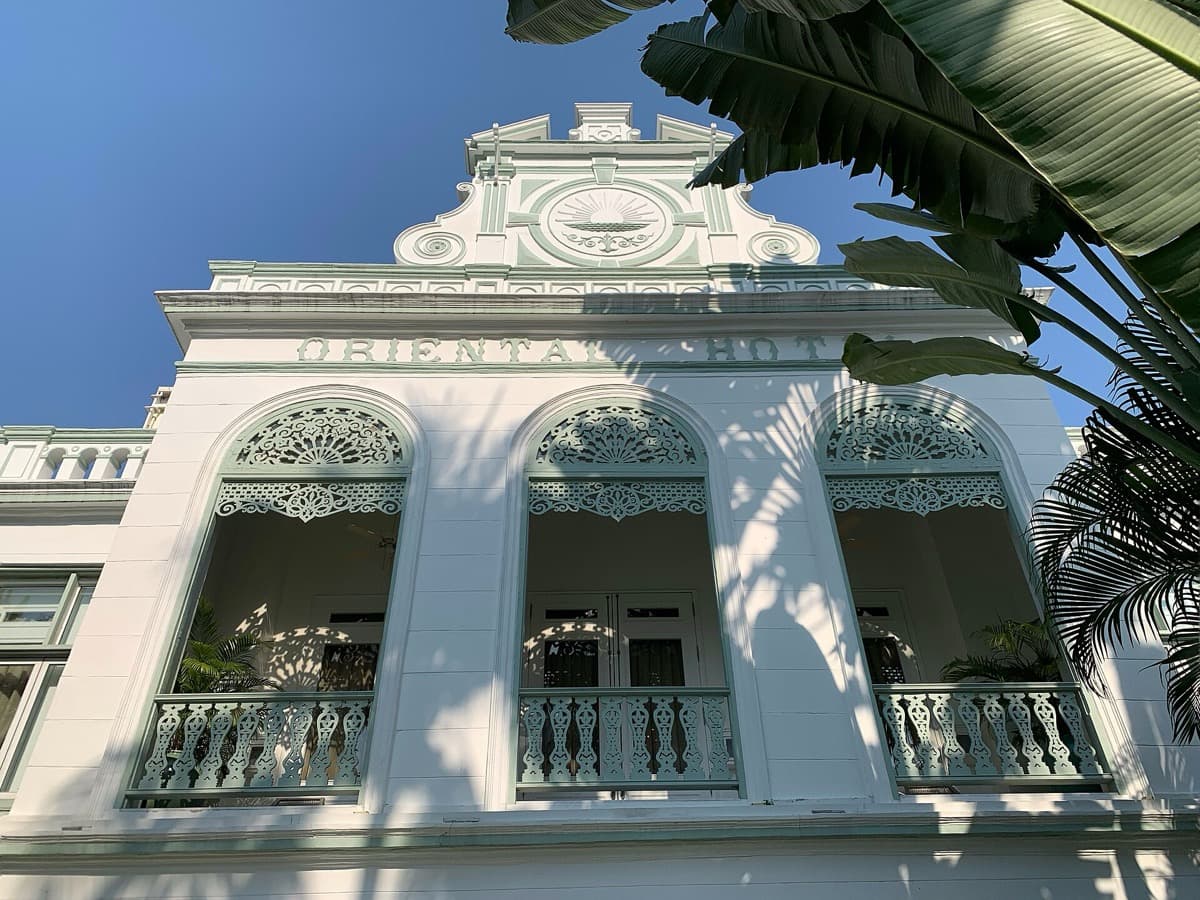
The Mandarin Oriental, known for most of its life as The Oriental, is the arrival point. It is recognized as the first hotel built in Thailand and the oldest hotel in Bangkok, dating its founding to eighteen seventy-six, when Danish sea captains opened it after an earlier hotel on the site burned in eighteen sixty-five. The same Hans Niels Andersen behind the trading house bought the property in eighteen eighty-one and developed it into a luxury hotel, tying the commercial and social centers of the quarter to one man. Its Authors' Wing honors literary guests including Somerset Maugham, Noel Coward, and Graham Greene. By the hotel's own tradition, Joseph Conrad, once a ship's officer on this river, drank at the bar but could never afford to stay the night.
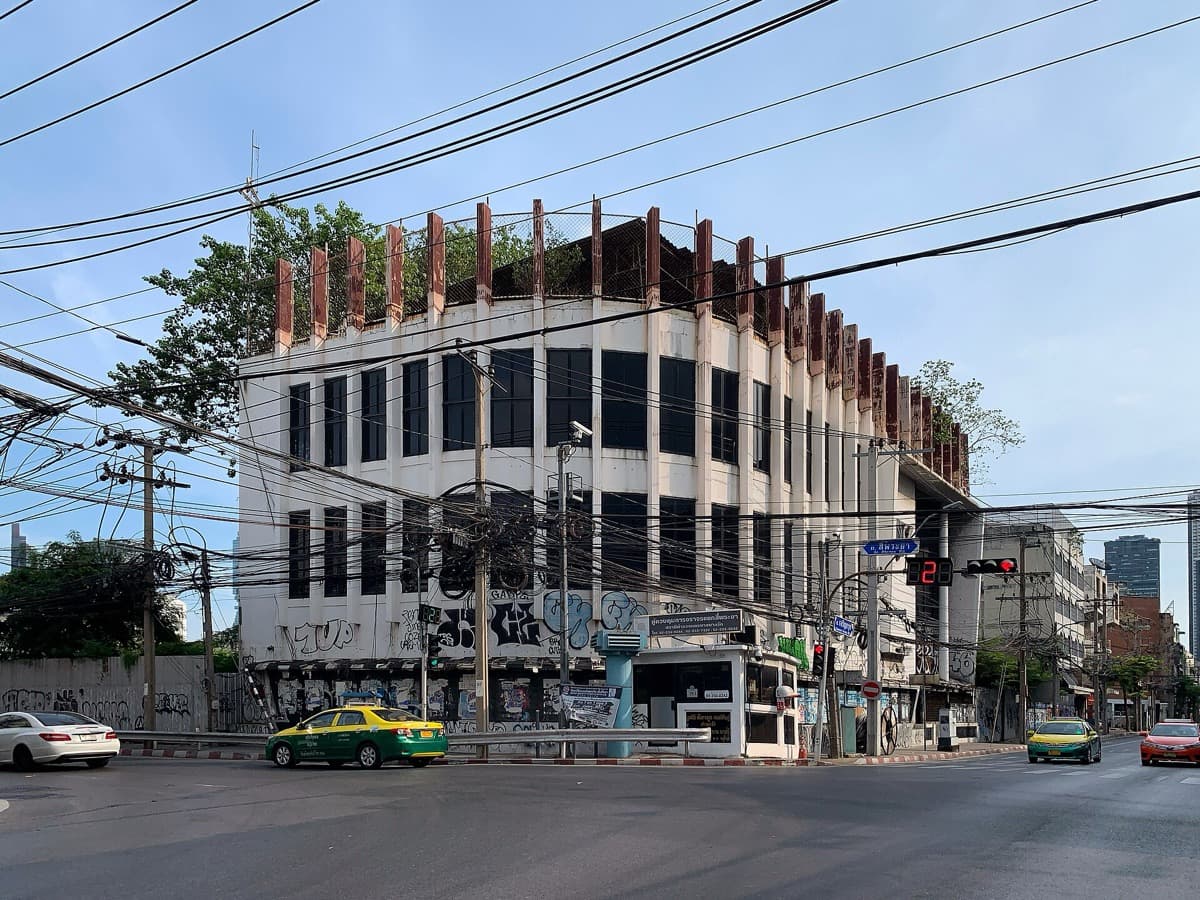
The Old Customs House is where the argument resolves. Built in eighteen eighty-eight in a neo-Palladian style by the Italian architect Joachim Grassi, as part of King Chulalongkorn's modernization, it was where the kingdom taxed river trade. Every ship entering Bangkok cleared its cargo and paid duties here, which made it the symbolic gateway to the country. This is not a monument to being opened up. It is a monument to control: the West was welcomed through a gate the kingdom owned and taxed. Operations moved downstream to Khlong Toei Port in nineteen forty-nine, and the building has weathered into a photogenic ruin now under redevelopment as a luxury hotel.
The walk ends behind the customs house at Haroon Mosque, founded in eighteen thirty-seven by Musa Bafadel, an Indonesian Arab trader from Pontianak, and named after his son. That date sits well before the consuls' petition. In eighteen ninety-nine the wooden mosque was moved about five hundred metres inland so the government could build the customs pier, so the modern port physically pushed an older, mixed Muslim community back from the water. The present building dates to nineteen thirty-four. Bang Rak was cosmopolitan long before the West formalized it.
Walk the road and let the water city and the land city sit together. Start planning from Bangkok.
Sources
- Charoen Krung, Wikipedia. Construction dates, the eighteen sixty-one consuls' petition, opening date, and naming history for the first modern road in Siam.
- General Post Office (Bangkok), Wikipedia. Nineteen forty opening, architects Sarot Sukkhayang and Mew Aphaiwong, and the British Legation site.
- Assumption Cathedral and Mandarin Oriental, Bangkok, Wikipedia. Cathedral continuity from eighteen twenty-one and the hotel's eighteen seventy-six founding claim.
- Customs House and Haroon Mosque, Bangkok, Wikipedia. The eighteen eighty-eight customs house by Joachim Grassi and the mosque's eighteen ninety-nine relocation inland.
- Roamer tour transcript, The First Road (bangkok-charoenkrung), fact-audited primary source for this article.
Ready to experience it?
Bang Rak (Charoen Krung): The First Road
90 min · 2.5 km · easy
More from Bangkok
Explore more at your own pace.
Bangkok Travel Guide 2026: Days, Transport, Season, Safety, and Budget
Bangkok in Layers: A Capital Founded as a Copy, Still Open for Business
The Emerald Buddha and the Palace: How Bangkok Was Built to Replace a City That Burned
The Golden Buddha of Wat Traimit: The Statue That Hid Its Own Gold for Two Centuries
The Oriental Hotel in Bangkok: How Danish Sea Captains Built Thailand's First Hotel